

What an IT-Grundschutz Profile is
The BSI describes profiles on its topic page as follows: „IT-Grundschutz-Profile sind Muster für Sicherheitskonzepte, die anhand eines Anwendungsbeispiels die IT-Grundschutz Vorgehensweise darstellen.“ (our translation: "IT-Grundschutz Profiles are templates for security concepts that use an application example to illustrate the IT-Grundschutz approach.") According to the same page, a profile documents the steps of a security process for a defined area of application: defining the area of application, a generalised structure analysis, protection requirements determination and modelling, selecting and adapting the modules, and specific requirements and safeguards. Anyone with similar conditions transfers this work to their own institution instead of doing it again.
Profiles are written by industry associations, working groups, public authorities, the BSI itself and individuals in theses. The BSI describes their structure in the structure description „IT-Grundschutz-Profile“, version 1.0 of 28 September 2018: formal aspects, management summary, scope, delimitation of the information domain, reference architecture, requirements to be met and safeguards to be implemented, residual risk analysis, application notes, supporting information and annex (structure description ch. 2). When you compare two profiles, you therefore usually find the information in the same place.
In terms of method, all profiles in the table are based on classic IT-Grundschutz: they model with modules from an edition of the IT-Grundschutz Compendium, and the editions named range from 2019 to 2023. We did not find a profile based on Grundschutz++ in the sources evaluated (as of 2 November 2026).
All IT-Grundschutz Profiles at a glance
The table contains 23 profiles with a document from the BSI profile list, one list entry without a document, the public information sheet on the i-Kfz profile, four KRITIS IT-Grundschutz Profiles, the KRITIS template and three theses, 33 rows in total. English versions and annexes do not have a row of their own. Each title leads to the download page at the BSI.
Version and date come from the version or change history of the document, otherwise from the formal details. Next to them is the date of the BSI download page. The two dates sometimes differ by months: the airport profile bears version 1.0 of 12 November 2024, the BSI page the date 19 February 2025; the master's thesis on insurance companies bears 9 December 2021, the BSI page 15 January 2026. The Compendium edition appears in the table as the document names it, usually in the formal details, otherwise on the title page, in the text or in the bibliography. If it names none, the entry reads "not stated". Where the corresponding profile page has inferred the edition from the module list, the result follows as "inferred". This is an inference that the document itself does not state.
| Profile (original title) | On this website | Publisher or author | Version and date according to the document; date of the BSI page | Compendium edition | Type |
|---|---|---|---|---|---|
| IT-Grundschutz-Profil zur Absicherung von 5G-Campusnetzen Eigenbetrieb (with annexes) | 5G campus networks | BSI; authored by SoftEd Systems GmbH | 1.0, Feb 2024 (history without day); BSI page 16 Feb 2024 | 2023 | BSI profile list |
| IT-Grundschutz-Profil zur Absicherung von 5G-Campusnetzen Fremdbetrieb (with annexes 1 to 4) | 5G campus networks | BSI; authored by TU Dresden, SoftEd Systems GmbH | 2.0 of 24 Nov 2023 (1.0 of 25 Oct 2022); BSI page 15 Dec 2023 | 2023 | BSI profile list |
| IT-Grundschutz-Profil für Bundesgerichte | Federal administration, federal courts | Workshop of information security officers (ISB) of the federal courts with the BSI | 1.0 of 7 Mar 2023; BSI page 4 May 2023 | 2023 | BSI profile list |
| IT-Grundschutz-Profil „Chemie“ (title in the formal details: for production plants in the chemical industry) | Chemical industry | BSI working group; version 1 with NAMUR working group 4.18 | 2.0.0 of 15 Jan 2025 (1.0 of 19 Jan 2023); BSI page 8 Sep 2025 | 2023 (ch. 8); the module list corresponds to the 2022 status | BSI profile list |
| Das IT-Grundschutz-Profil für die Nutzung der E-Akte Bund | Federal administration, E-Akte Bund | Anwendendengruppe (user group; BSI list: Anwenderkreis der E-Akte Bund) | 1.0 of 11 Jul 2024; BSI page 10 Jul 2024 | 2023 | BSI profile list |
| IT-Grundschutz-Profil der Einnahmeverwaltung des Ministeriums der Finanzen Sachsen-Anhalt | State administration | Information security officer of the Ministerium der Finanzen Sachsen-Anhalt (Ministry of Finance of Saxony-Anhalt) | 1.0 of 7 Sep 2023; BSI page 2 Oct 2023 | 2022 (as of Feb 2022) | BSI profile list |
| IT-Grundschutz-Profil für kleine und mittlere Flughäfen | Airports | Working group GSP-KMF, initiated by the BSI | 1.0 of 12 Nov 2024; BSI page 19 Feb 2025 | 2023 | BSI profile list |
| IT-Grundschutz-Profil für Handwerksbetriebe (entry on the BSI profile list) | this overview only | Zentralverband des Deutschen Handwerks (according to the BSI list) | no document linked on the BSI list | cannot be checked | BSI profile list, without document |
| IT-Grundschutz-Profil für Handwerkskammern | Chambers of skilled crafts | Deutscher Handwerkskammertag (DHKT); authored by chambers of skilled crafts | 1.0 of 11 Jul 2018; BSI page 18 Jul 2018 | not stated; inferred: 2018 | BSI profile list |
| IT-Grundschutz-Profil für Hochschulen | Universities | Arbeitskreis Informationssicherheit (information security working group) of ZKI e. V. | 2022.0.0 of 4 Aug 2022; BSI page 15 Dec 2022 | 2022 | BSI profile list |
| IT-Grundschutz-Profil „i-Kfz“ (internet-based vehicle registration) | i-Kfz | Arbeitskreis i-Kfz (registration authorities, technical service providers, Kraftfahrt-Bundesamt) | publicly only an information sheet, as of Aug 2023, 2 pages; BSI page 5 Dec 2023 | cannot be checked, full text in the protected area of the KBA | information sheet (BSI profile list) |
| IT-Grundschutz-Profil Basis-Absicherung Kommunalverwaltung | Municipalities | Arbeitsgruppe kommunale Basis-Absicherung (AG koBA), supported by the national associations of local authorities (kommunale Spitzenverbände) | 4.0 of 13 Nov 2023 (1.0 of 8 May 2018); BSI page 16 Jan 2024 | 2023 | BSI profile list |
| IT-Grundschutz-Profil für Leitstellen | Control centres | Fachverband Leitstellen e. V. | 2.0 of 12 Feb 2024 (1.0 of 1 Feb 2021); BSI page 18 Mar 2024 | 2023 | BSI profile list |
| IT-Grundschutz-Profil für oberste Bundesbehörden | Federal administration, supreme federal authorities | Workshop of information security officers of supreme federal authorities with the BSI | 1.0, history without date; BSI page 24 Jan 2024 | 2023 | BSI profile list |
| IT-Grundschutz-Profil für die obersten Landesbehörden Deutschlands | State administration | Raphael Grieger (FH Hagenberg) | 1.0 of 31 May 2019; BSI page 28 Jun 2019 | 2019 (bibliography) | BSI profile list |
| IT-Grundschutz-Profil für Papierfabriken | Paper mills | Verband Deutscher Papierfabriken e. V. (VDP) | 1.0 of 1 Jul 2019, published on 4 Jul 2019; BSI page 4 Jul 2019 | not stated; inferred: 2019 | BSI profile list |
| IT-Grundschutz-Profil für Reedereien - Mindest-Absicherung für den Landbetrieb | Shipping companies | Verein Hanseatischer Transportversicherer e. V. (VHT) | 1.0 of 18 Dec 2018; BSI page 17 Dec 2018 | not stated | BSI profile list |
| IT-Grundschutz-Profil für Reedereien - Mindest-Absicherung für den Schiffsbetrieb | Shipping companies | Verein Hanseatischer Transportversicherer e. V. (VHT) | 1.0 of 16 Jan 2020, published on 24 Jan 2020; BSI page 31 Jan 2020 | 2019 | BSI profile list |
| IT-Grundschutz-Profil für Ressort-Forschungseinrichtungen | Federal administration, departmental research | Arbeitskreis Ressort-Forschungseinrichtungen (according to the BSI list); authors from departmental research institutions and the BSI | 1.0 of 9 Sep 2024; BSI page 23 Sep 2024 | 2023 | BSI profile list |
| IT-Grundschutz-Profil für den Betrieb von UAS, Band 1: UAS-Betriebskategorie „Open (Offen)“ | Drones (UAS) | UAV DACH e. V. | 1.1 (logo replaced), without date; BSI page 29 Jan 2025 | not stated | BSI profile list |
| IT-Grundschutz-Profil für den Betrieb von UAS, Band 2: UAS-Betriebskategorie „Specific (Speziell)“ | Drones (UAS) | UAV DACH e. V. | 1.0, without date; BSI page 20 May 2026 | not stated | BSI profile list |
| IT-Grundschutz-Profil für den Betrieb von Uncrewed Aircraft Systems in Behörden und Organisationen mit Sicherheitsaufgaben | UAS in public safety organisations (BOS) | UAV DACH e. V. | 1.2 of 1 Feb 2026 (1.0 of 20 Oct 2025); BSI page 29 Oct 2025 | 2023 (list of sources, annex 6) | BSI profile list |
| IT-Grundschutz-Profil für die Verkehrssteuerungs- und Leitsysteme der Bundesautobahn | Motorway traffic control | Die Autobahn GmbH des Bundes | 1.0 of 22 Jun 2022; BSI page 29 Jun 2022 | 2021 (as of Feb 2021, ch. 8.3) | BSI profile list |
| IT-Grundschutz-Profil für Weltrauminfrastrukturen (BSI list: Teil 1: Raumsegment, part 1: space segment) | Space | BSI, OHB Digital Connect GmbH, Airbus CyberSecurity GmbH, Raumfahrtagentur im DLR | 1.0 of 30 Jun 2022; BSI page 30 Jun 2022 | 2022 | BSI profile list |
| IT-Grundschutz-Profil für Weltraumsysteme - Teil 2: Bodensegment | Space | BSI, ACS expert group „Cybersicherheit im Weltraum“ (cyber security in space) | 1.0 of 12 Apr 2024; BSI page 23 Apr 2024 | 2023 | BSI profile list |
| KRITIS-IT-Grundschutz-Profil für Mineralölfernleitungen | Oil pipelines | BSI | 1.0 of 5 Dec 2025; BSI page 5 Dec 2025 | 2022 (bibliography) | KRITIS profile |
| KRITIS-IT-Grundschutz-Profil ÖSPV | Public road passenger transport (ÖSPV) | BSI | 1.0 of 14 Feb 2025; BSI page 14 Feb 2025 | 2022 (as of Feb 2022) | KRITIS profile |
| KRITIS-IT-Grundschutz-Profil für Raffinerien | Refineries | BSI | 1.0 of 5 Dec 2025; BSI page 5 Dec 2025 | 2022 (bibliography) | KRITIS profile |
| KRITIS-IT-Grundschutz-Profil für Tankstellennetze | Filling station networks | BSI | 1.0 of 5 Dec 2025; BSI page 5 Dec 2025 | not stated; indications (KRITIS page, template, modules withdrawn in 2023) point to 2022 | KRITIS profile |
| Schablone zur Erstellung von KRITIS-IT-Grundschutz-Profilen | Section "Creating your own profile" | BSI | no version stated, © 2023; BSI page 17 Oct 2023 | 2022 | template (KRITIS) |
| IT-Grundschutz-Profil für einen großen IT-Dienstleister | Data centres and cloud | Christoph Möhring (author and publisher) | Working Draft, version 0.1 of 14 Mar 2018 (BSI list: version 1.0); BSI page 17 May 2018 | no edition named; the text refers to the Compendium „im Oktober 2017 freigegebene“ (our translation: "released in October 2017") | thesis (BSI page: master's thesis) |
| IT-Grundschutz-Profil für Versicherungsunternehmen der Privatwirtschaft | Insurance | Madlin Marisa Rech | 1.0 of 9 Dec 2021; BSI page 15 Jan 2026 | 2021 (bibliography) | thesis (master's thesis) |
| Erstellung eines IT-Grundschutz-Profils für ein Referenzunternehmen (kleines/mittelständisches Unternehmen, KMU) mit automatisierter Prozesssteuerung (Industrial Control System, ICS) | Section "Creating your own profile" | Sarah Fluchs, RWTH Aachen | master's thesis of 18 Jun 2017; BSI page 19 Jun 2017 | no edition; drafts of the modernised standards from 2016 and 2017 | thesis (master's thesis) |
What we noticed while reading:
- Version details differ. The profile for a large IT service provider calls itself "Working Draft, Version 0.1", while the BSI list shows it as version 1.0. The chemical industry profile bears version 2.0 of 15 January 2025; the BSI page speaks of an update in September 2025. The UAS profile for BOS is available in version 1.2 of 1 February 2026, and the date of the BSI page is older.
- Revision cycles have lapsed. Several profiles name a cycle of two or three years that has expired since the last version, for example chambers of skilled crafts (2018, two years), shipping companies onshore operations (2018, three years), paper mills (2019, two years), shipping companies ship operations (2020, three years), space segment and federal motorway (2022, two years). No newer version is linked on the BSI pages (as of 2 November 2026).
- Craft businesses: The BSI list names a profile of the Zentralverband des Deutschen Handwerks without a document and additionally refers to a „Routenplaner“ (route planner); when retrieved on 2 November 2026, this link returned error 404. We were therefore unable to check its content. The profile for chambers of skilled crafts is a different document.
Telling published profiles, KRITIS profiles and theses apart
The profile list contains documents of very different origin. The BSI is the publisher of the two 5G profiles and, together with partners, of the space profiles; the chemical industry and airport profiles carry a BSI copyright notice in the document. Other profiles are published by associations (VDP, VHT, DHKT, Fachverband Leitstellen, UAV DACH, ZKI), a working group of the national associations of local authorities, a federal company, a state ministry or participants in workshops with the BSI. The profile for the supreme state authorities was written by a single author.
KRITIS IT-Grundschutz Profiles are a separate series on the BSI's KRITIS page, all published by the BSI. The BSI describes them as documents that „unter Berücksichtigung branchenspezifischer Besonderheiten und KRITIS-spezifischer Anforderungen den Stand der Technik für KRITIS in ihrem jeweiligen Geltungsbereich konkretisieren“ (our translation: "specify the state of the art for KRITIS in their respective scope, taking into account sector-specific characteristics and KRITIS-specific requirements"). According to the same page, the approach corresponds to Standard Protection under BSI Standard 200-2 with additions, and the basis is the 2022 Compendium. Operators can use a suitable profile, but „müssen dieses jedoch noch an ihre jeweiligen spezifischen Gegebenheiten anpassen“ (our translation: "must, however, still adapt it to their respective specific circumstances"). The page and the profiles justify the need with Section 8a(1) of the BSI Act (BSIG); this reference relates to the old version of the BSI Act.
Three documents are filed at the BSI in the area of external theses. The thesis on insurance companies states on its title page that the profile was „im Rahmen einer Masterarbeit erstellt“ (our translation: "created as part of a master's thesis"); the BSI lists the thesis on a large IT service provider as a master's thesis, while the document itself is a working draft with the entry „Anerkennung durch BSI: in Diskussion“ (our translation: "recognition by BSI: under discussion"). The third thesis creates a pilot profile for water supply and wastewater disposal and explains the method behind it.
Linked does not mean recognised. The BSI's HTML pages on profiles and on the guide describe no recognition procedure. The 2018 structure description announces such a procedure: a uniform structure is said to facilitate „den Vergleich und die Anerkennung durch das BSI und die Aufnahme in das IT-Grundschutz-Profil Register“ (our translation: "the comparison and recognition by the BSI and inclusion in the IT-Grundschutz Profile register") (ch. 2). Chapter 3 states: „IT-Grundschutz-Profile können dann zukünftig zur Registrierung beim BSI eingereicht werden. Das BSI nimmt eine formale und stichprobenartige inhaltliche Prüfung vor.“ (our translation: "In future, IT-Grundschutz Profiles can then be submitted to the BSI for registration. The BSI carries out a formal check and a sample-based check of the content.") We did not find a public register on the BSI pages (as of 2 November 2026).
The profiles themselves show how open this has remained. The profiles for paper mills and shipping companies (onshore operations) write in the registration number field that it will be „nach erfolgreichem Durchlaufen des Registrierungsverfahrens vom BSI vergeben“ (our translation: "assigned by the BSI after successful completion of the registration procedure"); they do not carry a number. The profile for chambers of skilled crafts bears the number „HWK/2018/1.0“ without saying who assigned it. The UAS profile for BOS notes „Prüfung und Freigabe BSI“ (our translation: "review and approval BSI") for version 1.0. For your decision, this means: the list at the BSI is a place to find profiles. You check the publisher, how current it is and its suitability against the document, with the checklist further down.
A KRITIS profile is also not a sector-specific security standard (branchenspezifischer Sicherheitsstandard, B3S): the BSI keeps the B3S in a separate overview, and KRITIS profiles do not appear there (retrieved on 2 November 2026). Neither the profile nor the KRITIS page says whether a profile serves as evidence towards an authority. How Grundschutz++ relates to the obligations under the BSI Act in force today is described on the page NIS2 and IT-Grundschutz.
Profiles in Grundschutz++: absent from 300-1, close to blueprints
BSI Standard 300-1, version 1.0, does not mention IT-Grundschutz Profiles; a full-text search for „Profil“ returns no hit in the standard. The text of BSI Standard 200-2 does not name them either; profiles already stood alongside the standards before. For working with Grundschutz++ this means: no chapter of 300-1 says how to use a profile, and no profile is part of the methodology.
The closest is the blueprint from chapter 3.3: „Eine Blaupause ist ein vorgefertigter Katalog von Anforderungen.“ (our translation: "A blueprint is a predefined catalogue of requirements.") According to 300-1, blueprints are tailored to application scenarios, make a preselection of requirements and specify parameters; selection, version, assignment and adaptation must be documented in a traceable way. Incidentally, the word profile in the BSI's State-of-the-Art Library (Stand-der-Technik-Bibliothek) refers to something else: the OSCAL file format used there to select and adapt requirements from catalogues. It has nothing to do with IT-Grundschutz Profiles.
| Characteristic | IT-Grundschutz Profile | Blueprint under 300-1 ch. 3.3 |
|---|---|---|
| Content | Template security concept: scope, reference architecture, protection requirements, modelling, implementation notes, residual risk | predefined catalogue of requirements |
| Basis | Modules from an edition of the IT-Grundschutz Compendium | requirements used to make a „Vorauswahl“ (our translation: "preselection") for an application scenario |
| Parameters | no parameters in the sense of 300-1 ch. 3.5 | specified |
| Binding effect | template; the KRITIS page expressly requires adaptation | „Es kann für bestimmte Institutionen verpflichtende Blaupausen geben“ (our translation: "There may be mandatory blueprints for certain institutions") |
| Documentation when used | not regulated | document selection with version, assignment and adaptation in a traceable way |
Under Grundschutz++, a profile is therefore neither a blueprint nor a requirements package. It remains working material: scope, processes, target objects, justifications for protection requirements and implementation notes can be used, while the selection of requirements is made afresh. Which catalogues of the library meet the characteristics of a blueprint today, and how you record parameters, is described on the page Blueprints and parameters.
Reusing a profile under Grundschutz++
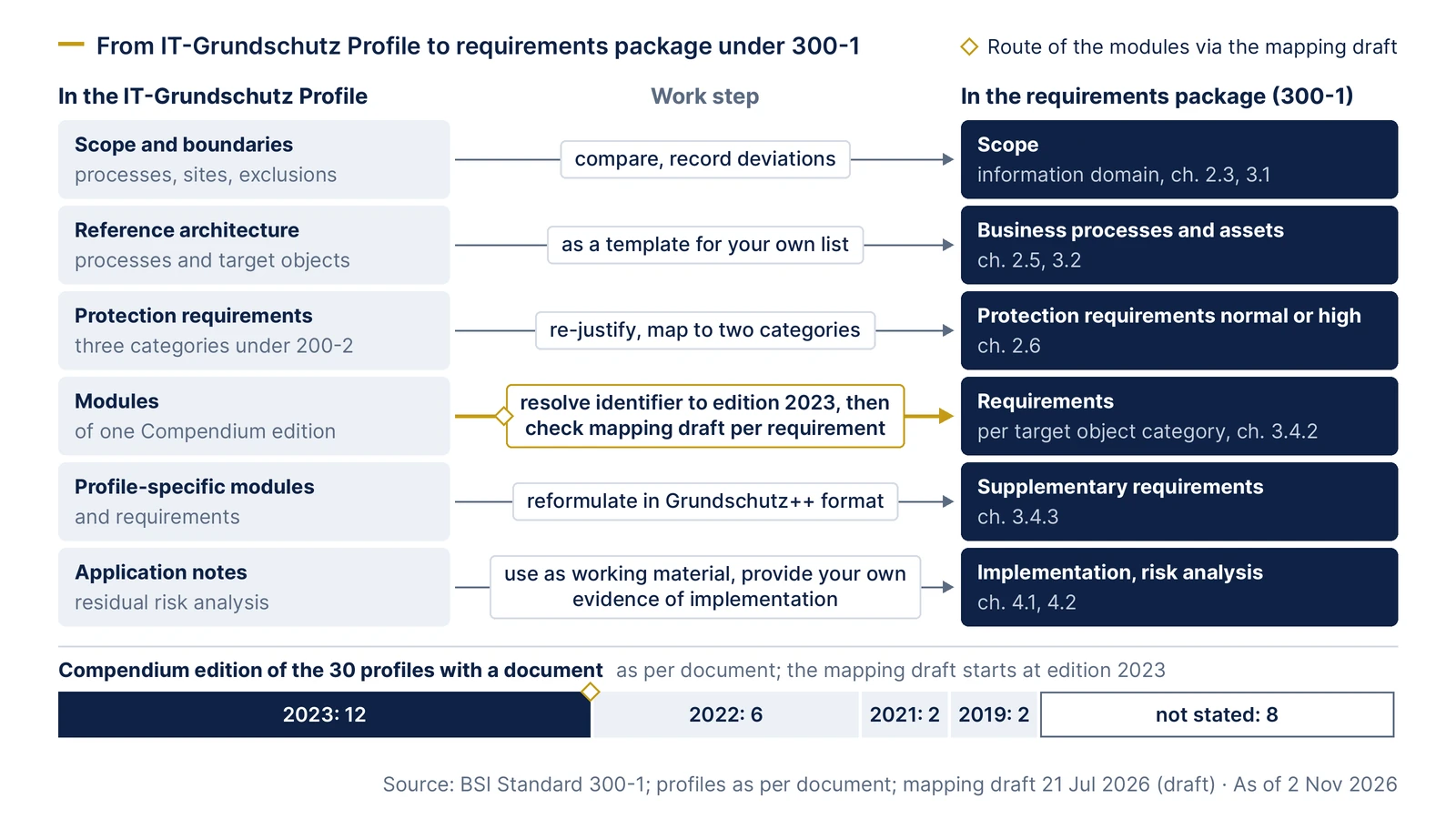
Anyone transferring a profile to Grundschutz++ first comes up against the Compendium edition. The BSI's mapping draft assigns requirements of the 2023 edition to the requirements of the user catalogue (Anwenderkatalog); it has the status „draft“ (as of 21 July 2026). For 12 of the 30 profiles with a document, the document names the 2023 edition; the module list of the chemical industry profile corresponds to the 2022 status despite this statement. For the others, first clarify whether the modelled modules still have the same identifier in the 2023 edition.
An example: the profile for shipping companies in ship operations (2019 edition) models, among others, „OPS.2.1 Outsourcing für Kunden“ (outsourcing for customers) and „SYS.2.2.2 Clients unter Windows 8.1“ (clients under Windows 8.1). According to the 2023 Compendium, both modules have been withdrawn, and OPS.2.1 is replaced there by „OPS.2.3 Nutzung von Outsourcing“ (use of outsourcing) (2023 Compendium, section „Neues im IT-Grundschutz-Kompendium“, what is new in the IT-Grundschutz Compendium). Modules INF.3 and INF.4, which this profile and the profile for supreme state authorities model, no longer appear in the table of contents of the 2023 edition; cabling is covered there by INF.12. Anyone who feeds such identifiers into the mapping unchecked finds no assignment and may take the gap for a gap in the mapping.
The checklist arranges the work into eleven points. It does not replace a migration of the whole ISMS; that is described on the page on migration to Grundschutz++, and how to check individual assignments on their merits on the page on the mapping.
| No. | Checkpoint | Where to look in the profile | Reference in 300-1 | What you record |
|---|---|---|---|---|
| 1 | Version and origin: is this the latest version, who published it, has the revision cycle lapsed? | Version or change history, formal aspects, download page at the BSI | ch. 2.9 (documentation) | Title, version, date according to history, publisher, retrieval date |
| 2 | Rights: may you copy texts and tables into your security concept? | Copyright, licence, confidentiality (for example CC BY-SA 3.0 Germany for the municipal profile, passing on only unchanged for the UAS profiles) | none | Licence and extent of reuse |
| 3 | Scope: do the processes, sites and exclusions of the profile match your area of application? | Scope, delimitation of the information domain | ch. 2.3, 3.1 | Deviations between the profile and your own area of application |
| 4 | Business processes and assets: which processes and target objects of the reference architecture exist in your organisation, and which are missing? | Reference architecture, structure analysis, network plan | ch. 2.5, 3.2 | Your own process list and assets with the origin note "from profile" |
| 5 | Protection requirements: do the profile's classifications fit your processes? | Protection requirements determination, damage scenarios | ch. 2.6: two categories; your own categories must be mapped to "normal" and "high" | Classification per process with your own justification |
| 6 | Target object categories (Zielobjektkategorien): which category from annex 1 fits each adopted target object? | Modelling, assignment of modules to target objects | ch. 3.4.2, annex 1 | Asset, target object category, justification |
| 7 | Identifiers: do the modelled modules have the same identifier in the 2023 edition? | Modelling tables, Compendium edition in the formal details | none, preparation for the mapping | Old identifier, 2023 identifier or "withdrawn", source |
| 8 | Mapping: which Grundschutz++ requirements are assigned to the 2023 requirements, and where does a gap remain? | Requirements of the modules, implementation notes of the profile | ch. 3.4 | Assignment per requirement with the note "mapping draft, status draft"; no assignment of whole modules |
| 9 | Profile-specific requirements: which requirements or user-defined modules has the profile formulated itself? | Sections on its own modules, risk analysis, annexes | ch. 3.4.3: supplementary requirements in Grundschutz++ format | Newly formulated supplementary requirements with origin |
| 10 | Legal references: which laws and standards does the profile cite, and do they still apply in that version? | Management summary, framework conditions, bibliography | ch. 2.2 (compliance management) | Obligations after review by your legal department; outdated references marked as historical |
| 11 | Residual risk and implementation notes: what do you take as material for implementation and risk analysis? | Residual risk analysis, application notes | ch. 4.1, 4.2 | Adopted notes as working material; you provide evidence of implementation yourself |
The example in detail, with all modules of both shipping company profiles, is on the page IT-Grundschutz Profiles for shipping companies.
For the documentation, we recommend handling a profile the way 300-1 chapter 3.3 requires for blueprints: record version, assignment and adaptations in a traceable way. The whole switch of an existing ISMS is described on the page Migration to Grundschutz++, and checking individual assignments on the page Checking the IT-Grundschutz 2023 mapping.
Creating your own profile
For profiles based on the classic methodology there are three aids. The BSI's structure description specifies structure and content and explains each section using an example for e-commerce providers. The BSI's guide page calls it „zunächst als Community Draft“ (our translation: "initially as a community draft"), while the document itself lists version 1.0 of 28 September 2018 as the final version. According to the same page, it has proved worthwhile „Branchenverbände und weitere übergeordnete Institutionen an dem Prozess zu beteiligen“ (our translation: "to involve industry associations and other umbrella institutions in the process"); it also describes a workshop concept of the Allianz für Cyber-Sicherheit (Alliance for Cyber Security) and the BSI's IT-Grundschutz team, with which interested parties create a profile for their sector in three sessions. According to their own statements, several profiles in the table were produced in workshops, for example paper mills, shipping companies and chambers of skilled crafts.
For KRITIS sectors there is the template for creating KRITIS IT-Grundschutz Profiles (Schablone zur Erstellung von KRITIS-IT-Grundschutz-Profilen). It is aimed at operators, their associations and the BSI, follows Standard Protection under BSI Standard 200-2 with KRITIS-specific additions and builds on the 2022 Compendium. As methodological background, the BSI links the master's thesis by Sarah Fluchs (RWTH Aachen, 2017); according to the BSI page, the pilot profile developed in it can „als Blaupause und Anleitung für die Erstellung von IT-Grundschutz-Profilen für weitere Branchen dienen“ (our translation: "serve as a blueprint and guide for creating IT-Grundschutz Profiles for further sectors"). The word blueprint is meant colloquially there and not in the sense of 300-1, and the thesis is based on the drafts of the standards from 2016 and 2017.
All three aids presuppose BSI Standard 200-2 and the Compendium. We did not find a guide for profiles under Grundschutz++ in the sources evaluated. A sector template under 300-1 would essentially consist of templates for business processes and assets, justified protection requirements, the assignment to target object categories, supplementary requirements and set parameters. That comes close to the blueprint from chapter 3.3; the sources do not say whether the BSI accepts or publishes such sector templates.
Whether a new profile based on the classic methodology is still worthwhile depends on your timetable: according to the BSI's milestone plan, classic IT-Grundschutz remains certifiable until 30 November 2031; details are on the page Timeline. Weighing an immediate against a later switch is described on the page Deciding on the switch.
What this overview does not decide
The table reflects the state of the BSI pages and the documents on 2 November 2026. Profiles that the BSI does not link, and versions accessible only to members of an association or an authority, are missing; for the i-Kfz profile we only read the public information sheet. Several profiles announce a confidential version for a narrower circle.
This page does not answer whether a profile is legally required for your institution, whether it fulfils an obligation under the BSI Act, a sector-specific law or a supervisory requirement, or whether an authority or an audit body recognises it as evidence. Legal references in older profiles, for example to Section 8a BSIG in the old version, reflect the state at the time they were written. Profiles have different rights holders and licences, and most exclude liability of the authors; anyone who adopts content checks the conditions in the document.
If you want to transfer a profile for your institution to Grundschutz++, the team at Blackfort Technology supports you in comparing it with your area of application, resolving the module identifiers and building the requirements package; the packages are on the page Consulting.
Rights notice: Quotations from the BSI pages on IT-Grundschutz Profiles, on the guide and on KRITIS IT-Grundschutz Profiles © Bundesamt für Sicherheit in der Informationstechnik, retrieved on 2 November 2026. Quotations from the structure description © Bundesamt für Sicherheit in der Informationstechnik 2018 and from BSI Standard 300-1 © Bundesamt für Sicherheit in der Informationstechnik 2026, source in each case the linked BSI pages. Module titles and section names from the IT-Grundschutz Compendium, 2023 edition, © Bundesamt für Sicherheit in der Informationstechnik and Reguvis Fachmedien GmbH 2023, source the linked Compendium page of the BSI. Quotations from the profiles: rights held by the rights holders named in the respective document; for the profiles for paper mills and shipping companies these are, according to the document, the workshop participants, for the theses their authors, otherwise the publisher or author as listed in the table. Reference in the table. Titles, versions and dates are details taken from the documents; tables and graphics from the profiles have not been reproduced.