
Two profiles in one series
The ground segment profile explicitly describes itself as the second part. Chapter 1 states that, „In Ergänzung zu dem“ (our translation: "in addition to the") profile for space infrastructures, it offers „Hilfestellung zur Absicherung des Bodensegments“ (our translation: "assistance in securing the ground segment"). Its life phases „orientieren sich an dem BSI-Profil für Weltrauminfrastrukturen“ (our translation: "are based on the BSI profile for space infrastructures") (Part 2, ch. 8.1), and for the demarcation it refers back: „Sämtliche Elemente des Raumsegments werden im IT-Grundschutz-Profil für Weltrauminfrastrukturen behandelt“ (our translation: "All elements of the space segment are dealt with in the IT-Grundschutz Profile for space infrastructures") (ch. 7.2). Conversely, Part 1 had deliberately included the ground segment only at the interface to the satellite (Part 1, ch. 6.2).
Both profiles refer to a Technical Guideline of the same series without stating its number (Part 1, foreword; Part 2, foreword and ch. 7.1). In our assessment, BSI TR-03184 is meant; there is a test specification for it, under which the BSI issues a certificate (BSI page on TR-03184, retrieved on 2 November 2026). If you need recognised evidence, check the TR first; the profiles help with building the security concept according to the IT-Grundschutz methodology.
Both profiles are aimed at those responsible for information security, IT and infrastructure security and at project managers; both explicitly address manufacturers and suppliers in the supply chain (Part 1, ch. 5.1; Part 2, ch. 6.1).
An article on the company website describes what the Technical Guideline requires: https://www.blackfort-tec.de/en.
Do the profiles fit your mission?
A good fit if …
- you manufacture or operate satellites or components for them and want to build a security concept according to the IT-Grundschutz methodology. Part 1 is explicitly also aimed at suppliers of satellite components (ch. 5.1).
- you plan, build or operate an operations ground segment with a control centre and TTC stations (Part 2, ch. 1.1, 6.1).
- you work in projects with the customer, contractors and operator and are looking for a common structure for security requirements (Part 2, ch. 10.1).
- your customer prescribes the IT-Grundschutz methodology. Part 1 describes itself as compatible with the requirements catalogue DLR-RF-PS-001 of the Deutsche Raumfahrtagentur im DLR, the German Space Agency at the German Aerospace Center (ch. 1).
Not a fit, or only a partial fit, if …
- your mission has more than normal protection requirements. Both profiles set "normal" as the lower bound and state themselves that numerous missions need more (Part 1, ch. 4.2, 10; Part 2, ch. 5.2, 13).
- your focus lies in the user ground segment: payload data, customer portals, marketing. Part 2 excludes it (ch. 7.2) and does not consider the payload directly (footnote on GP412 to GP414).
- you have to secure the radio link itself, for instance against jamming or spoofing. Part 2 excludes it, Part 1 only has general requirements and check questions in the checklist for it (ch. 8.3.4, checklist section 7).
- you process classified information (Verschlusssachen, VS). The spreadsheet for Part 2 lists VS rooms but assigns only INF.7 to them; it does not name the module CON.11.1 Classified Information Protection (VS-NfD) of the 2023 edition. Check the VS rules separately.
- you are aiming for a BSI certificate for your space system. For that, the test specification for TR-03184 applies, not the profiles.
- your mission flies outside LEO, MEO and GEO. Part 2 is limited to these three orbits (ch. 11.2).
- you expect a ready-made requirements package for Grundschutz++. Both profiles rest on BSI Standard 200-2 and the 2022 and 2023 editions; we have not found a version for Grundschutz++ in the sources evaluated (as of 2 November 2026).
Part 1: space segment (2022)
| Attribute | Details |
|---|---|
| Title on the title page | IT-Grundschutz-Profil für Weltrauminfrastrukturen. Mindestabsicherung für den Satelliten über den gesamten Lebenszyklus (IT-Grundschutz Profile for space infrastructures. Minimum protection for the satellite over the entire life cycle) |
| Title in the BSI list | IT-Grundschutz-Profil für Weltrauminfrastrukturen - Teil 1: Raumsegment (Part 1: space segment) |
| Publishers | BSI, OHB Digital Connect GmbH, Airbus CyberSecurity GmbH, Deutsche Raumfahrtagentur im DLR; drawn up in a working group set up by the BSI in 2021 (foreword, ch. 3) |
| Version and date | 1.0, published on 30 Jun 2022 (change history, tab. 3); revision cycle every two years according to the profile, we have not found a later version on the BSI page |
| Compendium edition | 2022 |
| Scope of document | 38 pages, including a checklist with minimum requirements (ch. 11) |
| Accessibility | „offen zugänglich“ (our translation: "openly accessible") (tab. 3); the BSI list also carries an English version |
| Rights | © Bundesamt für Sicherheit in der Informationstechnik 2022; no open licence stated |
| Type | IT-Grundschutz Profile published by the BSI, BSI as co-publisher |
| Location | BSI page on the profile, retrieved on 2 Nov 2026 |
Scope: the information domain is called „Satellit“ ("Satellite") and comprises all processes, applications, IT systems, rooms and buildings that are relevant to the satellite over the life cycle, directly or via interfaces (ch. 6.1). Of the ground segment, for instance the ground control centre, and of the launch infrastructure, the profile includes „lediglich die Schnittstelle, die direkt mit der Informationssicherheit des Satelliten in Bezug steht“ (our translation: "only the interface that is directly related to the information security of the satellite") (ch. 6.2). The reason given is the assumption: „Es ist davon auszugehen, dass für das Bodensegment IT-Grundschutz ohne raumfahrtspezifische Besonderheiten anwendbar ist“ (our translation: "It can be assumed that IT-Grundschutz is applicable to the ground segment without space-specific particularities") (ch. 5.1, fn. 2). Two years later the BSI published a separate profile for the ground segment with Part 2; Part 2 justifies this with the threat situation of ground segments (Part 2, foreword, ch. 1).
Reference architecture: seven life cycle processes from G01 concept and design to G07 decommissioning, plus G00 as common IT infrastructure (ch. 7.1; the introduction speaks of six processes; the figure below shows them). 41 applications, six of them on board, and as many IT systems, including on-board computers with a real-time operating system and the TT&C system with crypto unit (ch. 7.2, 7.3); seven rooms from the office to the satellite.
What makes the profile special: it models the satellite itself. The satellite can be regarded as a "room" and space as a "building" (ch. 7.5), so that the phases on the ground, in transport and in orbit remain distinguishable. It derives the protection requirements top-down from five example missions, from the very small satellite for experiments to the navigation constellation; the mission with the lowest impact of damage does not exceed "normal" anywhere, so "normal" applies as the minimum level with Standard Protection (ch. 5.2, 8.1.5). Beyond the modules, chapter 8.3 formulates requirements of its own: vulnerability scans and attack simulation, security management at subcontractors, protection of EGSE and MGSE against third-party access during integration (with examples such as deep discharge of the batteries), confidentiality of transport dates and routes, review of the launch facility before contract award, protection of the connection between ground and satellite, integrity protection for external information such as GPS time signals, safe mode and the erasure of information and crypto material before moving into a graveyard orbit. For target objects without a suitable module, explicitly the room „Satellit“ ("Satellite") and the launch hall, the profile recommends a case-by-case assessment, usually with the help of a risk analysis (ch. 8.2.2).
Modules: tables 14 to 23 examine every module of the 2022 edition and mark 80 as relevant. CON.2 Data Protection is excluded because, as a rule, no personal data would be processed, as is the IND layer. For CON.1 Crypto Concept the profile notes that the module is „für Kontrolle des Satelliten aber erforderlich“ (our translation: "but required for control of the satellite") and recommends BSI TR-02102 for the selection of procedures (tab. 16).
Mapping count Part 1: 79 of the 80 modules have an identifier in the 2023 edition. They comprise 1,566 requirement identifiers, 255 of them marked as dropped; 392 of these are assigned in the draft mapping to at least one Grundschutz++ requirement, in total 303 different requirements in 17 practices (Praktiken). Derivation and examples in the section Path to Grundschutz++.
Part 2: ground segment (2024)
| Attribute | Details |
|---|---|
| Title on the title page | IT-Grundschutz-Profil für Weltraumsysteme. Teil 2: Bodensegment - Mindestabsicherung über den gesamten Lebenszyklus (IT-Grundschutz Profile for space systems. Part 2: ground segment - minimum protection over the entire life cycle) |
| Title in the table „Formale Aspekte“ (formal aspects) | IT-Grundschutz-Profil für Bodensegmente (IT-Grundschutz Profile for ground segments; different wording in the document itself, tab. 4) |
| Publishers | BSI and the expert group „Cybersicherheit im Weltraum“ (cyber security in space) of the Allianz für Cybersicherheit (Alliance for Cyber Security); 18 authors from the BSI, industry and research, four more for technical quality assurance (ch. 4) |
| Version and date | 1.0 of 12 Apr 2024 (change history); the BSI page gives 23 Apr 2024; revision cycle every two years according to the profile |
| Compendium edition | 2023 |
| Scope of document | 47 pages; the structure analysis with applications, IT systems, rooms and module assignment is in a separate spreadsheet (ZIP on the BSI page on the structure analysis) |
| Accessibility | „offen zugänglich“ (our translation: "openly accessible") (tab. 4) |
| Rights | © Bundesamt für Sicherheit in der Informationstechnik 2024; no open licence stated |
| Type | IT-Grundschutz Profile published by the BSI, BSI as co-publisher |
| Location | BSI page on the profile, retrieved on 2 Nov 2026 |
Scope: the ground segment as an overall system of operations ground segment or Mission Control Center (MCC), Satellite Control Center (SCC) and the TTC ground stations for telemetry, tracking and command (ch. 1.1, 7.1). Excluded are the satellite including its development, test and launch processes on the ground, the interfaces to external service providers such as Space Situational Awareness, and the user ground segment with payload communication, processing of payload data and customer management (ch. 7.2). The profile assigns radio links and inter-satellite links to the space segment, „sodass sich als Schnittstelle zwischen Raum- und Bodensegment die Antennen der Bodenstationen ergeben“ (our translation: "so that the antennas of the ground stations form the interface between space and ground segment") (ch. 7.2); „die Funkstrecken selbst sind nicht Gegenstand dieses Dokuments“ (our translation: "the radio links themselves are not the subject of this document") (ch. 1.1).
Reference architecture: life phases 0 to 5 with 26 business processes in total (ch. 8.1). The operations phase alone comprises GP401 to GP414, from orbit determination via key management and TTC to customer management for commercial systems. The SCC and the satellite platform are regarded as the most critical systems; the MCC changes the platform only via change requests to the SCC (ch. 8.1). The spreadsheet lists 88 applications, 88 IT systems and rooms from the control room to the antenna building.
What makes the profile special: chapter 10 bundles experience of manufacturers and operators that goes beyond modules. Space and ground segments are created in projects between customer, contractor and operator, which is why the profile requires specification documents with clear responsibility and a joint risk assessment by customer and contractor with a risk register (ch. 10.1, 10.4). External services such as antenna networks „as a Service“ are to be selected according to one's own security requirements and audited; interface, protocols and data exchange belong in a document for the control of external interfaces (ch. 10.2). For operations communication it recommends end-to-end encryption between the mission control system and the platform, so that third-party ground stations also see only encrypted data (ch. 10.3). Business continuity management derives the recovery time from a question to the space segment: „Wie lange soll das Raumsegment ohne Verbindung zum Betriebsbodensegment (also autonom) „überleben“ können?“ (our translation: "How long should the space segment be able to 'survive' without a connection to the operations ground segment (i.e. autonomously)?") (ch. 10.5); this includes a geographically separate emergency workstation. Part 2 shows the protection requirements in three case studies, a CubeSat, a GNSS overlay service and a commercial telecommunications constellation, with overall results up to "very high" (ch. 11, 12).
Modules: the module assignment is only in the spreadsheet, sheet „Bausteine“ (modules). It names 65 modules, based on the 2023 edition, including CON.2 Data Protection, OPS.2.3 Use of Outsourcing and SYS.3.2.2 Mobile Device Management. For 24 target objects, „N.N.“ appears instead of a module, among them the manufacturing systems, several IT systems, the room „Satellit“ ("Satellite"), the building „Weltraum“ ("Space") and the manufacturing and integration hall. For such cases the profile refers to a risk analysis (ch. 9, 10.4).
Mapping count Part 2: all 65 modules have an identifier in the 2023 edition. They comprise 1,308 requirement identifiers, 214 of them marked as dropped; 331 of these are assigned in the draft mapping to at least one Grundschutz++ requirement, in total 294 different requirements in 18 practices. The profile-specific guidance from chapter 10 and the 24 target objects without a module are not in any mapping.
Where one profile ends and the other begins
The boundary is described in both profiles, but with differing precision. Part 2 draws it at the antennas of the ground stations and gives the radio link to the space segment. Part 1 does not treat the radio link as a target object of its own; for the „Schnittmenge In Orbit Phase und Bodensegment“ (our translation: "intersection of in-orbit phase and ground segment") it formulates general requirements: authentication, secure cryptographic procedures, detection of attacks, change of encryption and keys after an attack, emergency plans and exercises (Part 1, ch. 8.3.4). Both profiles deal with TTC communication because it reaches end to end from the control centre to the platform (Part 2, ch. 7.1).
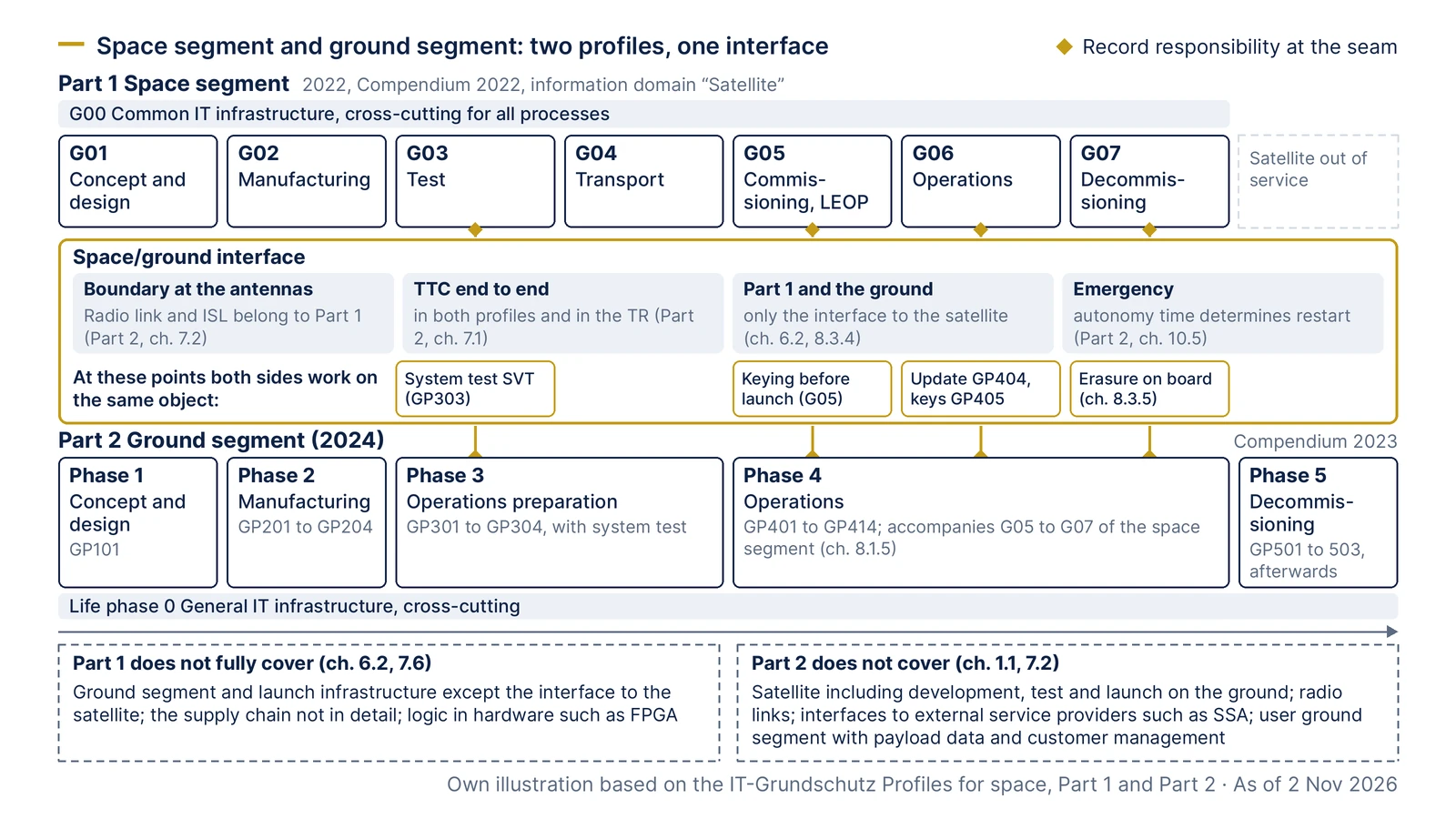
The life phases also only roughly line up. Part 1 has transport and commissioning with launch as phases of their own, Part 2 an operations preparation with training, operational products, system test with the space segment and acceptance. According to Part 2, the operations phase of the ground segment accompanies commissioning, operation and decommissioning of the space segment (ch. 8.1.5); the ground segment is decommissioned only afterwards (ch. 8.1.6). The figure places both profiles on one timeline and marks the points at which you must record responsibilities.
The module lists differ more than their common origin would suggest. 58 modules appear in both profiles. Only Part 1 names 21 more, for instance NET.1.2 Network Management, the WLAN modules, INF.11 General Vehicle for the transports, DER.2.3 and DER.3.2 as well as APP.7. Only Part 2 names seven, including CON.2, OPS.1.1.1 General IT Operation, OPS.1.2.6 NTP Time Synchronisation and APP.5.4 Unified Communications and Collaboration. Some of the differences follow from the 2022 and 2023 editions, others from the subject matter.
Working tool: space/ground interface matrix
The matrix lists ten topics that both profiles touch or that lie between them. For each topic it gives the location in Part 1 and Part 2, the question you answer for your mission and record in writing, and a suggested lead. The roles customer, contractor, operator and manufacturer come from the profiles; the assignment is our suggestion and depends in your project on contracts and responsibilities. Where a row says "not covered", neither of the two profiles covers the topic; there you need a requirement of your own or a risk analysis.
| Topic | Part 1 space segment | Part 2 ground segment | What you record | Lead (suggestion) |
|---|---|---|---|---|
| Operations communication (TTC) | Ch. 8.3.4: protect the connection particularly, authentication, secure cryptographic procedures; CON.1 with reference to TR-02102 (tab. 16) | Ch. 7.1, 10.3: end-to-end encryption between mission control system and platform recommended; boundary at the antennas (ch. 7.2) | Where does encryption begin and end, who specifies procedures and key lengths? | Operator (SCC) together with the platform manufacturer |
| Key material | G05: keying before launch; ch. 8.3.4: after attacks, review change of crypto hardware, software, algorithms and keys | GP405 key management; separate rooms for key management in the spreadsheet | Who generates, loads and changes keys in which phase, and who keeps them? | Operator; handover from the manufacturer before launch documented |
| Changing software on board | OPS.1.1.3: „Kann unterschiedlich gehandhabt werden zwischen Bodensegment und Satellit“ (our translation: "Can be handled differently between ground segment and satellite") (tab. 17); ch. 8.3.4.1: plan for redundancies | GP404: developer delivers, operator checks with simulator, schedules and uploads | Who releases an on-board software update, how is integrity checked before upload? | Operator releases; manufacturer supplies test evidence |
| Testing across the seam | G03; ch. 8.3.1.2: attack simulation in integration and in-orbit phase taking the ground segment into account | GP303 system test against the space segment, GP304 acceptance with penetration tests | Which path is attacked by whom, and who accepts the result? | Customer commissions; contractor carries out |
| Emergency and loss of communication | Ch. 8.3.4.2: emergency plans in hard and soft copy, safe mode, regular exercises | Ch. 10.5: recovery time from the autonomy time of the satellite, geographically separate emergency workstation, emergency tests with change of site | How long does the satellite survive without contact, and what recovery time follows from this for the ground? | Operator; autonomy time from the manufacturer |
| External data for control | Ch. 8.3.4.1: integrity protection for external information such as GPS time signals | GP401 orbit determination from tracking or telemetry data, GP407 SSA data | Which external data feed into commands or manoeuvres, and how is their integrity checked? | Operator (flight dynamics) |
| Third-party ground stations | Ch. 6.2: have a comparable security level in facilities on the ground demonstrated | Ch. 10.2, 10.3: select, integrate and audit providers; end-to-end encryption protects confidentiality | What evidence do you require from the provider, and what remains if its station fails? | Operator |
| Supply chain | Ch. 4.3, 8.3.1.3, checklist section 4: check subcontractors, security requirements in tenders | Ch. 5.3, GP201, 10.2: select suppliers by trustworthiness, bind service providers contractually | What minimum protection do you require in which phase, and how do you check it? | Customer for the requirements; each contractor for its subcontractors |
| Collision avoidance and SSA | Tab. 13: scenarios of impairment by and of other satellites | GP407, GP410; interfaces to external SSA service providers not covered (ch. 7.2) | Who operates the connection to the SSA service, and how is it secured? | Operator; the connection to the external SSA service is not modelled in either profile |
| End of mission | Ch. 8.3.5: erase information and crypto material before the graveyard orbit, tamper safeguards without further space debris; checklist section 8 | Ch. 8.1.6: GP501 to GP503 erasure, archiving, documentation, after decommissioning of the space segment | Who commands the erasure on board, who confirms it, and what is archived on the ground and for how long? | Operator; documentation by the operator of the ground segment |
For a mission that also operates a user ground segment, an eleventh row is added: payload communication, processing of payload data and customer portals lie outside both profiles (Part 2, ch. 7.2; Part 1 considers the ground only at the interface). The matrix is suitable as an annex to the interface document under Part 2, ch. 10.2, and as a template for the joint risk assessment by customer and contractor under ch. 10.4.
Transferring space and ground segment to Grundschutz++
The two space profiles rest on two different Compendium editions, so we count them separately: for Part 1 the 80 modules from tables 14 to 23, for Part 2 the modules from the sheet „Bausteine“ (modules) of the spreadsheet. We first check each identifier against the 2023 edition and then count via the mapping of the State-of-the-Art Library (Stand-der-Technik-Bibliothek), which is still a draft (status "draft", 21 July 2026); resolved against the user catalogue (Anwenderkatalog) build 2026-10-29. For Part 1, SYS.2.2.2 Clients under Windows 8.1 is dropped without replacement in the 2023 edition, and OPS.3.1 Outsourcing for Service Providers is replaced by OPS.3.2 Providing Outsourcing (Compendium 2023, „Neues im IT-Grundschutz-Kompendium“, our translation: "What's new in the IT-Grundschutz Compendium"). Part 1 chose OPS.3.1 and excluded OPS.2.1 Outsourcing for Customers; if you outsource services yourself, also check OPS.2.3 Use of Outsourcing. In the spreadsheet for Part 2, Android appears as "SYS.3.2.3"; we count it as SYS.3.2.4.
The number of requirements includes all identifiers in the 2023 Compendium, including those marked „ENTFALLEN“ (dropped). "With assignment" means: the draft refers from at least one sub-requirement to a Grundschutz++ requirement. The count does not distinguish the type of relationship (equivalent, subset, superset, intersection). An assignment does not prove complete coverage.
| Figure | Part 1 space segment | Part 2 ground segment |
|---|---|---|
| Modules according to the profile | 80 (2022 edition) | 65 (2023 edition) |
| of which counted with 2023 identifier | 79 | 65 |
| Requirement identifiers in the 2023 Compendium | 1,566, 255 of them dropped | 1,308, 214 of them dropped |
| of which with assignment in the draft mapping | 392 | 331 |
| Assignments module to Grundschutz++ requirement (different targets per module, summed) | 630, in total 303 different requirements | 555, in total 294 different requirements |
| Practices affected | 17; most different requirements in DET (73), ARCH (61), KONF (45) and TEST (30) | 18; most different requirements in DET (73), ARCH (58), KONF (46) and TEST (30) |
| Modules without a single assignment | 10, including ORP.4, CON.3, CON.6, SYS.1.3, INF.7 | 7, including ORP.4, CON.2, CON.3, CON.6, SYS.1.3 |
| Target references in the draft that cannot be resolved in the catalogue (all to the identifier VRB.1.2) | 12 | 10 |
Three examples at requirement level, each from the location in the profile to the gap. Identifiers, titles and modal verbs come from the user catalogue build 2026-10-29; the relationship from the draft mapping.
| Location in the profile | Requirement 2023 | Grundschutz++ according to the draft | Gap |
|---|---|---|---|
| Part 1, tab. 16: CON.1 „für Kontrolle des Satelliten aber erforderlich“ (our translation: "but required for control of the satellite"); ch. 8.3.4: change of keys after attacks. Part 2: GP405 key management | CON.1.A1 Selection of suitable cryptographic procedures (B); CON.1.A4 Suitable key management (B) | CON.1.A1 intersects with KONF.2.2 Cryptographic procedures in IT systems (SOLLTE, i.e. SHOULD), BER.7.1 Established algorithms for key generation (SOLLTE) and BER.7.8 Established algorithms for key use (SOLLTE). The draft contains no entry for CON.1.A4. | Of 13 requirements in CON.1 that are not dropped, 3 are assigned. You assign key generation and key change across space and ground yourself; candidates such as BER.7.10 Expired keys (SOLLTE) are our classification, not part of the draft. Keying before launch and change after attacks remain profile-specific. |
| Part 1, tab. 21: SYS.4.3 for on-board computer, TT&C system and transport container software; ch. 8.3.5: erasure and tamper safeguards at the end of the mission. Part 2: SYS.4.3 for the satellite in the system test | SYS.4.3.A16 Tamper protection for embedded systems (H); SYS.4.3.A11 Secure decommissioning of an embedded system (S); SYS.4.3.A14 Secured and authenticated boot process for embedded systems (H) | A16 intersects with DET.4.9 Tamper check-up (KANN, i.e. MAY, security level elevated (erhöht)). The draft contains no entry for A11 and A14. | 4 of 18 requirements of the module are assigned, all in the practice DET. The explanation for DET.4.9 has publicly installed devices and device seals in mind, not a satellite in orbit. Annex 1 of 300-1 has no target object category (Zielobjektkategorie) for satellites; if such an asset is not adequately covered, 300-1 requires an explicit risk assessment (ch. 2.11). |
| Part 2, ch. 10.5: regular emergency tests with change from site A to B, emergency workstation. Part 1, ch. 8.3.4: regular emergency exercises | DER.4.A10 Tests and emergency exercises (H); DER.4.A13 Review and control of the emergency management system (H) | A13 equivalent to NOT.1.2 Regular review (MUSS, i.e. MUST). The draft contains no entry for A10. | The exercise itself is not assigned. In the catalogue, NOT.3.4 Functional test (KANN), NOT.2.1.4 Crisis team exercise (KANN) and NOT.3.5 Alternative telecommunications (SOLLTE) come into consideration; that is our classification. You set the recovery time derived from the autonomy time of the satellite as a parameter of your own. |
Profile-specific requirements are not in any mapping. In Part 1 these are chapter 8.3 (vulnerability scanning, attack simulation, security management of subcontractors, protection in design and integration, transport, launch facility, intersection of in-orbit phase and ground segment, decommissioning) and the checklist in chapter 11. In Part 2 they are the guidance from chapter 10 (process environment, external services, operations communication, risk management, business continuity management) and the 24 target objects with „N.N.“ in the spreadsheet. You take over this content as supplementary requirements into your requirements package or deal with it in the risk analysis.
For working with Grundschutz++ this also means: the "very high" ratings from the case studies of Part 2 are permissible as a category of their own, but under 300-1 ch. 2.6 they must be mapped to the two categories "normal" and "high"; how you justify this is described on the page Protection requirements determination. Assign satellite, antennas and ground stations to the target object categories as far as possible (Modelling with target object categories). How to check individual assignments of the draft is set out on the page Checking the IT-Grundschutz 2023 mapping. All figures on this page are our own count over a draft and not an official mapping.
What this page does not decide
Both profiles refer to the BSI Act (BSIG) in the version of their time. Part 1 names obligations under Section 8a and Section 8f BSIG for operators and manufacturers under the KRITIS or UBI regulation and cites, as the only critical facility in the space sector, the ground station of a satellite navigation system under the BSI-Kritisverordnung (BSI Critical Infrastructures Regulation), as of 2022 (ch. 5.5). Part 2 writes that the profile could be used to fulfil the requirements for operators of critical infrastructure (KRITIS) under Section 8a(1) BSIG (ch. 6.4). These references are historical. This page does not answer whether and which obligations apply to your organisation today.
Nor does the page deal with space law, export and import rules, which Part 2 mentions in connection with supplier selection (ch. 6.5), rules for classified information and requirements of individual customers. Whether a security concept built according to these profiles is recognised as evidence in a tender, an accreditation or an audit is decided by the body concerned. According to their own statement, the profiles are a recommendation and guidance (Part 1, foreword; Part 2, foreword).
For classification under current law: NIS2 and IT-Grundschutz. For business continuity management, Part 2 refers to BSI Standard 200-4 (ch. 10.5).
Transferring and developing the profiles
Blackfort Technology supports manufacturers and operators as a team in tailoring both profiles to a specific mission: filling in the interface matrix, documenting deviations from the reference architectures, transferring profile-specific requirements into a requirements package under Grundschutz++ and checking the assignments of the draft mapping.
Service packages: Consulting on Grundschutz and Grundschutz++. All other profiles with profile summaries can be found in the overview of IT-Grundschutz Profiles.
Rights notice: Quotations from the IT-Grundschutz-Profil für Weltrauminfrastrukturen (Teil 1: Raumsegment), publishers Bundesamt für Sicherheit in der Informationstechnik, OHB Digital Connect GmbH, Airbus CyberSecurity GmbH and Raumfahrtagentur des Deutschen Zentrums für Luft- und Raumfahrt, © Bundesamt für Sicherheit in der Informationstechnik 2022, source: BSI page on the profile. Quotations from the IT-Grundschutz-Profil für Weltraumsysteme Teil 2: Bodensegment, publishers Bundesamt für Sicherheit in der Informationstechnik and Expertenkreis „Cybersicherheit im Weltraum“ der Allianz für Cybersicherheit, © Bundesamt für Sicherheit in der Informationstechnik 2024, source: BSI page on the profile. The quotations are verbatim, the summaries are our own. Requirement and module titles from the IT-Grundschutz-Kompendium, Edition 2023, © 2023 Reguvis Fachmedien GmbH and © 2023 Bundesamt für Sicherheit in der Informationstechnik, source: BSI page on the IT-Grundschutz Compendium. These titles are not under CC BY-SA 4.0; the licence notice at the end of the page applies to the extracts from catalogue and mapping data. The counts from the spreadsheet for the structure analysis are our own evaluations.