

The rules in BSI Standard 300-1
In the second process step, the requirements analysis, the identified assets of the information domain are assigned to target object categories. Chapter 3 describes target object categories as „standardisierte Klassen (z. B. Anwendungen, IT-Systeme) zu den im GS++ beschriebenen Anforderungen“ (our translation: "standardised classes (e.g. applications, IT systems) for the requirements described in GS++"). Chapter 3.4.2 governs the assignment: you assign at least one category to each asset and include all categories above it. Requirements are attached to each of these categories.
The user catalogue (Anwenderkatalog) sets out these steps as methodology requirements of the practice (Praktik) Structure Modelling (Strukturmodellierung). STM.2.1.3 requires: „Strukturmodellierung MUSS allen relevanten Assets eine oder mehrere Zielobjektkategorien zuweisen.“ (our translation: "Structure modelling MUST assign one or more target object categories to all relevant assets.") The guidance on it calls for a function-oriented assignment: what counts is how the asset acts in the business process, technical characteristics alone are not enough. Assets that are hard to assign are analysed in the risk assessment. STM.2.1.4.1 governs inheritance: the categories above it in the hierarchy are also assigned to the asset. According to the guidance, all parent nodes up to the root are included, and inheritance is deterministic and can be automated.
Requirements that occur several times across several assets or several categories are to be taken into account only once in the requirements package under chapter 3.4. The catalogue provides STM.2.1.4.2 „Konsolidierung und Redundanzprüfung“ (our translation: "consolidation and redundancy check") for this. We recommend keeping the assignment to all affected assets in the package, so that when you later check the implementation status you know where to look.
Three types of requirements in the package
Chapter 3.4 distinguishes three types of requirements. The figures in the table come from our own count in the Grundschutz++ user catalogue, build of 29 October 2026, recursively across all levels of nested requirements. They change with every build.
| Type | Rule in 300-1 | Number in build 2026-10-29 |
|---|---|---|
| Requirements from the methodology practices | apply to all institutions and every information domain, without a target object category (ch. 3.4, 3.4.1) | 95 (practices GC, STM, UMS, VRB, PERF) |
| technical and organisational requirements without a target object category | must be included in the requirements package (ch. 3.4, 3.4.1) | 265 |
| Requirements of the practice Risk Management (RISK), a class of its own in the catalogue | without a target object category, therefore always in the package like the previous row | 4 |
| technical and organisational requirements with a target object category | to be applied insofar as assets have been assigned to the category (ch. 3.4) | 636, of which 39 with two categories |
| Total | 1,000 |
This means 364 requirements are in the package regardless of the modelling. Modelling decides which share of the 636 requirements with a target object category is added. Under chapters 3.3 and 3.4.3, requirements from blueprints (Blaupausen) and your own additions come on top, for example from compliance management or for assets that no category adequately covers.
The 39 target object categories and their hierarchy
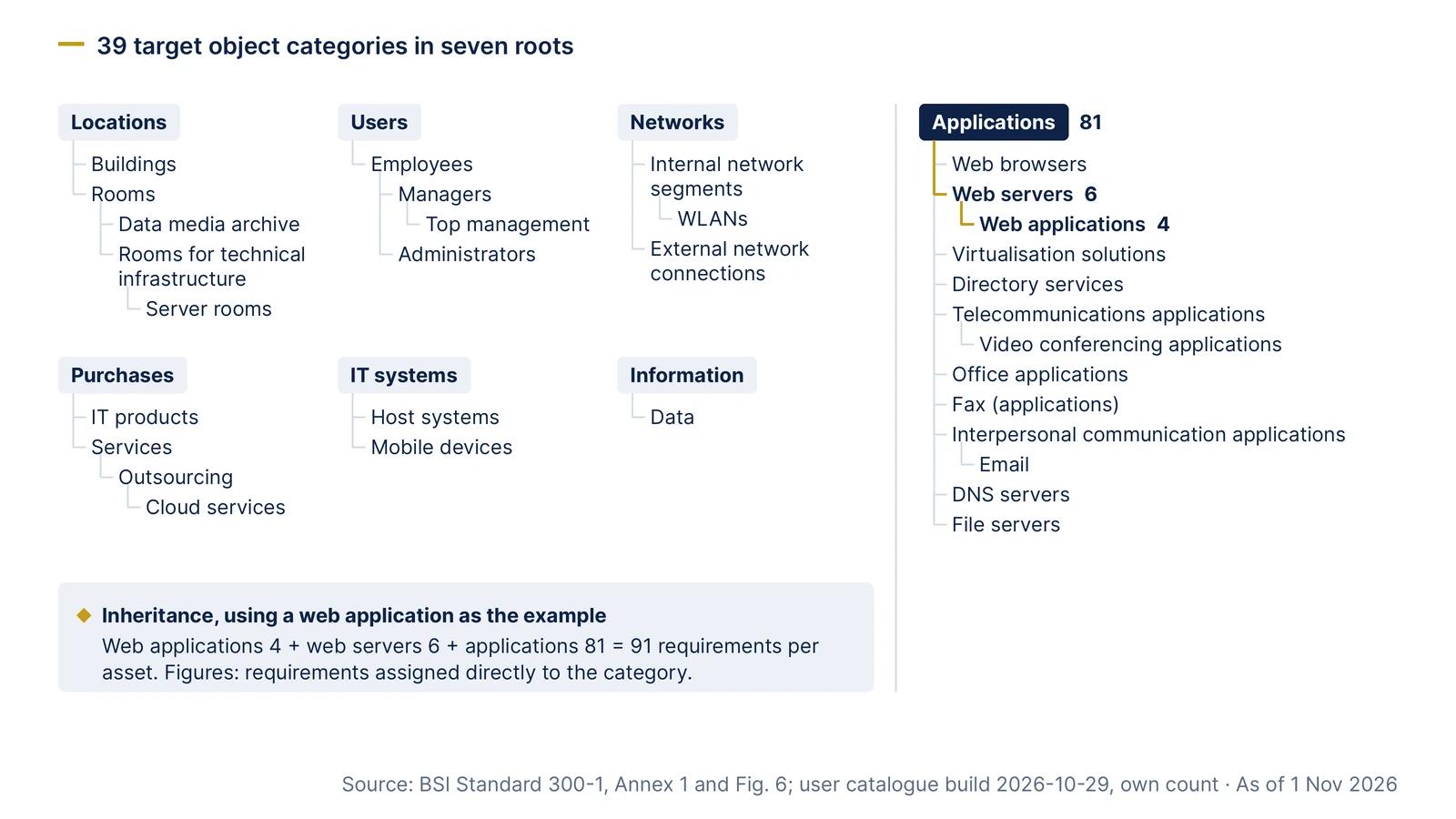
Annex 1 of 300-1 defines 39 target object categories, and Figure 6 shows their hierarchy: seven root nodes, up to four levels. For each category, the table gives the path up to the root and the number of requirements assigned directly to that category in the catalogue. Through inheritance, an asset also receives the requirements of all parent categories. Three names differ between the standard and the catalogue: Datenträgerarchiv (data media archive) is called „Archiv“ (archive) in the catalogue, Fax(-anwendungen) (fax applications) „Faxanwendungen“, and Interpersonelle Kommunikationsanwendungen (interpersonal communication applications) „Interpersonelle Kommunikation“ (interpersonal communication). Figure 6 abbreviates Mobile Endgeräte (mobile devices) to „Endgeräte“ (devices).
| Root | Category with path | Level | directly assigned requirements |
|---|---|---|---|
| Locations | Locations (Standorte) | 1 | 59 |
| Locations > Buildings (Gebäude) | 2 | 2 | |
| Locations > Rooms (Räume) | 2 | 6 | |
| Locations > Rooms > Data media archive (Datenträgerarchiv) | 3 | 2 | |
| Locations > Rooms > Rooms for technical infrastructure (Räume für technische Infrastruktur) | 3 | 3 | |
| Locations > Rooms > Rooms for technical infrastructure > Server rooms (Serverräume) | 4 | 4 | |
| Users | Users (Nutzende) | 1 | 81 |
| Users > Employees (Mitarbeitende) | 2 | 11 | |
| Users > Employees > Managers (Führungskräfte) | 3 | 2 | |
| Users > Employees > Managers > Top management (Institutionsleitung) | 4 | 1 | |
| Users > Employees > Administrators (Administrierende) | 3 | 9 | |
| Networks | Networks (Netze) | 1 | 34 |
| Networks > Internal network segments (Interne Netzsegmente) | 2 | 3 | |
| Networks > Internal network segments > WLANs | 3 | 4 | |
| Networks > External network connections (Externe Netzanschlüsse) | 2 | 16 | |
| IT systems | IT systems (IT-Systeme) | 1 | 93 |
| IT systems > Host systems (Hostsysteme) | 2 | 9 | |
| IT systems > Mobile devices (Mobile Endgeräte) | 2 | 15 | |
| Information | Information (Informationen) | 1 | 5 |
| Information > Data (Daten) | 2 | 31 | |
| Purchases | Purchases (Einkäufe) | 1 | 39 |
| Purchases > IT products (IT-Produkte) | 2 | 14 | |
| Purchases > Services (Dienstleistungen) | 2 | 31 | |
| Purchases > Services > Outsourcing | 3 | 29 | |
| Purchases > Services > Outsourcing > Cloud services (Cloud-Dienste) | 4 | 9 | |
| Applications | Applications (Anwendungen) | 1 | 81 |
| Applications > Web browsers (Webbrowser) | 2 | 14 | |
| Applications > Web servers (Webserver) | 2 | 6 | |
| Applications > Web servers > Web applications (Webanwendungen) | 3 | 4 | |
| Applications > Virtualisation solutions (Virtualisierungslösungen) | 2 | 4 | |
| Applications > Directory services (Verzeichnisdienste) | 2 | 3 | |
| Applications > Telecommunications applications (TK-Anwendungen) | 2 | 9 | |
| Applications > Telecommunications applications > Video conferencing applications (VK-Anwendungen) | 3 | 5 | |
| Applications > Office applications (Office-Anwendungen) | 2 | 2 | |
| Applications > Fax (applications) (Fax(-anwendungen)) | 2 | 3 | |
| Applications > Interpersonal communication applications (Interpersonelle Kommunikationsanwendungen) | 2 | 10 | |
| Applications > Interpersonal communication applications > Email (E-Mail) | 3 | 14 | |
| Applications > DNS servers (DNS-Server) | 2 | 5 | |
| Applications > File servers (Dateiserver) | 2 | 3 |
Hierarchy as in 300-1 Figure 6, names as in Annex 1, figures from our own count in the user catalogue build 2026-10-29. The sum of direct assignments is 675 because 39 requirements have two categories, for example Users and Locations or Users and Interpersonal communication. We count a requirement with two categories for an asset as soon as one of the two categories is assigned to the asset. The catalogue does not expressly specify this reading.
The distribution stands out: most requirements are attached to the roots. Chapter 3.4.2 describes the requirements at the highest level as predominantly conceptual („Verfahren verankern“ (our translation: "establish procedures") and similar), while the specific categories further down have few, more concrete requirements. Web applications, for example, have four directly assigned requirements: KONF.11.4 „Erraten von Zugriffslinks“ (our translation: "guessing of access links"), KONF.12.1.7 „Filtern schädlicher Webinhalte“ (our translation: "filtering of malicious web content"), KONF.12.1.10 „HTTP-Response-Header“ (our translation: "HTTP response headers") and KONF.12.10 „Cookie-Attribute“ (our translation: "cookie attributes"). A web application receives the larger part through Web servers and Applications.
Worked example: assignment with inheritance
Fictitious example: the funding agency of a German federal state models the business process GP-01 „Förderanträge bearbeiten“ (processing funding applications) with high protection requirements. Assets A-01 to A-12 are taken from the mini inventory on the structure analysis page. The column "Requirements per asset" counts the requirements of all assigned and inherited categories, for that asset alone in each case. All figures are calculated with the catalogue build of 29 October 2026.
| ID | Asset | assigned category/categories | inherited | Requirements per asset |
|---|---|---|---|---|
| A-01 | Funding portal | Web applications | Web servers, Applications | 91 |
| A-02 | Funding case management application | Applications | - | 81 |
| A-03 | Application data and decisions | Data | Information | 36 |
| A-04 | VM group for the case management application | Host systems | IT systems | 102 |
| A-05 | Virtualisation platform | Virtualisation solutions; Host systems | Applications; IT systems | 184 |
| A-06 | Server room | Server rooms | Rooms for technical infrastructure, Rooms, Locations | 72 |
| A-07 | Case officers' notebooks | Mobile devices | IT systems | 108 |
| A-08 | Application administrators | Administrators | Employees, Users | 101 |
| A-09 | Portal hosting (IaaS) | Cloud services | Outsourcing, Services, Purchases | 108 |
| A-10 | Email notification | Interpersonal communication applications, Applications | 105 | |
| A-11 | Internet connection | External network connections | Networks | 50 |
| A-12 | Administrative network | Internal network segments | Networks | 37 |
The virtualisation platform A-05 receives two categories because it is software (hypervisor) and hardware (hosts) at the same time. STM.2.1.3 expressly allows one or more categories per asset.
Consolidation after round 1: The twelve assets bring a total of 1,075 requirement assignments. After removing duplicates, 576 distinct requirements with a target object category remain. The difference arises mainly from shared roots: four assets receive the 81 requirements of the category Applications, three the 93 of the category IT systems. Each appears only once in the package.
Completeness check: which categories are still missing?
After the first round, it pays to look at the categories to which no asset is assigned, either directly or through inheritance. In the example, these were 14 of 39. For each one, you decide whether an asset is missing or whether the category genuinely does not occur in the information domain. 300-1 does not prescribe this check as a separate step. It is a suggestion for finding forgotten assets before an audit finds them.
| Category without asset | Decision in the fictitious example | Result |
|---|---|---|
| Buildings | The office building was missing. The server room alone does not inherit the building requirements, because Buildings and Rooms are siblings under Locations. | A-14 office building: 61 requirements, 1 new |
| Directory services | Logging on to the case management application goes through the central directory service. | A-15 directory service: 84 requirements, 3 new |
| Office applications, Web browsers | Decisions are prepared with office software, and the portal is checked in the browser. | A-16 office software and browser on the notebooks: 97 requirements, 14 new |
| Managers, Top management | Management signs decisions above a value threshold and approves residual risks. | A-17 management of the funding agency: 95 requirements, 3 new |
| Data media archive | Files are kept only electronically in the case management application. | not assigned, justification documented |
| WLANs | There is no WLAN in the office building. | not assigned, justification documented |
| Fax (applications), Telecommunications and Video conferencing applications | No application data is processed by fax, telephone or video conference for GP-01. | not assigned, check again in the next cycle |
| DNS servers, File servers | Name resolution is provided by the state network (interface), and GP-01 does not use file shares. | not assigned, interface documented |
| IT products | Funding portal, case management application and notebooks are procured IT products within the meaning of Annex 1, so the category is assigned to them in addition. Its requirements also apply to future replacement purchases. | A-01, A-02 and A-07 additionally receive IT products (inherited: Purchases): 14 new requirements |
A category can be covered even though an asset is missing. In the example, the case officers had not been recorded, yet the category Employees was still populated because A-08 application administrators inherits it. A-13 case officers (group, 25 people) was added with 92 requirements, none of them new. This changes nothing for the package, but it does for the later check: the requirements for employees also apply to the case officers and must be checked there.
Result after round 2: 17 assets, 1,663 assignments, 611 distinct requirements with a target object category after consolidation. The five additional assets and the additional category IT products brought 35 new requirements (21 and 14). Seven categories remain without an asset, each with a documented justification. This shows how strongly inheritance works: the bulk comes through the root categories, and most assets add only a few specific requirements. A forgotten category therefore hardly shows up in the figures and has to be looked for deliberately.
The requirements package in the example
The 364 requirements without a target object category are added to the 611 requirements from modelling. The package for GP-01 therefore comprises 975 of the 1,000 requirements in the build. For implementation, what counts is the breakdown by security level and modal verb.
| Part of the package | Number | Meaning |
|---|---|---|
| Security level normal-SdT, MUSS (MUST) | 149 | mandatory; no exemption and no risk acceptance (300-1 ch. 4.1.2) |
| Security level normal-SdT, SOLLTE (SHOULD) | 603 | to be fulfilled; permanent non-fulfilment only with a risk assessment and approval of the residual risk (ch. 4.1.2); for temporary non-fulfilment see the note below the table |
| Security level erhöht (elevated), KANN (MAY) | 220 | optional; a pool for the risk assessment in case of high protection requirements (ch. 3.4.2) |
| Security level erhöht (elevated), SOLLTE (SHOULD) | 3 | BES.1.4, DET.4.12.1, REA.2.5; set to SOLLTE in the build, although ch. 3.4.2 provides for KANN for "erhöht" |
| Total | 975 |
For SOLLTE requirements that are temporarily not fulfilled, 300-1 is not unambiguous. Chapter 2.11 states: „Für SOLLTE-Anforderungen, die in der Umsetzungsplanung enthalten, aber noch nicht erfüllt sind, muss eine Restrisikobetrachtung durchgeführt werden.“ (our translation: "For SHOULD requirements that are included in the implementation planning but not yet fulfilled, a residual risk assessment must be carried out.") Chapter 4.1.2 states: „Eine temporäre Nichterfüllung löst keine Risikobetrachtung aus.“ (our translation: "A temporary non-fulfilment does not trigger a risk assessment.") How the two passages fit together is an open question of interpretation.
Because GP-01 has high protection requirements, the explicit risk assessment is mandatory (ch. 2.11). The 223 requirements at security level "erhöht" are the first source of additional safeguards for it. How to deal with unfulfilled MUSS, SOLLTE and KANN requirements is described on the page Assessing requirements and documenting deviations. The risk assessment itself is covered under Risk analysis.
The figures apply to this build. Before every recalculation, check which build applies, see Grundschutz++ user catalogue.
Deviation between standard and catalogue: remove or include?
At one point, the standard and the catalogue contradict each other in the current build. 300-1 states in chapter 3.4.1: „Alle weiteren Anforderungen ohne zugewiesene Zielobjektkategorie sind verpflichtend in das Anforderungspaket aufzunehmen.“ (our translation: "All other requirements without an assigned target object category must be included in the requirements package.") The guidance on the catalogue requirement STM.2.1.5, by contrast, describes a relevance decision per requirement. Requirements that are not relevant are removed from the package with a justification. The implementation status also differs: in chapter 4.1.1 the standard provides for "fulfilled" (erfüllt), "not fulfilled" (nicht erfüllt) and "not applicable" (nicht anwendbar), the guidance on UMS.1.1 in the catalogue only „umgesetzt“ (implemented) and „nicht umgesetzt“ (not implemented).
We recommend following the standard: include all requirements without a target object category in the package and record their status under chapter 4.1.1. If the underlying component does not exist in the information domain or the requirement cannot be fulfilled functionally, it is recorded as "not applicable" with a justification. Otherwise it is "fulfilled" or "not fulfilled". A mere lack of relevance is none of these cases. This way, the justification is where an audit looks for it, and the package remains comparable with the catalogue once the BSI aligns it.
Modelling under 200-2 and under 300-1
Under BSI Standard 200-2 chapter 8.3, the information domain is reproduced using the modules of the IT-Grundschutz Compendium. The assignment of modules to target objects is documented in a table with module, relevance, target object, justification and contact person (chapter 8.3.4). According to the BSI topic page, the State-of-the-Art Library (Stand-der-Technik-Bibliothek) replaces the Compendium, and the user catalogue now only describes requirements that are not aimed at specific IT solutions. It has no product-related modules like those in the Compendium. Their place is taken by target object categories with inheritance.
In practice, this means the question is about the function of an asset in the process, and the search for the matching module is no longer needed. An old modelling table remains useful all the same. The column „Zielobjekt“ (target object) supplies the asset list, and the column „Begründung“ (justification) for non-relevant modules supplies material for the completeness check above. For comparing old module requirements with Grundschutz++ requirements, the BSI repository contains a mapping table that still has draft status. What it does is described on the migration page.
Continue with:
- Assets and dependencies as the basis for modelling: Structure analysis and asset capture
- Protection requirements that determine the security level: Protection requirements determination
- Transferring an existing modelling: Migration to Grundschutz++
Blackfort Technology supports modelling and recalculates requirements packages from the catalogue data, see Consulting.
Rights notice: Quotations from BSI Standard 300-1 © Bundesamt für Sicherheit in der Informationstechnik 2026, source: BSI Standard 300-1 „Methodik Grundschutz++“, version 1.0 of 20 October 2026, https://www.bsi.bund.de/DE/Themen/Unternehmen-und-Organisationen/Standards-und-Zertifizierung/Grundschutz-in-der-Informationssicherheit/Grundschutz-Plus-Plus/grundschutz-plus-plus_node.html. Quotations from BSI Standard 200-2 © Bundesamt für Sicherheit in der Informationstechnik, source: BSI Standard 200-2 „IT-Grundschutz-Methodik“, version 1.0, https://www.bsi.bund.de/DE/Themen/Unternehmen-und-Organisationen/Standards-und-Zertifizierung/IT-Grundschutz/BSI-Standards/BSI-Standard-200-2-IT-Grundschutz-Methodik/bsi-standard-200-2-it-grundschutz-methodik_node.html. They are not licensed under CC BY-SA 4.0. The licence notice at the end of the page applies only to the excerpts from the catalogue data.