

What the Grundschutz++ user catalogue contains
The Grundschutz++ user catalogue is part of the State-of-the-Art Library, which the BSI publishes on GitHub. On its Grundschutz++ page, the BSI writes: „Sie löst das IT-Grundschutz-Kompendium ab.“ (our translation: "It replaces the IT-Grundschutz Compendium.") The catalogue contains the technical and organisational requirements and, in addition, the normative content of the methodology, which the BSI has transferred from BSI Standard 300-1 into requirements of their own (300-1, ch. 3.4.1). Anyone working under 300-1 therefore has two texts in front of them: the standard, which describes the approach, and the catalogue, from which their own requirements package is built.
The requirements are available as JSON in OSCAL format. This means they can be loaded directly into tools and evaluated there; the BSI names automatable checking as the purpose of the format. For areas with normal protection requirements, the catalogue is based on a general risk assessment by the BSI. With normal protection requirements, a separate risk assessment is therefore generally not needed, with three exceptions under ch. 2.11 of 300-1: if a business process has high protection requirements for at least one protection goal, if a relevant asset is not sufficiently covered by the target object categories (Zielobjektkategorien) and their requirements, and if an applicable SOLLTE (SHOULD) requirement is permanently not fulfilled. For SOLLTE requirements that are planned but not yet fulfilled, ch. 2.11 also requires a residual risk assessment with approval by top management.
According to the BSI, the user catalogue describes „nur noch Anforderungen, die nicht auf spezifische IT-Lösungen abzielen“ (our translation: "only requirements that are not aimed at specific IT solutions"). Product-related implementation descriptions are kept separately in the library's Implementation Layer. These component definitions describe a possible implementation; the repository stresses that they are not an actual implementation and do not replace action by the responsible body.
File guide: which file for what
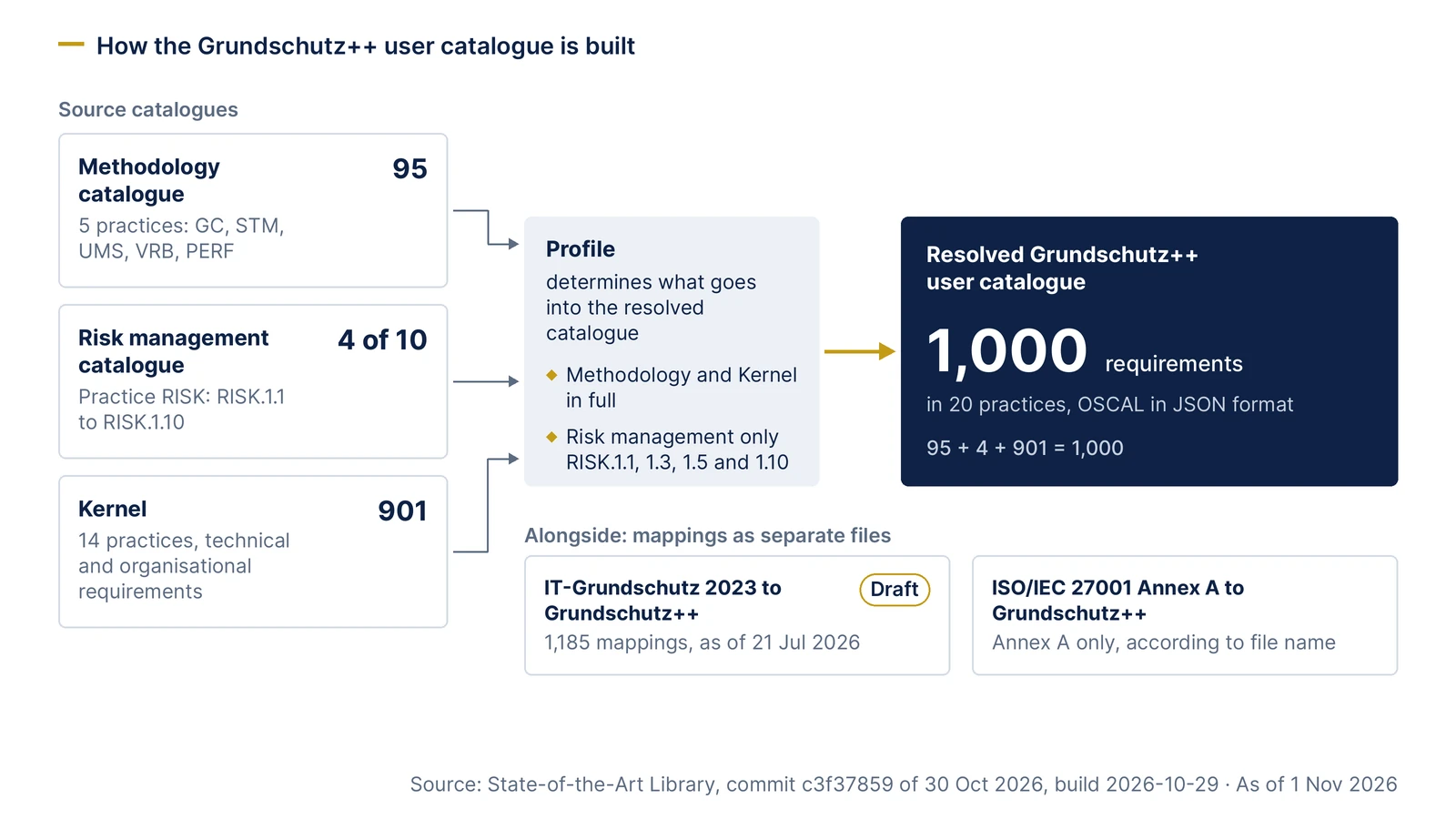
The library contains more than the user catalogue. For a requirements package, use the resolved file. The repository README describes resolved catalogues as directly usable within an organisation; source catalogues and profiles under sources/ are aimed at editors. The table reflects commit c3f37859 of 30 October 2026.
| File (path in the repository) | Content | What you need it for | Note |
|---|---|---|---|
control_layer/Grundschutz++/Grundschutz++-resolved_catalog.json | Resolved Grundschutz++ user catalogue, 1,000 requirements in 20 practices, build 2026-10-29 | Building a requirements package, transferring data into an ISMS tool | The only file that contains methodology, risk management and technical and organisational requirements together |
control_layer/Grundschutz++/sources/profiles/Grundschutz++-profile.json | Profile that determines what goes into the resolved catalogue | Understanding why a requirement is included or missing | Takes over the methodology catalogue and the Kernel in full, from the risk management catalogue only RISK.1.1, RISK.1.3, RISK.1.5 and RISK.1.10; sets the parameter of GC.1.1 to "BSI Grundschutz++" and one parameter of NOT.1.1.4 to "BSI-Standard 200-4" |
control_layer/Grundschutz++/sources/catalogs/Methodik-Grundschutz++/BSI-Methodik-Grundschutz++-catalog.json | 95 methodology requirements in GC, STM, UMS, VRB and PERF | Reading the methodology requirements separately | Source catalogue; does not produce a requirements package on its own |
control_layer/Kernel/BSI-Stand-der-Technik-Kernel-catalog.json | Source catalogue of the technical and organisational requirements | Comparisons, work as an editor | In the resolved catalogue, 901 requirements come from the Kernel |
control_layer/Risikomanagement/BSI-Anforderungen-zum-Risikomanagement-catalog.json | 10 requirements RISK.1.1 to RISK.1.10, as of 22 Oct 2026 | Aligning the risk procedure | Only four of them are in the user catalogue, details on Risk minimum criteria |
control_layer/Mappings/IT-GS2023-zu-GSpp/ITGS-to-GS++-mapping_collection.json | 1,185 mappings from IT-Grundschutz 2023 to Grundschutz++, last-modified 21 Jul 2026, exported on 9 Jun 2026 according to the metadata (generated-at) | Transferring existing documentation | Status "draft". The target identifiers match the catalogue versions of 5 Mar to 20 Apr 2026 completely (1,185 of 1,185), most recently commit 333c147 of 20 Apr 2026 (own resolution against all 23 catalogue versions in the repository). In five steps, with the builds of 28 May, 24 Jun, 3 Jul, 16 Jul and 26 Jul 2026, the BSI then reassigned identifiers; the UUIDs stayed the same. Even against the build of 28 May 2026, only 1,150 of the 1,185 mappings match, 35 do not. The date 9 Jun 2026 is only the export date of the mapping file. Against the build of 29 Oct 2026, 1,039 of the 1,185 mappings match directly via the identifier; for 90, the identifier now points to a different requirement, 40 identifiers no longer exist (the requirement can only be found via the UUID), and 16 targets (VRB.1.2) are missing from the build entirely (own count). So link via the UUID (oscal_uuid in the mapping, alt-identifier in the catalogue) and check each mapping on its merits |
control_layer/Mappings/ISO-27001-zu-GSpp/ISO27001-AnnexA-to-GS++-mapping_collection.json | Mapping of ISO/IEC 27001 Annex A to Grundschutz++ | Aligning existing ISO documentation | Annex A only, according to the file name |
control_layer/WLAN/, control_layer/Lieferkettensicherheit/ | Further resolved catalogues with their own profile | Topics with their own selection of requirements | The repository does not state explicitly whether these are blueprints (Blaupausen) within the meaning of 300-1 ch. 3.3 |
control_layer/Mindeststandard-TLS/Entwurf-Mindeststandard-TLS-catalog.json | Draft of a minimum standard | Not for the requirements package | The file name marks it as a draft (Entwurf) |
documentation/namespaces/ | Vocabularies: practices, target object categories, modal verbs, security levels, effort levels, threats | Reading the catalogue fields correctly | CSV files in UTF-8 with a header row |
implementation_layer/ | Component definitions, including password policy, network architecture, Keycloak | Ideas for implementation | Describe an implementation, are not one themselves |
assessment_layer/ | Intended for assessment plans, assessment results and plans of action | Nothing at present | According to the README, no artefacts published yet |
How a requirement is structured in the catalogue
Every requirement follows a sentence template of practice, modal verb, result and action word. One example is UMS.1.1 „Ermittlung des Umsetzungsstatus“ (determining the implementation status). The catalogue reads: „Umsetzung MUSS den Umsetzungsstatus der Anforderungen im Anforderungspaket vollständig {{ insert: param, ums.1.1-prm1 }} überprüfen.“ (our translation: "Implementation MUST check the implementation status of the requirements in the requirements package completely {{ insert: param, ums.1.1-prm1 }}.") The placeholder is a parameter labelled „regelmäßig“ (regularly); the catalogue sets no fixed value here. Read as a sentence, it means: the implementation status is checked completely and regularly. What "regularly" means for you is defined when you create the requirements package (300-1, ch. 3.5).
The most important fields you will come across when importing or reading the file:
| Field in the catalogue | Meaning | Values in build 2026-10-29 |
|---|---|---|
id, title | Identifier and title of the requirement, e.g. UMS.1.1 | 1,000 identifiers, nested down to the fourth level |
modal_verb | Level of obligation: MUSS, SOLLTE or KANN (MUST, SHOULD or MAY) | 149 MUSS, 627 SOLLTE, 224 KANN |
sec_level | Security level: "normal-SdT" (standard security level, SdT stands for Stand der Technik, state of the art) or "erhöht" (elevated) | 773 normal-SdT, 227 erhöht |
target_object_categories | Target object category to which the requirement is attached | 636 requirements with, 364 without a target object category |
params | Parameters such as "regelmäßig" (regularly), to be specified by the organisation | zero to several per requirement |
effort_level | Effort level 0 to 5; according to the namespace, 0 means the effort „wird nicht bewertet, da ihre Implementierung in jedem Fall zwingend erforderlich ist“ (our translation: "is not assessed, as its implementation is mandatory in any case"), 1 stands for quick wins, 5 for elaborate, complex safeguards | 0: 148, 1: 52, 2: 171, 3: 281, 4: 159, 5: 189 |
threats | Assigned elementary threats (G 0.1 to G 0.47) | 901 requirements with threat assignment |
confidentiality, integrity, availability, authenticity | Effect of the requirement on the respective protection goal, levels 0 to 2 | set for 901 and 900 requirements respectively |
guidance | Explanatory text on the requirement | Running text, partly with examples |
documentation | Recommended type of documentation, e.g. "ISMS-Regelwerk" (ISMS rule set) | set for 961 requirements |
The catalogue in figures: 20 practices, build 2026-10-29
We counted the resolved catalogue recursively across all levels: 652 requirements on the first, 327 on the second, 19 on the third and 2 on the fourth level, 1,000 in total. Counting only two levels gives 979. By origin, 95 requirements come from the methodology catalogue, 4 from the risk management catalogue and 901 from the Kernel. The focus of each practice is taken from the namespace file practices.csv.
| Code | Practice | Focus | Requirements |
|---|---|---|---|
| GC | Governance and compliance (Governance und Compliance) | Methodology | 35 |
| STM | Structure modelling (Strukturmodellierung) | Methodology | 15 |
| UMS | Implementation (Umsetzung) | Methodology | 11 |
| VRB | Improvement (Verbesserung) | Methodology | 10 |
| PERF | Monitoring and evaluation (Monitoring-Evaluation) | Methodology | 24 |
| RISK | Risk management (Risikomanagement) | Methodology | 4 |
| ASST | Information and assets (Informationen und Assets) | Organisational | 58 |
| PERS | Personnel (Personal) | Organisational | 30 |
| BES | Procurement management (Beschaffungsmanagement) | Organisational | 109 |
| DLS | Service provider management (Dienstleistersteuerung) | Organisational | 18 |
| TEST | Changes and tests (Änderungen und Tests) | Organisational | 36 |
| GEB | Building management (Gebäudemanagement) | Organisational | 75 |
| SENS | Awareness (Sensibilisierung) | Organisational | 87 |
| NOT | Emergency planning (Notfallplanung) | Organisational | 37 |
| ARCH | Architecture (Architektur) | Technical | 63 |
| BER | Authorisation (Berechtigung) | Technical | 92 |
| DET | Detection (Detektion) | Technical | 82 |
| REA | Security incident handling (Sicherheitsvorfallsbehandlung) | Technical | 23 |
| KONF | Configuration (Konfiguration) | Technical | 157 |
| DEV | Development (Entwicklung) | Technical | 34 |
The methodology requirements are almost all MUSS requirements (76 MUSS, 19 SOLLTE, plus the four RISK requirements with MUSS). In the Kernel, SOLLTE predominates with 608 requirements, plus 224 KANN and 69 MUSS. All 224 KANN requirements have the security level "erhöht".
Checklist: are you working with the right catalogue version?
The BSI republishes the catalogue on an ongoing basis. A figure or requirement text without a build date can no longer be verified later. We check these points before working with a catalogue file:
| Check | What you check | Value in the version used here |
|---|---|---|
| 1. Right file | Path ends in Grundschutz++-resolved_catalog.json, the field metadata.title reads „Anwenderkatalog Grundschutz++“ | met |
| 2. Build date | Record metadata.last-modified and metadata.version; the catalogue's version is a timestamp, not a sequential number | 2026-10-29T08:03 |
| 3. Commit | Record the repository commit hash for every export and every count | c3f37859, 30 Oct 2026 |
| 4. Count check | Count recursively across all controls levels; if your figure differs, the cause lies in the counting method or in the file | 1,000 |
| 5. Completeness in the tool | Are the 95 methodology requirements and the four RISK requirements included? Importing only the Kernel leaves out the methodology | 95 + 4 + 901 |
| 6. Names of the target object categories | The catalogue partly uses shorter names than Annex 1 of 300-1, for example "Archiv" (archive) instead of "Datenträgerarchiv" (data media archive) or "Faxanwendungen" (fax applications) instead of "Fax(-anwendungen)" | 39 categories |
| 7. Mapping version | Mappings have their own date and status; record them separately and check the targets via the UUID against the build used, because the mapping matches the catalogue versions of 5 Mar to 20 Apr 2026 and the BSI reassigned identifiers from the build of 28 May 2026 onwards | 21 Jul 2026, draft; 146 of 1,185 target identifiers no longer match build 2026-10-29 |
| 8. Known deviations from the standard | Note in the requirements package the points where catalogue text and 300-1 differ (next section) | three points |
| 9. Licence | The library is licensed under CC BY-SA 4.0; mark the origin and your own changes. What this means for your tool is a matter for review by your legal department | CC BY-SA 4.0 |
| 10. New build | 300-1 explicitly names changes to the requirements of the library as a reason for validating the requirements package (ch. 5.5) | Plan a comparison |
Where catalogue and standard still differ
The build of 29 October 2026 does not match the text of BSI Standard 300-1 in three places. The build dates from 29 October 2026, the standard from 20 October 2026. Record the deviations with the catalogue version in your requirements package.
First, the implementation status. The guidance on UMS.1.1 reads: „Der Umsetzungsstatus einer Anforderung kann grundsätzlich nur ‚umgesetzt‘ (‚ja‘) oder ‚nicht umgesetzt‘ (‚nein‘) sein.“ (our translation: "The implementation status of a requirement can in principle only be 'implemented' ('yes') or 'not implemented' ('no').") The standard provides for three values, namely „erfüllt“, „nicht erfüllt“ and „nicht anwendbar“ (our translation: "fulfilled", "not fulfilled" and "not applicable") (300-1, ch. 4.1.1).
Second, the requirements without a target object category. Under 300-1 they must be included in the requirements package (ch. 3.4.1). The guidance on STM.2.1.5, by contrast, provides for a relevance decision: non-relevant requirements „werden aus dem Anforderungspaket gestrichen“ (our translation: "are deleted from the requirements package"), with a justification.
Third, the security levels. Under 300-1, requirements with the security level "erhöht" (elevated) contain the modal verb KANN (MAY) (ch. 3.4.2). Three requirements in the build are marked "erhöht" and SOLLTE: BES.1.4 „Outsourcing-Strategie“ (outsourcing strategy), DET.4.12.1 „Auslastung des Netzes“ (network utilisation) and REA.2.5 „IT-Forensik“ (IT forensics).
In these cases we follow the text of the standard and record the deviation with the catalogue version in the requirements package. How to document status and deviations in detail is described on the page Assessing requirements, documenting deviations.
From the BSI modules to the practices
In the IT-Grundschutz Compendium, the requirements were grouped into modules and ordered by layers: process-oriented ISMS, ORP, CON, OPS and DER, system-oriented INF, NET, SYS, APP and IND (200-2, ch. 2.4). Grundschutz++ orders them by practices. The following comparison shows what changes for reading and modelling.
| Feature | IT-Grundschutz Compendium (200-2) | Grundschutz++ user catalogue (300-1) |
|---|---|---|
| Structure | Modules in ten layers | 20 practices with a methodology (6), organisational (8) or technical (6) focus |
| Assignment to the information domain | Modules are modelled onto target objects (200-2, ch. 8.3) | Assets are assigned to 39 target object categories, parent categories apply as well (300-1, ch. 3.4.2) |
| Link to threats | Cross-reference table per module | G0 identifier directly on the requirement (300-1, Annex 4) |
| Explanation | Implementation guidance for many modules | Explanatory text per requirement |
| Format | Document | OSCAL JSON |
What changes methodologically for requirement levels, modal verbs and implementation status is set out in the comparison of IT-Grundschutz 2023 and Grundschutz++.
Where the old layers point in the draft mapping
The BSI mapping of IT-Grundschutz 2023 to Grundschutz++ has draft status. We counted the 1,185 mappings by the layer of the old requirement and by the practice of the target identifier in the mapping file. The targets lie in 18 of the 20 practices; STM and RISK do not occur. 16 of these targets (VRB.1.2) no longer exist in the build of 29 October 2026; without them, 10 mappings from ISMS and 28 from DER point to VRB. The table shows only the direction, not a verified one-to-one transfer.
| Layer 2023 | Mappings | Most frequent target practices (count) |
|---|---|---|
| ISMS | 45 | UMS (14), VRB (13), GC (6) |
| ORP | 45 | UMS (18), PERS (8), ARCH (6) |
| CON | 62 | DEV (26), TEST (11), ARCH (6), DET (6) |
| OPS | 162 | DET (61), TEST (49), ARCH (28) |
| DER | 113 | DET (40), VRB (32), UMS (22) |
| INF | 87 | ARCH (43), TEST (17), DET (13) |
| NET | 271 | ARCH (219), DET (34), UMS (7) |
| SYS | 140 | ARCH (63), DET (55), KONF (9) |
| APP | 194 | KONF (60), DET (36), ARCH (30) |
| IND | 66 | DET (21), ARCH (16), TEST (10) |
In practice this means that an old module is spread across several practices. When transferring from an existing IT-Grundschutz Check, it is therefore better to search per requirement than per module. What this means for your documents is described in the comparison of IT-Grundschutz 2023 and Grundschutz++, how to carry it out on the page Migration.
What the catalogue does not do
The catalogue provides requirements, not ready-made safeguards. Which safeguard fulfils a requirement is defined in implementation planning (300-1, ch. 4.3). According to the BSI milestone plan (as of October 2026), the concept for performance measurement is to be integrated into the methodology on 26 February 2027, and performance indicators for each methodology requirement are to follow by 31 March 2027. As long as uniform specifications are lacking, organisations are free to design their performance evaluation as they see fit (300-1, ch. 5.1).
The standard provides for blueprints (Blaupausen), i.e. predefined requirement catalogues for specific application scenarios; for certain organisations there may be mandatory blueprints (300-1, ch. 3.3). Which ones these are is not stated in the sources evaluated here (as of 1 November 2026).
With high protection requirements, the catalogue alone is not sufficient. The standard then requires a separate risk assessment, for which the requirements with the security level "erhöht" are a pool to draw on (300-1, ch. 2.11 and 3.4.2). How this works is shown on the page Risk analysis.
For reading in the browser, the BSI repository refers to a State-of-the-Art Viewer (Stand-der-Technik-Viewer) (https://bsi-community.github.io/Stand-der-Technik-Viewer/). For the requirements package, the file with a documented version remains the basis. If you want to align existing documentation from the IT-Grundschutz Compendium 2023, the team at Blackfort Technology supports you with the readiness analysis and the migration; the services are described on the page Consulting.
Rights notice: Quotations from the BSI page on Grundschutz++ (retrieved on 1 November 2026) and from BSI standards are © Bundesamt für Sicherheit in der Informationstechnik. They are not licensed under CC BY-SA 4.0; the licence notice at the end of the page applies only to the excerpts from the catalogue data.
Frequently asked questions
Are there still BSI modules in Grundschutz++?
How many requirements does the Grundschutz++ catalogue have?
Where can I download the Grundschutz++ user catalogue?
control_layer/Grundschutz++/Grundschutz++-resolved_catalog.json. Record the commit and build date when downloading.