

Risk analysis or risk assessment?
BSI Standard 300-1 speaks of Risikobetrachtung (risk assessment), meaning risk identification, risk evaluation and risk treatment (chapter 4.2). The older BSI Standard 200-3 is titled „Risikoanalyse auf der Basis von IT-Grundschutz“ (risk analysis on the basis of IT-Grundschutz). In searches, „Risikoanalyse“ (risk analysis) is the common term. On this page it always means the explicit risk assessment under 300-1.
This is distinct from the general risk assessment that the BSI has carried out itself. It is built into the Grundschutz++ user catalogue (Anwenderkatalog) and is based on an assumed typical threat situation. Users with normal protection requirements therefore do not have to carry out a risk assessment of their own (300-1, chapter 2.11 and Annex 4). The elementary threats underlying the requirements are listed in the metadata of the catalogue and can be used for your own analysis.
When a risk analysis is mandatory
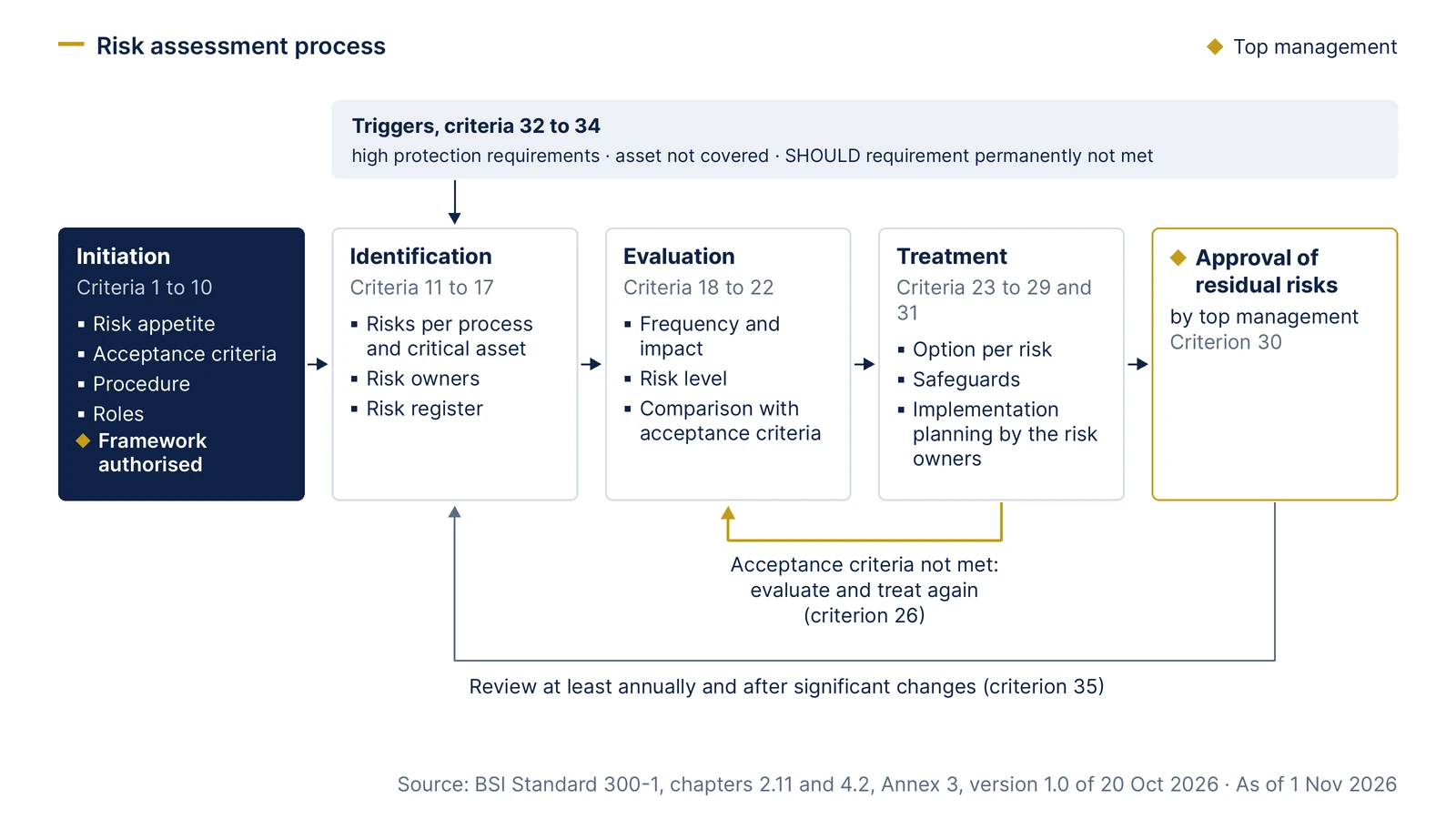
300-1 names three triggers for an explicit risk assessment (chapter 2.11) and anchors them as minimum criteria 32 to 34 in Annex 3. In addition, there is a smaller obligation for SHOULD requirements that are planned but not yet fulfilled.
| Trigger | Reference | Object of analysis | Typical example |
|---|---|---|---|
| Business process with high protection requirements for at least one protection goal | Ch. 2.6, 2.11; minimum criterion 32 | the business process, supplemented by critical assets | Processing of health data |
| Relevant asset that the target object categories and their requirements do not adequately cover | Ch. 2.11, 3.4.3; minimum criterion 33 | the asset | Special-purpose device with its own operating system whose particular features no requirement covers |
| Applicable SHOULD requirement, permanently not fulfilled | Ch. 4.1.2; minimum criteria 17 and 34 | the requirement with its assigned elementary threats | Legacy application cannot support encryption |
| SHOULD requirement planned but not yet fulfilled | Ch. 2.11 (residual risk), 4.1.1 | the open risk until implementation | Roll-out under way, completion in four months |
With normal protection requirements, adequately covered assets and requirements that are fulfilled, there is no trigger. For SHOULD requirements that are planned but not yet fulfilled, the residual risk assessment from the last row remains. How this obligation from chapter 2.11 relates to chapter 4.1.2, which provides for no risk assessment in the case of temporary non-fulfilment, is an open question of interpretation. Initiating the risk assessment is, however, part of process step 1 and therefore part of setting up the ISMS for every institution (chapter 2.11).
Preparation: the framework must be in place before the first risk
Before the first risk is evaluated, the institution needs a framework on three levels (300-1, chapter 2.11). Strategic: how much risk it is willing to take and from which level a risk is acceptable. Methodological: which procedure and which scales it uses to find, evaluate and treat risks, and whether it starts from threats or from scenarios. Organisational: who has which role and who decides as risk owner.
Top management puts this framework into force (Annex 3, criterion 9). Without this authorisation, the first evaluated risk has no yardstick. Whether your framework covers all requirements of Annex 3 can be checked criterion by criterion on the page Risk minimum criteria. When choosing the procedure, you may draw on common standards such as ISO/IEC 27005 or ISO 31000 (chapter 2.11).
The process in three steps
| Step | What it produces | 300-1 |
|---|---|---|
| Risk identification | Risks per business process, for high protection requirements first at this level, supplemented by critical assets along the resource path; each risk with an owner in the register. Unless otherwise specified, this is the process owner, and where several processes are affected, one of them takes the lead. | Ch. 3.2, 4.2.1 |
| Risk evaluation | For each risk a justified estimate of frequency and impact, the resulting level, the comparison with the acceptance criteria and a ranking. Whether to work with levels, figures or both is for the institution to decide. | Ch. 4.2.2 |
| Risk treatment | For each risk a treatment option, and in the case of reduction the safeguards. Top management approves the residual risks, the risk owner approves the implementation planning. Reviews take place at least annually and after significant changes. | Ch. 4.2.3 |
The case (fictitious): Beihilfe claims with an external scanning service provider
A fictitious state authority (Landesamt) processes Beihilfe claims from its employees (Beihilfe is the healthcare allowance for German public servants). An external scanning service provider digitises paper claims with doctors' invoices and transfers the images over an encrypted connection to the authority's specialist application. The business process has the identifier GP-07. All names, values and decisions are invented. We take the scales for frequency of occurrence and damage from BSI Standard 200-3 (chapter 5.1). The matrix and the acceptance criteria are our own example values.
Trigger. The protection requirements determination gives GP-07 “high” for confidentiality, because disclosure of health data would impair the claimants' right to informational self-determination and cause considerable reputational damage. This is one of the damage scenarios that 300-1 offers as guidance for high protection requirements (chapter 2.6). Integrity and availability are “normal”. Under minimum criterion 32, a risk assessment must therefore be carried out.
Framework, authorised by the head of the authority. Before the case, the authority laid down the following:
| Specification (fictitious) | Content | Minimum criterion |
|---|---|---|
| Procedure | Scenario-based procedure for identification and evaluation; treatment with four options; both described in the risk policy | 1 to 4 |
| Methodological basis | Risk scenarios built from the elementary threats G 0.1 to G 0.47 | 10 |
| Roles | The risk owner is the head of the Beihilfe division as business process owner. The information security officer (ISB) facilitates and maintains the register | 5, 16 |
| Risk appetite | Low risk appetite for the confidentiality of health data; processing delays of up to ten working days are acceptable | 7 |
| Acceptance criteria | “low”: accepted. “medium”: acceptable for a limited period, at most twelve months, with justification. “high” and “very high”: to be treated, otherwise exception approval by the head of the authority | 8, 27, 28 |
| Frequency of occurrence | rare: „höchstens alle fünf Jahre“ (our translation: "at most every five years"); medium: „einmal alle fünf Jahre bis einmal im Jahr“ (our translation: "once every five years to once a year"); frequent: „einmal im Jahr bis einmal pro Monat“ (our translation: "once a year to once a month"); very frequent: „mehrmals im Monat“ (our translation: "several times a month") (200-3, chapter 5.1, table 8) | 6, 18 |
| Damage impact | negligible, limited, considerable, existence-threatening (based on 200-3, table 9), supplemented for GP-07 with examples for each level | 6, 19 |
| Authorisation | Policy, roles, criteria and risk appetite signed by the head of the authority | 9 |
Risk matrix (own example)
| Frequency of occurrence | negligible | limited | considerable | existence-threatening |
|---|---|---|---|---|
| rare | low | low | medium | high |
| medium | low | medium | high | very high |
| frequent | low | medium | high | very high |
| very frequent | medium | high | very high | very high |
The matrix is not taken from 200-3. 200-3 shows a matrix of its own expressly for illustration only and recommends adapting it (chapter 5.2).
Identification and evaluation in the case
Objects of analysis. GP-07 is analysed, supplemented by the scanning service as a critical asset (target object category Outsourcing), because its risk situation is not adequately captured by looking at the business process alone (minimum criteria 11 and 13). The resource path: incoming mail, scanning service provider, transfer via the external network connection, specialist application, server, server room.
Existing safeguards. The safeguards already implemented are taken into account together with their status (minimum criterion 12): a contract with a confidentiality obligation, encrypted transfer, and the requirements at level “normal-SdT” for outsourcing are in the requirements package and fulfilled. It remains open how long the service provider stores the images and whether it keeps the data of several clients separate.
This gives rise to two risks. The first concerns confidentiality and is the core of the case, the second concerns availability and shows the route to time-limited acceptance.
| Entry in the risk register | R-07-01 | R-07-02 |
|---|---|---|
| Object of analysis | GP-07, asset scanning service | GP-07, asset scanning service |
| Risk description | Health data from claim images become accessible without authorisation at the service provider, because images are stored indefinitely and clients on a shared platform are not demonstrably separated | Failure of the service provider halts digitisation, claims are left unprocessed |
| Elementary threats | G 0.19 Disclosure of sensitive information, G 0.32 Misuse of authorisation | G 0.11 Failure or disruption of service providers |
| Protection goals | Confidentiality | Availability |
| Risk owner | Head of the Beihilfe division | Head of the Beihilfe division |
| Frequency of occurrence with justification | medium: shared platform, data held permanently, access by changing staff of the service provider | medium: a multi-day outage at the service provider once in three years |
| Damage impact with justification | considerable: disclosure affecting many claimants, considerable reputational damage | limited: delay of up to ten working days, paper claims remain available |
| Risk level | high | medium |
| Comparison with acceptance criteria | not acceptable | acceptable for a limited period |
| Priority | 1 | 2 |
These fields cover the minimum information that criterion 15 requires for the risk register. The treatment option and the reference to the safeguards follow in the next step. Criteria 14, 18, 19, 20, 21 and 22 are met with protection goal, frequency, impact, level, priority and comparison.
Treatment and approval in the case
R-07-01: risk reduction. The risk owner chooses risk reduction as the option (minimum criterion 23). She derives the safeguards from the evaluation (criterion 24). The first source is the requirements at security level “erhöht” (elevated), which 300-1 provides for exactly this purpose (chapter 3.4.2). Where the catalogue contains nothing suitable, the authority formulates a requirement of its own in the catalogue format and adds it to the requirements package (chapter 3.4.3).
| Safeguard (fictitious) | Origin | Addresses (threat from the risk register) | G0 according to the catalogue | Evidence |
|---|---|---|---|---|
| M-07-01 Lay down client separation at the service provider in the contract and check it on site | BES.4.5.2 „Mandantentrennung“ (client separation) (MAY, level erhöht): „Beschaffungsmanagement für Outsourcing KANN eine festgelegte Mandantentrennung vereinbaren.“ (our translation: "Procurement management for outsourcing MAY agree a defined client separation.") | R-07-01 (G 0.19, G 0.32) | G 0.14, G 0.19, G 0.20, G 0.29 | Contract addendum, report of the on-site check |
| M-07-02 Delete images five working days after confirmed handover, monthly deletion log | Own requirement EIG-BES-01: „Beschaffungsmanagement für Outsourcing SOLLTE die Löschung übergebener Antragsdaten beim Dienstleister nach {{fünf Arbeitstagen}} vereinbaren.“ (our translation: "Procurement management for outsourcing SHOULD agree the deletion of transferred claim data at the service provider after {{five working days}}.") | R-07-01 (G 0.19) | own requirement, no assignment | Contract addendum, monthly deletion log |
| M-07-03 Regulate the deletion of all data at the end of the contract | BES.6.2.1 „Löschverfahren“ (deletion procedure) (MAY, level erhöht): agree a procedure for irrecoverable deletion in the event of termination | R-07-01 (G 0.19) | G 0.18, G 0.20 | Contract clause |
Re-evaluation. After the safeguards, the authority estimates the frequency of occurrence as “rare”, while the impact remains “considerable”. The risk level falls to “medium”. Because the initial level “high” did not meet the acceptance criteria, evaluation and treatment had to be carried out again (criterion 26). Under the authority's criteria, “medium” is acceptable for a limited period.
Approvals. The residual risk “medium” is accepted for a limited period until the review in twelve months (criterion 28), documented in the register (criterion 29) and authorised by the head of the authority (criterion 30). The risk owner signs off the implementation planning for M-07-01 to M-07-03 (criterion 31). The register records the treatment option and the reference to the safeguards (criteria 15 and 25).
R-07-02: time-limited risk acceptance. The level “medium” lies within the criteria. The risk owner chooses risk acceptance, limited to twelve months. After that, it is checked whether a second service provider is needed. The head of the authority also authorises this residual risk.
What would have happened without safeguards. Had the authority rejected M-07-01 to M-07-03, R-07-01 would remain at “high” and therefore outside the acceptance criteria. Such a risk may only remain untreated if top management authorises it as an exception (criterion 27).
Variants: SHOULD requirement permanently not fulfilled and asset not covered
If the trigger is a SHOULD requirement that is permanently not fulfilled, identification starts with the requirement itself. Example: a legacy application will not be able to fulfil KONF.14.1.1 „Obligatorische Verschlüsselung“ (mandatory encryption) for the foreseeable future. The catalogue assigns it the threats G 0.43 „Einspielen von Nachrichten“ (our translation: "replay of messages") and G 0.15 „Abhören“ (our translation: "eavesdropping"). Under minimum criterion 17, these must be taken into account in the risk assessment. The rest of the process follows the case above, and top management approves the residual risks (chapter 4.1.2). How to classify the non-fulfilment correctly beforehand is explained on the page Assessing requirements, documenting deviations.
If the trigger is an asset that the target object categories do not adequately cover, the asset is the focus. 300-1 assumes that every asset can be assigned to at least one target object category (chapter 3.4.2). The gap then lies in the requirements that are missing for the particular features of the asset. In this case, the result of the risk assessment is usually additional requirements of your own in the requirements package (chapter 3.4.3).
And BSI Standard 200-3?
300-1 does not prescribe a particular procedure. 200-3 can be used as the procedure if it meets the 35 minimum criteria. In the case above we adopted its scales. 200-3 has the same four treatment options as minimum criterion 23: risk avoidance, risk reduction, risk transfer and risk acceptance (200-3, chapter 6.1).
When a 200-3 procedure is carried over, three differences typically stand out. 200-3 works with target objects whose protection requirements are high or very high and also allows the analysis at the level of business processes. In 300-1, the business process with high protection requirements is the standard level. 200-3 asks in the risk policy whether risks are assigned to risk owners (chapter 2). 300-1 requires a risk owner for each risk and sets the business process owner as the default. And 300-1 requires risk appetite and risk acceptance criteria as separate specifications authorised by top management. 200-3 deals with risk appetite in an annex (chapter 9.1).
Where the results go
- Requirements package: requirements of your own from the risk assessment supplement the package (300-1, chapters 3.4 and 3.4.3).
- Implementation plan: safeguards with assignment to requirements and risks, date, responsible person and evidence (chapters 4.3 and 4.4).
- Management review: the status of risk treatment is one of the items that top management reviews (chapter 5.3).
- Monitoring: new vulnerabilities and threats feed back into the risk assessment via the monitoring procedures (chapter 5.4).
- Review: once a year and additionally when something significant changes or is about to change, in this case for example a change of service provider (minimum criterion 35).
How the risk results come together with the other documents to form a concept is shown on the page Security concept. If you would like a risk assessment for a business process with high protection requirements to be prepared or facilitated, the team at Blackfort Technology can support you, see Consulting.
Rights notice: Short quotations from BSI Standard 300-1 „Methodik Grundschutz++“ (Grundschutz++ methodology), version 1.0 of 20 October 2026, © Bundesamt für Sicherheit in der Informationstechnik 2026, source: BSI page on Grundschutz++; from BSI Standard 200-3 „Risikoanalyse auf der Basis von IT-Grundschutz“ (risk analysis on the basis of IT-Grundschutz), version 1.0, © Bundesamt für Sicherheit in der Informationstechnik 2017, source: BSI page on BSI Standard 200-3. These quotations are not licensed under CC BY-SA 4.0. The licence notice at the end of the page applies only to the excerpts from the catalogue data.