

Three statuses instead of four
BSI Standard 300-1 of the Bundesamt für Sicherheit in der Informationstechnik (BSI), the German Federal Office for Information Security, requires the implementation status of every requirement in the requirements package to be checked in full. The status can be "fulfilled" (erfüllt, "yes"), "not fulfilled" (nicht erfüllt, "no") or "not applicable" (nicht anwendbar) (ch. 4.1.1). For "not applicable", 300-1 gives exactly two reasons: „Eine Anforderung kann als ‚nicht anwendbar‘ gelten, wenn die Anforderung funktional nicht erfüllt werden kann oder die zugrunde liegende Komponente nicht im Informationsverbund existiert.“ (our translation: "A requirement can be considered 'not applicable' if the requirement cannot be fulfilled functionally or the underlying component does not exist in the information domain.") (ch. 4.1.1). Every such classification needs its own justification.
Anyone coming from classic IT-Grundschutz knows four values: "dispensable" (entbehrlich), "yes", "partially" and "no" (200-2, ch. 8.4.2). "Partially" no longer exists in Grundschutz++. A requirement that is half implemented is not fulfilled. In its guidance on UMS.1.1, the catalogue sets out a further rule: „Eine Anforderung gilt nur dann als umgesetzt, wenn sie selbst sowie alle in Abhängigkeit stehenden Anforderungen umgesetzt sind.“ (our translation: "A requirement is only considered implemented if it and all requirements that depend on it are implemented.")
"Dispensable" and "not applicable" are not the same thing. Under 200-2, a requirement could also be dispensable if it was covered by alternative safeguards. 300-1 gives only two reasons for "not applicable": it cannot be fulfilled functionally, or the component does not exist. In our reading, an alternative safeguard therefore leads to "fulfilled" if it demonstrably achieves the result of the requirement, and otherwise to "not fulfilled".
| Status 200-2 | Status 300-1 | What to do when carrying it over |
|---|---|---|
| yes | fulfilled | Assign the evidence to the safeguard (300-1, ch. 4.3); check dependent requirements as well |
| partially | not fulfilled | Plan the missing part as a safeguard; continue according to the modal verb (for SHOULD, classify as temporary or permanent) |
| no | not fulfilled | Continue according to the modal verb |
| dispensable (not relevant) | not applicable | Reword the justification: cannot be fulfilled functionally, or component does not exist |
| dispensable (alternative safeguard) | fulfilled or not fulfilled | Check whether the alternative safeguard achieves the result of the requirement |
The order in which you assess
Once the implementation status has been determined, you first check the requirements with the security level "normal-SdT" (SdT = Stand der Technik, state of the art) and document the status for each (300-1, ch. 4.1.2). According to 300-1, requirements at the level "erhöht" (increased) contain the modal verb MAY and are optional (ch. 3.4.2); three exceptions in the current build are listed further down. They are used mainly for the risk assessment, for example when a business process has high protection requirements (ch. 3.4.2).
The standard leaves open how you determine the status. It names interviews and document reviews as well as automated configuration checks and technical scans; what matters is a structured procedure that assesses all requirements in the same way (ch. 4.1). Before you assess, the parameters must be specified. A requirement that says "regularly" can only be checked once it is settled what regularly means for you (ch. 3.5).
MUST, SHOULD, MAY: what follows from non-fulfilment
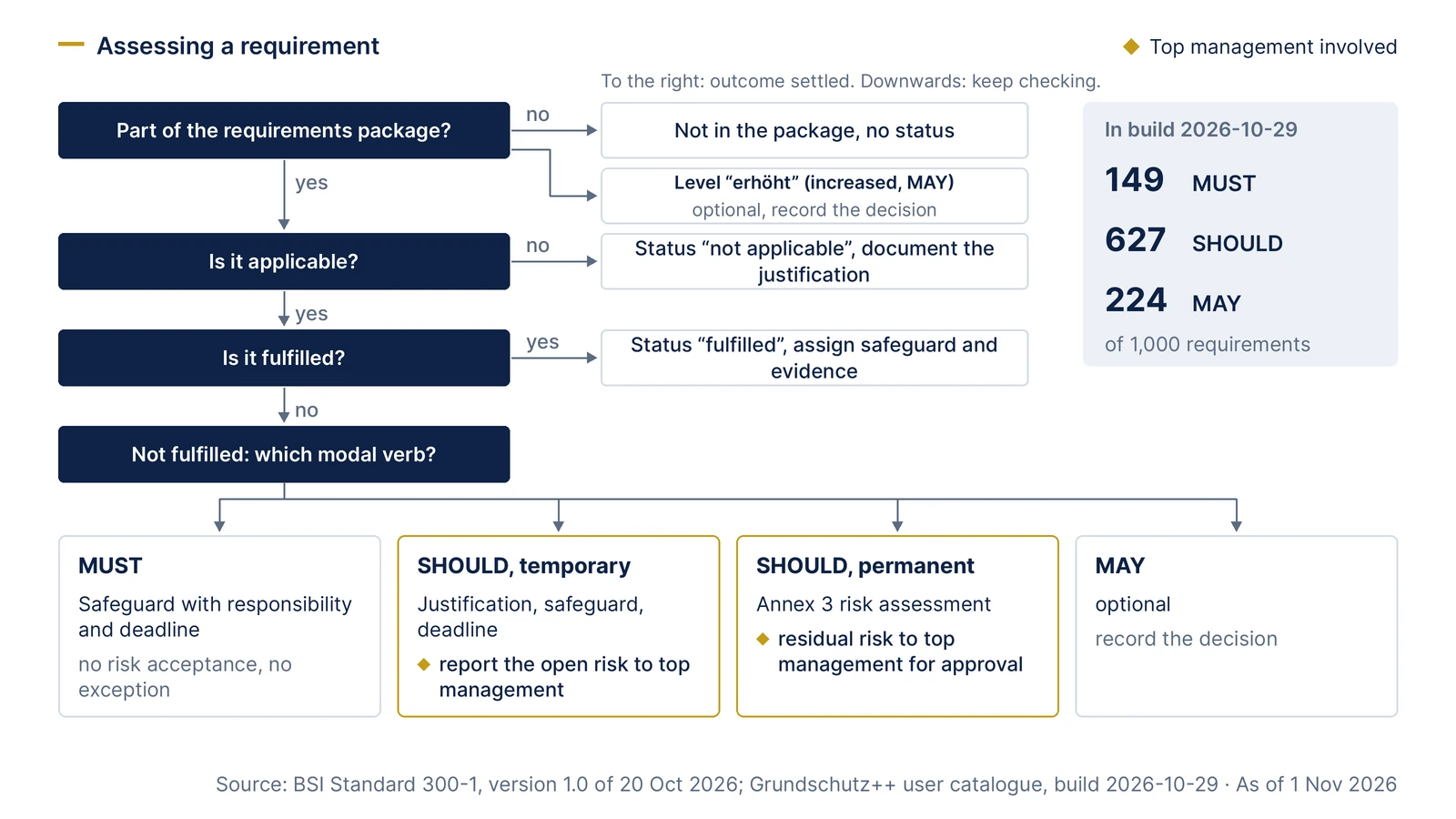
The State-of-the-Art Library (Stand-der-Technik-Bibliothek) defines the meaning of the modal verbs in a vocabulary file of its own, and 300-1 sets out the consequences of non-fulfilment in chapter 4.1.2. In the build of 29 October 2026, 149 requirements have the modal verb MUST, 627 SHOULD and 224 MAY.
| Modal verb | Meaning according to the catalogue vocabulary | Consequence of non-fulfilment (300-1, ch. 4.1.2) | What you document |
|---|---|---|---|
| MUST (MUSS) | „eine Anforderung …, die unbedingt erfüllt werden muss (uneingeschränkte Anforderung)“ (our translation: "a requirement … that must be fulfilled unconditionally (unrestricted requirement)") | Define safeguards for fulfilment; the standard rules out replacing them with a risk assessment, an exception or acceptance | Status, safeguard, responsibility, deadline |
| SHOULD (SOLLTE) | „normalerweise erfüllt werden muss, es aber Gründe geben kann, dies doch nicht zu tun. Dies muss aber sorgfältig abgewogen und stichhaltig begründet werden.“ (our translation: "must normally be fulfilled, but there may be reasons not to do so. This must, however, be weighed carefully and justified soundly.") | Classify non-fulfilment as temporary or permanent. Permanent: risk assessment, residual risks to top management for approval | Classification, sound justification, for permanent cases a reference to the risk register |
| MAY (KANN) | „keine generelle Verpflichtung …, sondern es wird lediglich aufgezeigt, dass diese Handlung oder Maßnahme je nach Situation (d.h. nach Risikoanalyse) sinnvoll sein kann“ (our translation: "no general obligation …, it merely shows that this action or safeguard may be useful depending on the situation (i.e. after risk analysis)") | No mandatory consequence; implementation remains voluntary | Decision whether the requirement is included; with high protection requirements, a link to the risk assessment |
SHOULD requirements: temporarily or permanently not fulfilled
300-1 distinguishes two cases (ch. 4.1.2). Temporary means: fulfilment is planned and scheduled for a foreseeable date; the standard requires a sound justification for this. Permanent means: „Eine dauerhafte Nichterfüllung liegt vor, wenn die Anforderung auf absehbare Zeit oder endgültig nicht erfüllt wird.“ (our translation: "Permanent non-fulfilment exists if the requirement will not be fulfilled for the foreseeable future or definitively.") (ch. 4.1.2). In this case a risk assessment follows (Annex 3, minimum criterion (Mindestkriterium) 34), top management approves the residual risks (minimum criterion 30), and the threats that the catalogue assigns to the requirement belong in the assessment (minimum criterion 17). In the catalogue they appear as a G0 identifier on the requirement.
The standard is not consistent on temporary non-fulfilment; we treat this as an open question of interpretation. Chapter 4.1.2 says it does not trigger a risk assessment. Under chapter 4.1.1, top management must be informed of the risk that exists for planned but still open requirements until they are implemented; top management must bear this risk. For SHOULD requirements that are planned but not yet fulfilled, chapter 2.11 speaks of a residual risk assessment whose result top management approves. The standard does not say which of these passages takes precedence; the sources we evaluated contain no clarification from the BSI.
In practice we handle it like this: for every temporary non-fulfilment, the justification, safeguard and date are in the implementation plan, and the open risk is described in one sentence. We present this list to top management as a whole for information and approval. We only start a full risk analysis under Annex 3 for permanent non-fulfilment. This is our reading of an open question and is not a requirement of the standard; you should clarify early how your audit team assesses it.
Permanent non-fulfilment should remain rare. If such cases accumulate, then according to 300-1 the state of the art may be missed as a whole, and a certification may find a significant deviation (erhebliche Abweichung) (ch. 4.1.2). The page Risk analysis shows how the risk assessment for permanent non-fulfilment works; you can check whether your procedure covers the requirements of Annex 3 with the risk minimum criteria.
MUST with no way out, MAY as an option
For a MUST requirement that is not fulfilled, the only route is through safeguards. The standard explicitly rules out risk assessment, exemption and risk acceptance (ch. 4.1.2). In practice, open MUST requirements therefore belong at the top of the implementation plan. Most MUST requirements come from the methodology: 76 of the 95 methodology requirements are worded with MUST, plus the four RISK requirements. The 69 MUST requirements of the kernel are all the same series of framework requirements that repeats in every organisational and technical practice (Praktik): „Verfahren und Regelungen“, „Dokumentation“, „Zuweisung der Aufgaben“, „Bekanntgabe“ and „Regelmäßige Überprüfung“ (our translation: "procedures and rules", "documentation", "assignment of tasks", "announcement" and "regular review"), in SENS without the review.
MAY requirements do not necessarily have to be taken into account. Record nevertheless whether you include a MAY requirement. With high protection requirements, they are the obvious pool of safeguards for risk treatment (300-1, ch. 3.4.2). Three requirements in build 2026-10-29 have the level "erhöht" (increased) but SHOULD instead of MAY: BES.1.4, DET.4.12.1 and REA.2.5. We document them like increased requirements and note the deviation from the standard, with details on the page Grundschutz++ user catalogue.
Decision tree for every requirement
The tree summarises the rules from 300-1 chapters 3.4 and 4.1. Work through it for each requirement and, where necessary, for each asset.
- Does the requirement belong in the requirements package?
- Methodology requirement: yes, it applies to every information domain (ch. 3.4.1).
- Requirement without a target object category (Zielobjektkategorie): yes, it must be included (ch. 3.4.1).
- Requirement with a target object category: yes, if an asset of this category or of a subordinate category is assigned (ch. 3.4.2). Otherwise it does not belong in the package and needs no status.
- Security level "erhöht" (increased): optional; record the decision, and with high protection requirements draw on it in the risk assessment.
- Is the requirement applicable? It is only not applicable if it cannot be fulfilled at all, technically or organisationally, or if the component does not exist in the information domain. Then status "not applicable" with justification. End.
- Is it fulfilled? It is fulfilled if the result of the requirement is achieved with the specified parameter and the dependent requirements are also fulfilled. Then status "fulfilled", assign safeguard and evidence. End.
- Not fulfilled: which modal verb?
- MUST: define a safeguard and put it in the implementation plan with responsibility and deadline. No risk acceptance.
- SHOULD, fulfilment planned and foreseeable: temporary. Justification, safeguard, deadline; report the open risk to top management.
- SHOULD, cannot be fulfilled for the foreseeable future or definitively: permanent. Risk assessment under Annex 3 with the assigned elementary threats; residual risk to top management for approval.
- MAY: optional; record the decision.
Six sample cases from a fictitious public authority
The following cases are invented. The requirements and their texts come from the Grundschutz++ user catalogue (Anwenderkatalog), build 2026-10-29. The fictitious authority runs a specialist application for application procedures, has no fax machines and prohibits group accounts.
| Case (fictitious) | Requirement | Finding | Status and classification | Documentation and consequence |
|---|---|---|---|---|
| 1. MUST not fulfilled | BER.1.1.1 „Dokumentation“ (our translation: "Documentation") (MUST, normal-SdT): „Berechtigung MUSS die Verfahren und Regelungen dokumentieren.“ (our translation: "Authorisation MUST document the procedures and rules.") | The authorisation procedure is practised but not written down anywhere | not fulfilled; MUST | Safeguard "write and approve the authorisation concept" with responsibility and deadline; risk acceptance not possible |
| 2. SHOULD temporary | BER.5.9 „Mehr-Faktor-Authentisierung für weitreichende Berechtigungen“ (our translation: "Multi-factor authentication for far-reaching privileges") (SHOULD, normal-SdT) | MFA for administration accounts has been commissioned, and the rollout will be completed in four months | not fulfilled; SHOULD temporary | Justification, safeguard and date in the implementation plan; open risk in the collective submission to top management |
| 3. SHOULD permanent | KONF.14.1.1 „Obligatorische Verschlüsselung“ (our translation: "Mandatory encryption") (SHOULD, normal-SdT): „Konfiguration für Anwendungen SOLLTE unverschlüsselte und anfällige Verbindungen über Netze deaktivieren.“ (our translation: "Configuration for applications SHOULD deactivate unencrypted and vulnerable connections over networks.") | The specialist application exchanges data with a partner's legacy system only unencrypted; a replacement is not in sight | not fulfilled; SHOULD permanent | Risk assessment with the assigned threats G 0.43 and G 0.15; treatment, for instance an isolated transmission path; residual risk to top management for approval |
| 4. Not applicable | BER.3.17 „Gruppenkonten - MFA“ (our translation: "Group accounts - MFA") (SHOULD, normal-SdT, without target object category) | Group accounts are prohibited and not set up technically; a reconciliation of the directory service confirms this | not applicable | Justification "component does not exist" with a reference to the reconciliation; reassess if group accounts are introduced |
| 5. Increased, optional | KONF.14.1.2 „Ende-zu-Ende-Verschlüsselung“ (our translation: "End-to-end encryption") (MAY, erhöht) | Business process with normal protection requirements | not in the package | Note the decision; with high protection requirements, check it as a possible safeguard in the risk assessment |
| 6. Formerly "partially" | DET.3.1 „Protokollierung sicherheitsrelevanter Ereignisse“ (our translation: "Logging of security-relevant events") (SHOULD, normal-SdT), parameter set to 90 days by the authority | The specialist application logs, but keeps the logs for only 30 days | not fulfilled; SHOULD temporary if the storage extension is planned | No "partially": plan the missing retention period as a safeguard, set a date |
A borderline case for the status "not applicable": KONF.12.13 „Sendebericht“ (our translation: "Transmission report") is tied to the target object category fax applications (Faxanwendungen). If the authority has no fax, it assigns no asset of this category, and the requirement does not enter the requirements package at all. You need "not applicable" mainly for requirements without a target object category, which are mandatory in the package.
What is recorded for each requirement
The standard does not prescribe a particular form, but it does require a set of details. The table maps each item to its source in the standard; where it says "our own recommendation", the field goes beyond the standard. With these fields, every assessment can be traced later, even when people change.
| Field | Content | Source in the standard |
|---|---|---|
| Requirement and catalogue version | Identifier, title, build date of the catalogue | Identifier: ch. 3.4; build date: our own recommendation, so that the validation under ch. 5.5 remains traceable |
| Reference | Asset or target object category, or "without target object category" | Ch. 3.4.2 |
| Parameter value | Specification, e.g. "regularly = annually" | Ch. 3.5 |
| Status | fulfilled, not fulfilled, not applicable | Ch. 4.1.1 |
| Justification | Mandatory for "not applicable" and for temporary non-fulfilment | Ch. 4.1.1 and 4.1.2 |
| Classification | for SHOULD: temporary or permanent | Ch. 4.1.2 |
| Safeguards | assigned safeguard(s); if one safeguard addresses several requirements, all assignments | Ch. 4.3 |
| Date and person | Date of implementation or review, person documenting or reviewing | Ch. 4.3 |
| Evidence | unambiguously assigned evidence; for automated checks, tool, time and result | Ch. 4.3 |
| Responsibility and deadline | for open safeguards | Ch. 4.4 |
| Risk reference | for permanent non-fulfilment, the identifier in the risk register and the date of the residual risk approval | Ch. 4.1.2, Annex 3 |
| History | earlier findings with time, responsible person and tool used | Ch. 4.3 (recommended) |
You plan who delivers which evidence when on the page Evidence plan.
Mistakes to avoid in the assessment
- Carrying "partially" forward. Partial fulfilment taken over from the existing records must appear as "not fulfilled" with a planned safeguard.
- "Not applicable" without justification. The standard requires one for every single requirement.
- Alternative safeguard as "not applicable". If the alternative achieves the result, the requirement is fulfilled; otherwise it is not.
- Risk acceptance for MUST. The standard rules this out.
- Permanent non-fulfilment without risk assessment. Minimum criterion 34 makes it mandatory.
- Parameters not specified. Without a defined value, "fulfilled" cannot be evidenced.
- Overlooking dependencies. According to the catalogue guidance on UMS.1.1, a requirement is only considered implemented once the dependent requirements are implemented.
If you want existing records from the IT-Grundschutz Check reassessed, the team at Blackfort Technology takes on this work; more on the page Consulting.
Rights notice: Short quotations from BSI Standard 300-1 „Methodik Grundschutz++“, version 1.0 of 20 October 2026, © Bundesamt für Sicherheit in der Informationstechnik 2026, source: BSI page on Grundschutz++. These quotations are not licensed under CC BY-SA 4.0; the licence notice at the end of the page applies only to the extracts from the catalogue data.