

What the minimum criteria are for
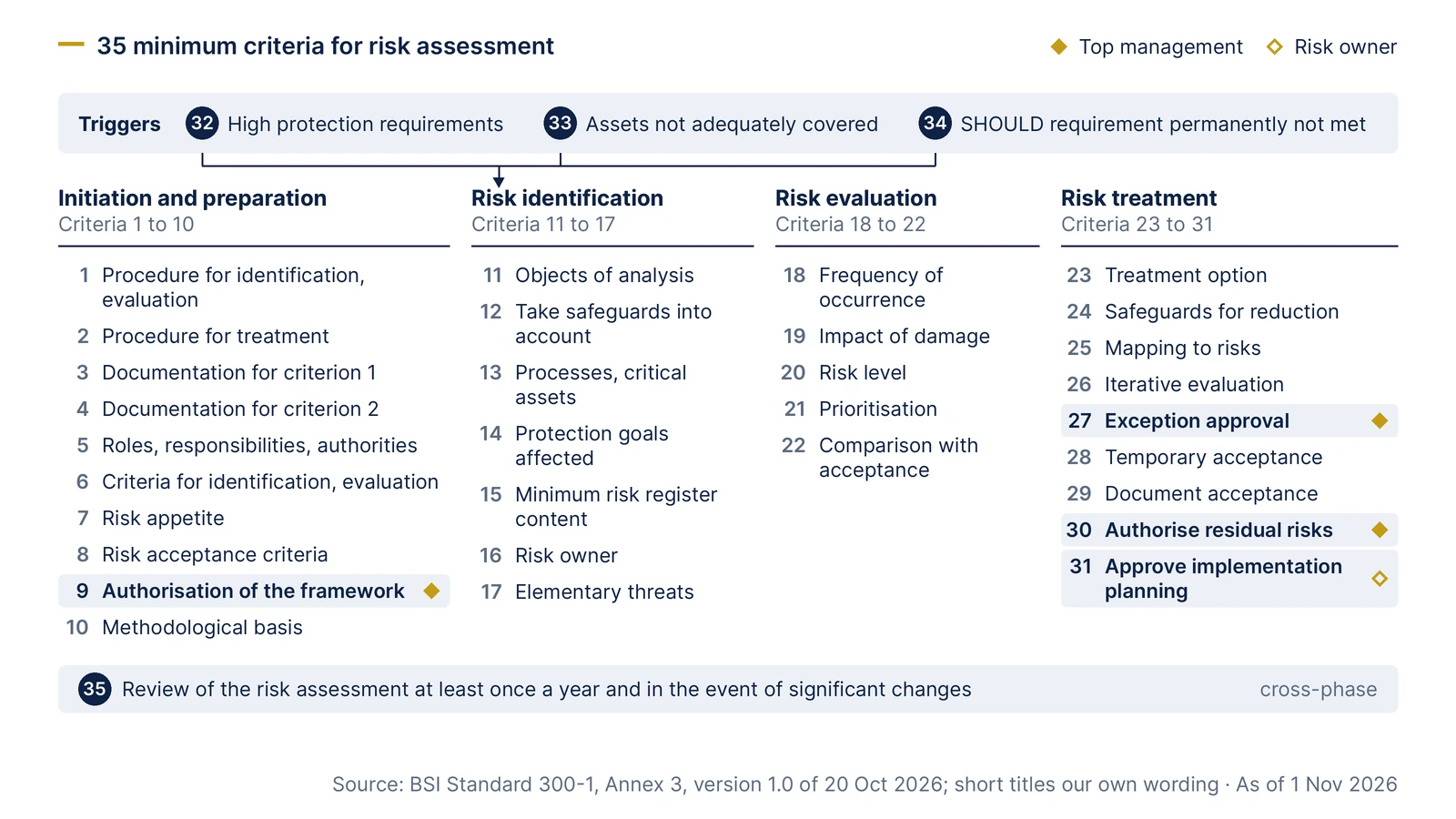
BSI Standard 300-1 leaves the procedure for risk identification, risk evaluation and risk treatment open. Users can choose it themselves, provided the binding minimum criteria laid down in Annex 3 are met. Common standards such as ISO/IEC 27005 or ISO 31000 may be used (ch. 2.11). The criteria are meant to ensure that the chosen methodology is comparable and verifiable, for example in a certification. For initiating and carrying out the risk assessment, chapter 4.2 refers to the same binding criteria.
The criteria test the procedure and how it is applied. They do not tell you whether an individual risk has been rated correctly. How a risk case runs under these rules is shown on the Risk analysis page with a fully worked example.
In our reading, criteria 1 to 10 apply to every organisation that works under Grundschutz++. Initiating the risk assessment is part of process step 1 (ch. 2.11), and the requirements RISK.1.1, RISK.1.3, RISK.1.5 and RISK.1.10 are listed in the user catalogue (Anwenderkatalog) without a target object category (Zielobjektkategorie), which makes them a mandatory part of every requirements package (ch. 3.4.1). Criteria 11 to 31 apply as soon as there is a trigger under criteria 32 to 34.
How this reference is structured
The tables follow the structure of Annex 3: four phases and a block of cross-phase requirements. The standard itself says (300-1, Annex 3, p. 36): „Die Nummerierung der Kriterien dient ausschließlich der eindeutigen Referenzierung und stellt keinen zeitlichen oder zwingend sequenziellen Ablauf der Risikobetrachtung dar.“ (our translation: "The numbering of the criteria serves solely to reference them unambiguously and does not represent a chronological or necessarily sequential course of the risk assessment.") and „Die Zuordnung der Kriterien zu den einzelnen Phasen dient der Strukturierung. Einzelne Kriterien können phasenübergreifend wirken und daher auch Bezüge zu anderen Phasen der Risikobetrachtung aufweisen.“ (our translation: "The assignment of the criteria to the individual phases serves to structure them. Individual criteria can have a cross-phase effect and can therefore also relate to other phases of the risk assessment.")
Standard text and explanation are kept separate. The second column gives the title of each criterion verbatim, in German in quotation marks with our translation, and states in a few words of our own what it is about. It does not reproduce the content of the criterion. Only the passages this page discusses are quoted verbatim, each with its location. You will find the full wording in BSI Standard 300-1, version 1.0 of 20 October 2026, Annex 3, pp. 36-39 (German). This wording applies when your procedure is checked. The third and fourth columns are our explanation: the check question and the evidence do not come from the BSI and are not additional requirements of the standard. They show how we recognise in practice whether a procedure covers a criterion.
Rights notice: Quotations from BSI Standard 300-1 „Methodik Grundschutz++“ (Grundschutz++ methodology), version 1.0 of 20 October 2026, © Bundesamt für Sicherheit in der Informationstechnik 2026, source: BSI page on Grundschutz++. Short quotations from BSI Standard 200-3 „Risikoanalyse auf der Basis von IT-Grundschutz“ (risk analysis on the basis of IT-Grundschutz), version 1.0, © Bundesamt für Sicherheit in der Informationstechnik 2017, source: BSI page on BSI Standard 200-3. These quotations are not licensed under CC BY-SA 4.0. The licence notice at the end of the page applies only to the excerpts from the catalogue data of the State-of-the-Art Library (Stand-der-Technik-Bibliothek).
Initiation and preparation: criteria 1 to 10
These ten criteria describe the framework that has to be in place before the first risk is evaluated. They correspond to the three levels in chapter 2.11: strategically the risk appetite and the acceptance criteria (7, 8), methodologically the procedures, criteria and methodological basis (1 to 4, 6, 10), organisationally the roles (5). Criterion 9 requires top management to authorise the framework.
| No. | Criterion under BSI Standard 300-1, Annex 3 (title verbatim with our translation, subject in our own words) | Check question (our explanation) | Evidence required (our explanation) |
|---|---|---|---|
| 1 | „Verfahren zur Risikoidentifikation und Risikobewertung“ (our translation: "Procedure for risk identification and risk evaluation") Subject: a uniform procedure for identification and evaluation | Is there a procedure for identification and evaluation that is uniform across the entire scope, and has it been introduced as binding? | Risk policy in force with its scope; risk assessments that visibly follow this procedure |
| 2 | „Verfahren zur Risikobehandlung“ (our translation: "Procedure for risk treatment") Subject: a uniform procedure for treatment | Is the treatment process (options, decision paths, approvals) governed uniformly and introduced? | Risk treatment section in the policy; treatment decisions that follow this process |
| 3 | „Dokumentation des Verfahrens zur Risikoidentifikation und Risikobewertung“ (our translation: "Documentation of the procedure for risk identification and risk evaluation") Subject: written version of the procedure from criterion 1 | Is the procedure described in such a way that a competent third party can apply it without asking questions? | Controlled document with version, approval and validity (document control under 300-1, ch. 2.9) |
| 4 | „Dokumentation des Verfahrens zur Risikobehandlung“ (our translation: "Documentation of the procedure for risk treatment") Subject: written version of the procedure from criterion 2 | Is the treatment process recorded in writing and under document control in the same way? | Controlled document, possibly the same text as for criterion 3 |
| 5 | „Rollen, Zuständigkeiten und Befugnisse“ (our translation: "Roles, responsibilities and authorities") Subject: roles with their authorities, above all the risk owner (Risikoeigentümer) | Are all roles in the risk process named, and is it defined in particular what a risk owner may decide? | Role description or responsibility matrix with decision-making authorities; appointments of the persons |
| 6 | „Kriterien für Risikoidentifikation und Risikobewertung“ (our translation: "Criteria for risk identification and risk evaluation") Subject: yardsticks for identification and evaluation | Are scales and definitions for frequency of occurrence, impact of damage and risk level defined, as well as criteria for when something is recorded as a risk? | Scale definitions, risk matrix or calculation rule, recording criteria |
| 7 | „Risikoappetit“ (our translation: "Risk appetite") Subject: definition of the risk appetite | Is there an explicit statement of how much risk the organisation is willing to take, separate from the acceptance criteria? | Definition of the risk appetite by management, e.g. per protection goal or type of information |
| 8 | „Risikoakzeptanzkriterien“ (our translation: "Risk acceptance criteria") Subject: acceptance criteria with reference to the risk appetite | Are acceptance criteria defined for each risk level, and is it clear how they follow from the risk appetite? | Acceptance criteria with reference to the risk appetite and stating who may accept |
| 9 | „Autorisierung von Verfahren, Rollen, Kriterien und Risikoappetit“ (our translation: "Authorisation of procedures, roles, criteria and risk appetite") Subject: putting the framework into force by top management | Has top management authorised all four elements in their current version? | Resolution or signature of top management with date and version of the authorised documents |
| 10 | „Methodische Grundlage der Risikoidentifikation“ (our translation: "Methodological basis of risk identification") Subject: starting point of identification, such as threats or scenarios | Is it defined what identification builds on, for example threats and vulnerabilities or risk scenarios? | Description of the method, e.g. use of the elementary threats G 0.1 to G 0.47 as the starting catalogue |
Risk identification: criteria 11 to 17
The seven criteria define what is recorded for each risk and at which level identification takes place. Criterion 15 also serves as the field list for the risk register.
| No. | Criterion under BSI Standard 300-1, Annex 3 (title verbatim with our translation, subject in our own words) | Check question (our explanation) | Evidence required (our explanation) |
|---|---|---|---|
| 11 | „Untersuchungsobjekte“ (our translation: "Objects of analysis") Subject: the objects examined in each case | Is it fixed in writing for every risk assessment which business processes and assets were examined? | Profile sheet or header of each risk assessment with the objects of analysis and the delimitation |
| 12 | „Berücksichtigung vorhandener und geplanter Maßnahmen“ (our translation: "Consideration of existing and planned safeguards") Subject: inclusion of existing and planned safeguards | Does the procedure require implemented and planned safeguards to be included together with their status, and is this done in the entries? | Procedural rule; field "safeguards considered, with implementation status" in the register or worksheet |
| 13 | „Risikoidentifikation auf Ebene der Geschäftsprozesse und kritischer Assets“ (our translation: "Risk identification at the level of business processes and critical assets") Subject: the level at which risks are sought. Wording: „Risiken sollten auf Ebene der Geschäftsprozesse und, soweit im Einzelfall erforderlich, ergänzend auf Ebene der für die Risikosituation kritischen Assets identifiziert werden.“ (our translation: "Risks should be identified at the level of the business processes and, where necessary in individual cases, additionally at the level of the assets critical to the risk situation.") (300-1, Annex 3, p. 37) | Does identification start at the business process, and is there a justification for why individual assets are examined in addition? | Risk entries linked to the business process; justification for every critical asset examined individually; documentation of dependencies under 300-1, ch. 3.2 |
| 14 | „Zuordnung der betroffenen Schutzziele“ (our translation: "Assignment of the protection goals affected") Subject: protection goals per risk | Does every risk state which protection goals it affects, with at least confidentiality, integrity and availability to choose from? | Mandatory field for protection goals in the risk register |
| 15 | „Mindestangaben im Risikoregister“ (our translation: "Minimum content of the risk register") Subject: mandatory fields of the risk register | Does the register contain all the fields listed, and are they filled in for the entries? | Field structure of the register; sample of complete entries |
| 16 | „Zuweisung des Risikoeigentümers“ (our translation: "Assignment of the risk owner") Subject: risk owner per risk, by default the process owner | Does every risk have a risk owner, and is there a determination for every deviation from the business process owner? | Risk owner field; list of business process owners; deviating determinations |
| 17 | „Elementare Gefährdungen bei dauerhaft nicht erfüllten SOLLTE-Anforderungen“ (our translation: "Elementary threats for SHOULD requirements permanently not fulfilled") Subject: threats of the requirement not fulfilled | For SHOULD requirements permanently not fulfilled, are the threats used that the catalogue assigns to the requirement? | Entries with the identifier of the requirement and its G0 identifiers, stating the catalogue version |
Risk evaluation: criteria 18 to 22
Evaluation requires two estimates based on defined criteria, a risk level combined from them, a priority and a comparison with the acceptance criteria. The standard leaves open whether the evaluation is qualitative, quantitative or hybrid (ch. 4.2.2).
| No. | Criterion under BSI Standard 300-1, Annex 3 (title verbatim with our translation, subject in our own words) | Check question (our explanation) | Evidence required (our explanation) |
|---|---|---|---|
| 18 | „Festlegung der Eintrittshäufigkeit“ (our translation: "Determination of the frequency of occurrence") Subject: frequency with a time reference | Does the scale for the frequency of occurrence refer to a defined period, and is it applied that way? | Scale with time reference; estimate per risk |
| 19 | „Festlegung der Schadensauswirkung“ (our translation: "Determination of the impact of damage") Subject: justified estimate of the damage | Is every estimate of the impact of damage justified and tied to the scale? | Damage scale; justification field per risk |
| 20 | „Festlegung des Risikoniveaus“ (our translation: "Determination of the risk level") Subject: level from frequency and impact | Does the risk level follow traceably from both values? | Risk matrix or calculation rule; register with frequency, impact and result |
| 21 | „Priorisierung zu behandelnder Risiken“ (our translation: "Prioritisation of risks to be treated") Subject: order of the risks to be treated | Is there a rule for the priority, and does every risk to be treated have one? | Prioritisation rule; priority field |
| 22 | „Abgleich mit den Risikoakzeptanzkriterien“ (our translation: "Comparison with the risk acceptance criteria") Subject: comparison with the acceptance criteria | Is it recorded for every risk whether it meets the acceptance criteria? | Field for the comparison result per risk |
Risk treatment: criteria 23 to 31
This is where the approval points lie. Top management authorises exceptions (27) and residual risks (30), the risk owner authorises the implementation planning (31). Temporarily accepted risks need a time limit (28).
| No. | Criterion under BSI Standard 300-1, Annex 3 (title verbatim with our translation, subject in our own words) | Check question (our explanation) | Evidence required (our explanation) |
|---|---|---|---|
| 23 | „Festlegung der Risikobehandlungsoption“ (our translation: "Determination of the risk treatment option") Subject: choice of one of four treatment options | Does every risk to be treated have exactly one of these options? | Treatment option field with a fixed range of values |
| 24 | „Maßnahmen zur Risikoreduktion“ (our translation: "Safeguards for risk reduction") Subject: derivation of the reduction safeguards | Is it clear which cause or threat from the evaluation each safeguard addresses? | Justification per safeguard; reference to requirements with the level „erhöht“ (elevated) or to own requirements |
| 25 | „Zuordnung von Maßnahmen zu Risiken“ (our translation: "Assignment of safeguards to risks") Subject: linking risks and safeguards | Can you get from the risk to the safeguard and from the safeguard to the risk? | Mutual references in the risk register and the implementation plan |
| 26 | „Iterative Risikobewertung und Risikobehandlung“ (our translation: "Iterative risk evaluation and risk treatment") Subject: repetition of evaluation and treatment | Is a risk outside the criteria evaluated again after treatment? | Evaluation history per risk with the value before and after treatment |
| 27 | „Autorisierung nicht weiter behandelter Risiken (Ausnahmegenehmigung)“ (our translation: "Authorisation of risks not treated further (exception approval)") Subject: exception by top management. Note in the standard: „Die Überschneidung mit Kriterium 34 ist bewusst belassen.“ (our translation: "The overlap with criterion 34 has been left deliberately.") (300-1, Annex 3, p. 38) | Has top management authorised every risk that lies outside the criteria and is not treated further? | Exception approval with justification, date and signature of top management |
| 28 | „Temporäre Risikoakzeptanz“ (our translation: "Temporary risk acceptance") Subject: time limit for temporary acceptance | Does every temporarily accepted risk have an expiry date? | Time limit field; follow-up on the expiry date |
| 29 | „Dokumentation akzeptierter Risiken“ (our translation: "Documentation of accepted risks") Subject: record of accepted risks | Are all accepted risks recorded with the date and the accepting role? | Register entries with the status "accepted" |
| 30 | „Autorisierung der Restrisiken“ (our translation: "Authorisation of residual risks") Subject: approval of the residual risks by management. Note in the standard: „Die Überschneidung mit Kriterium 31 ist bewusst belassen. Kriterium 31 regelt ausdrücklich die Ausnahmegenehmigung.“ (our translation: "The overlap with criterion 31 has been left deliberately. Criterion 31 expressly governs the exception approval.") (300-1, Annex 3, p. 38) | Has top management authorised the residual risks? | Management submission with a list of residual risks and an approval note with date |
| 31 | „Freigabe der Umsetzungsplanung“ (our translation: "Approval of the implementation planning") Subject: approval of the implementation planning by the risk owner | Has the risk owner authorised the implementation planning for their risks? | Approval note in the implementation plan with date and name of the risk owner |
Cross-phase requirements: criteria 32 to 35
Criteria 32 to 34 are the three triggers for a risk assessment, criterion 35 is the obligation to review. They apply to all phases.
| No. | Criterion under BSI Standard 300-1, Annex 3 (title verbatim with our translation, subject in our own words) | Check question (our explanation) | Evidence required (our explanation) |
|---|---|---|---|
| 32 | „Risikobetrachtung bei hohem Schutzbedarf“ (our translation: "Risk assessment for high protection requirements") Subject: trigger high protection requirements | Is there a risk assessment for every business process with high protection requirements? | Comparison of the list of protection requirements with the list of risk assessments |
| 33 | „Nicht hinreichend abgedeckte Assets“ (our translation: "Assets not adequately covered") Subject: trigger asset not adequately covered | Is there a check step that detects assets not adequately covered, and a risk assessment for each of them? | Check step in the modelling; list of the assets concerned with a reference to the risk assessment |
| 34 | „Dauerhafte Nichterfüllung einer SOLLTE-Anforderung“ (our translation: "Permanent non-fulfilment of a SHOULD requirement") Subject: trigger SHOULD requirement permanently not fulfilled | Does every permanent non-fulfilment of a SHOULD requirement lead to a risk assessment? | Comparison of the requirements classified as permanent with the entries in the risk register |
| 35 | „Überprüfung der Risikobetrachtung“ (our translation: "Review of the risk assessment") Subject: annual and event-driven review | Is the risk assessment reviewed every year, and is it defined which planned or actual changes trigger a review? | Record of the last review; list of triggers for significant changes |
Passages in the standard that raise questions
When comparing with the full text, we noticed three passages. The assessment is ours. The text of the criteria applies in any case.
- Cross-references in the notes on 27 and 30. The note on criterion 30 says that criterion 31 governs „ausdrücklich die Ausnahmegenehmigung“ (our translation: "expressly the exception approval") (300-1, Annex 3, p. 38). Criterion 31, however, governs the approval of the implementation planning. The exception approval is in criterion 27. We read this reference as an editorial oversight. The note on criterion 27 mentions a deliberate overlap with criterion 34. It makes sense if a SHOULD requirement permanently not fulfilled is to remain untreated as a risk outside the acceptance criteria.
- Criterion 13 with „sollten“ (our translation: "should") (300-1, Annex 3, p. 37). All other criteria are worded as obligations („ist … zu verankern“, „ist festzulegen“, „sind … zuzuweisen“, our translation: "is to be embedded", "is to be defined", "are to be assigned"), criterion 13 with „sollten“. Chapter 4.2.1, by contrast, uses the indicative: for high protection requirements, „werden die Risiken vorrangig auf Ebene der Geschäftsprozesse identifiziert“ (our translation: "the risks are identified primarily at the level of the business processes"). We therefore treat criterion 13 like the others and justify every deviation.
- Temporary non-fulfilment: an open question of interpretation. Annex 3 contains no criterion on the temporary non-fulfilment of a SHOULD requirement. Criterion 28 concerns temporarily accepted risks and does not cover requirements temporarily not fulfilled. Chapter 2.11 requires a residual risk assessment approved by top management for SHOULD requirements that are planned but not yet fulfilled. Chapter 4.1.2 states that temporary non-fulfilment does not trigger a risk assessment. The standard does not say how the two passages are to be read together. The question remains open until the BSI clarifies it. How we deal with it until then is described on the page Assessing requirements, documenting deviations.
Minimum criteria and the user catalogue
The Grundschutz++ user catalogue (build 2026-10-29) contains only four requirements of the risk management practice (Praktik): RISK.1.1 „Methodik für das Risikomanagement“ (our translation: "Methodology for risk management"), RISK.1.3 „Risikoeigentümer“ (our translation: "Risk owner"), RISK.1.5 „Freigabe des Risikomanagements“ (our translation: "Approval of risk management") and RISK.1.10 „Freigabe der Umsetzungsplanung“ (our translation: "Approval of the implementation planning"). The catalogue profile takes exactly these four from the source catalogue „BSI Anforderungen zum Risikomanagement“ (our translation: "BSI requirements for risk management", as of 22 October 2026). The source catalogue contains ten requirements, among them RISK.1.2 „Einhaltung der BSI-Kriterien“ (our translation: "Compliance with the BSI criteria") with the text „Risikomanagement MUSS die Einhaltung des BSI-Kriterienkatalogs bei der Methodenauswahl anweisen.“ (our translation: "Risk management MUST instruct compliance with the BSI criteria catalogue when selecting the method."), RISK.1.4 „Risikoappetit“ (our translation: "Risk appetite") and RISK.1.8 „Kriterien für die Risikoakzeptanz“ (our translation: "Criteria for risk acceptance").
In practice this means that if you check your risk procedure only against the user catalogue, you will find four requirements in the risk management practice and a few more in the methodology, for example GC.12.1 „Methodik für das Risikomanagement“ (our translation: "Methodology for risk management"), GC.7.2 „Geschäftsprozesse mit hohem Schutzbedarf“ (our translation: "Business processes with high protection requirements") and STM.4.1 „Durchführung der Risikobetrachtung“ (our translation: "Carrying out the risk assessment"), but no counterpart for all 35 criteria. Check against the wording of Annex 3. In our mapping, the four catalogue requirements correspond most closely to criteria 1 to 4 (RISK.1.1), 5 and 16 (RISK.1.3), 9 (RISK.1.5) and 31 (RISK.1.10). Where catalogue and standard otherwise differ is described on the Grundschutz++ user catalogue page.
Printable checklist
The checklist summarises the 35 criteria in short form. Print the page or save it as a PDF using your browser's print function, place your risk policy and your risk register next to it and tick one box per criterion. Every "unclear" and every "missing" becomes a task with a responsible person and a deadline. Titles and check questions do not replace the wording of Annex 3.
| No. | Criterion (title verbatim from 300-1, Annex 3, with our translation) | Check question (our explanation) | In our procedure | Location or note |
|---|---|---|---|---|
| 1 | „Verfahren zur Risikoidentifikation und Risikobewertung“ (our translation: "Procedure for risk identification and risk evaluation") | Is there a procedure for identification and evaluation that is uniform across the entire scope, and has it been introduced as binding? | ☐ provided for ☐ unclear ☐ missing | |
| 2 | „Verfahren zur Risikobehandlung“ (our translation: "Procedure for risk treatment") | Is the treatment process (options, decision paths, approvals) governed uniformly and introduced? | ☐ provided for ☐ unclear ☐ missing | |
| 3 | „Dokumentation des Verfahrens zur Risikoidentifikation und Risikobewertung“ (our translation: "Documentation of the procedure for risk identification and risk evaluation") | Is the procedure described in such a way that a competent third party can apply it without asking questions? | ☐ provided for ☐ unclear ☐ missing | |
| 4 | „Dokumentation des Verfahrens zur Risikobehandlung“ (our translation: "Documentation of the procedure for risk treatment") | Is the treatment process recorded in writing and under document control in the same way? | ☐ provided for ☐ unclear ☐ missing | |
| 5 | „Rollen, Zuständigkeiten und Befugnisse“ (our translation: "Roles, responsibilities and authorities") | Are all roles in the risk process named, and is it defined in particular what a risk owner may decide? | ☐ provided for ☐ unclear ☐ missing | |
| 6 | „Kriterien für Risikoidentifikation und Risikobewertung“ (our translation: "Criteria for risk identification and risk evaluation") | Are scales and definitions for frequency of occurrence, impact of damage and risk level defined, as well as criteria for when something is recorded as a risk? | ☐ provided for ☐ unclear ☐ missing | |
| 7 | „Risikoappetit“ (our translation: "Risk appetite") | Is there an explicit statement of how much risk the organisation is willing to take, separate from the acceptance criteria? | ☐ provided for ☐ unclear ☐ missing | |
| 8 | „Risikoakzeptanzkriterien“ (our translation: "Risk acceptance criteria") | Are acceptance criteria defined for each risk level, and is it clear how they follow from the risk appetite? | ☐ provided for ☐ unclear ☐ missing | |
| 9 | „Autorisierung von Verfahren, Rollen, Kriterien und Risikoappetit“ (our translation: "Authorisation of procedures, roles, criteria and risk appetite") | Has top management authorised all four elements in their current version? | ☐ provided for ☐ unclear ☐ missing | |
| 10 | „Methodische Grundlage der Risikoidentifikation“ (our translation: "Methodological basis of risk identification") | Is it defined what identification builds on, for example threats and vulnerabilities or risk scenarios? | ☐ provided for ☐ unclear ☐ missing | |
| 11 | „Untersuchungsobjekte“ (our translation: "Objects of analysis") | Is it fixed in writing for every risk assessment which business processes and assets were examined? | ☐ provided for ☐ unclear ☐ missing | |
| 12 | „Berücksichtigung vorhandener und geplanter Maßnahmen“ (our translation: "Consideration of existing and planned safeguards") | Does the procedure require implemented and planned safeguards to be included together with their status, and is this done in the entries? | ☐ provided for ☐ unclear ☐ missing | |
| 13 | „Risikoidentifikation auf Ebene der Geschäftsprozesse und kritischer Assets“ (our translation: "Risk identification at the level of business processes and critical assets") | Does identification start at the business process, and is there a justification for why individual assets are examined in addition? | ☐ provided for ☐ unclear ☐ missing | |
| 14 | „Zuordnung der betroffenen Schutzziele“ (our translation: "Assignment of the protection goals affected") | Does every risk state which protection goals it affects, with at least confidentiality, integrity and availability to choose from? | ☐ provided for ☐ unclear ☐ missing | |
| 15 | „Mindestangaben im Risikoregister“ (our translation: "Minimum content of the risk register") | Does the register contain all the fields listed, and are they filled in for the entries? | ☐ provided for ☐ unclear ☐ missing | |
| 16 | „Zuweisung des Risikoeigentümers“ (our translation: "Assignment of the risk owner") | Does every risk have a risk owner, and is there a determination for every deviation from the business process owner? | ☐ provided for ☐ unclear ☐ missing | |
| 17 | „Elementare Gefährdungen bei dauerhaft nicht erfüllten SOLLTE-Anforderungen“ (our translation: "Elementary threats for SHOULD requirements permanently not fulfilled") | For SHOULD requirements permanently not fulfilled, are the threats used that the catalogue assigns to the requirement? | ☐ provided for ☐ unclear ☐ missing | |
| 18 | „Festlegung der Eintrittshäufigkeit“ (our translation: "Determination of the frequency of occurrence") | Does the scale for the frequency of occurrence refer to a defined period, and is it applied that way? | ☐ provided for ☐ unclear ☐ missing | |
| 19 | „Festlegung der Schadensauswirkung“ (our translation: "Determination of the impact of damage") | Is every estimate of the impact of damage justified and tied to the scale? | ☐ provided for ☐ unclear ☐ missing | |
| 20 | „Festlegung des Risikoniveaus“ (our translation: "Determination of the risk level") | Does the risk level follow traceably from both values? | ☐ provided for ☐ unclear ☐ missing | |
| 21 | „Priorisierung zu behandelnder Risiken“ (our translation: "Prioritisation of risks to be treated") | Is there a rule for the priority, and does every risk to be treated have one? | ☐ provided for ☐ unclear ☐ missing | |
| 22 | „Abgleich mit den Risikoakzeptanzkriterien“ (our translation: "Comparison with the risk acceptance criteria") | Is it recorded for every risk whether it meets the acceptance criteria? | ☐ provided for ☐ unclear ☐ missing | |
| 23 | „Festlegung der Risikobehandlungsoption“ (our translation: "Determination of the risk treatment option") | Does every risk to be treated have exactly one of these options? | ☐ provided for ☐ unclear ☐ missing | |
| 24 | „Maßnahmen zur Risikoreduktion“ (our translation: "Safeguards for risk reduction") | Is it clear which cause or threat from the evaluation each safeguard addresses? | ☐ provided for ☐ unclear ☐ missing | |
| 25 | „Zuordnung von Maßnahmen zu Risiken“ (our translation: "Assignment of safeguards to risks") | Can you get from the risk to the safeguard and from the safeguard to the risk? | ☐ provided for ☐ unclear ☐ missing | |
| 26 | „Iterative Risikobewertung und Risikobehandlung“ (our translation: "Iterative risk evaluation and risk treatment") | Is a risk outside the criteria evaluated again after treatment? | ☐ provided for ☐ unclear ☐ missing | |
| 27 | „Autorisierung nicht weiter behandelter Risiken (Ausnahmegenehmigung)“ (our translation: "Authorisation of risks not treated further (exception approval)") | Has top management authorised every risk that lies outside the criteria and is not treated further? | ☐ provided for ☐ unclear ☐ missing | |
| 28 | „Temporäre Risikoakzeptanz“ (our translation: "Temporary risk acceptance") | Does every temporarily accepted risk have an expiry date? | ☐ provided for ☐ unclear ☐ missing | |
| 29 | „Dokumentation akzeptierter Risiken“ (our translation: "Documentation of accepted risks") | Are all accepted risks recorded with the date and the accepting role? | ☐ provided for ☐ unclear ☐ missing | |
| 30 | „Autorisierung der Restrisiken“ (our translation: "Authorisation of residual risks") | Has top management authorised the residual risks? | ☐ provided for ☐ unclear ☐ missing | |
| 31 | „Freigabe der Umsetzungsplanung“ (our translation: "Approval of the implementation planning") | Has the risk owner authorised the implementation planning for their risks? | ☐ provided for ☐ unclear ☐ missing | |
| 32 | „Risikobetrachtung bei hohem Schutzbedarf“ (our translation: "Risk assessment for high protection requirements") | Is there a risk assessment for every business process with high protection requirements? | ☐ provided for ☐ unclear ☐ missing | |
| 33 | „Nicht hinreichend abgedeckte Assets“ (our translation: "Assets not adequately covered") | Is there a check step that detects assets not adequately covered, and a risk assessment for each of them? | ☐ provided for ☐ unclear ☐ missing | |
| 34 | „Dauerhafte Nichterfüllung einer SOLLTE-Anforderung“ (our translation: "Permanent non-fulfilment of a SHOULD requirement") | Does every permanent non-fulfilment of a SHOULD requirement lead to a risk assessment? | ☐ provided for ☐ unclear ☐ missing | |
| 35 | „Überprüfung der Risikobetrachtung“ (our translation: "Review of the risk assessment") | Is the risk assessment reviewed every year, and is it defined which planned or actual changes trigger a review? | ☐ provided for ☐ unclear ☐ missing |
Where existing procedures typically have gaps
If you already have a risk procedure, for example under BSI Standard 200-3 or based on ISO/IEC 27005, you bring part of the framework with you. 200-3 already requires a policy on handling risks adopted by management, covering among other things the methodology, risk acceptance criteria, responsibilities and the update interval (200-3, ch. 2). Several of the initiation criteria are therefore already in place. When 200-3 and common procedures are compared with Annex 3, these points stand out in particular:
- Risk appetite separate from the acceptance criteria, and both authorised (7, 8, 9). 200-3 deals with risk appetite in an annex (ch. 9.1). 300-1 requires it as a separate determination.
- Business process level (13). Procedures that work per target object need a step that starts at the business process and singles out critical assets with a justification.
- Risk owner for every risk, by default the business process owner (5, 16).
- Time reference for the frequency of occurrence (18). The example scale in 200-3 includes one („höchstens alle fünf Jahre“ bis „mehrmals im Monat“, our translation: "at most every five years" to "several times a month", ch. 5.1). Scales that only distinguish between "unlikely" and "likely" have none.
- Justification of the impact of damage for each risk (19).
- Time limit for temporary acceptance (28) and authorisation of the implementation planning by the risk owner (31).
- Elementary threats of the requirement for SHOULD requirements permanently not fulfilled (17).
- Review for planned changes as well (35), in addition to changes that have already taken place.
If you would like your procedure compared against all 35 criteria, the Blackfort Technology team provides a gap list with proposals for the policy and the register. The services are described on the Consulting page. The Risk analysis page shows the process with an example, and the catalogue page Grundschutz++ user catalogue shows the other differences between catalogue and standard.