What BSI Standard 300-1 requires on evidence
The requirements are spread across chapter 4 of the standard (process step implementation). Taken together, they make up the mandatory fields of an evidence plan:
| Information | Requirement in 300-1 | Reference |
|---|---|---|
| Status of each requirement | „Für jede Anforderung muss der aktuelle Umsetzungsstatus vollständig überprüft werden“ (our translation: "For each requirement, the current implementation status must be fully reviewed"). Permitted values: fulfilled, not fulfilled, not applicable. Every case of non-applicability is justified. | Chapter 4.1.1 |
| Review method | A structured method is recommended. Interviews, document reviews, automated configuration checks and technical scans are named. | Chapter 4.1 |
| Safeguard for the requirement | „Für jede Anforderung muss eindeutig erkennbar sein, welche Maßnahme/-n ihr zugeordnet sind.“ (our translation: "For each requirement, it must be clearly recognisable which safeguard(s) are assigned to it.") If one safeguard covers several requirements, all assignments are shown. | Chapter 4.3 |
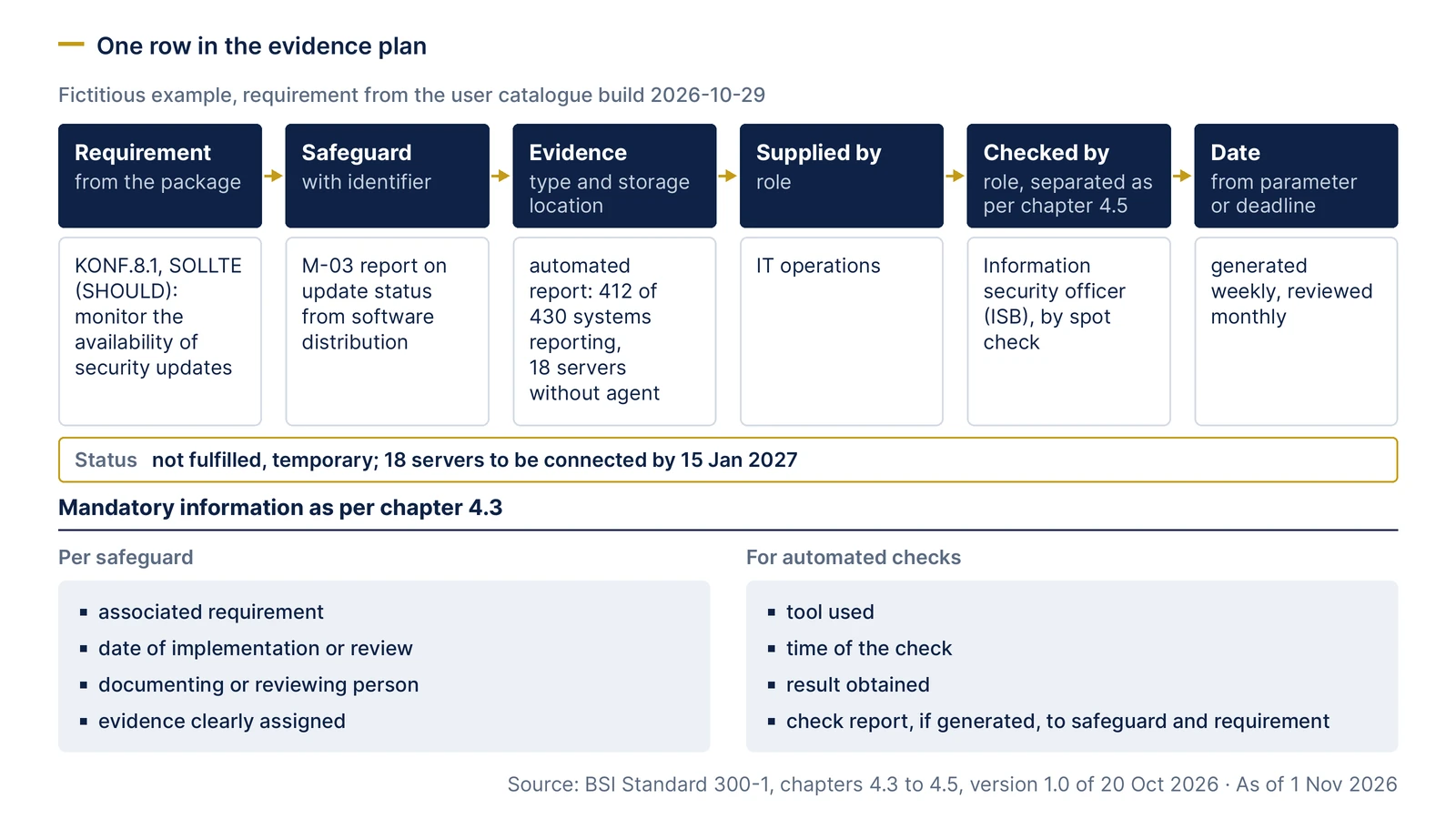
| Minimum information per safeguard | „die zugehörige Anforderung, das Datum der Umsetzung oder Überprüfung sowie die dokumentierende beziehungsweise prüfende Person“ (our translation: "the associated requirement, the date of implementation or review and the documenting or reviewing person") | Chapter 4.3 |
| Evidence for the safeguard | „Die zur Beurteilung herangezogenen Nachweise sind der jeweiligen Maßnahme eindeutig zuzuordnen“ (our translation: "The evidence used for the assessment is to be clearly assigned to the respective safeguard"). | Chapter 4.3, „Nachweis der Umsetzung“ (evidence of implementation) |
| Automated check | Record the tool, time of the check and result. Assign a check report produced by the tool to the safeguard and the requirement. | Chapter 4.3 |
| Changes and history | Update the documentation when an assignment, the implementation status or a check result changes. A history with time, responsible person and tool is recommended. | Chapter 4.3, „Dokumentation“ (documentation) |
| Responsibility and deadline | Responsibilities and deadlines are set out in the implementation plan, for example in a project management or ticketing system. For complex safeguards, they are split into a subject-matter and an operational responsibility. | Chapter 4.4 |
| Separation of roles | Implementation and progress tracking are to be distributed across roles so that no conflict of interest arises. | Chapter 4.5 |
The methodology part of the user catalogue turns some of this into requirements: UMS.1.1 („Umsetzung MUSS den Umsetzungsstatus der Anforderungen im Anforderungspaket vollständig [regelmäßig] überprüfen“, our translation: "Implementation MUST fully review the implementation status of the requirements in the requirements package [regularly]", where MUSS corresponds to MUST), UMS.3.1 („eindeutig zuweisen“, our translation: "clearly assign", the persons responsible for implementing requirements not yet fulfilled) and UMS.4.1 (set „ein realistisches Zieldatum“, our translation: "a realistic target date"). A well-maintained evidence plan is the document you use to evidence these three requirements: it shows when the status was last reviewed, who is responsible for open requirements and by when they are to be fulfilled.
Which types of evidence exist and what the catalogue says about them
As the range of possible methods, 300-1 names interviews, document reviews, automated configuration checks and technical scans (chapter 4.1). For the plan, it helps to fix the type for each requirement before the work is distributed. An organisational requirement such as approval of the policy is evidenced by a document with an approval note. A technical requirement such as monitoring the patch status is best evidenced by a report from the tool that is running anyway.
The user catalogue gives a pointer for this. In the build of 29 October 2026, 961 of the 1,000 requirements contain, in their requirement wording, an entry in the field documentation from the namespace documentation_guidelines, with 62 different values (own count). The most frequent are „Konfigurationshistorie“ (configuration history, 183 requirements), „IT-Betriebskonzept“ (IT operations concept, 116), „Beschaffungskriterien“ (procurement criteria, 70), „Detektions-Konzept“ (detection concept, 61), „Arbeitsanweisung“ (work instruction) and „Schulungsplan“ (training plan) (60 each). 300-1 does not explain the field. Going by its name, it indicates the kind of document in which implementation is recorded. Use it as a suggestion for where to store the evidence. The standard does not prescribe it.
Rule of thumb: A piece of evidence belongs to a safeguard, and the safeguard to one or more requirements. If you attach evidence directly to requirements and skip the safeguard, you cannot later show which safeguard fulfils which requirement, and that is exactly the assignment chapter 4.3 requires.
Matrix: requirement, evidence, responsibility, date
Fictitious example. The requirements and their catalogue entries come from the Grundschutz++ user catalogue (build 2026-10-29), parameters in square brackets. Safeguards, roles, tools and dates are invented and only show how the columns are filled in.
| Requirement (modal verb, target object category) | Safeguard | Evidence (type, catalogue entry documentation) | Supplied by | Checked by | Date or cycle | Status |
|---|---|---|---|---|---|---|
| GC.5.1.4 Approval of the security policy: have the defined security policy authorised by top management (MUSS, no target object category) | M-01 Adopt the policy at the management meeting | Policy with approval note and meeting minutes (document review; Informationssicherheitsleitlinie, information security policy) | Information security officer (ISB) | Internal audit | once, again whenever the policy changes | fulfilled |
| UMS.1.1 Determining the implementation status: fully review the implementation status of the requirements in the requirements package [regularly] (MUSS, no target object category) | M-02 Status review of all requirements; parameter "regularly" set to quarterly | Status list with date and reviewing person per requirement (document review; no entry in the catalogue) | ISB | Top management takes note, internal audit checks | quarterly | fulfilled |
| KONF.8.1 Automatic check: monitor the availability of security updates (SOLLTE, i.e. SHOULD; IT systems) | M-03 Report on update status from software distribution | Automated report with tool, time and result, reconciled with the inventory of IT systems: 412 of 430 systems reporting, 18 servers without agent (configuration check; Konfigurationshistorie, configuration history) | IT operations | ISB by spot check | generated weekly, reviewed monthly; 18 servers to be connected by 15 Jan 2027 | not fulfilled, temporary; residual risk identified, reported to top management and approved by it for a limited period until 15 Jan 2027 (see note below the table) |
| DET.3.1.1 Authentications: log successful and failed authentications (SOLLTE, IT systems) | M-04 Central logging of logon events | Export of the logging configuration and one sample log entry per system group (configuration check; Audit Log) | IT operations, servers | ISB | monthly | fulfilled |
| BER.3.17 Group accounts - MFA: enable multi-factor authentication for group accounts (SOLLTE, no target object category) | M-05 MFA for the remaining three group accounts | Export of the account settings from the identity service (configuration check; IT-Betriebskonzept, IT operations concept) | Identities and permissions team | ISB | implementation deadline 31 Mar 2027 | not fulfilled, temporary; residual risk identified, reported to top management and approved by it for a limited period until 31 Mar 2027 (see note below the table) |
| BER.5.9 Multi-factor authentication for far-reaching permissions: enable multi-factor authentication for far-reaching permissions (SOLLTE, no target object category) | M-11 MFA for all administrator accounts in the directory service | Export of the account settings with tool, time and result: 25 of 27 accounts with MFA, two emergency accounts deliberately without MFA (configuration check; IT-Betriebskonzept, IT operations concept) | IT operations, identities | ISB | review within twelve months at the latest | not fulfilled, permanently for the emergency accounts; risk assessment carried out, residual risk submitted to top management for approval at the next management review |
| NOT.4.16.1 Testing restoration: review restoration at least on the basis of representative samples [regularly] (SOLLTE, data) | M-06 Restoration test for three selected data sets; parameter set to every six months | Test record with date, scope and result: one data set not fully restored (document review; Datensicherungskonzept, data backup concept) | Person responsible for data backup | ISB | every six months; retest by 31 Jan 2027 | not fulfilled, temporary; residual risk identified, reported to top management and approved by it for a limited period until 31 Jan 2027 (see note below the table) |
| SENS.2.8 Reporting events: instruct users to report security-relevant events (SOLLTE, users) | M-07 Briefing on joining and annually | Attendance list from the learning platform, briefing material (document review; Arbeitsanweisung, work instruction) | Staff development | ISB | annually and on joining | fulfilled |
| PERF.4.1 Suitability review: document the results of reviews of the suitability, adequacy and effectiveness of the ISMS [regularly] and on specific occasions in a management report (MUSS, no target object category) | M-08 Management report; parameter "regularly" set to every six months | Management report and minutes of the management review (document review; Managementbericht, management report) | ISB | Top management | every six months and on specific occasions | fulfilled |
Note on temporary non-fulfilment: Chapter 4.1.2 states that temporary non-fulfilment does not trigger a risk assessment. Chapter 2.11 requires, for SOLLTE (SHOULD) requirements that are included in implementation planning but not yet fulfilled, a residual risk assessment and approval of the risk by top management. Chapter 4.1.1 requires the risk to be identified and reported to top management. How the two passages fit together is an open question of interpretation. If you want to be on the safe side, identify the residual risk, report it to top management and obtain its approval.
Three items are missing from the table for reasons of space and belong in your plan: the storage location of the evidence (path, ticket or report number), the date of the last review with its result, and the person who carried out the review. Only then is the minimum information from chapter 4.3 complete.
Who supplies, who checks
In the evidence plan, two responsibilities should get separate columns: who implements and supplies the evidence, and who tracks progress and checks it. For the relationship between the two, chapter 4.5 requires that a possible conflict of interest be prevented „durch eine angemessene Rollenverteilung“ (our translation: "through an appropriate distribution of roles"). In small organisations where IT operations implements almost everything, this can be solved as follows: the ISB checks the evidence supplied by operations, and the internal audit checks the ISB's own evidence.
For complex safeguards, chapter 4.4 recommends naming a subject-matter and an operational responsibility and forming sub-tasks with their own responsibilities and deadlines. In the plan, this means: the unit with subject-matter responsibility decides whether the evidence supports the requirement, and the unit with operational responsibility produces it. Under chapter 4.2.3, implementation planning for safeguards arising from risk treatment is authorised by the responsible risk owners. Under chapter 4.4, the approach as a whole is approved by top management, because it has to provide the resources.
Plan with roles, not names: people change, roles remain. On the other hand, record by name in the review entry who actually carried out a review, because chapter 4.3 requires „die dokumentierende beziehungsweise prüfende Person“ (our translation: "the documenting or reviewing person").
Deriving dates from parameters and deadlines
Dates in the evidence plan have two sources. The first is the parameters of the requirements. In the build of 29 October 2026, 211 requirements have parameters, 68 of them the parameter „regelmäßig“ (regularly) (own count). The organisation sets the value when or after creating the requirements package (chapter 3.5). It is also the cycle in which the evidence has to be produced anew. If you set "regularly" to "annually", you need new evidence every year, and that has to be in the plan.
The second source is implementation deadlines for requirements that are not yet fulfilled. Chapter 4.4 requires realistic deadlines, UMS.4.1 a realistic target date. For SOLLTE requirements that are temporarily not fulfilled, the deadline is also a sensible date for reviewing the classification as "temporary".
Event-driven dates are added to this: if the assignment, implementation status or check result of a safeguard changes, the documentation has to be updated (chapter 4.3). The risk assessment is to be reviewed at least annually and in the event of significant changes (Annex 3, criterion 35). Set the cycles so that the evidence is available before the internal audit and before the management review. Both draw on it (chapters 5.2 and 5.3).
Automated evidence in the plan
If a piece of evidence comes from a tool, chapter 4.3 requires three items with it: which tool, when the check took place, with which result. You attach a report from the tool to the safeguard and the requirement. In the recommended history, you can later see who checked when and with which tool.
In the plan, this means that the entry "report from software distribution" is not enough. Record which tool in which version produces the report, which systems it covers and who accepts the report. If a tool covers only part of the assets of a target object category (Zielobjektkategorie), the gap belongs in the plan, with a second piece of evidence or a justification. A technical report also only says something about the time it was generated. The cycle in the plan must match the parameter of the requirement.
The page Automated evidence shows how to record the check objective, method, result and limitation of such evidence.
Where the evidence plan sits in the ISMS
The evidence plan is part of the implementation plan from chapter 4.3. In practice, it pays to keep it as a separate view, because others read it: IT operations wants to know what it has to supply by when, the internal audit wants to know where to look, and top management wants to see how much evidence is missing.
- Where the requirements come from is governed by the requirements package. How a status is assigned and a deviation documented is described under Assessing requirements and documenting deviations.
- How the plan comes together with the other documents to form a security concept is described in Security concept.
- Which documents should be ready for an audit is shown on the page Certification.
- For SOLLTE requirements that are permanently not fulfilled, the plan does not replace the risk assessment. See Risk analysis.
Six steps to an evidence plan
- Export the requirements package. Each requirement gets a row, including those that are not applicable. Their justification is their evidence.
- Assign safeguards. At least one safeguard with its own identifier per requirement. Safeguards that cover several requirements are listed with all their assignments.
- Define the type of evidence, such as interview, document review, configuration check or scan. Use the catalogue entry in the field
documentationas a suggestion for the storage location. - Enter roles. Supplying and checking role kept separate, for complex safeguards split into subject-matter and operational.
- Derive dates. Cycle from the parameter, deadline for requirements not fulfilled, events that trigger an update.
- Approve and follow up. Have the approach approved by top management (chapter 4.4), track progress continuously (chapter 4.5), feed the result into the management report.