

Procedure map: two routes to a certificate
| Feature | ISO 27001 on the basis of IT-Grundschutz (classic) | ISO 27001 on the basis of Grundschutz++ |
|---|---|---|
| Methodology | BSI Standards 200-x, approach under 200-2 | BSI Standard 300-1 „Methodik Grundschutz++“, version 1.0 of 20 Oct 2026 |
| Requirements | IT-Grundschutz Compendium | Grundschutz++ user catalogue (Anwenderkatalog) of the State-of-the-Art Library (Stand-der-Technik-Bibliothek) |
| Criteria according to the BSI | ISO 27001, IT-Grundschutz approach under 200-2 and IT-Grundschutz Compendium (200-2, chapter 11) | ISO 27001 certification on the basis of GS++ (milestone plan); the BSI has not yet described the criteria and audit scheme in the sources evaluated |
| Permitted approach | intended for Standard Protection, possible in principle for Core Protection; Basic Protection alone is not sufficient | 300-1 does not use these approaches; starting with the most important business process in the highest protection requirements category is recommended (chapter 2.6) |
| Audit | audit by an external auditor certified by the BSI; audit report to the certification body | certification of persons as GS++ audit team leader (GS++-Auditteamleiter) can be applied for from 1 Jan 2027, separate further training for already certified audit team leaders from Q1 2027 |
| Decision | certification body within the BSI | not expressly described in the sources evaluated |
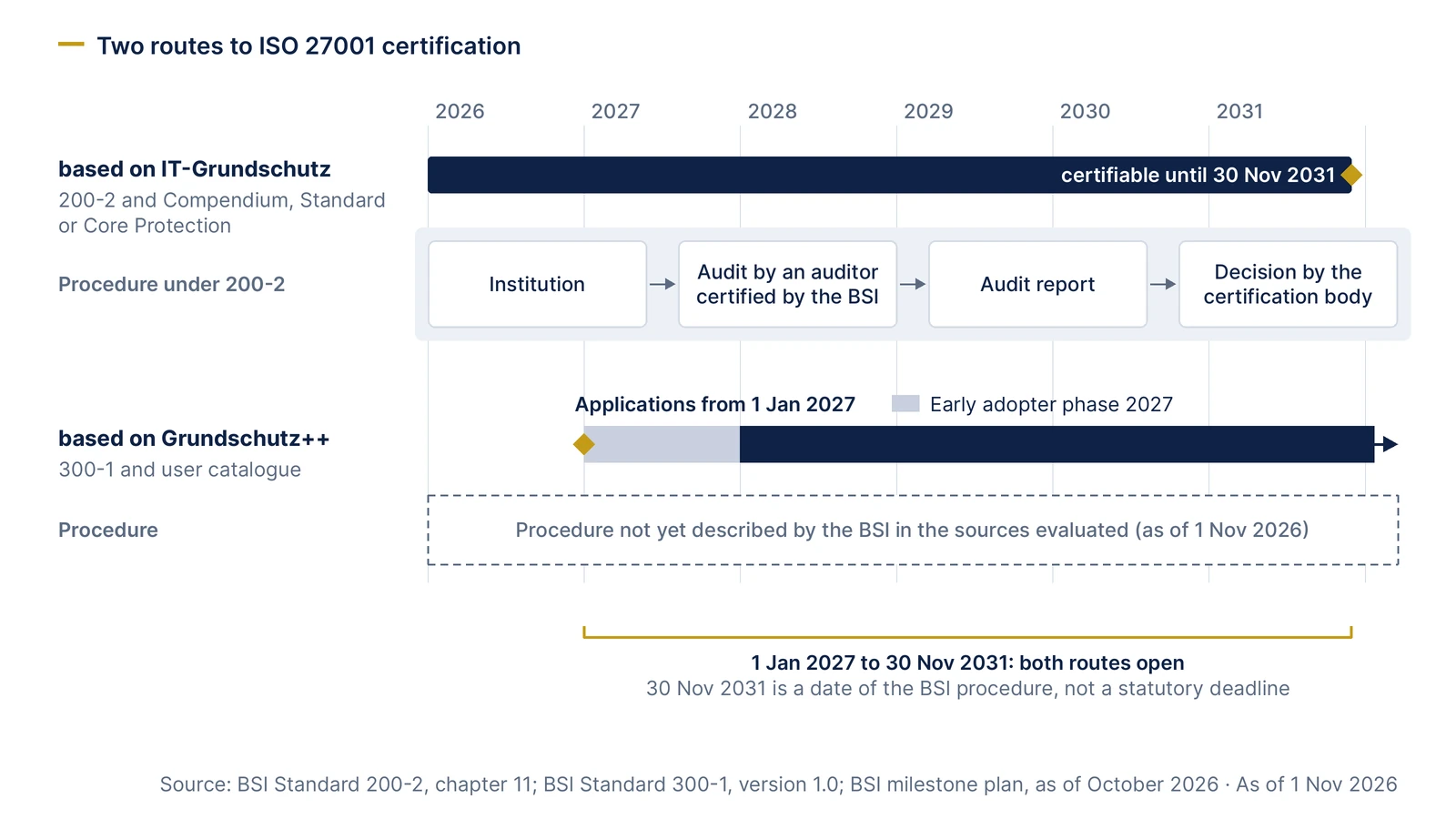
| Period according to the milestone plan | certifiable until 30 Nov 2031 | applications from 1 Jan 2027; early adopter phase in 2027 |
Between 1 January 2027 and 30 November 2031 both routes are therefore open. The end of certifiability is set in the BSI milestone plan and is not a statutory deadline. The BSI adjusts the milestone plan continuously. All dates with their status are in the date register.
Certification under ISO/IEC 27001 without reference to Grundschutz is a third route, which this page does not cover; Blackfort Technology provides information on it at https://www.blackfort-tec.de/en. 300-1 does not mention an attestation (Testat); what attestation and certificate mean in classic IT-Grundschutz is explained on the IT-Grundschutz page.
How the classic procedure works
BSI Standard 200-2 describes the classic procedure in chapter 11. The audit is carried out against three sets of criteria: the ISO 27001 standard, the IT-Grundschutz approach under 200-2 and the IT-Grundschutz Compendium. The audit is performed by an external auditor certified by the BSI, who summarises the result in an audit report. On this basis the certification body decides on the certificate.
For the audit the institution needs certain documents, which it prepares and keeps up to date; auditors and the certification body within the BSI assess them (200-2, chapter 5). Which documents these are is set out in the list of reference documents on the BSI website. As examples, 200-2 names policies on risk analysis, on document control, on the internal audit of the ISMS and on corrective and preventive actions. What chapter 5 otherwise describes as good documentation practice becomes mandatory for a certification.
The certificate relates to the information domain under consideration and to a point in time. 200-2 describes it as evidence that IT-Grundschutz has been implemented in this domain and that „zu einem bestimmten Zeitpunkt ein definiertes Sicherheitsniveau erreicht wurde“ (our translation: "a defined level of security was achieved at a particular point in time").
What 300-1 lays down for certification
BSI Standard 300-1 is a methodology and does not describe a certification procedure. In four places, however, it draws a line that matters in the audit.
First, 300-1 states: „Im Ergebnis muss, für ein zertifizierbares ISMS, in der niedrigsten Kategorie stets der Stand der Technik eingehalten werden“ (our translation: "As a result, for a certifiable ISMS, the state of the art must always be complied with in the lowest category"), even if an institution introduces its own categories alongside "normal" and "high" (chapter 2.6). Second, the 35 minimum criteria (Mindestkriterien) are meant to make the chosen risk method comparable and auditable in the audit (chapter 2.11 and Annex 3). Third, MUSS requirements (MUST) are to be fulfilled without an exception approval or risk acceptance; if permanent non-fulfilment of SOLLTE requirements (SHOULD) accumulates, the standard warns of „eine erhebliche Abweichung“ (our translation: "a significant deviation") in the certification (chapter 4.1.2). Fourth, the monitoring process step requires an internal audit programme and a management review (chapters 5.2 and 5.3).
According to the standard, the methodology requirements cover clauses 4 to 10 of DIN EN ISO/IEC 27001 (chapter 3.4). How auditors will audit Grundschutz++ in detail, for example with which samples and which classification of deviations, has not yet been published by the BSI in the sources evaluated. So plan on the basis of the standard and check before applying which audit documents the BSI has provided by then.
Roles in the procedure
| Role | Task | Source |
|---|---|---|
| Top management | is responsible for the ISMS and cannot delegate this responsibility; approves scope, protection requirements, order, resources and policy; authorises the risk framework and the residual risks | 300-1, chapters 2.10 and 2.11; Annex 3, criteria 9 and 30 |
| Information security officer (ISB) | part of the security organisation with defined responsibilities; conflicts of interest with IT management or data protection officers are to be avoided | 300-1, chapter 2.8 |
| Internal audit team | carries out the internal audit programme; selected so that objectivity and impartiality are ensured; reports to the management level | 300-1, chapter 5.2 |
| External auditor | audits the ISMS and prepares the audit report; certified by the BSI in the classic procedure | 200-2, chapter 11 |
| Certification body | assesses the audit report and reference documents and decides on the certificate; in the classic procedure the certification body within the BSI | 200-2, chapters 5 and 11 |
| Consultant | supports the institution in setting up and preparing; anyone who is both an IT-Grundschutz consultant (IT-Grundschutz-Berater) and an audit team leader may not audit an institution they have previously advised | BSI programme IT-Grundschutz-Berater, version 2.1 |
For the roles under Grundschutz++, the BSI has announced certifications of persons as GS++ consultant (GS++-Berater) and GS++ audit team leader; according to the milestone plan, applications are possible from 1 January 2027. The admission requirements have not yet been published.
Audit document check for Grundschutz++
Based on BSI Standard 300-1, the list sets out which documents an ISMS built under Grundschutz++ can present when it goes into the audit. It is our own derivation from the text of the standard and is not a BSI list; for the classic procedure the BSI list of reference documents applies.
| No. | Document | Audit question | 300-1 |
|---|---|---|---|
| 1 | Scope including excluded areas | Defined and approved by top management? Business processes fully included? | 2.3, 2.10 |
| 2 | List of business processes | For each process an identifier, name, responsible unit, short description, main applications? | 2.5, Annex 2 |
| 3 | Protection requirements determination per business process | Category "normal" or "high" justified for each protection goal, own categories mapped, approved by top management? | 2.6, 2.10 |
| 4 | Information security policy | Objectives and strategy included, approved by top management, communicated to all staff? | 2.7 |
| 5 | Roles and responsibilities of the security organisation | Qualifications defined, conflicts of interest avoided, involvement of the ISB in projects regulated? | 2.8 |
| 6 | Procedures for communication and document control | Set up and embedded for all ISMS-relevant documents? | 2.9 |
| 7 | Risk assessment framework | Risk appetite, acceptance criteria, procedures and roles authorised by top management? | 2.11, Annex 3 criterion 9 |
| 8 | Description of the information domain and asset overview | Interfaces documented, dependencies recorded in line with the protection requirements? | 3.1, 3.2 |
| 9 | Selection of blueprints (Blaupausen) | Selection with version, assignment and adaptation documented in a traceable way? | 3.3 |
| 10 | Requirements package | Methodology requirements, all requirements without a target object category (Zielobjektkategorie) and those of the assigned categories included, parameters specified? | 3.4, 3.5 |
| 11 | Implementation status | For each requirement fulfilled, not fulfilled or not applicable, every non-applicability justified? | 4.1.1 |
| 12 | Risk register and approvals | Minimum information for each risk present, residual risks authorised by top management, last review no more than one year old? | 4.2, Annex 3 criteria 15, 30, 35 |
| 13 | Implementation plan with evidence | For each safeguard the requirement, date and reviewing person; evidence assigned, for automated checks the tool, time and result? | 4.3, 4.4 |
| 14 | Internal audit programme and audit reports | Objectives, scope and audit team defined, reports reviewed and passed on to the management level? | 5.2 |
| 15 | Management report and management review | Audit results, performance evaluation, incidents, status of risk treatment and of earlier decisions taken into account? | 5.3 |
| 16 | Validation of the requirements | Changes in the information domain, in the State-of-the-Art Library and in blueprints reviewed and documented? | 5.5 |
| 17 | Nonconformities and correction and improvement plan | Causes analysed, plan included in the implementation plan, effectiveness evaluated? | 6.1, 6.3, 6.4 |
How the evidence in row 13 is produced is shown in the evidence plan; how the documents come together into a security concept is shown on the security concept page.
For certificate holders: what needs clarifying now
If you hold an ISO 27001 certificate on the basis of IT-Grundschutz today, the BSI milestone plan means you do not have to switch immediately: classic IT-Grundschutz remains certifiable until 30 November 2031. What the cut-off date means for current certificates, surveillance audits and a recertification shortly before it has not been described in more detail by the BSI in the sources evaluated. Clarify this with your auditor in good time.
In our view there is much to be said for planning the switch with the next recertification cycle. Five questions help with planning:
- Date: When is the next recertification, and is it before or after the end of the early adopter phase on 31 December 2027?
- Protection requirements: Which business processes have so far had "high" or "very high", and how do you map three categories onto two?
- Status: How many requirements in the IT-Grundschutz Check are at "partially" or "dispensable"? Neither value exists in 300-1 any more.
- Risk method: Does your procedure under 200-3 or ISO/IEC 27005 meet the 35 minimum criteria in Annex 3?
- Mapping: Have you checked which mappings from the BSI mapping of the 2023 Compendium to Grundschutz++ fit your modules? The mapping has the status "draft".
Which route suits your starting position is covered in Deciding on the switch; the work packages of the transition are described in Migration to Grundschutz++.
A certificate and a legal obligation are two different things
A certificate shows third parties that an ISMS was audited at a point in time. Sections 30, 43 and 44 of the BSI Act (BSIG) do not give rise to an express obligation to certify; whether further evidence obligations apply to operators of critical facilities is not covered on this page. Section 30 BSIG requires important and particularly important entities to take measures in line with the state of the art and does not prescribe a framework. For federal administration bodies, Section 44(1) BSIG refers to the minimum requirements from BSI Standards, IT-Grundschutz and minimum standards. Under Section 43(1) BSIG, the management of a federal administration body is responsible for creating the conditions for ensuring information security; the body demonstrates compliance to the BSI no later than five years after the Act enters into force and regularly thereafter in accordance with the BSI's requirements. Sections 43 and 44 BSIG do not expressly mention an ISO 27001 certificate.
Whether a certificate is required in your case by contract or by a client is a matter for the individual case and belongs in a review by your legal department. This page provides a professional assessment and is not legal advice.
Preparing for the audit
Whatever the procedure, it is worth going through your own documentation before applying, through the eyes of the auditor: can every requirement be traced through to its evidence? Is every approval by top management dated and easy to find? Does the scope in the application match the information domain in the documents? The internal audit under chapter 5.2 is the intended tool for this; it is meant to show potential for improvement and serves the institution's self-monitoring.
Institutions may currently design the performance evaluation under chapter 5.1 freely because uniform requirements are still outstanding; the BSI has announced the concept for performance measurement for 26 February 2027 and indicators for each methodology requirement for 31 March 2027. Anyone going into the audit before then documents their own design and justifies it.
If you are looking for support with preparation, you will find Blackfort Technology's services under Consulting on IT-Grundschutz and Grundschutz++.