

What IT-Grundschutz is
IT-Grundschutz is the BSI methodology for an ISMS. It consists of BSI Standards 200-1 (management system), 200-2 (approach) and 200-3 (risk analysis) together with the IT-Grundschutz Compendium. 200-2 is available as version 1.0 of October 2017, replaced 100-2 and builds on 200-1 and ISO 27001 (200-2, chapters 1.1 and 1.2).
The core idea: for typical processes, applications and components the BSI has assessed the threat situation in advance and derived requirements from it. According to 200-3 this has the advantage „dass Anwender des IT-Grundschutzes für einen Großteil des Informationsverbundes keine individuelle Bedrohungs- und Schwachstellenanalyse durchführen müssen, weil diese bereits vorab vom BSI durchgeführt wurde“ (our translation: "that users of IT-Grundschutz do not have to carry out an individual threat and vulnerability analysis for a large part of the information domain, because the BSI has already done this in advance") (200-3, chapter 1.2). Organisation, personnel, buildings and technology are considered together, including industrial control systems and IoT devices.
The precondition is IT operations with defined roles, whatever their size (200-2, chapter 1.3). The methodology is aimed primarily at the people who are responsible for, or advise on, security management.
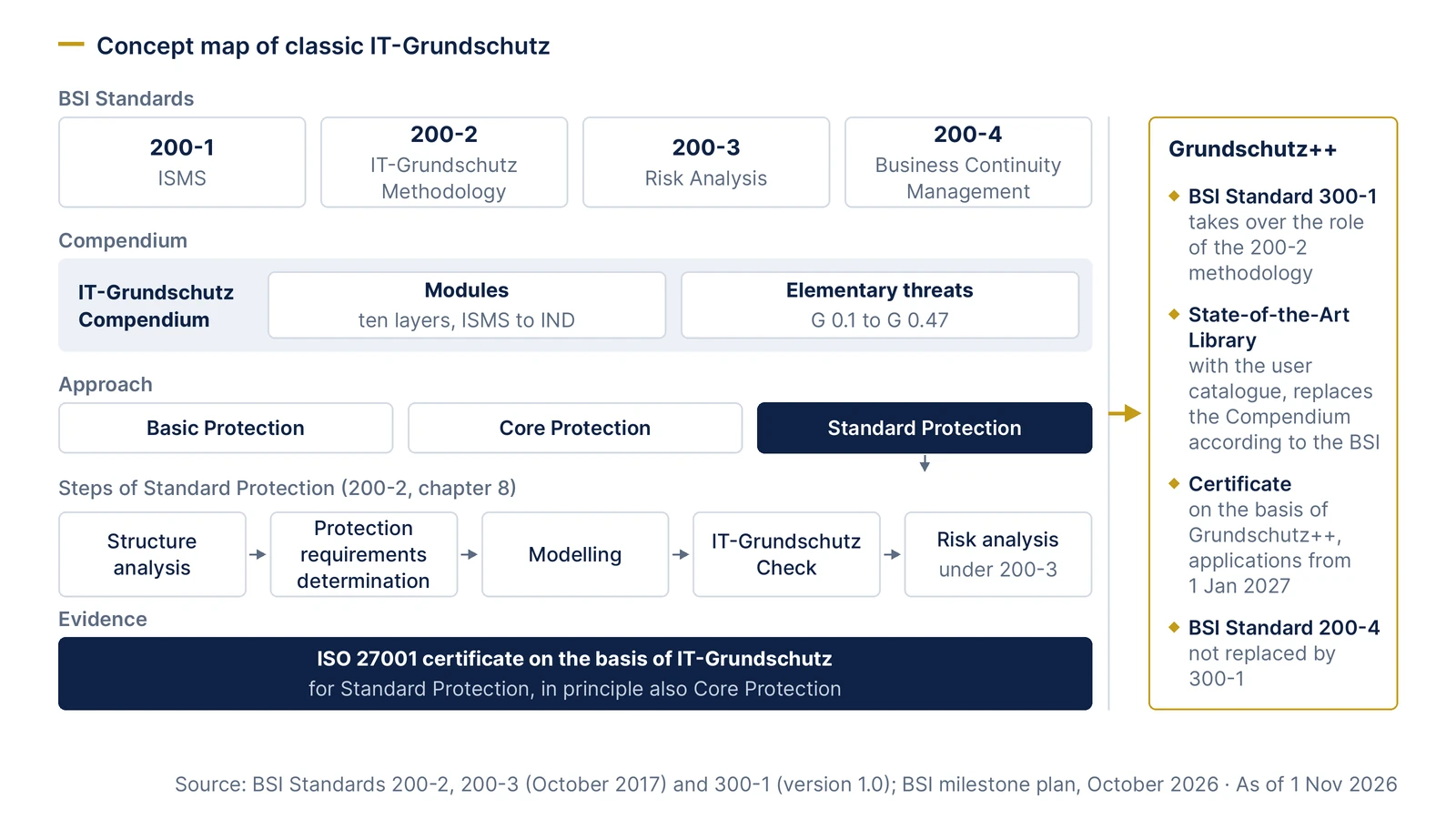
IT-Grundschutz concept map
The terms of classic IT-Grundschutz, ordered by standards, methodology, Compendium, approaches and evidence. The last column says what becomes of them under Grundschutz++.
| Term | What it is | Where it is defined | Relation to Grundschutz++ |
|---|---|---|---|
| BSI Standard 200-1 | Information security management systems (ISMS): general framework for how information security is initiated and managed. | 200-1; referenced in 200-2, chapters 1.2 and 1.4 | Not mentioned by 300-1; whether it will be formally withdrawn is open. |
| BSI Standard 200-2 | IT-Grundschutz methodology: step-by-step procedure with three approaches. | 200-2, version 1.0, October 2017 | The role of the methodology is taken over by BSI Standard 300-1; 300-1 does not mention 200-2. |
| BSI Standard 200-3 | Risk analysis on the basis of IT-Grundschutz: threat overview, risk rating by frequency of occurrence and extent of damage, risk treatment. | 200-3, version 1.0, October 2017 | Grundschutz++ leaves the method open but requires 35 minimum criteria (Mindestkriterien) (300-1, Annex 3). |
| BSI Standard 200-4 | Business continuity management (BCM). | 200-4 | Not replaced by 300-1; the integration of other management systems announced for 2027 and later has not yet been described. |
| IT-Grundschutz Compendium | Collection of modules with threat situation and security requirements; available for download from the BSI or from Bundesanzeiger Verlag. | 200-2, chapter 8.3.1; the BSI mapping table to Grundschutz++ refers to the 2023 edition | According to the BSI, replaced by the State-of-the-Art Library (Stand-der-Technik-Bibliothek). |
| Module | Bundle of security requirements on a topic or component, with description, scope and threat situation; sorted into process-oriented layers (ISMS, ORP, CON, OPS, DER) and system-oriented layers (INF, NET, SYS, APP, IND). | 200-2, chapters 2.4, 8.3.1 | Replaced by practices (Praktiken, topic groups) and target object categories (Zielobjektkategorien). |
| Basic requirement, standard requirement, elevated protection needs | Basic requirements are to be met as a priority, standard requirements address normal protection requirements, requirements in case of elevated protection needs are suggestions. Basic and standard together represent the state of the art. | 200-2, chapters 2.7, 8.3.1 | Replaced by the security level „normal-SdT“ (normal, state of the art) or „erhöht“ (elevated) and the modal verbs MUSS, SOLLTE, KANN (MUST, SHOULD, MAY). |
| Implementation notes | Guidance with descriptions of safeguards showing how requirements can be met; not binding. | 200-2, chapter 2.7 | In the user catalogue (Anwenderkatalog), 998 of 1,000 requirements have an explanation (guidance, build 29 Oct 2026); 300-1 does not describe implementation notes in the previous sense. |
| Elementary threats | 47 abstract threats G 0.1 to G 0.47, the basis of the modules and of risk analysis. | 200-3, chapter 3 | Retained (300-1, Annex 4); in the catalogue the identifier is recorded as metadata on the requirement, in the build of 29 Oct 2026 for 901 of 1,000 requirements. |
| Information domain | All infrastructural, organisational, personnel and technical components of a scope of application; the scope of the security concept. | 200-2, chapter 3.3.4 | The term remains and now consists of assets; alongside it stands the scope of the ISMS. |
| Structure analysis | Survey of business processes, applications, network plan, IT systems, ICS, other devices and rooms, with grouping. | 200-2, chapter 8.1 | Recording of assets with dependencies, depth according to protection requirements. |
| Protection requirements determination | Classification as "normal", "high", "very high", starting from business processes and applications, inherited by IT systems, rooms and connections (maximum principle). | 200-2, chapter 8.2 | Two categories per business process. |
| Modelling | Selection of modules and their assignment to the target objects of the information domain. | 200-2, chapter 8.3 | Assignment of assets to 39 target object categories; the result is the requirements package. |
| IT-Grundschutz Check | Target/actual comparison per requirement with the values "dispensable", "yes", "partially", "no", usually by interviews and sampling. | 200-2, chapter 8.4 | Replaced by determining the implementation status with "fulfilled", "not fulfilled", "not applicable". |
| Risk analysis | Required among other things for high or very high protection requirements, for target objects that cannot be adequately modelled and for operating scenarios not provided for; procedure under 200-3 recommended. | 200-2, chapter 8.5; 200-3, chapter 1.2 | Mandatory for high protection requirements, assets not covered and SOLLTE requirements that are permanently not fulfilled. |
| Basic Protection | Entry-level approach: broad initial protection across all relevant business processes with the basic requirements. | 200-2, chapters 3.3.1, 6 | Not described in 300-1. |
| Core Protection | Entry-level approach for a few particularly threatened business processes and assets, the „Kronjuwelen“ (our translation: "crown jewels"). | 200-2, chapters 3.3.2, 7 | Not described in 300-1; starting with the most important business process is similar. |
| Standard Protection | Comprehensive approach preferred by the BSI; the goal of every application of IT-Grundschutz. | 200-2, chapters 3.3.3, 8 | Not described in 300-1; 300-1 has a single approach in five process steps. |
| Attestation (Testat) | Term used alongside the certificate. | Not regulated in 200-2 and 300-1 | Not covered by 300-1. The procedure, issuing body and distinction are dealt with on the Certification page. |
| ISO 27001 certificate on the basis of IT-Grundschutz | Certification under the BSI scheme with ISO 27001, the IT-Grundschutz approach and the Compendium as sets of criteria; audit by an external auditor certified by the BSI, decision by the certification body. Intended for Standard Protection, possible in principle for Core Protection, not sufficient for Basic Protection alone. | 200-2, chapter 11 | According to the milestone plan until 30 Nov 2031; from 1 Jan 2027 applications on the basis of Grundschutz++. |
| IT-Grundschutz consultant, audit team leader | Personnel certifications of the BSI. | BSI milestone plan | Separate further training as GS++ consultant (GS++-Berater) and GS++ audit team leader (GS++-Auditteamleiter) from the first quarter of 2027. |
How the security process works under 200-2
200-2 describes the security process in phases: initiation with top management assuming responsibility, design and planning, provision of resources and choice of an approach; then the information security policy, building the organisation, drawing up and implementing the security concept and finally maintenance and continual improvement (chapter 2.6). Under 200-2, responsibility for information security „verbleibt“ (our translation: "remains") „in jedem Fall bei der obersten Managementebene“ (our translation: "in every case with top management"); the task is typically delegated to an information security officer (ISB) (chapter 2.3).
In Standard Protection, the security concept follows a fixed sequence. The structure analysis surveys business processes, applications, network plan, IT systems and rooms and combines similar objects into groups. The protection requirements determination first assesses business processes and applications and derives the protection requirements of the other objects from them. Modelling assigns the appropriate modules to the target objects. The IT-Grundschutz Check compares the requirements with the actual state. Where protection requirements are high or very high, or objects cannot be modelled, a risk analysis under 200-3 follows. The safeguards are then consolidated, planned and implemented (chapters 8 and 9).
The result is a security concept that refers to the requirements in the Compendium and therefore stays comparatively compact (chapter 2.7). Maintenance covers review against key figures, a maturity model, review of implementation and, where needed, extension of the approach, for example from Basic to Standard Protection (chapter 10).
Basic, Core and Standard Protection
Classic IT-Grundschutz offers three approaches. Basic Protection is intended for organisations whose information security is still at an early stage, whose business processes have no significantly elevated threat potential and for which minor security incidents are tolerable. It achieves broad, fundamental initial protection, but its security level is well below that of Standard Protection (200-2, chapters 1.2 and 3.3.1).
Core Protection concentrates on a small but very important part of the information domain, the „Kronjuwelen“ (our translation: "crown jewels"). It fits when an organisation can quickly identify and delimit a few business processes with significantly elevated protection requirements (chapter 3.3.2). Standard Protection essentially corresponds to the classic approach under 100-2 and, according to the BSI, is the approach that should be aimed for in principle (chapter 3.3.3).
Basic and Core Protection are expressly intended as a starting point; „Ziel muss es sein, mittelfristig ein vollständiges Sicherheitskonzept gemäß der Standard-Absicherung zu erstellen“ (our translation: "the goal must be to draw up a complete security concept in line with Standard Protection in the medium term") (200-2, chapter 3.3). Top management decides which approach applies to which area and documents this with a schedule (chapter 3.3.5). For a certificate, Standard Protection is the basis, Core Protection is possible in principle, and Basic Protection alone is not sufficient (chapter 11).
Attestation and certificate
The evidence procedure described in 200-2 is ISO 27001 certification on the basis of IT-Grundschutz. The audit criteria are ISO/IEC 27001, the BSI 200-x standards and the Compendium. An external auditor certified by the BSI carries out the audit, and the certification body decides on the basis of the audit report (200-2, chapter 11). 200-2 states what the certificate proves: it shows that „ein funktionierendes IS-Management vorhanden ist“ (our translation: "a functioning IS management is in place") and that „zu einem bestimmten Zeitpunkt ein definiertes Sicherheitsniveau erreicht wurde“ (our translation: "a defined security level was achieved at a specific point in time") (chapter 11).
Alongside the certificate, practitioners also speak of an attestation (Testat). 200-2 does not regulate any attestation. The certification page sets out which forms of evidence exist, who issues them and which documents an audit needs.
As reasons for a certificate, 200-2 names among other things evidence towards customers and partners and connection to a shared network; conversely, organisations can require such a certificate from their partners (chapters 1.4, 11).
Where IT-Grundschutz is required
For bodies of the federal administration, Section 44(1) of the BSI Act (BSIG) refers to minimum requirements arising from the BSI standards and the Grundschutz Compendium (IT-Grundschutz) and from the federal minimum standards in the versions applicable at the time. Under Section 44(2) BSIG, implementing them ensures compliance with the requirements of Section 30 BSIG, unless a more far-reaching implementing act of the European Commission under the NIS2 Directive applies. From when Grundschutz++ is the „jeweils geltende Fassung“ (our translation: "version applicable at the time") is not expressly laid down by the BSI topic page or 300-1; the responsible office of the body checks this.
For particularly important and important entities outside the federal administration, Section 30 BSIG does not prescribe a framework. The measures are to comply with the state of the art and take account of the relevant European and international standards. IT-Grundschutz is one possible route there. The requirement often comes from contracts, for example when a public-sector client asks for Grundschutz evidence. Whether an obligation exists is a legal question for your legal department to examine.
What changes with Grundschutz++
With BSI Standard 300-1 „Methodik Grundschutz++“ (Grundschutz++ methodology) (version 1.0 of 20 October 2026, published by the BSI on 26 October 2026 and presented at it-sa on 27 October 2026), the BSI has redefined the methodology. The requirements are in the Grundschutz++ user catalogue (Anwenderkatalog) of the State-of-the-Art Library (Stand-der-Technik-Bibliothek), which according to the BSI replaces the IT-Grundschutz Compendium. According to the milestone plan, certification applications on the basis of Grundschutz++ are possible from 1 January 2027, and certifiability of classic IT-Grundschutz ends on 30 November 2031. That is a BSI procedural date and not a statutory deadline.
Anyone working under classic IT-Grundschutz today therefore does not have to switch immediately, but should plan the switch. What Grundschutz++ is can be found on the home page, the differences in detail in the comparison of IT-Grundschutz 2023 and Grundschutz++, the dates in the timeline and choosing the right moment under Deciding on the switch. Protection requirements, structure analysis and risk analysis have their own pages: Protection requirements determination, Structure analysis, Risk analysis.
For consulting on IT-Grundschutz and Grundschutz++, see Consulting. Blackfort Technology offers ISMS consulting under ISO 27001 without a Grundschutz connection at https://www.blackfort-tec.de/en.