
Structure analysis in 200-2 and asset capture in 300-1
In BSI Standard 200-2, structure analysis (chapter 8.1) is the first survey step of Standard Protection: it compiles which business processes, information, applications, IT and ICS systems, rooms and networks belong to the scope. The subtasks are capturing the business processes, applications and information, surveying the network plan, surveying IT, ICS and IoT systems and capturing rooms and buildings. Similar objects are to be combined into groups.
BSI Standard 300-1 does not use the term structure analysis. The task sits in chapter 3.1 (definition and delimitation of the information domain) and chapter 3.2 (capture of the assets). The Grundschutz++ user catalogue (Anwenderkatalog) lists it as methodology requirement STM.2.1.2 in the practice (Praktik) structure modelling (Strukturmodellierung): „Strukturmodellierung MUSS alle relevanten Assets für die betrachteten Geschäftsprozesse festlegen.“ (our translation: "Structure modelling MUST define all relevant assets for the business processes under consideration.") Anyone searching for "structure analysis" while working with Grundschutz++ therefore ends up at asset capture.
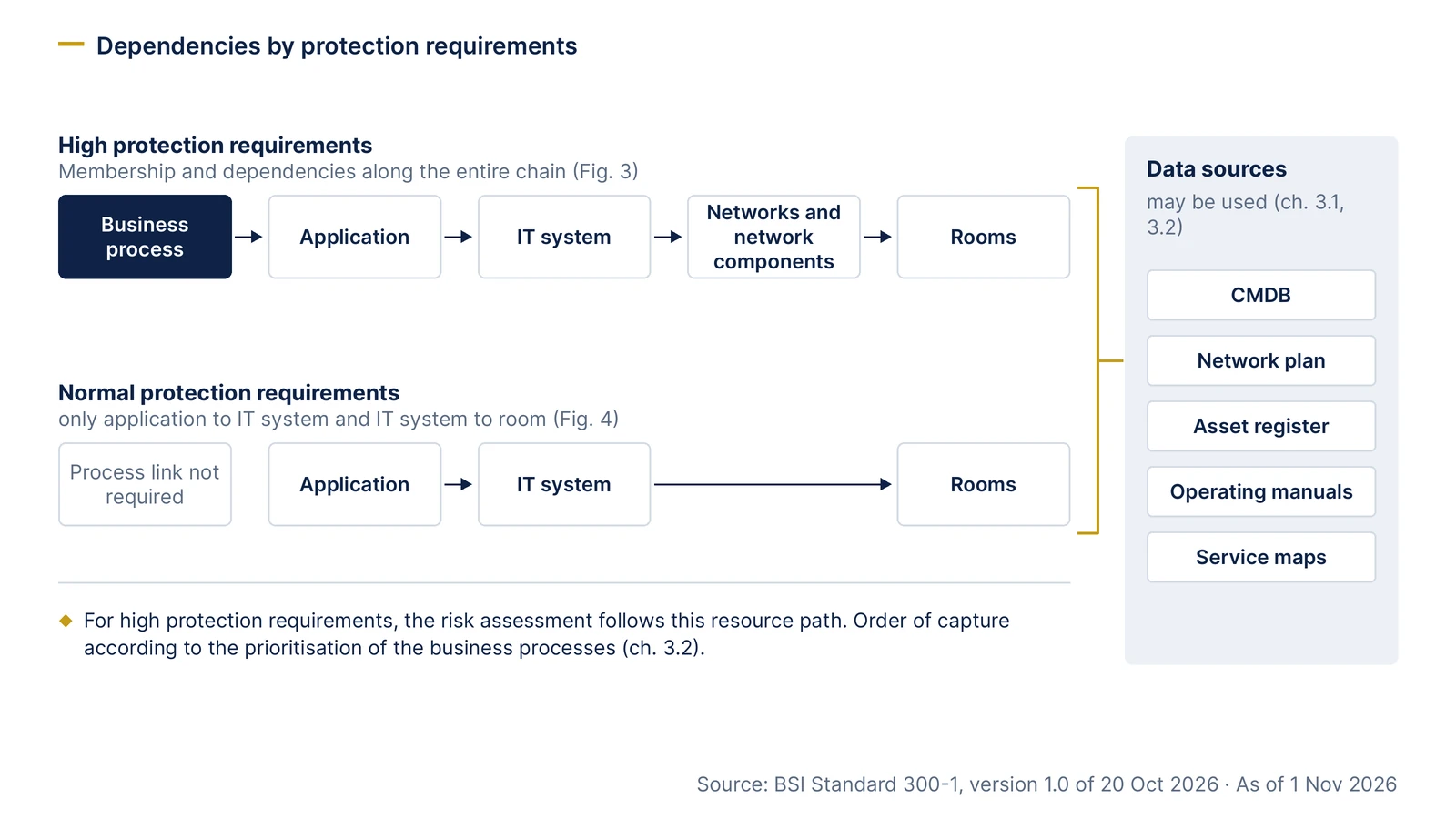
Three differences shape the work. First, the order of capture follows the prioritisation of the business processes from the protection requirements determination (chapter 3.2). Structure analysis under 200-2 also started with the business processes (chapter 8.1.2). Second, the depth to which dependencies are documented depends on the protection requirements of the process. Third, the standard expressly allows existing sources such as CMDBs, asset registers, operating manuals, network plans or service maps to be used to avoid duplicate work. The form of presentation is up to you, for example a table, CMDB, service map, network plan or dependency overview.
Dependencies: what is required for normal and high protection requirements
Chapter 3.2 distinguishes two levels of documentation. The table sets them side by side. You determine the protection requirements themselves beforehand for each business process, see protection requirements determination.
| Protection requirements of the business process | Minimum documentation | Reference |
|---|---|---|
| normal | Dependencies between applications and IT systems (physical and virtual) and between IT systems and rooms. Membership of the assets in the business process is not required. | 300-1 ch. 3.2, Fig. 4 |
| high | Membership and dependency of the assets in relation to the business process along the chain business process, application, IT system, networks and network components, rooms. The standard states: „Die bei hohem Schutzbedarf dokumentierten Abhängigkeiten dienen als Orientierung. Entscheidend ist, dass die wesentlichen Abhängigkeiten nachvollziehbar dokumentiert werden.“ (our translation: "The dependencies documented for high protection requirements serve as guidance. What matters is that the essential dependencies are documented in a traceable way.") | 300-1 ch. 3.2, Fig. 3 |
The standard gives the reason for the deeper documentation for high protection requirements: the risk assessment (Risikobetrachtung) is carried out at the level of the business process and along the resource path (ch. 3.2). For a process with high protection requirements it is mandatory under ch. 2.11, see risk analysis. Without a resource path it lacks its basis.
How to determine the protection requirements per process is explained on the page protection requirements determination.
Capture model: which fields each asset needs
The guidance on catalogue requirement STM.2.1.2 names the details recorded for each asset: a unique name or ID, a short description and the purpose, the assignment to business processes, a responsible role or asset owner, where applicable the location or logical classification, and dependencies between assets. We add fields from 200-2 that are useful for groups and for later reconciliation. The model applies to all asset types from chapter 3.1: business process, information, systems and applications, network and communication components, infrastructural and physical assets, and personnel and organisational assets.
| Field | Content | Origin | Typical data source |
|---|---|---|---|
| Asset ID | unique, stable identifier | STM.2.1.2 (guidance) | CMDB key, inventory number |
| Name and short description | what the asset is and what it is used for | STM.2.1.2 (guidance) | CMDB, operating manual |
| Business process(es) | identifier of the processes for which the asset is needed | STM.2.1.2 (guidance); for high protection requirements 300-1 ch. 3.2 | process register, interviews with the business unit |
| Responsible role | asset owner or responsible role | STM.2.1.2 (guidance) | CMDB, organisation chart |
| Location or logical classification | building and room or network segment, application context | STM.2.1.2 (guidance) | network plan, room register |
| Dependencies | which other assets it runs on or obtains data from | 300-1 ch. 3.1, 3.2 | service map, CMDB relationships, network plan |
| Group and number | for grouped assets: group name and number of individual objects | 300-1 ch. 3.2 (grouping possible); 200-2 ch. 8.1.1 | inventory, client management |
| Platform | operating system, hardware or virtualisation platform | 200-2 ch. 8.1.5 | CMDB, systems management |
| Status | in operation, in testing, in planning | 200-2 ch. 8.1.5 | CMDB, change management |
| Operation | on premises or outsourced, cloud service, service provider | 300-1 ch. 3.1 question 4 | contract overview |
| Target object category/categories | assigned in the next step | 300-1 ch. 3.2, 3.4.2 | result of modelling |
Strictly speaking, assignment to the target object category (Zielobjektkategorie) belongs to the next step. We nevertheless keep the field during capture so that the assignment later sits in the same table. How it works is shown on modelling with target object categories.
Forming groups without losing information
In chapter 3.2, 300-1 allows grouping where the characteristics and purpose of assets are similar. 200-2 is more specific in chapter 8.1.1: objects can be grouped if they „vom gleichen Typ sind, ähnliche Aufgaben haben, ähnlichen Rahmenbedingungen unterliegen und den gleichen Schutzbedarf aufweisen“ (our translation: "are of the same type, have similar tasks, are subject to similar framework conditions and have the same protection requirements"). For technical objects, 200-2 names further characteristics, including configuration and network connection. The benefit shows in the audit: if a group is formed properly, a sample under 200-2 generally stands for the security status of the whole group.
Grundschutz++ requires an adjustment, because there the protection requirements are attached to the business process. As a group criterion we therefore also include that all group members serve the same business processes, or at least processes of the same protection requirements category. A group of clients of which some support a process with high protection requirements must be split. The type and number of the combined objects are recorded, as provided for by the action points for 200-2 chapter 8.1.1.
In virtualised environments and on cloud platforms, a structure survey without groups is hardly manageable. Under 200-2 chapter 8.1.1, VMs on different hosts may also form a group together, provided their task, configuration and protection requirements match. Chapter 8.1.4 requires that it remains clear which virtual machine runs on which host. In chapter 3.2, 300-1 expressly names physical and virtual IT systems.
Checklist: data quality of CMDB and network plan
Inventory data saves work if it is correct. In chapter 8.1.4, 200-2 points out that in practice network plans are often only updated after major changes and must be reconciled with the IT structure actually in place before use. The results of automatic discovery must be checked to see whether all relevant components really were identified. The following checklist is our working aid for this reconciliation. Every question answered "no" is a follow-up item before the data is transferred into asset capture.
| No. | Check question | Why |
|---|---|---|
| 1 | Does every entry have a unique, stable ID and a responsible role? | ID and owner are required by the guidance on STM.2.1.2 |
| 2 | Is the date of last maintenance known per entry or per data set? | without a date there is no evidence that reconciliation with reality took place (200-2 ch. 8.1.4) |
| 3 | Has the network plan been reconciled with the actual state in recent months, for example with discovery data or firewall rules? | 200-2 ch. 8.1.4: reconciliation before use |
| 4 | Are virtual systems assigned to their hosts? | 200-2 ch. 8.1.4; 300-1 ch. 3.2 (physical and virtual) |
| 5 | Can applications be assigned to the IT systems they run on? | minimum dependency for normal protection requirements (300-1 ch. 3.2) |
| 6 | Can IT systems be assigned to rooms, including for cloud and housing services? | minimum dependency for normal protection requirements (300-1 ch. 3.2) |
| 7 | Is there a link from applications to business processes? | mandatory for high protection requirements (300-1 ch. 3.2) |
| 8 | Are outsourced services and cloud services included, not just your own hardware? | 300-1 ch. 3.1 question 4 |
| 9 | Are external interfaces identifiable, for example transitions to partners, service providers and other information domains? | 300-1 ch. 3.1, documentation of interfaces |
| 10 | Are non-networked systems, mobile storage media and paper records with protection requirements captured? | missing from discovery data; 200-2 ch. 8.1.3 and 8.1.5 |
| 11 | Are there duplicates or systems with the status "decommissioned" that are still listed as active? | distort the assignment and later the requirements package |
| 12 | Do existing groups meet the group criteria, including the same processes or the same protection requirements category? | 200-2 ch. 8.1.1; 300-1 ch. 3.2 |
Mini inventory: a worked example
Fictitious example: a funding agency of a German federal state (Land) captures the assets for business process GP-01 "Processing funding applications". The process has high protection requirements (derivation on the page protection requirements determination). This is why the membership of each asset in GP-01 and the resource path are documented. All names and figures are invented.
| ID | Asset | Type (300-1 ch. 3.1) | Group/number | Owner | Location/classification | depends on | Operation |
|---|---|---|---|---|---|---|---|
| GP-01 | Processing funding applications | Business process | - | Head of funding unit | - | A-01, A-02, A-03 | internal |
| A-01 | Funding portal (application intake) | Systems and applications | 1 | Specialist administration | Cloud, DMZ segment | A-09, A-11 | IaaS provider |
| A-02 | Specialist funding application | Systems and applications | 1 | Specialist administration | Server room, specialist application segment | A-04 | internal |
| A-03 | Application data and notices of decision | Information | - | Head of funding unit | in A-02 | A-02 | internal |
| A-04 | VM group specialist application (app, DB) | Systems and applications | 4 VMs | IT operations | on A-05 | A-05 | internal |
| A-05 | Virtualisation platform | Systems and applications | 3 hosts | IT operations | Server room A-06 | A-06, A-12 | internal |
| A-06 | Server room | Infrastructural and physical assets | 1 | Facility management | Office building, basement | - | internal |
| A-07 | Caseworker notebooks | Systems and applications | 40 | IT operations | Offices, mobile working | A-12 | internal |
| A-08 | Specialist administration | Personnel and organisational assets | 3 persons | Head of IT unit | - | - | internal |
| A-09 | Portal hosting (IaaS) | Personnel and organisational assets (service, outsourced) | 1 contract | Procurement | Provider's data centre | - | external |
| A-10 | Email notification to applicants | Systems and applications | 1 | IT operations | Server room | A-05 | internal |
| A-11 | Internet connection | Network and communication components | 2 lines | IT operations | Handover point, server room | A-06 | Provider |
| A-12 | Administrative network (LAN, segments) | Network and communication components | 1 | IT operations | Office building | A-06 | internal |
A-09 represents the hosting contract. The systems at the provider are captured via A-01, and the assignment to the target object category cloud services follows on the modelling page. The resource path for the risk assessment can be read from the "depends on" column, for example GP-01 → A-02 → A-04 → A-05 → A-12 → A-06. For a process with normal protection requirements, 300-1 (ch. 3.2) does not require the assets to be assigned to the process. Only the relationships application to IT system and IT system to room are then mandatory. The guidance on STM.2.1.2 in the catalogue, by contrast, provides for the assignment to business processes for every asset. We recommend always maintaining it.
The inventory is a first version. When target object categories are assigned, a completeness check shows that assets are still missing, in the example among others the caseworkers, the office building and the directory service. How the same assets are mapped to target object categories and which requirements package results from this is worked through on the page modelling with target object categories.
Procedure in five steps
- Record the business processes. Where no process map exists, Annex 2 of 300-1 considers a table with identifier, name, responsible business unit, short description and main applications sufficient. As sources, Annex 2 names, among others, organisation charts, schedules of responsibilities (Geschäftsverteilungspläne), the record of processing activities, the CMDB and contract overviews.
- Set the order. Capture follows the prioritisation from the protection requirements determination (ch. 3.2). Start with the process that top management approved first.
- Check and transfer inventory data. Reconcile CMDB, network plan, asset register and contract overview using the checklist above, then transfer them into the capture model.
- Close gaps in interviews. In chapter 8.1.3, 200-2 recommends a joint session of the business unit, application owners and IT to capture dependencies. This also fits Grundschutz++. According to 200-2, standard software such as email is often no longer mentioned explicitly in interviews.
- Document dependencies according to protection requirements and record the interfaces to the outside, as chapter 3.1 requires. Assignment to target object categories follows.
If you come from an existing IT-Grundschutz ISMS, you can use the old structure analysis as a data source. What can be carried over is described on the page Grundschutz++ migration. Blackfort Technology supports the evaluation of inventory data, more under consulting.
Rights notice: Quotations from BSI Standard 300-1 © Bundesamt für Sicherheit in der Informationstechnik 2026, source: BSI-Standard 300-1 „Methodik Grundschutz++“, version 1.0 of 20 October 2026, https://www.bsi.bund.de/DE/Themen/Unternehmen-und-Organisationen/Standards-und-Zertifizierung/Grundschutz-in-der-Informationssicherheit/Grundschutz-Plus-Plus/grundschutz-plus-plus_node.html. Quotations from BSI Standard 200-2 © Bundesamt für Sicherheit in der Informationstechnik, source: BSI-Standard 200-2 „IT-Grundschutz-Methodik“, version 1.0, https://www.bsi.bund.de/DE/Themen/Unternehmen-und-Organisationen/Standards-und-Zertifizierung/IT-Grundschutz/BSI-Standards/BSI-Standard-200-2-IT-Grundschutz-Methodik/bsi-standard-200-2-it-grundschutz-methodik_node.html. They are not licensed under CC BY-SA 4.0. The licence notice at the end of the page applies only to the excerpts from the catalogue data.