

What BSI Standard 300-1 requires
Section 2.6 of 300-1 governs the protection requirements determination. Each business process is assessed individually, separately for confidentiality, integrity and availability. The yardstick is the damage that an impairment of the process can cause and the information it processes. The result is documented for each process.
The standard sets two categories: „Normal (die Auswirkungen sind begrenzt und überschaubar)“ (our translation: "Normal (the impact is limited and manageable)") and „Hoch (die Auswirkungen können beträchtlich sein)“ (our translation: "High (the impact can be considerable)") (BSI Standard 300-1, Section 2.6). As an aid for a rating of high it names five damage scenarios, which the matrix below picks up as K1 to K5: violations of the law with consequences that threaten the institution's existence, infringements of the right to informational self-determination with considerable reputational damage, danger to personal safety, lasting reputational damage and financial consequences that threaten the institution's existence.
If you want finer distinctions, you may define your own categories, but you must map them to normal and high. On this, Section 2.6 states: „Im Ergebnis muss, für ein zertifizierbares ISMS, in der niedrigsten Kategorie stets der Stand der Technik eingehalten werden.“ (our translation: "As a result, for a certifiable ISMS, the state of the art must always be met in the lowest category.") The protection requirements of the business processes are submitted to top management for approval (Section 2.10).
The user catalogue (Anwenderkatalog) implements this in methodology requirement GC.7.1.2: „Governance und Compliance MUSS eine Einstufung des Schutzbedarfs der relevanten Geschäftsprozesse oder Informationen unter Berücksichtigung der Geschäftsziele und in Absprache mit der Institutionsleitung festlegen.“ (our translation: "Governance and Compliance MUST define a rating of the protection requirements of the relevant business processes or information, taking the business objectives into account and in consultation with top management.") The guidance on it names two further indicators for high: serious effects of a breach of the security objectives on the business objectives or on existing obligations, and information in the process that is classified as particularly confidential. According to the guidance, top management decides which process is the most important.
What changes compared with BSI Standard 200-2
If you have worked under 200-2 so far, you know the protection requirements determination as a multi-stage procedure across all target objects. 300-1 is considerably leaner. The table compares the points that matter for the rating. The full overview of changes between the two worlds is on the page comparing IT-Grundschutz 2023 and Grundschutz++.
| Point | BSI Standard 200-2 | BSI Standard 300-1 |
|---|---|---|
| Reference object | business processes and applications; derived from them, IT systems, rooms and communication links (Sections 8.2, 8.2.2) | each business process, with a view to the information it processes (Section 2.6) |
| Categories | normal, high, very high (Section 8.2.1) | normal, high; own categories only with a mapping to these two (Section 2.6) |
| Damage scenarios | six, including impairment of task performance, with threshold tables for each category (Section 8.2.1) | five scenarios as an aid for high; impairment of task performance is not on the list (Section 2.6) |
| Derivation to objects | inheritance by the maximum principle, consideration of dependencies, cumulation and distribution effects (Section 8.2.2) | no derivation to objects described; the terms do not appear |
| Consequence of elevated protection requirements | for high or very high, check whether higher-grade safeguards are needed, then risk analysis (Section 8, overview) | for high in at least one basic value, an explicit risk assessment is required (Sections 2.6, 2.11) |
| Consequence for documentation | not governed in Section 8.2 | depth of dependency documentation depends on the protection requirements of the process (Section 3.2) |
| Order | not governed in Section 8.2 | recommendation: start with the most important process in the highest category; all processes in scope successively (Section 2.6) |
One detail deserves attention: the definition of high („die Auswirkungen können beträchtlich sein“, our translation: "the impact can be considerable") is almost identical in both standards. In several scenarios, however, the aids in 300-1 start at consequences that threaten the institution's existence, which 200-2 assigns to the category very high in its tables. An old rating of "high" therefore cannot be carried over without review, see the review questions below.
Assessment matrix for each business process
The matrix turns the aid scenarios from 300-1 Section 2.6 and the indicators from the guidance on GC.7.1.2 into questions you can check. It is completed for each business process and each basic value. Our working rule: if at least one criterion plausibly applies to a basic value, that basic value is rated high and the justification is recorded. If none applies, also check the definition from Section 2.6: if the impact can be considerable, the basic value stays high. Only if it is limited and manageable is it normal. The criteria are therefore not an exhaustive list. The standard does not prescribe this rule. It names the scenarios as an aid. The guidance on GC.7.1.2 is stricter: for financial or reputational damage that threatens the institution's existence and in cases K6 and K7, „ist der Schutzbedarf des Prozesses als hoch einzustufen“ (our translation: "the protection requirements of the process are to be rated as high"). The rule does, however, make the decision traceable for top management and for an audit.
| No. | Criterion for high | Key question | Origin |
|---|---|---|---|
| K1 | Violation of laws, regulations, contracts | Can a breach of the basic value lead to a legal or contractual violation with consequences that threaten the institution's existence? | 300-1 Section 2.6 |
| K2 | Right to informational self-determination | Is personal data impaired in a way that causes considerable reputational damage? | 300-1 Section 2.6 |
| K3 | Personal safety | Can the breach put people at physical risk? | 300-1 Section 2.6 |
| K4 | Internal or external impact | Is the reputation of the institution damaged lastingly? | 300-1 Section 2.6 |
| K5 | Financial impact | Does the financial damage reach a level that threatens the institution's existence? | 300-1 Section 2.6 |
| K6 | Business objectives and obligations | Does the breach have serious effects on business objectives, statutory mandate or existing obligations? | Guidance on GC.7.1.2 |
| K7 | Particularly confidential information | Does the process handle information that counts as particularly confidential under your classification? (confidentiality only) | Guidance on GC.7.1.2 |
Result line for each process: confidentiality normal/high, integrity normal/high, availability normal/high, each with the applicable criteria K1 to K7 and a one-sentence justification. For availability, 300-1 has no scenario on task performance. If you have used tolerable downtimes as a yardstick so far, place them under K6 and set the threshold yourself.
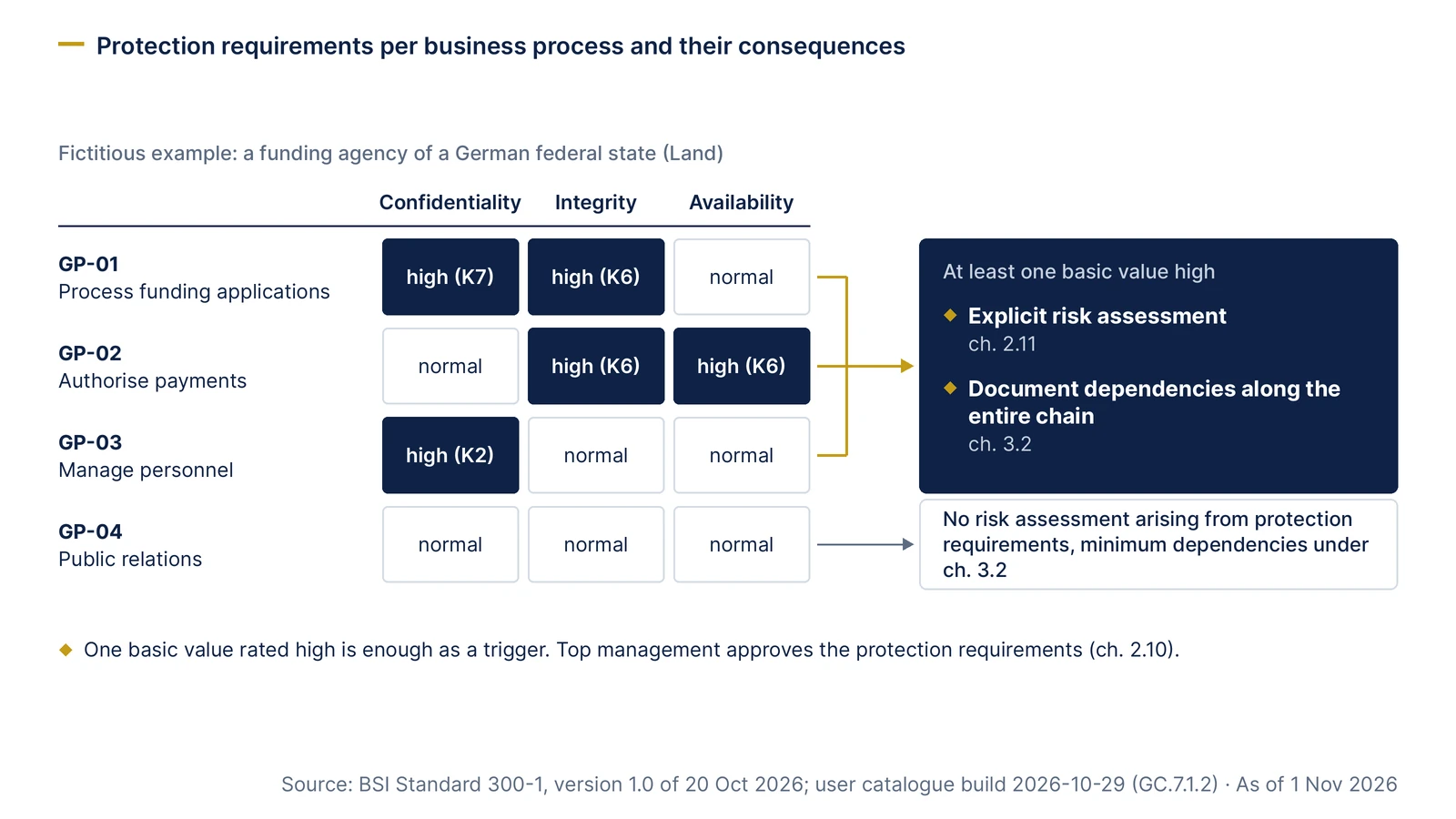
Completed scenarios
Fictitious example: a funding agency of a federal state with four business processes. The justifications show how the criteria are applied. Processes, information and assessments are invented and do not replace an assessment in your institution.
| Process | Confidentiality | Integrity | Availability | Justification | Consequence |
|---|---|---|---|---|---|
| GP-01 Process funding applications | high (K7) | high (K6) | normal | Applications contain trade secrets of the applicants and are classified internally as "confidential". In the funding agency's classification policy this level is defined as particularly confidential and mapped to high. Manipulated approval data lead to wrongful grants and jeopardise the funding mandate. An outage of a few days can be absorbed by extending deadlines. | explicit risk assessment; document dependencies down to the room; starting process |
| GP-02 Authorise payments | normal | high (K6) | high (K6) | Falsified payment data lead to wrong payments and jeopardise the proper use of funds which the funding agency is obliged to ensure. Payment dates are fixed by the funding conditions. | explicit risk assessment; second process |
| GP-03 Manage personnel | high (K2) | normal | normal | Personnel files contain health and appraisal data. A leak would considerably affect the persons concerned and lastingly damage trust in the funding agency. | explicit risk assessment for confidentiality |
| GP-04 Public relations | normal | normal | normal | Published content is public. A falsified announcement would be awkward but could be corrected quickly. No criterion applies, and the impact remains limited and manageable. | no risk assessment arising from protection requirements (other triggers under Section 2.11 remain); document minimum dependencies |
GP-02 shows a typical point: the process has normal protection requirements for confidentiality and high ones for integrity and availability. Under Section 2.11, one basic value with high protection requirements is enough to trigger the explicit risk assessment. It makes sense to focus it on the basic values concerned. 300-1 does not specify this. How the risk assessment works is shown on the page Risk analysis.
Review questions: from three categories to two
If you come from an existing security concept under 200-2, you have ratings for processes, applications, IT systems, rooms and connections in three categories. The following review questions help you turn them into a rating under 300-1 without losing justifications. They are our working aid. Where a question goes back to a requirement of the standard, the reference is given.
- Is there a separate rating for each business process in scope? 300-1 requires one per process (Section 2.6). Ratings that exist only for applications or IT systems are not sufficient.
- Is the process list current and complete? Minimum information under Annex 2: identifier, name, person, role or organisational unit responsible for the business side, short description, main applications.
- Old "very high": becomes high. 300-1 has no higher category. If you want to keep the distinction, maintain "very high" as your own category and map it to high (Section 2.6).
- Old "high": justify anew. Check each basic value against criteria K1 to K7 and against the definition from Section 2.6. Only if no criterion applies and the impact is limited and manageable can the process become normal. Document the downgrade with a justification and submit it to top management.
- Old "normal": check samples against K1 to K7, above all K6 and K7, which do not literally match the scenarios of 200-2.
- Did the old rating depend on task performance or on tolerable downtimes? This scenario is missing from 300-1. Place it under K6 and record your own threshold.
- Were the protection requirements of an object lowered because of redundancy (distribution effect)? 200-2 itself calls this an anticipation of the risk analysis (Section 8.2.2). In Grundschutz++ this consideration belongs in the risk assessment of the process.
- Were objects rated higher because of cumulation, for example a central server? The rating no longer applies, but the insight remains valuable: record the server during asset capture as a dependency of several processes and include it in the risk assessment of the processes with high protection requirements.
- Are there your own classification levels, for example public, internal, confidential, secret? Define which levels map to normal and which to high (Section 2.6), and check whether rules for classified information (Verschlusssachen) need to be observed separately.
- Is there a category below normal, for example "non-critical"? For a certifiable ISMS the state of the art applies there as well (Section 2.6).
- Has the new rating been submitted to top management for approval? Approving the protection requirements is a decision for top management (Section 2.10).
Process, roles and approval
In 300-1 the protection requirements determination sits in the first process step, between identifying the business processes (Section 2.5) and defining the information domain in the second step. The order has consequences: the protection requirements determine which process you start with, how deeply you document the assets and whether an explicit risk assessment is needed. Section 2.5 states: „Geschäftsprozesse bilden die Grundlage für die Schutzbedarfsfeststellung, die Identifizierung der Assets der Institution sowie für die Risikobetrachtung.“ (our translation: "Business processes form the basis for the protection requirements determination, the identification of the institution's assets and the risk assessment.")
In our view, a short session per process with the unit responsible for the business side, the information security officer (ISB) and, where needed, data protection works well. The business side knows the consequences of an outage or a falsification, and the ISB makes sure the criteria are applied consistently. The result goes to top management as a decision paper, together with the proposal for which process to start with. If there are several processes with high protection requirements, under Section 2.6 top management in principle selects the most important one.
The rating is not final. 200-2 describes the protection requirements determination in Section 8.2.2 as an iterative process that is to be reviewed again after risk analyses. 300-1 names changes in the information domain in Section 5.5 as a subject of regular validation. Plan the review of the rating into the annual cycle and trigger it when there are new processes, new types of information or changed legal obligations.
Adjacent steps:
- Which processes and areas are considered in the first place: Defining the information domain
- Capturing assets and dependencies to match the protection requirements: Structure analysis and asset capture
- What high protection requirements mean for the requirements package: Modelling with target object categories
- Risk assessment for processes with high protection requirements: Risk analysis
Blackfort Technology facilitates protection requirements sessions and prepares approval by top management, see Consulting.
Rights notice: Quotations from BSI Standard 300-1 © Bundesamt für Sicherheit in der Informationstechnik 2026, source: BSI Standard 300-1 „Methodik Grundschutz++“, version 1.0 of 20 October 2026, https://www.bsi.bund.de/DE/Themen/Unternehmen-und-Organisationen/Standards-und-Zertifizierung/Grundschutz-in-der-Informationssicherheit/Grundschutz-Plus-Plus/grundschutz-plus-plus_node.html. Quotations from BSI Standard 200-2 © Bundesamt für Sicherheit in der Informationstechnik, source: BSI Standard 200-2 „IT-Grundschutz-Methodik“, version 1.0, https://www.bsi.bund.de/DE/Themen/Unternehmen-und-Organisationen/Standards-und-Zertifizierung/IT-Grundschutz/BSI-Standards/BSI-Standard-200-2-IT-Grundschutz-Methodik/bsi-standard-200-2-it-grundschutz-methodik_node.html. They are not licensed under CC BY-SA 4.0. The licence notice at the end of the page applies only to the excerpts from the catalogue data.