

What an information domain is in Grundschutz++
BSI Standard 300-1 defines the information domain in chapter 3.1 as the „Gesamtheit von infrastrukturellen, organisatorischen, personellen und technischen Assets“ (our translation: "totality of infrastructural, organisational, personnel and technical assets"). The standard counts as assets „alle materiellen und immateriellen Werte der Institution, die für die betrachteten Geschäftsprozesse benötigt werden“ (our translation: "all tangible and intangible assets of the organisation that are needed for the business processes under consideration"). You decide yourself how far the domain extends: it can cover the whole scope or only part of it, for example one organisational unit or one specialist procedure together with the processes that run on it.
The delimitation is no mere formality. Chapter 3.1 gives the reason: „Eine klare und nachvollziehbare Abgrenzung des Informationsverbunds stellt sicher, dass alle relevanten Informationen, Assets und deren Abhängigkeiten vom ISMS erfasst werden.“ (our translation: "A clear and traceable delimitation of the information domain ensures that all relevant information, assets and their dependencies are covered by the ISMS.") The assets recorded in the information domain are a prerequisite for the requirements package (Anforderungspaket). If you work imprecisely here, you later get a requirements package that either has gaps or includes areas nobody is responsible for.
In the Grundschutz++ user catalogue (Anwenderkatalog), the delimitation appears as methodology requirement STM.1.1: „Strukturmodellierung MUSS den nachvollziehbar abgegrenzten Informationsverbund auf Basis des Geltungsbereichs festlegen.“ (our translation: "Structure modelling MUST define the traceably delimited information domain on the basis of the Geltungsbereich (area of application).") Interfaces are covered by STM.1.2: „Strukturmodellierung MUSS Schnittstellen des Informationsverbunds zu externen Prozessen festlegen.“ (our translation: "Structure modelling MUST define interfaces of the information domain to external processes.") Both are MUSS (MUST) requirements. Under chapter 4.1.2 of the standard, accepting the risk instead of fulfilling the requirement is ruled out for MUSS requirements.
Scope and information domain: two levels
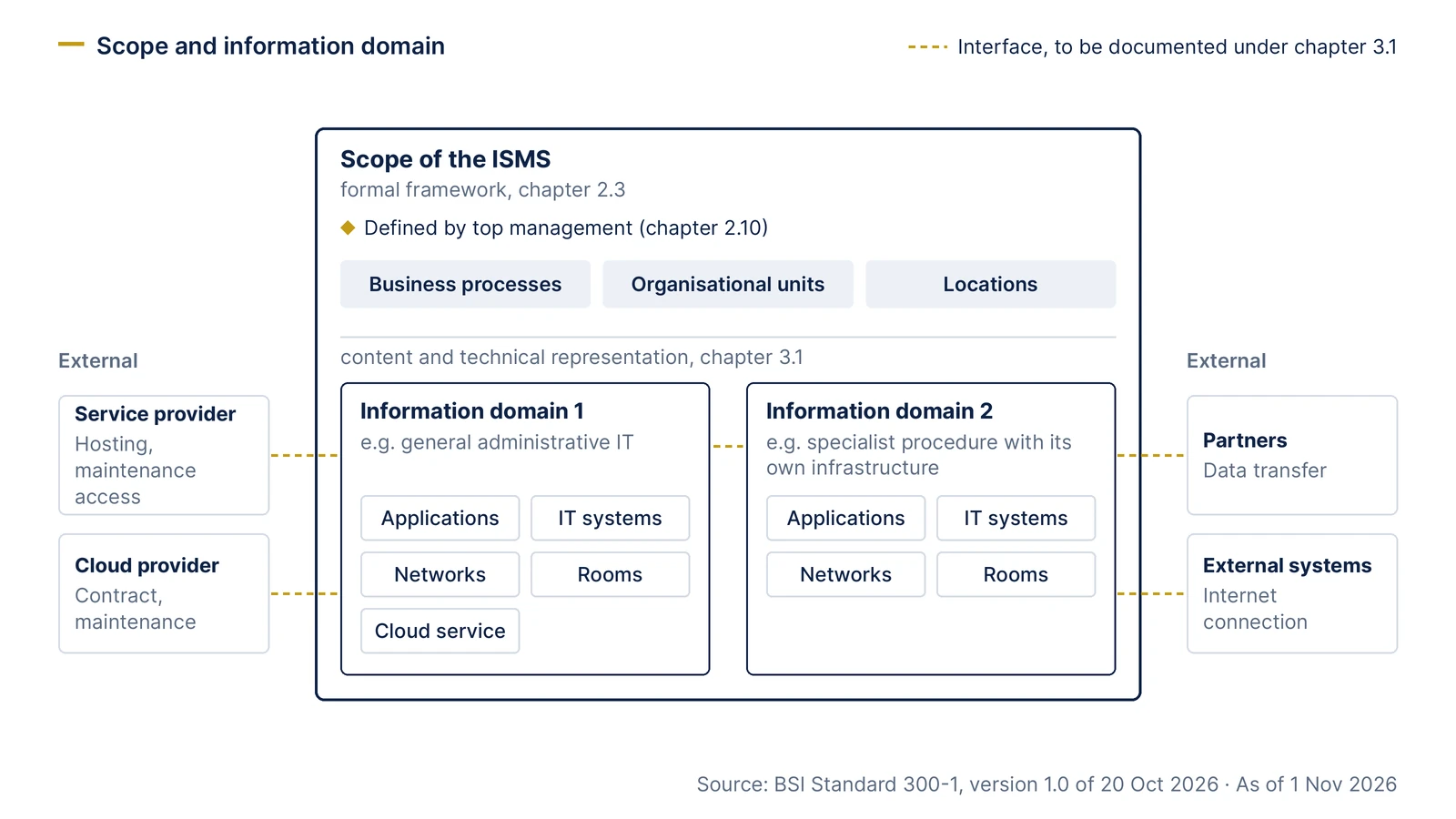
This is where 300-1 departs clearly from classic IT-Grundschutz. BSI Standard 200-2 equates the two terms in chapter 3.3.4: there, the area of application (Geltungsbereich) for the security concept is called the „Informationsverbund“ (information domain). 300-1 separates them (ch. 3.1): „Ein Anwendungsbereich legt den formalen und organisatorischen Umfang fest, in dem das ISMS angewendet wird. Der Informationsverbund stellt die inhaltlich-technische Abbildung des Anwendungsbereichs dar. Der Anwendungsbereich kann einen oder mehrere Informationsverbünde enthalten.“ (our translation: "A scope defines the formal and organisational extent within which the ISMS is applied. The information domain is the content and technical representation of the scope. The scope may contain one or more information domains.")
The scope is defined by top management (Institutionsleitung, chapter 2.3). It is based on the organisational context, the legal, regulatory and contractual requirements and the strategic objectives. Under chapter 2.10, the definition of the scope is submitted to top management as a decision paper. The catalogue covers this in GC.6.1: „Governance und Compliance MUSS den nachvollziehbar abgegrenzten Geltungsbereich nach Freigabe der Institutionsleitung festlegen.“ (our translation: "Governance and compliance MUST define the traceably delimited Geltungsbereich (area of application) after approval by top management.") For the scope, the catalogue uses the word Geltungsbereich. It means the formal framework from 300-1 chapter 2.3, not the Geltungsbereich in the sense of 200-2, which there corresponds to the information domain.
Under chapter 2.3, the scope comprises business processes, relevant organisational units, locations, applications and IT systems. What matters is that the business processes under consideration are fully included. This already applied under 200-2, which states that the business processes under consideration must be „komplett im Geltungsbereich enthalten“ (our translation: "completely contained in the area of application"). Excluded areas may be named explicitly to draw the boundary more clearly.
In practice this means: first, top management decides which parts of the organisation, locations and business processes the ISMS covers. Then, for this framework, you describe which assets belong to it and where the technical, organisational and physical boundaries run. Several information domains within one scope make sense where areas are operated largely separately in technical terms, for example a specialist procedure with its own infrastructure alongside the general administrative IT.
The standard's four test questions
To identify the relevant assets, chapter 3.1 requires four sets of questions to be answered and documented. They also provide the structure of any sound delimitation. Wording according to BSI Standard 300-1, ch. 3.1, p. 13:
- Organisational and personnel assignment: „Welche Institutionsbereiche, Rollen und Personen gehören zum Geschäftsprozess?“ (our translation: "Which parts of the organisation, roles and persons belong to the business process?")
- Technical assignment: „Welche Anwendungen, Systeme und Netze sind Bestandteil des Informationsverbundes?“ „Wo verlaufen die technischen Grenzen und wie sind Schnittstellen zu externen Systemen gestaltet?“ (our translation: "Which applications, systems and networks are part of the information domain?" "Where do the technical boundaries run and how are interfaces to external systems designed?")
- Infrastructural assignment: „Welche Standorte, Gebäude und Räumlichkeiten gehören zum Informationsverbund?“ (our translation: "Which locations, buildings and premises belong to the information domain?")
- Outsourcing delimitation: „Welche organisatorischen, technischen und infrastrukturellen Teile werden lokal betrieben und welche werden an externe Parteien ausgelagert?“ „Welche Cloud-Dienste werden genutzt?“ (our translation: "Which organisational, technical and infrastructural parts are operated locally and which are outsourced to external parties?" "Which cloud services are used?")
The same section also requires all transitions to the outside to be recorded: to external processes and systems and to other information domains, in each case at the organisational, technical and physical level (chapter 3.1, „Dokumentation und Schnittstellen“, i.e. documentation and interfaces). Existing asset data and digitally recorded system data may be used for the documentation. How to evaluate these records is described on the page Structure analysis.
Scoping worksheet: the delimitation in one table
The following worksheet turns the requirements of 300-1 and the catalogue requirements into checkable fields. The right-hand column shows entries for a fictitious example: a funding agency of a German federal state that starts with the business process "GP-01 Processing funding applications" as its first process. Name, systems and service providers are invented.
| Field | Guiding question | Reference | Fictitious example |
|---|---|---|---|
| Scope | Which parts of the organisation, locations and business processes does the ISMS cover? When did top management approve this? | 300-1 ch. 2.3, 2.10; GC.6.1 | Entire funding agency, one location; management decision of DD.MM.YYYY |
| Business processes under consideration | Which processes lie within the information domain, and are they fully included? | 300-1 ch. 2.3, 2.5 | GP-01 Processing funding applications (first cycle), further processes to follow |
| Organisation and people | Which units, roles and people are involved in the process? | 300-1 ch. 3.1 question 1 | Funding division, specialist administration, IT operations, external developers of the portal |
| Technology | Which applications, systems and networks belong to it? Where does the technical boundary run? | 300-1 ch. 3.1 question 2 | Funding portal, specialist procedure, virtualisation platform, administrative network; boundary at the firewall to the state network |
| Infrastructure | Which locations, buildings and rooms belong to it? | 300-1 ch. 3.1 question 3 | Office building, server room, office space of the division |
| Outsourcing and cloud | What is operated locally, what is outsourced? Which cloud services? | 300-1 ch. 3.1 question 4 | Portal hosting as IaaS with a service provider; specialist procedure in the agency's own server room |
| External interfaces | Which organisational, technical and physical transitions to external processes, systems and other information domains exist? | 300-1 ch. 3.1; STM.1.2 | Data transfer to the state treasury, internet connection, maintenance access of the portal service provider |
| Excluded areas | What is deliberately not included, and why? | 300-1 ch. 2.3 | Canteen billing (separate service provider, no connection to the administrative network) |
| Responsibility | Who is responsible for the domain and its interfaces? | 300-1 ch. 2.8 | Information security officer (ISB) coordinates, head of division as process owner |
| Change triggers | Which changes force a new delimitation? | 300-1 ch. 5.5 | new service provider, new location, new business process |
The "Change triggers" column is our addition. In chapter 5.5, the standard requires changes in the information domain to be taken into account when validating the requirements. With fixed triggers, you spot such changes before an audit finds them.
Borderline cases and how to document them
Borderline cases arise mainly where a business process leaves your own organisation or where infrastructure is shared with areas outside the scope. The standard sets no case-by-case rules for this. It does, however, require the delimitation to be traceable and the interfaces to be documented. The suggested handling in the table is our assessment of how this can be implemented in a verifiable way.
| Borderline case | Question | Suggested handling | Basis in 300-1 |
|---|---|---|---|
| SaaS application for a process in scope | Is the service inside or outside the domain? | Include it as an asset and assign it to the target object category (Zielobjektkategorie) cloud services; document contract, interfaces and division of responsibilities | Ch. 3.1 question 4; Annex 1 (cloud services) |
| Servers located in a service provider's data centre (housing) | Does the third-party room belong to the domain? | Your own systems belong to it, the service provider's service is recorded as outsourcing; cover room and access questions through the contract and its evidence | Annex 1 (outsourcing, example „RZ-Housing“, i.e. data centre housing) |
| Shared directory service with areas outside the scope | Does the entire directory service have to be in the domain? | The directory service is needed for logging on in the process and therefore belongs to it as an asset; describe the boundary to the other users as an interface | Ch. 3.1 question 2; Annex 1 (directory services) |
| External developers or consultants with access | Are they people of the domain? | Yes, if they can regularly use assets; record them as users | Annex 1 (users, example „externe Berater“, i.e. external consultants) |
| Mobile working and home office | Do private rooms count as part of the domain? | The mobile devices belong to it; for rooms outside the premises, document the rules on mobile working as the boundary | Ch. 3.1 question 3; Annex 1 (mobile devices) |
| Paper files and archive | Does analogue information belong to it? | Yes, if the process handles it; record files as information or data, storage rooms as a data media archive | Annex 1 (data, example „Aktenordner“, i.e. lever arch files; data media archive) |
| Data transfer to another authority or a partner | Where does the domain end? | At your own transfer point; document the line and the transfer as an external network connection and as an interface to an external process | Ch. 3.1; Annex 1 (external network connections); STM.1.2 |
| Starting with only one business process | Is a narrow first domain permissible? | Yes, as a first cycle; the remaining processes of the scope must be examined step by step, and this belongs in the plan | Ch. 2.6 |
How large the first information domain should be
In chapter 2.6, 300-1 recommends starting the initial implementation with the most important business process from the highest protection requirements category. All business processes of the scope are to be examined successively. The guidance on catalogue requirement STM.2.1.2 adds that in the first pass of the PDCA cycle it is sufficient to record the assets for the most important business process. Further processes can be added in subsequent cycles or in parallel.
A narrow first domain is therefore methodologically covered, and the remaining processes are added in later cycles. If the scope covers the entire organisation, the decision paper for top management also needs to set out the order in which the remaining business processes follow. Under chapter 2.10, defining this order is likewise a decision for top management.
A typical mistake is a domain cut along the organisational structure while the process runs across it. If a funding application starts in the specialist division, runs through a service provider's IT and ends at the treasury, the domain must reflect this path or record the transitions as interfaces. Cutting the domain along organisational structures is permissible under ch. 3.1. In that case, however, the transitions of the process into other areas must be documented as interfaces, and the process must be fully included in the scope (ch. 2.3).
What follows the delimitation
Once the delimitation is in place, it is clear for which assets you then document dependencies. Under chapter 3.2, how deep this goes depends on the protection requirements of the business process: for high protection requirements, the assignment of the assets to the process is documented together with their dependencies; for normal protection requirements, at least the dependencies between applications and IT systems and between IT systems and rooms.
Each of the next steps has its own page:
- Define protection requirements per business process: Protection requirements determination
- Record assets from CMDB, network plan and asset register: Structure analysis and asset capture
- Assign assets to target object categories and build the requirements package: Modelling with target object categories
- Transfer an existing delimitation from an IT-Grundschutz ISMS: Migration to Grundschutz++
Blackfort Technology supports you with the delimitation and prepares the decision paper for top management. More on the Consulting page.
Rights notice: Quotations from BSI Standard 300-1 © Bundesamt für Sicherheit in der Informationstechnik 2026, source: BSI-Standard 300-1 „Methodik Grundschutz++“, version 1.0 of 20 October 2026, https://www.bsi.bund.de/DE/Themen/Unternehmen-und-Organisationen/Standards-und-Zertifizierung/Grundschutz-in-der-Informationssicherheit/Grundschutz-Plus-Plus/grundschutz-plus-plus_node.html. Quotations from BSI Standard 200-2 © Bundesamt für Sicherheit in der Informationstechnik, source: BSI-Standard 200-2 „IT-Grundschutz-Methodik“, version 1.0, https://www.bsi.bund.de/DE/Themen/Unternehmen-und-Organisationen/Standards-und-Zertifizierung/IT-Grundschutz/BSI-Standards/BSI-Standard-200-2-IT-Grundschutz-Methodik/bsi-standard-200-2-it-grundschutz-methodik_node.html. They are not licensed under CC BY-SA 4.0. The licence notice at the bottom of the page applies only to the extracts from the catalogue data.