
Now or later: the short answer
Three facts limit the room for manoeuvre. First, Grundschutz++ has been applicable since October 2026: BSI Standard 300-1 is available in version 1.0 of 20 October 2026, according to its change history the first applicable version, and was published by the BSI on 26 October 2026 and presented at it-sa on 27 October 2026. Second, according to the milestone plan, applications for ISO 27001 certification on the basis of Grundschutz++ can only be submitted from 1 January 2027. Third, the certifiability of classic IT-Grundschutz ends on 30 November 2031. That is a date in the BSI procedure, not a statutory deadline.
This results in a window of just under five years in which both paths can be certified side by side. Anyone who starts afresh under the classic procedure within this window and also needs a certificate after 2031 will foreseeably build twice. Anyone already certified does not have to switch immediately, but should not postpone the switch until shortly before 2031, because many organisations could then need audit capacity at the same time. That is our assessment, not a statement by the BSI.
One argument against a very early switch is that parts of Grundschutz++ are not yet finished. The BSI has announced performance measurement and indicators for February and March 2027 and an application example for December 2026, and the user catalogue (Anwenderkatalog) in the build of 29 October 2026 is not yet aligned with 300-1 in every respect. Anyone switching early should plan for these points.
Five questions that determine the path
- What is in place? No ISMS, an ISMS under BSI Standard 200-2 (with or without a certificate) or an ISMS under ISO/IEC 27001 without reference to Grundschutz.
- Who requires which evidence by when? Your own top management, a client, a contract, an authority. What matters is whether evidence is needed before or after 1 January 2027 and whether classic IT-Grundschutz is explicitly named.
- When are your own dates? Surveillance and recertification audits, planned revision of the security concept, major changes to the information domain.
- Are there business processes with high protection requirements? Then 300-1 requires an explicit risk assessment against the 35 minimum criteria (Mindestkriterien) in Annex 3. Whether your current procedure meets these criteria affects the effort of the switch.
- How much change can the project absorb? According to 300-1, version 1.0 is aimed primarily at “Early Adopters”, and according to the milestone plan the early adopter phase runs until 31 December 2027. Anyone who needs fixed templates should plan more buffer for adjustments.
Decision table by starting situation
The recommendations are our professional assessment for the typical situation. They do not replace a review of your contracts or your legal obligations; that is a matter for your legal department.
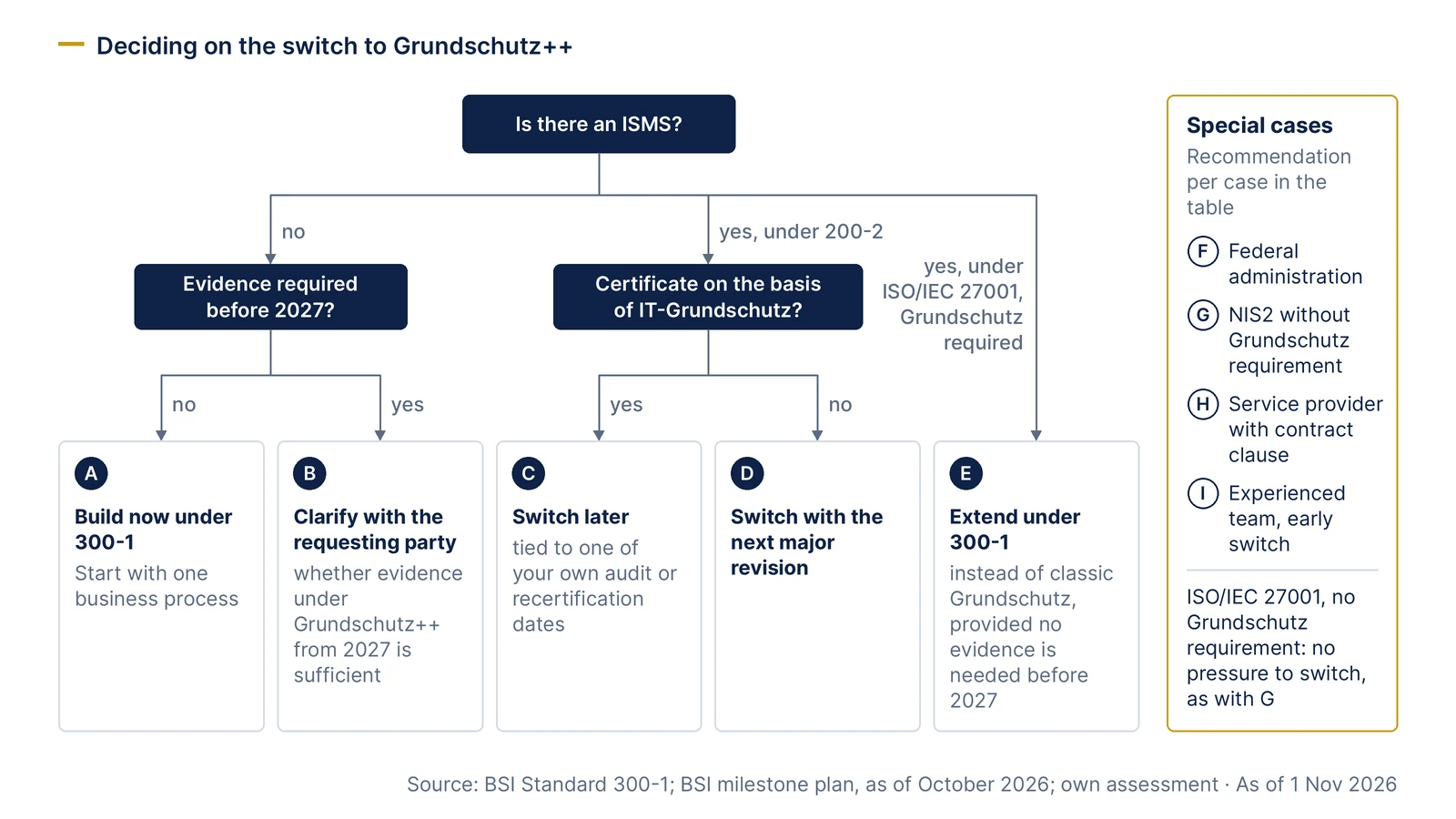
| Starting situation | Recommendation | Rationale | Next steps |
|---|---|---|---|
| A. No ISMS, evidence in 2027 or later | Build now under 300-1. | Anyone building from scratch under 200-2 who also needs a certificate after 30 November 2031 will have to convert again before then. 300-1 allows you to start with one business process. | Record business processes in line with Annex 2, determine protection requirements per process, choose a starting process, have the scope and resources approved. |
| B. No ISMS, evidence required before 2027 | Clarify with the requesting party whether evidence under Grundschutz++ from 2027 is sufficient. Evidence by the end of 2026 is hardly achievable without an existing ISMS (our assessment); if there is no alternative, discuss a deadline extension and the classic path with a planned migration. | According to the milestone plan, no certification application on the basis of Grundschutz++ is possible before 1 January 2027. | Clarify the requirement in writing, present both options with a timetable to top management. |
| C. ISO 27001 certificate on the basis of IT-Grundschutz | Switch later, tied to one of your own audit or recertification dates; prepare now. | The milestone plan creates no immediate obligation; the switch can be combined with audit preparation that is planned anyway. | Compare your existing setup against 300-1, check your risk procedure against Annex 3, set the target audit for the switch. |
| D. ISMS under 200-2 without a certificate, for example Basic Protection | Switch with the next major revision. | Without a certificate there is no audit cycle to tie the switch to. 300-1 does not describe the Basic, Core and Standard Protection approaches. | Bring the existing business process list up to the minimum details in Annex 2, transfer protection requirements per business process into the two categories of 300-1, carry over existing asset and network data, change status values to „erfüllt“, „nicht erfüllt“, „nicht anwendbar“ (our translation: "fulfilled", "not fulfilled", "not applicable"). |
| E. ISMS under ISO/IEC 27001, client requires Grundschutz | Grundschutz++ instead of classic Grundschutz, provided no evidence is needed before 2027. | 300-1 maps its first two process steps to clauses of ISO/IEC 27001; the management framework is the starting point. A later second switch is avoided. | Clarify with the client which evidence is meant; add business processes, target object categories (Zielobjektkategorien) and the status logic. |
| F. Federal administration body | Start preparing now; align the timing with the applicable version published by the BSI. | Section 44(1) BSIG refers to the BSI Standards and the IT-Grundschutz Compendium (IT-Grundschutz) in their respective applicable versions as published by the BSI on its website. We found no explicit statement on the topic page or in 300-1 as to when Grundschutz++ becomes the applicable version; in its metadata the user catalogue names „§ 44 Abs. 1 BSIG“ (our translation: "Section 44(1) BSIG") as the implemented norm, without a date. | Have the competent body check which version applies; prepare business processes, protection requirements and the risk procedure regardless. |
| G. NIS2 entity without a Grundschutz requirement | No pressure to switch from the Grundschutz timetable; choose a framework according to your own needs. | Section 30 BSIG requires measures in line with the state of the art, but does not prescribe a framework. | Assess technically whether Grundschutz++ fits your processes. On implementing NIS2 itself: https://www.blackfort-tec.de/en. |
| H. Service provider with a Grundschutz clause in the contract | The contract wording decides; switch only once the agreed version has been clarified. | A contract can stipulate a specific version or the applicable version at any given time. That is a legal question. | Pass the contract to the legal department for review; agree the target evidence and timing with the client. |
| I. Experienced team that wants to switch early | Now, as an early adopter, with a fixed catalogue version. | 300-1 version 1.0 is aimed at exactly this group. The catalogue is rebuilt continuously and still deviates from the standard in individual points. | Record the build with date and commit, document deviations between catalogue and standard, follow the standard in case of doubt, set BSI dates as checkpoints. |
What you can do now, regardless of timing
Some tasks pay off in every starting situation, because they are needed for Grundschutz++ and do no harm in the classic procedure either.
- Create a business process list. Annex 2 of 300-1 requires for each process an identifier, name, the person, role or organisational unit responsible for the subject matter, a short description and the essential applications. A table is sufficient.
- Check your risk procedure against the minimum criteria. Whether 200-3, ISO/IEC 27005 or your own procedure: Annex 3 lists 35 criteria, including risk appetite, risk acceptance criteria, risk owners, minimum details in the risk register and time limits for temporarily accepted risks. The criteria in detail are on the page Risk minimum criteria.
- Resolve „teilweise“ (our translation: "partially"). 300-1 only knows „erfüllt“, „nicht erfüllt“ and „nicht anwendbar“ (our translation: "fulfilled", "not fulfilled" and "not applicable"). Every requirement previously rated as partially fulfilled needs a decision on how it will be assessed in future.
- Prepare inventory data. 300-1 allows CMDBs, asset registers, operating manuals, network diagrams and service maps to be used. The cleaner this data is, the less survey work is needed.
- Prepare evidence from operations. Automated checks are permitted if the tool, time and result are documented and assigned to the requirement (ch. 4.3).
- Review the mapping table. The BSI mapping from the 2023 Compendium to Grundschutz++ helps with an initial comparison, but has the status “draft” (as of 21 July 2026).
Arguments for and against an early switch
| For an early switch | Against an early switch |
|---|---|
| No second rebuild before 2031. | Performance measurement and indicators only follow in February and March 2027; your own definitions will then have to be adjusted. |
| You can start with the most important business process, and the ISMS grows step by step. | The user catalogue is not yet aligned with 300-1 in every respect (status values, deletion of requirements without a target object category). |
| With normal protection requirements no separate risk assessment, as long as all assets are covered and no SOLLTE (SHOULD) requirement remains open permanently; dependencies only documented to the extent required. | It is still open which blueprints (Blaupausen) will become mandatory for which organisations. |
| Machine-readable catalogue, automated evidence explicitly permitted. | There is no experience from audits under Grundschutz++ before 2027; the BSI application example is announced for December 2026. |
| Early adopters feed their experience into further development (300-1, introduction). | Version 1.0 is aimed primarily at experienced organisations. |
Putting the decision to top management
Under 300-1, responsibility for the ISMS lies with top management and cannot be delegated; among other things, the scope, the protection requirements of the business processes, the order of processing, resources and the information security policy are submitted to it for approval (ch. 2.10). The switch decision belongs in the same submission. A decision paper should contain at least:
- starting situation and the row of the decision table that applies
- chosen path and target date, with rationale
- scope and first business process
- required internal resources and external support
- open points from the BSI timetable with review dates
- date on which the decision will be reviewed
The work packages after the decision are described on the page Grundschutz++ migration, all dates are in the timeline, the differences in the comparison. If you would like to commission an assessment of your existing setup and a migration plan: Readiness assessment and migration concept. Consulting is provided by the team at Blackfort Technology; the page Consulting gives an overview.