
Consulting
Grundschutz++ readiness: assessment of your existing ISMS and migration concept
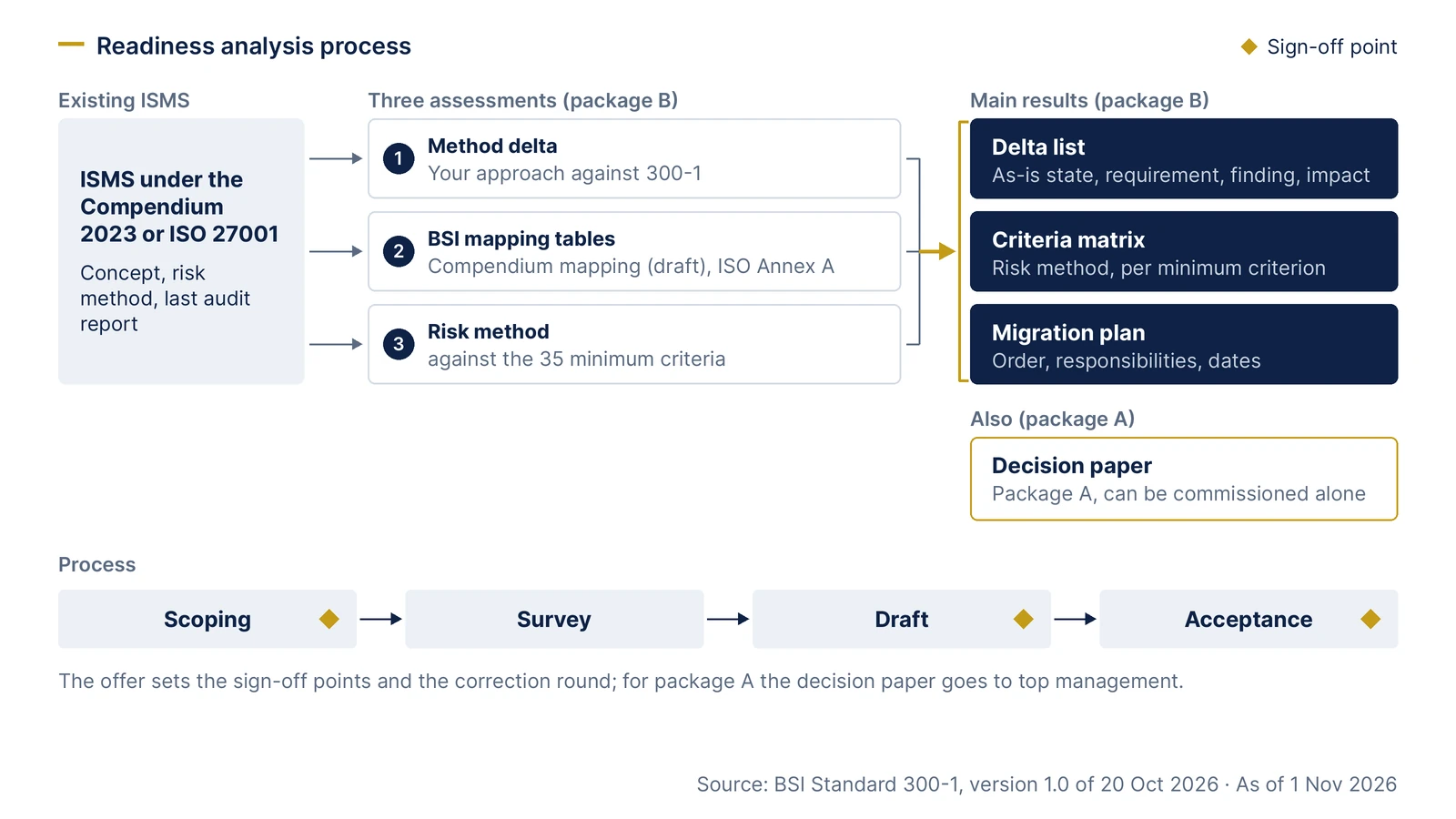
The Grundschutz++ readiness analysis assesses your existing ISMS against BSI Standard 300-1 of the German Federal Office for Information Security (Bundesamt für Sicherheit in der Informationstechnik, BSI) and the Grundschutz++ user catalogue (Anwenderkatalog), and plans the way there. Package B delivers the gap analysis as a delta list, a check of your risk method against the 35 minimum criteria (Mindestkriterien) and a migration concept with order and responsibilities. Package A delivers the decision paper for your top management on framework and timing of the switch.

Starting point
You run an ISMS under the IT-Grundschutz Compendium 2023 or under ISO 27001 and want to know what a switch to Grundschutz++ means for you and when it pays off. The method is set out in BSI Standard 300-1, version 1.0 of 20 October 2026. According to the milestone plan (Meilensteinplan), certifications based on Grundschutz++ can be applied for from 1 January 2027, and classic IT-Grundschutz remains certifiable until 30 November 2031.
The changes affect the foundations of your documentation: protection requirements per business process with two categories instead of three, modelling via 39 target object categories (Zielobjektkategorien), an implementation status without "partially" and "dispensable", MUSS (MUST) requirements without exception approval and a risk method that meets the minimum criteria of Annex 3. The BSI mapping table from the Compendium 2023 to Grundschutz++ is a draft. Its mappings need a professional check before you transfer evidence on that basis.
Scope of services
Both packages can be commissioned individually. The decision paper for top management belongs to package A. The delta list, the check of the risk method and the migration concept belong to package B.
Package A
Decision and transition planning
Choice of framework between classic IT-Grundschutz, ISO 27001 without reference to Grundschutz and Grundschutz++; timeline up to 2031 with your recertification dates; recommendation on the timing of the switch. We assess the requirements and client demands you name, or that appear in your documents, from an information security perspective. Whether and how they legally apply to you is for your legal department to assess.
Package B
Method delta
Comparison of your approach with 300-1: business processes and protection requirements, mapping from three to two categories, modelling from modules to target object categories, status model, handling of MUSS and SOLLTE (SHOULD) requirements.
Package B
Comparison using the mapping tables
Initial coverage via the BSI mapping tables from the Compendium 2023 and from ISO/IEC 27001:2022 Annex A to Grundschutz++. We check each mapping on which you want to base evidence individually, because the Compendium mapping is a draft.
Package B
Check of the risk method
Your procedure under BSI Standard 200-3, ISO/IEC 27005 or your own method against the 35 minimum criteria of Annex 3, with a finding and the evidence needed for each criterion.
The 35 minimum criteriaPackage B
Migration concept
Order starting from the first business process, work packages with inputs and results, responsibilities, dates and sign-off points, aligned with your recertification date.
Grundschutz++ migrationFormat of the results
You receive all results in editable formats, with chapter references to 300-1 and the catalogue build used.
01
Decision paper (package A)
Three to five pages for top management: framework, timing, resources, open points, proposed resolution.
02
Delta list (package B)
Per area and practice (Praktik): existing state, requirement under 300-1, finding, consequence; effort according to the effort level the catalogue gives for each requirement in the field effort_level.
03
Risk method criteria matrix (package B)
35 rows, per minimum criterion: provided for, unclear or missing, with the reference in your procedure and the evidence needed.
04
Checked mappings (package B)
List of the mappings from the BSI tables on which you rely, with our professional finding for each mapping.
05
Migration plan (package B)
Work packages, order, responsibilities, dates and sign-off points up to the goal.
Excerpt from a delta list
Fictitious example with invented figures. It shows how a finding becomes a consequence in the migration plan.
| Area | Existing state under 200-2 and Compendium 2023 | Requirement under 300-1 | Finding | Consequence in the migration plan |
|---|---|---|---|---|
| Protection requirements | three categories, inherited per target object | two categories per business process (chapter 2.6) | two processes so far "very high" | mapping to "high", explicit risk consideration for both processes |
| Implementation status | 14 requirements at "partially" | "fulfilled", "not fulfilled" or "not applicable" (chapter 4.1.1) | status to be reassessed | reassessment; classify unfulfilled SOLLTE requirements as temporary or permanent |
| Dispensability | 9 requirements at "dispensable" | "not applicable" if the requirement cannot be fulfilled functionally or the component is missing; justification per requirement (chapter 4.1.1) | 3 justifications do not match the new definition | plan safeguards, or risk consideration in case of permanent non-fulfilment |
| Risk method | procedure under 200-3, risk appetite described, not authorised | authorisation by top management (Annex 3, criterion 9) | gap | submission for authorisation at the next management meeting |
| Modelling | modules of the Compendium 2023 | target object categories under Annex 1; BSI mapping is a draft | 41 mappings checked, 6 differ in substance | document and justify your own mapping |
Fictitious example. Chapter references refer to BSI Standard 300-1, version 1.0 of 20 October 2026.
Process and acceptance
Fixed points at which you see and approve results.
1
Scoping
Initial call, review of the documents, definition of the information domain and scope; then a binding offer.
2
Survey
Review of the documentation and workshops with the information security officer (ISB), IT operations and the owners of the business processes.
3
Draft
The commissioned results (package B: delta list, criteria matrix, migration plan; package A: decision paper) as a draft to your contact person.
4
Acceptance
Results meeting, correction round, acceptance by your contact person. For package A, the decision paper goes to top management.
The offer sets the sign-off points and the scope of the correction round.

Your contact
Christian Gebhardt · Founder and managing director, Blackfort Technology
Christian Gebhardt, founder and managing director of Blackfort Technology, is happy to take your enquiry personally. In a free initial call you work out together what you need; the consulting is carried out by the Blackfort Technology team.
What we need from you
Documents
Information security policy, structure analysis, protection requirements determination, modelling, results of the IT-Grundschutz Check, risk analyses and risk method, last audit report; for ISO 27001 the statement of applicability and the risk treatment plan.
Tool export
If you use an ISMS tool: an export of the modelling and the implementation status.
Contact person
An internal coordinator for dates, queries and acceptance.
Business units and IT operations
One meeting each with the owners of the most important business processes and with IT operations.
Top management
For package A, a meeting to present the decision paper.
Exclusions
The readiness analysis assesses and plans. Not included are:
- Implementing the safeguards and the new modelling itself. That is package C "Implementation and migration".
- A statement on whether you will pass a certification audit. The analysis is neither a certification forecast nor an audit.
- An overall score in per cent or a seal. You receive findings per area and criterion.
- Legal advice. Whether and how requirements legally apply to you is for your legal department to assess.
- Selecting or introducing an ISMS tool.
- Ongoing operation and external information security officer (package D); link under "Further reading".
We do not publish prices on this website. After the initial call you receive a binding offer for the agreed scope.
Frequently asked questions
What is a Grundschutz++ readiness analysis?
An assessment of your existing ISMS against BSI Standard 300-1 and the Grundschutz++ user catalogue. It shows what you can carry over, what changes and what is new, and leads to a migration plan (package B). The decision paper for top management is package A.
How do a gap analysis and a migration concept differ?
The gap analysis establishes where your existing ISMS deviates from 300-1, as a delta list with findings. The migration concept sets out in which order, with which responsibilities and by when you close the deviations.
Can we simply adopt the BSI mapping from the Compendium 2023 to Grundschutz++?
It is useful as initial coverage. However, the mapping table has the status "draft" in the BSI repository. Mappings on which you base evidence should be checked professionally, and the check should be documented.
Will we get a maturity level in per cent at the end?
No. You receive findings per area and criterion and a plan for closing the gaps. A percentage would hide the fact that 300-1 only knows "fulfilled", "not fulfilled" or "not applicable" for each requirement, and that MUSS requirements allow no exception.
Further reading
Get in touch
Request a readiness analysis
Tell us your basis (Compendium 2023 or ISO 27001), the information domain and your next audit date. In the free initial call we clarify the scope.
Request an initial callSources
- BSI Standard 300-1 "Methodik Grundschutz++" (Grundschutz++ methodology), version 1.0 (German) (version 2026-10-20), retrieved 2026-11-01
- BSI Standard 200-2 "IT-Grundschutz-Methodik" (IT-Grundschutz Methodology) (German), retrieved 2026-11-01
- BSI topic page Grundschutz++ (Themenseite Grundschutz++) with milestone plan, as of October 2026 (German), retrieved 2026-11-01
- BSI State-of-the-Art Library (Stand-der-Technik-Bibliothek), Grundschutz++ user catalogue (build 2026-10-29, commit c3f37859) and mapping IT-Grundschutz 2023 to Grundschutz++ (status draft, as of 21 July 2026) (German) (version 2026-10-29), retrieved 2026-11-01
Quotations from BSI standards and BSI web pages are © Federal Office for Information Security (BSI) and are reproduced verbatim, in quotation marks and with source reference. This is an independent offering, not an offering of the BSI.
- Last updated
- 2026-11-06
- Technically reviewed
- 2026-11-06
- Catalogue version
- Grundschutz++ user catalogue, build 2026-10-29 (commit c3f37859); mapping IT-Grundschutz 2023 to Grundschutz++ as of 2026-07-21, status draft
This content provides general technical and organisational information on IT-Grundschutz and Grundschutz++ and does not constitute legal advice (no legal services within the meaning of the German RDG). It replaces neither an audit nor a decision by the certification body.