

What the BSI means by a security concept
In classic IT-Grundschutz, creating the security concept is one of the central tasks of information security management. Under Standard Protection it covers the fields of action scope definition, structure analysis, protection requirements determination, modelling, IT-Grundschutz Check and risk analysis (200-2, chapter 8). Implementation follows an implementation plan that names at least the target object, module, requirement, safeguard, schedule, budget and the persons responsible (200-2, chapter 9.4).
The concept is compact because it refers to the requirements in the Compendium instead of repeating them (200-2, chapter 2.7). The concept is drawn up by the information security officer (ISB) and approved by the management level (200-2, chapter 5.2.1). As an example of security management documents, 200-2 expressly names the „Sicherheitskonzept mit den Berichten zur Risikoanalyse“ (our translation: "security concept with the reports on the risk analysis") (chapter 5.2.2). If the risk analysis adds further safeguards, the concept must then be consolidated (200-3, chapter 7).
BSI Standard 300-1 does not use the word security concept. It divides the approach into five process steps and requires documented results in each, such as the scope, business processes with protection requirements, information domain and assets, requirements package, implementation status, risk assessment (Risikobetrachtung), implementation plan, and audit programme and management review. For organisations that have to present a security concept, for example to a client or internally, the dossier built from these results is the obvious equivalent. This mapping is our own structure, not a BSI requirement.
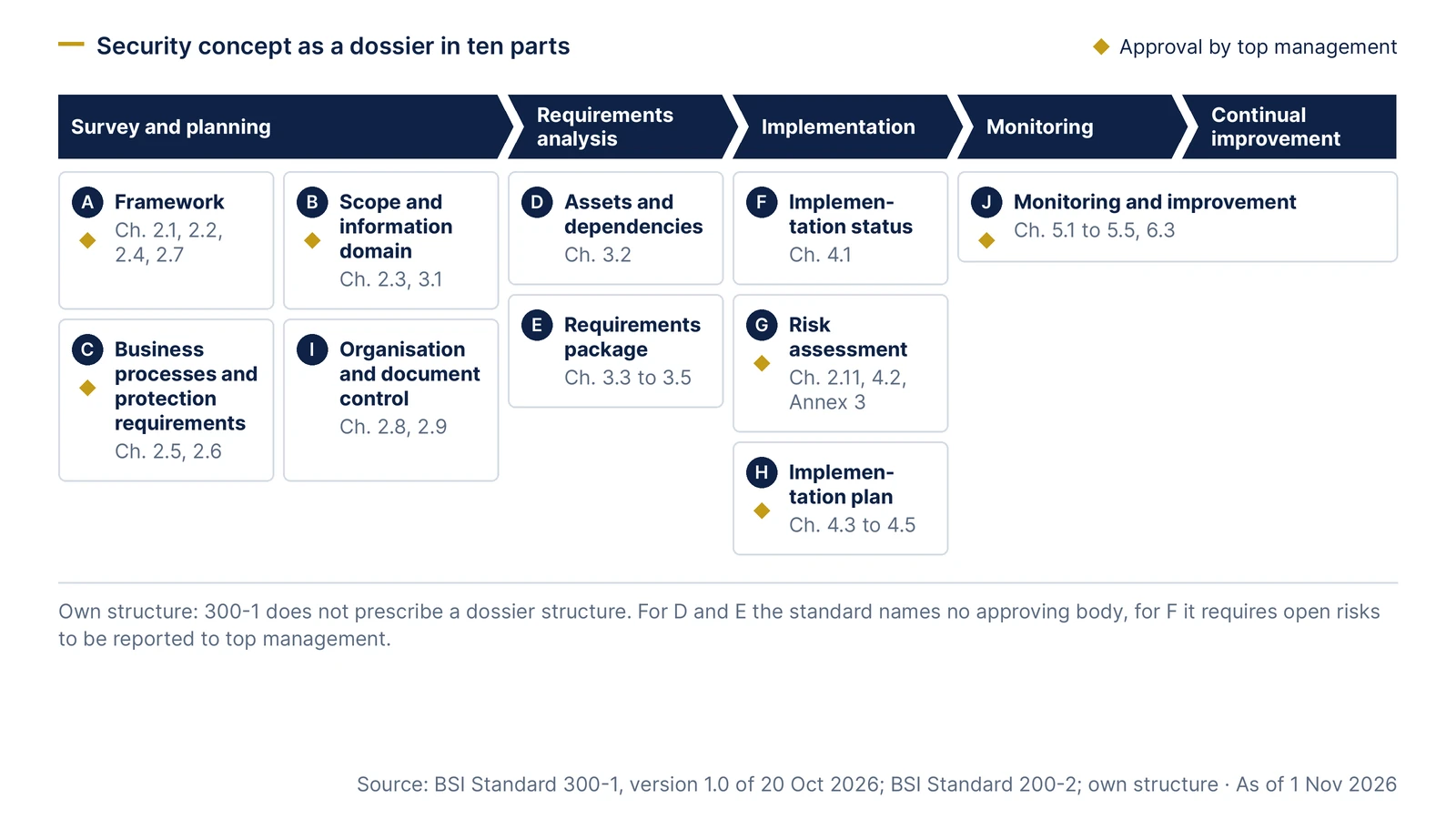
Dossier structure: ten parts from the results of 300-1
The table assigns to each part of the dossier the results from 300-1 that belong in it, the equivalent in the classic concept under 200-2 and the body that approves it. Strictly speaking, part J belongs to the operation of the ISMS. We include it because auditors ask whether the concept is actually put into practice.
| Part | Content (results from 300-1) | Equivalent in 200-2 | Approval |
|---|---|---|---|
| A Framework | Context of the organisation (ch. 2.1), compliance requirements (2.2), interested parties (2.4), information security policy with measurable objectives and strategy (2.7) | Policy, general conditions | Top management (2.7, 2.10) |
| B Scope and information domain | Scope with business processes, organisational units, sites, applications, IT systems and exclusions (2.3); boundaries of the information domain with interfaces and outsourcing (3.1) | Scope, information domain | Top management for the scope (2.10) |
| C Business processes and protection requirements | Documented business processes (2.5, Annex 2), protection requirements per business process "normal" or "high" (2.6), order of processing (2.10) | Protection requirements determination per target object | Top management (2.10) |
| D Assets and dependencies | Recorded assets; for high protection requirements, membership of and dependency on the business process, for normal at least applications to IT systems and IT systems to rooms (3.2) | Structure analysis | ISB or designated role (own definition, 300-1 names no approving body) |
| E Requirements package | Selected blueprints (Blaupausen) with version (3.3), mandatory requirements (3.4.1), assignment of the target object categories (Zielobjektkategorien) (3.4.2), additional own requirements (3.4.3), specified parameters (3.5), catalogue version | Modelling | ISB or designated role (own definition, 300-1 names no approving body) |
| F Implementation status | Status per requirement "fulfilled", "not fulfilled" or "not applicable" with justifications; classification of unfulfilled SOLLTE (SHOULD) requirements (4.1) | IT-Grundschutz Check | Reporting of open risks to top management (4.1.1) |
| G Risk assessment | Framework under ch. 2.11, risk register, treatment decisions (4.2), minimum criteria (Mindestkriterien) from Annex 3 | Risk analysis under 200-3 | Top management for framework and residual risks, risk owners for implementation planning |
| H Implementation plan | Safeguards per requirement with assignment, priority, date, person documenting or checking and evidence (4.3); responsibilities and deadlines (4.4); progress (4.5) | Implementation plan | Top management for the approach (4.4) |
| I Organisation and document control | Roles and responsibilities (2.8), communication, document control procedure (2.9) | Security organisation | Top management through the policy (2.7); otherwise own definition |
| J Monitoring and improvement | Performance evaluation (5.1), internal audit programme (5.2), management review (5.3), monitoring procedures (5.4), validation of the requirements (5.5), correction and improvement plan (6.3) | Maintenance and improvement (200-2, ch. 10) | Top management (management review) |
List of documents with reuse
If you already have a security concept under 200-2, you do not start from scratch. The table shows for each document what can be carried over and what has to be developed anew. The assessment "adopt" means that the document serves as input and is checked against the reference given.
| Document | Reuse | What to check or change | Reference in 300-1 |
|---|---|---|---|
| Information security policy | adopt | Add concrete, measurable objectives and a strategy for achieving them; commitment of top management; communication to all staff | Ch. 2.7 |
| Scope, information domain | adopt | Describe scope and information domain separately; business processes entirely within the scope; name exclusions | Ch. 2.3, 3.1 |
| List of business processes | adopt, if available | Per process: identifier, name, persons responsible, short description with purpose and result, main applications | Ch. 2.5, Annex 2 |
| Protection requirements determination | as input | New, per business process in two categories; own categories must be mapped to "normal" and "high". More on the page Protection requirements determination | Ch. 2.6 |
| Structure analysis (lists, network plan) | largely adopt | Add dependencies according to protection requirements; CMDB, asset register and network plans may be used. More on the page Structure analysis | Ch. 3.2 |
| Modelling (modules applied to target objects) | only as an aid | New: assign assets to the target object categories. The 2023 mapping to Grundschutz++ has draft status. More on the page Modelling | Ch. 3.4.2 |
| Results of the IT-Grundschutz Check | adopt remarks | Reassess status; "partially" no longer exists, "dispensable" is not the same as "not applicable". More on the page Assessing requirements | Ch. 4.1 |
| Risk analysis under 200-3 | adopt threats and safeguards | Check the procedure against the 35 minimum criteria, assign risks at business process level. More on the pages Risk minimum criteria and Risk analysis | Ch. 2.11, 4.2, Annex 3 |
| Implementation plan (Realisierungsplan) | transfer into the implementation plan under 300-1 | For each safeguard, add which requirement it fulfils, when it was implemented or checked and who documented or checked this; assign evidence | Ch. 4.3, 4.4 |
| Role descriptions | adopt | Check for conflicts of interest (head of IT and ISB, data protection officer and ISB); define when the ISB is involved in projects | Ch. 2.8 |
| Policies on document control, internal audits, corrective actions | adopt | Document control for all ISMS-relevant documents; audit programme with objectives and risks | Ch. 2.9, 5.2, 6.3 |
| Management reports | adopt structure | Add the contents of the management review, for example the status of risk treatment and of earlier management decisions | Ch. 5.3 |
Outline of the document and cover sheet
Whether you keep the dossier as one document or as a folder of individual documents with a cover document is your choice. 300-1 requires a procedure for controlling all ISMS-relevant documents that ensures traceability, currency and completeness over the life cycle (chapter 2.9). For the cover sheet, the minimum labelling from 200-2 has proven useful (chapter 5.2.3). We use this outline:
- Cover sheet: unique title, author or document owner and function, version number, last and next planned revision, approved on and by, classification, authorised roles (200-2, chapter 5.2.3). Supplemented by the version of BSI Standard 300-1 and the build date of the user catalogue (Anwenderkatalog).
- Summary for top management: scope in one paragraph, number of business processes per protection requirement, implementation status, open MUSS (MUST) requirements, residual risks for approval.
- Parts A to I as in the table above, each with a reference to the controlled individual documents.
- Part J as a reference to the audit programme, management review and improvement plan.
- Annex: abbreviations, register of approvals with date, change history.
As in the classic concept, the dossier refers to requirements by identifier instead of repeating their text. This keeps it short and makes it easier to compare against a new catalogue version.
Quality check before approval
In chapter 7, BSI Standard 200-3 names four aspects for consolidating a security concept. We apply them to the dossier with our own guiding questions and use them as the final review before submission to top management.
| Aspect (based on 200-3, ch. 7) | Our guiding question for the dossier |
|---|---|
| Suitability | Is there a safeguard for every threat from the risk assessments, and does it fit the objectives of the policy? |
| Interaction | Do safeguards from different parts of the dossier get in each other's way, for example logging and deletion periods? |
| User-friendliness | Would staff work around the safeguard in daily practice, and would anyone notice if it failed? |
| Appropriateness | Does the effort match the protection requirements of the business process, and is no safeguard too weak for its risk? |
In addition we check three points that follow from 300-1: every requirement in the package has a status (chapter 4.1.1). Every safeguard is assigned to at least one requirement and vice versa (chapter 4.3). Every residual risk has been approved by top management (chapter 4.2.3).
Approval and maintenance
300-1 states: „Die Verantwortung für die Umsetzung eines ISMS liegt bei der Institutionsleitung und kann nicht delegiert werden.“ (our translation: "Responsibility for implementing an ISMS lies with top management and cannot be delegated.") (chapter 2.10). The items submitted to top management for approval are above all the scope, the protection requirements and order of the business processes, resources and the policy. Added to these are the residual risks from the risk assessment (chapter 4.2.3) and the approach to implementation planning (chapter 4.4). Record these approvals with their dates in the dossier.
A dossier only stays useful if it grows with the ISMS. 300-1 names the occasions: changes in the information domain, adjustments to the requirements of the State-of-the-Art Library (Stand-der-Technik-Bibliothek) and to the blueprints used, and changes in the methodology (chapter 5.5). The risk assessment must be reviewed at least once a year (Annex 3, criterion 35). If a safeguard, its implementation status or a check result changes, the documentation must be updated; keeping a history is recommended (chapter 4.3).
Because the user catalogue is machine-readable, large parts of E, F and H can be generated from a tool. Automated checks are admissible as evidence if the tool, time and result are documented (chapter 4.3). Who delivers which evidence and when is planned on the Evidence plan page; how the dossier is used in the audit is described on the Certification page.
When support pays off
A dossier with this structure can largely be built from existing documents. The effort lies where the methodology changes: protection requirements per business process, assignment to target object categories and reassessment of the implementation status. The Blackfort Technology team takes on this work as a baseline assessment with a migration concept, see Baseline assessment and migration concept and Consulting. How to plan individual pieces of evidence is explained on the Evidence plan page, the audit procedure on the Certification page.
Rights notice: Short quotations from BSI Standard 300-1 „Methodik Grundschutz++“, version 1.0 of 20 October 2026, © Bundesamt für Sicherheit in der Informationstechnik 2026, source: BSI page on Grundschutz++ (German); from BSI Standard 200-2 „IT-Grundschutz-Methodik“, version 1.0, © Bundesamt für Sicherheit in der Informationstechnik 2017, source: BSI page on BSI Standard 200-2 (German); from BSI Standard 200-3 „Risikoanalyse auf der Basis von IT-Grundschutz“, version 1.0, © Bundesamt für Sicherheit in der Informationstechnik 2017, source: BSI page on BSI Standard 200-3 (German).