

What BSI Standard 300-1 says about automated tests
The requirements are in chapter 4 of the standard (process step implementation) and in one place in chapter 3. In summary:
| Reference | Statement | Consequence for the evidence record |
|---|---|---|
| Chapter 4.1 | „Mögliche Verfahren zur Überprüfung können von Interviews und Dokumentenprüfungen bis zu automatisierten Konfigurationsprüfungen und technischen Scans reichen.“ (our translation: "Possible verification procedures can range from interviews and document reviews to automated configuration checks and technical scans.") The standard recommends a structured procedure for this. | Field method: name the procedure, test comparable requirements in the same way. |
| Chapter 4.1.1 | „Für jede Anforderung muss der aktuelle Umsetzungsstatus vollständig überprüft werden“ (our translation: "For each requirement, the current implementation status must be fully verified"). The permitted values are „erfüllt“, „nicht erfüllt“ and „nicht anwendbar“ (our translation: "fulfilled", "not fulfilled" and "not applicable"). | Field linked requirement: status per requirement, not per test run. |
| Chapter 4.3, „Nachweis der Umsetzung“ (evidence of implementation) | „Erfolgt die Überprüfung automatisiert, sind das eingesetzte Tool, der Zeitpunkt der Prüfung und das ermittelte Prüfergebnis zu dokumentieren.“ (our translation: "If the verification is automated, the tool used, the time of the test and the test result obtained must be documented.") If the tool produces a test report, it is assigned to the safeguard and the requirement. | Fields method and result: tool with version, point in time, result, filing of the report. |
| Chapter 4.3 | For each safeguard, at least „die zugehörige Anforderung, das Datum der Umsetzung oder Überprüfung sowie die dokumentierende beziehungsweise prüfende Person“ (our translation: "the associated requirement, the date of implementation or verification and the person documenting or verifying") are to be recorded. | An automated test also needs a person who assesses the result and enters it. |
| Chapter 4.3, „Dokumentation“ (documentation) | New test results and changes are added; the standard recommends a history showing the point in time, the responsible person and the tool. | Every test run creates a new entry; old entries are kept. |
| Chapter 3.5 | Parameters such as „regelmäßig“ (our translation: "regularly") are configurable elements of a requirement that „zur automatisierten Prüfung genutzt werden können“ (our translation: "can be used for automated testing"); the organisation specifies them during or after the creation of the requirements package. | Field test objective: use the defined parameter value as the target value. |
On its Grundschutz++ topic page the BSI writes: „Die Anforderungen sind in einem maschinenlesbaren Format abrufbar. Dadurch wird die Prüfung der Anforderungen automatisierbar.“ (our translation: "The requirements are available in a machine-readable format. This makes it possible to automate the testing of the requirements.") The same page states that the user catalogue (Anwenderkatalog) now only describes requirements that do not target specific IT solutions. In practice this means: the requirement is machine-readable. Which query in which product tests it is for the organisation to decide and document.
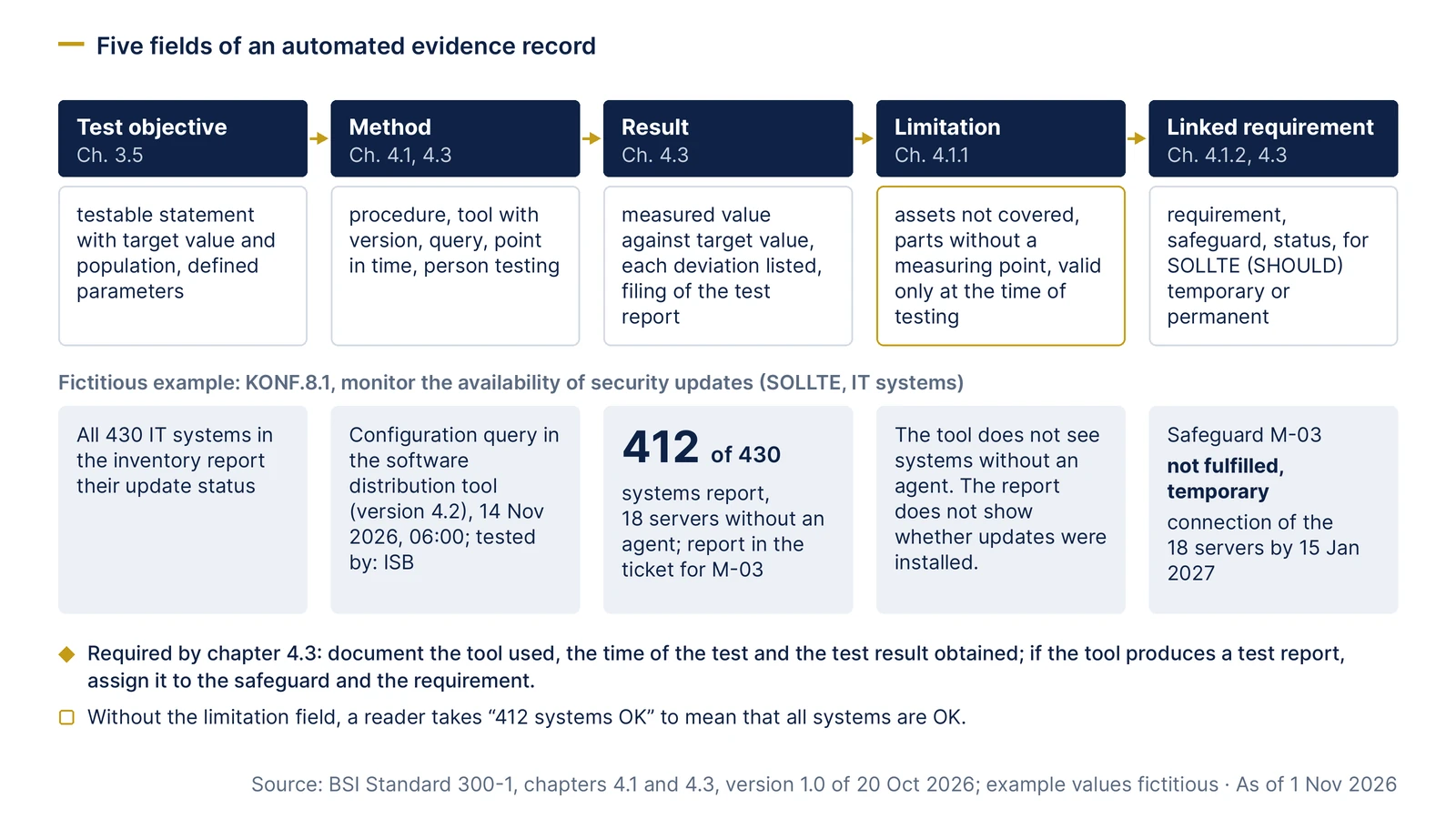
Five fields of an automated evidence record
A report from a tool contains measured values. To support a status in the implementation plan, it needs a framework. We use five fields for this; the structure is our own recommendation, and it contains the mandatory details from 300-1.
| Field | Content | Reference to 300-1 |
|---|---|---|
| Test objective | What exactly is measured, as a testable statement with target value and population, for example "all IT systems in the inventory report their update status". Defined parameters are included here. | Chapter 3.5 (parameters) |
| Method | Procedure (configuration query, scan, log analysis, comparison of two inventories), tool with version, query or test rule, point in time, person testing. | Chapters 4.1, 4.3 |
| Result | Measured value against target value, each deviation named individually, filing location of the test report. | Chapter 4.3 |
| Limitation | What the test does not cover: assets outside the reach of the tool, parts of the requirement without a technical measuring point, validity only at the time of testing. | Chapter 4.1.1 (full verification per requirement) |
| Linked requirement | Requirement with identifier, modal verb and target object category (Zielobjektkategorie), assigned safeguard, the resulting status and, for SOLLTE requirements (SHOULD) that are not fulfilled, the classification as temporary or permanent. | Chapters 4.1.2, 4.3 |
The limitation field is what makes automated evidence auditable. Without it, every later reader takes "412 systems OK" to mean that all systems are OK.
Sample record: six technical tests
Fictitious example. The requirements come from the Grundschutz++ user catalogue (build 2026-10-29). Information domain, tools, dates, figures and safeguard identifiers are invented. Tools are named by their function because the catalogue does not prescribe products.
| Test objective | Method | Result | Limitation | Linked requirement |
|---|---|---|---|---|
| All 430 IT systems in the inventory report their security update status to the central software distribution tool. | Configuration query in the software distribution tool (version 4.2), 14 Nov 2026, 06:00, export as CSV; comparison of device names with the inventory. Tested by: information security officer (ISB). | 412 of 430 systems report. 18 servers without an agent, list in the report. Report filed in the ticket for safeguard M-03. | The tool does not see systems without an agent; they only show up in the comparison with the inventory. This report does not show whether updates were installed. | KONF.8.1: monitor the availability of security updates (SOLLTE, IT systems). Safeguard M-03. Status: not fulfilled, temporary; connection of the 18 servers by 15 Jan 2027; residual risk identified, reported to top management and approved by it for a limited period until 15 Jan 2027 (see note below the table). |
| Successful and failed logins from all six server groups arrive in the central logging system. | Query in the logging system for login events per source over seven days, 18 Nov 2026; in addition, one test login with a wrong password per server group. Tested by: ISB. | All six groups deliver success and failure events; all six test logins appear within two minutes. | The query shows receipt per group, not per individual system; the test login is a sample. This row does not test retention and analysis of the events. | DET.3.1.1: log successful and failed authentications (SOLLTE, IT systems). Safeguard M-04. Status: fulfilled. |
| If a log source fails, this is noticed. | Planned shutdown of log forwarding on a test server, 18 Nov 2026, 10:00; check whether the monitoring rule in the logging system generates an alert. Tested by: ISB. | Alert after 35 minutes to the operations mailbox; target value according to the detection concept: 60 minutes. | One failure pattern has been tested (forwarding off). This rule does not detect a source that keeps sending, but incompletely. | DET.4.1: monitor the proper functioning of logging (SOLLTE). Safeguard M-12. Status: fulfilled. |
| Every account with far-reaching privileges requires multi-factor authentication. | Script reads the members of the groups defined as privileged and their authentication policy from the directory service, 20 Nov 2026; script version recorded in the repository. Tested by: ISB. | 25 of 27 accounts with mandatory MFA. Two emergency accounts without MFA, deliberately set up that way. | Which privileges count as "far-reaching" has been defined by the organisation; the script only checks these groups. It does not cover local administration accounts outside the directory service. | BER.5.9: enable multi-factor authentication for far-reaching privileges (SOLLTE). Safeguard M-11. Status: not fulfilled, permanent for the emergency accounts; this triggers a risk assessment in accordance with chapter 4.1.2, residual risk scheduled for approval in the next management review. |
| The built-in storage of all 370 laptops and workstations is encrypted. | Query of the encryption status in endpoint management, 21 Nov 2026. Tested by: ISB, using data from the endpoint management of the workplace IT operations team. | 368 encrypted, 2 without a status report for more than 30 days. | This tool does not cover servers; they have a row of their own. The status shows that encryption is active, not whether the method and key length meet the organisation's own requirements. | KONF.3.2: encrypt built-in storage media (SOLLTE, IT systems). Safeguard M-13. Status: not fulfilled, temporary; clarification of the two devices by 15 Dec 2026; residual risk identified, reported to top management and approved by it for a limited period until 15 Dec 2026 (see note below the table). |
| Vulnerability scans run as defined, findings are analysed and treated. | Review of the vulnerability scanner reports for August to October 2026 and comparison of the critical findings with the ticket system, 25 Nov 2026; in addition, a document review of the detection concept. Tested by: ISB. | Three monthly scans carried out, 14 critical findings, 3 of them without a ticket. | The requirement calls for an established procedure. The scan reports show that scans were carried out and what they found; only the document shows that the procedure has been defined and approved. | DET.5.3: establish a procedure for vulnerability scanning including the analysis and treatment of the findings (SOLLTE). Safeguard M-09. Status: not fulfilled, temporary; tickets and follow-up check by 15 Dec 2026; residual risk identified, reported to top management and approved by it for a limited period until 15 Dec 2026 (see note below the table). |
Two rows show borderline cases of the method: for BER.5.9, the technical finding for the defined groups shows a permanent non-fulfilment that triggers a risk assessment; the local accounts need a second piece of evidence. For DET.5.3, the technical report alone is not enough because the requirement calls for an organisational decision.
Note on temporary non-fulfilment: chapter 4.1.2 says that a temporary non-fulfilment does not trigger a risk assessment. Chapter 2.11 requires, for SOLLTE requirements that are included in the implementation planning but not yet fulfilled, a residual risk assessment and approval of the risk by top management; chapter 4.1.1 requires the risk to be identified and reported to top management. How these passages fit together is an open question of interpretation. For KONF.8.1, KONF.3.2 and DET.5.3, the sample record takes the cautious route: identify the residual risk, report it to top management and have it approved for a limited period up to the implementation deadline.
Where automated evidence stops
Completeness: chapter 4.1.1 requires the implementation status of every requirement to be fully verified. Under chapter 3.4, a requirement that applies to several assets of the same target object category appears only once in the requirements package, and there is no "partially" status. A tool that sees only some of the assets therefore cannot justify "fulfilled" on its own. Comparison with the inventory belongs to every technical test, and assets outside the tool's reach need a second piece of evidence.
Point in time: chapter 4.3 requires the time of the test because a test result only applies to that moment. How often testing takes place follows from the parameter of the requirement or from your evidence plan. A report older than the defined interval no longer proves the current state.
Person: even with automated testing, the documentation names the person testing (chapter 4.3). The tool supplies measured values; the status is assigned by a person who assesses deviations, checks exceptions and makes the classification as temporary or permanent. Under chapter 4.5, a conflict of interest between implementation and progress tracking is to be prevented by an appropriate allocation of roles; whoever operates the tool should therefore not sign off their own report alone.
Organisational parts: in the build of 29 October 2026, 137 requirements have the action word „verankern“ (establish) and 100 the action word „dokumentieren“ (document) (our own count of the action_word field). According to chapter 3.4.2, the requirements at the highest level of a target object category strand mostly contain requirements of a conceptual nature. Technical reports then show that the procedure is being followed; the procedure itself is proven by a document review.
Not applicable: the fact that a tool reports nothing on a requirement does not make it "not applicable". Under chapter 4.1.1 there are only two reasons for that: the requirement cannot be fulfilled functionally, or the underlying component does not exist in the information domain. Both must be justified per requirement.
Effectiveness: an active setting does not yet prove that the safeguard achieves its purpose. For the evaluation, chapter 6.4 provides for measurable criteria for the effectiveness of each safeguard and for targeted tests. The test login and the planned shutdown in the sample record are such tests; a pure configuration query is not.
Which requirements lend themselves to technical tests
The catalogue does not mark any requirement as "testable by automation". The field documentation of the requirement statement gives an indication. In the build of 29 October 2026, 183 of the 1,000 requirements have the value „Konfigurationshistorie“ (configuration history) there and 19 the value „Audit Log“, 202 in total (our own count across all levels). Of these, 144 are SOLLTE and 58 KANN (MAY) requirements; none of them is a MUSS (MUST) requirement. This classification is our analysis, not a BSI specification, and it is not exhaustive: requirements with other entries, such as „Inventar IT-Systeme“ (IT system inventory) or „Detektions-Konzept“ (detection concept), can also be tested technically in part, as the sample record shows.
The methodology requirements can hardly be tested technically. Under chapter 3.4.1 they apply mandatorily to every information domain and concern procedures, roles and reports, that is implementation status, audits or the management report. One of them calls for monitoring itself: PERF.5.1, a MUSS requirement, calls for establishing „effektive Monitoring-Methoden und -tools zur [regelmäßigen] Überwachung der Informationssicherheit“ (our translation: "effective monitoring methods and tools for [regular] monitoring of information security"). Anyone who generates technical evidence systematically has thereby laid part of the groundwork for PERF.5.1; it does not replace evidence that these methods and tools have been established.
- Well suited: requirements with a clear measuring point in a configuration or a log, such as update status, mandatory MFA, encryption status, logging of specific events.
- Suitable with a second piece of evidence: requirements calling for a procedure whose execution leaves technical traces, such as vulnerability scans or restore tests.
- Hardly suitable: requirements for policies, roles, contracts, training and top management decisions; here document review and interview remain the procedures.
Versioning test rules and keeping results up to date
A test rule is the translation of a requirement into a query. Because the catalogue is worded product-neutrally, this translation contains a decision of your own: which groups count as privileged, which systems belong to the population, which threshold counts as fulfilled. Record these decisions in writing, with reference to the requirement, and store scripts and queries under version control. If a test rule changes, the statement made by the evidence changes.
The history recommended in chapter 4.3 almost builds itself if every test run creates its own entry with point in time, tool, version, result and person testing, and earlier entries are kept. If the result changes, update the status in the implementation plan. If a tool is replaced, it is best to run the old and the new test in parallel for a while so that differences in counting become visible.
For top management, the results can be condensed into indicators, such as the share of systems with a current update status. Chapter 5.4 expressly names the creation of indicators and reports as one purpose of the monitoring data. How to keep such values separate from the BSI's announced specifications is shown on the page on management review and indicators.
Where automated evidence sits in the ISMS
Automated evidence is one part of the evidence plan. The remaining questions are covered on separate pages:
- Who provides and checks which evidence and when is set out in the evidence plan.
- How a status is assigned and a deviation documented is described under assessing requirements and documenting deviations.
- What follows from a permanent non-fulfilment such as in the BER.5.9 example is described on the risk analysis page.
- How to analyse the catalogue data yourself is shown on the page on the Grundschutz++ user catalogue.
- How test results feed into the report to top management is shown on the page management review and indicators.
Blackfort Technology supports you with this as part of implementation under Grundschutz++: in the evidence plan we define with you which reports from your operations tools prove a requirement, which limitations are documented with them and where a second piece of evidence is needed.