

What 300-1 and the catalogue require for the management review
In the management review, top management checks under chapter 5.3 whether the ISMS is suitable, adequate and effective; it is based on the management report. Chapter 5.3 lists the points to be taken into account. The methodology part of the user catalogue sets out the management report as requirements in the practice (Praktik) PERF. Side by side below; the mapping of the rows is ours:
| Point | 300-1 | Requirement in the user catalogue (build 2026-10-29) |
|---|---|---|
| Management report as the basis | Chapter 5.3 | PERF.4.1 (MUSS, i.e. MUST): document the results of the reviews of the suitability, adequacy and effectiveness of the ISMS [regularly] and as required by events in a management report |
| Report to top management | Chapter 5.3; status reports to management also under chapter 4.5 | PERF.4.2 (MUSS): inform top management about the status of the management system [regularly] on the basis of the management report |
| Status of earlier management decisions | Chapter 5.3 | PERF.4.1.1 (SOLLTE, i.e. SHOULD): status of follow-up actions from previous management reviews |
| Changes in the organisation or the threat situation | Chapter 5.3 | PERF.4.1.2 (SOLLTE): changed conditions with an impact on information security management |
| Security incidents | Chapter 5.3 | PERF.4.1.3 (SOLLTE): successes and problems to date, for example security incidents |
| Audit results | Chapter 5.3 | PERF.4.1.4 (SOLLTE): audit reports |
| Results of the performance evaluation | Chapters 5.1 and 5.3 | PERF.1.1 (MUSS): establish procedures and rules for measuring and evaluating the performance of the ISMS |
| Status of risk treatment | Chapter 5.3 | PERF.4.1.7 (SOLLTE): successful implementation of safeguards and the risk reduced as a result (status of the implementation plan) |
| Suitability of the safeguards | - | PERF.4.1.5 (SOLLTE): evaluation of the suitability of implemented security safeguards for achieving the security objectives |
| Feedback | - | PERF.4.1.6 (SOLLTE): evaluation of feedback from customers, business partners, employees or the public on security aspects |
| Improvements | Chapter 6.3 | PERF.4.1.8 (SOLLTE): improvements to the ISMS derived from the review |
| Safeguard proposals | - | PERF.4.1.9 (MUSS): prioritised safeguard proposals with realistic estimates of the expected implementation effort |
| Regularity | Chapter 5.3 | Parameter „regelmäßig“ (regularly) in PERF.4.1 and PERF.4.2; the organisation sets the value (chapter 3.5) |
Three of the requirements on the management report (group PERF.4) are MUSS requirements and, under chapter 4.1.2, allow neither an exception nor risk acceptance: the documented management report (PERF.4.1), informing top management (PERF.4.2) and the prioritised safeguard proposals with effort (PERF.4.1.9). Added to these is PERF.1.1 on performance measurement, also MUSS. A management report without safeguard proposals and effort estimates does not fulfil PERF.4.1.9. On the purpose of the review, chapter 5.3 states that top management thereby takes „sichtbar Verantwortung für das ISMS und dessen regelmäßige Verbesserung“ (our translation: "visible responsibility for the ISMS and its regular improvement").
What the BSI has announced on indicators
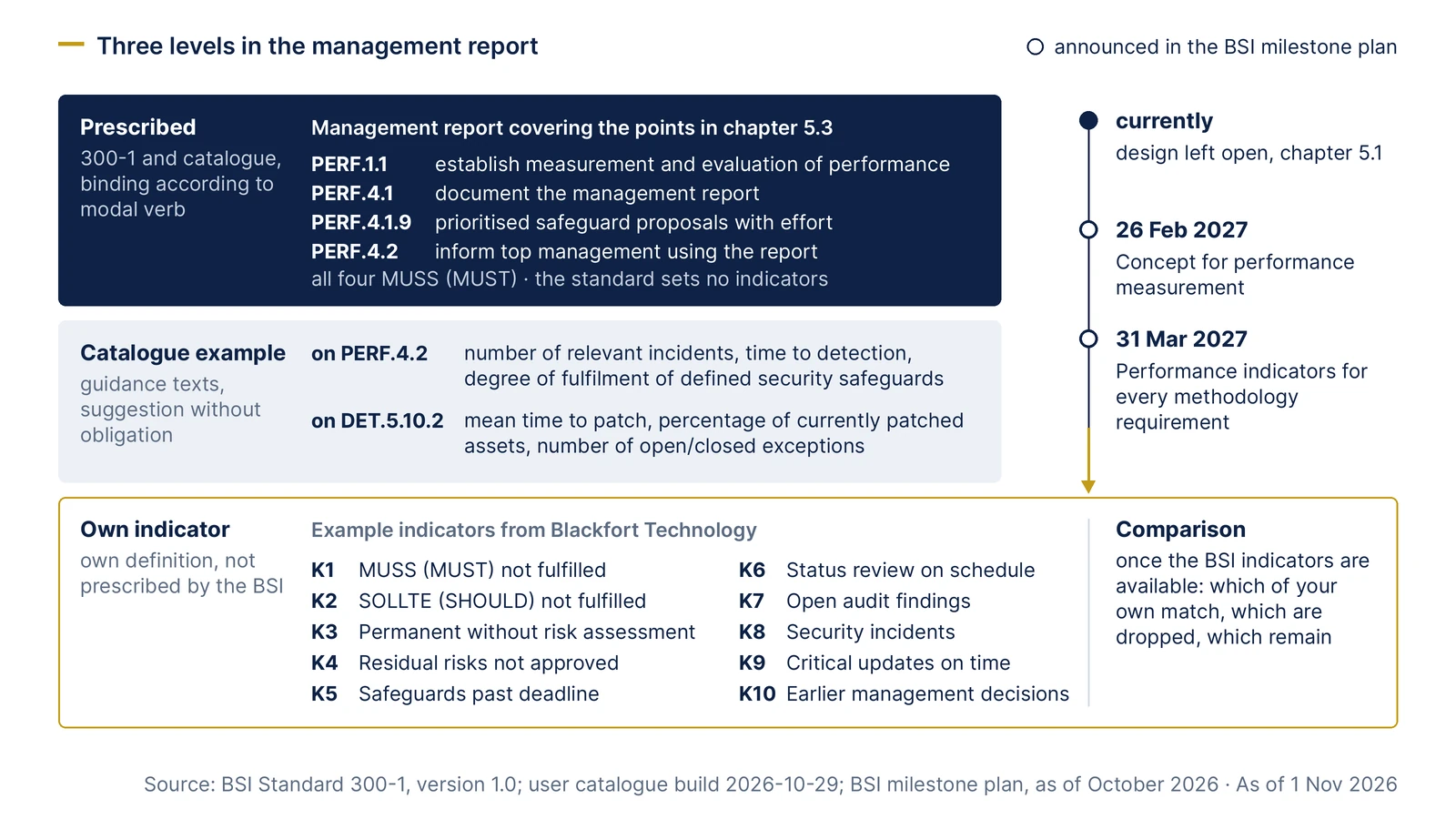
On performance evaluation, 300-1 states in chapter 5.1: „Da die Entwicklung einheitlicher Vorgaben zur Leistungsbewertung im GS++ noch aussteht, sind die Institutionen frei in der Ausgestaltung.“ (our translation: "As the development of uniform specifications for performance evaluation in GS++ is still pending, organisations are free to design it as they see fit.") The performance evaluation should be presented to top management in a way that can be traced. The BSI milestone plan (as of October 2026) gives two dates:
| Date | Milestone according to the BSI | What this means for your indicators |
|---|---|---|
| 26 Feb 2027 | „Das Konzept zur Leistungsmessung des ISMS auf Basis des GS++ ist in die Methodik integriert und kann angewendet werden.“ (our translation: "The concept for measuring the performance of the ISMS on the basis of GS++ is integrated into the methodology and can be applied.") | From then on there is a BSI method. What it looks like is not known before publication. |
| 31 Mar 2027 | „Jede Anforderung aus den Methodik-Praktiken hat Leistungskennzahlen zur Leistungsmessung.“ (our translation: "Every requirement from the methodology practices has performance indicators for performance measurement.") | Indicators are coming for the methodology requirements. The milestone says nothing about indicators for the technical and organisational requirements. |
On scope: the methodology catalogue of the State-of-the-Art Library (Stand-der-Technik-Bibliothek, as of 22 October 2026) contains the practices GC, STM, UMS, VRB and PERF with 95 requirements in total; the user catalogue of 29 October 2026 also has 95 (own count). Under chapter 3.4, the methodology requirements relate to the entire information domain and cover chapters 4 to 10 of DIN EN ISO/IEC 27001. In substance, they are requirements for procedures, roles, audits and reports. Which indicators the BSI will assign to them is not known before publication.
Until the end of March 2027, this means you choose your indicators yourself. Choose them so that you can later set them alongside the BSI indicators and replace them if necessary, and mark them in every report as your own provisional definition.
Keeping prescribed requirements, catalogue examples and own indicators apart
A management report under Grundschutz++ currently contains three kinds of information side by side. So that nobody mistakes an internal definition for a BSI requirement, every indicator should be clearly assigned to one of these levels:
| Level | Examples | Binding force |
|---|---|---|
| Prescribed by 300-1 and the catalogue requirements | Management report covering the points in chapter 5.3; MUSS requirements PERF.1.1, PERF.4.1, PERF.4.1.9, PERF.4.2. The standard does not prescribe indicators. | binding according to the modal verb |
| Example in the catalogue (guidance texts on requirements) | On PERF.4.2, the guidance text names as possible indicators „Anzahl relevanter Vorfälle, Zeit bis zur Entdeckung, Erfüllungsgrad definierter Sicherheitsmaßnahmen“ (our translation: "number of relevant incidents, time to detection, degree of fulfilment of defined security safeguards"). On DET.5.10.2, it names „durchschnittliche Zeit bis zum Patch (Mean Time To Patch), Prozentsatz aktuell gepatchter Assets, Anzahl offener/geschlossener Ausnahmen“ (our translation: "average time to patch (mean time to patch), percentage of currently patched assets, number of open/closed exceptions"). | suggestion; the requirements themselves do not prescribe these indicators |
| Own indicator of the organisation | Everything you define in addition, such as the example indicators in the next section. | own definition, to be compared with the BSI indicators by 2027 |
A sentence from the classic BSI Standard 200-2, chapter 10.1.1, helps with the selection: „Kennzahlen haben eine begrenzte Aussagekraft, da damit einzelne, meist wenige Bereiche der Informationssicherheit punktuell beleuchtet werden, nämlich meist diejenigen, in denen sich leicht Messwerte erzielen lassen.“ (our translation: "Indicators have limited informative value, as they shed light selectively on individual, usually few areas of information security, namely usually those in which measured values can easily be obtained.") If you only report values from tools, you show top management the technical slice and miss points such as audit results or open risk decisions. For users of classic IT-Grundschutz, BSI Standard 200-1 continues to apply, with the section „Managementbewertungen“ (management reviews) in chapter 8.3, and in the 2023 Compendium the requirement ISMS.1.A12 „Management-Berichte zur Informationssicherheit“ (management reports on information security).
Our own example indicators (not prescribed by the BSI)
Labelling: The following indicators are proposals from Blackfort Technology. They come neither from BSI Standard 300-1 nor from the user catalogue. They build on terms used in the standard so that they can be counted from the implementation plan and set alongside the indicators announced by the BSI.
| Own indicator | Calculation | Data source | Link to 300-1 | Limitation |
|---|---|---|---|---|
| K1 MUSS requirements not fulfilled | Number on the reference date, with list | Implementation plan | Chapter 4.1.2: no exception, no risk acceptance | says nothing about the severity of the individual gap |
| K2 SOLLTE requirements not fulfilled | Number, split into temporary and permanent | Implementation plan | Chapter 4.1.2 | a total without the split hides the permanent cases |
| K3 Permanent non-fulfilments without a completed risk assessment | Number | Implementation plan, risk register | Chapters 2.11 and 4.1.2 | target is zero |
| K4 Residual risks without approval by top management | Number, with age | Risk register | Chapter 4.2.3 | target is zero after every meeting |
| K5 Safeguards past their deadline | Number and share of all open safeguards | Implementation plan, ticketing system | Chapters 4.4 and 4.5 | postponed deadlines do not show up; keep a history |
| K6 Status review on schedule | Share of requirements whose last status review lies within the value set for „regelmäßig“ (regularly) | Evidence plan | Chapter 4.1.1; requirement UMS.1.1 | measures currency, not the quality of the review |
| K7 Open audit findings | Number, of which older than 90 days | Audit reports, implementation plan | Chapter 5.2.2 | the 90-day threshold is chosen freely |
| K8 Security incidents | Number by own severity level, median time to detection | Incident handling | Chapters 5.3 and 5.4 | few cases, so report as a number and with a short description |
| K9 Security updates within the deadline | Share of IT systems on which critical updates are installed within the set deadline | Software distribution, inventory | Chapter 5.4; cf. guidance text on DET.5.10.2 | only as good as the coverage of the tool |
| K10 Implementation of earlier decisions by top management | Number completed, open, postponed | Minutes of the management review | Chapter 5.3 | - |
We have deliberately not provided an overall percentage. For each requirement, 300-1 only knows "fulfilled", "not fulfilled" and "not applicable", and a MUSS requirement that is not fulfilled cannot be offset against many fulfilled SOLLTE requirements. How technical values such as K9 are produced reliably is described on the page Automated evidence.
Meeting pack for the management review
Fictitious example. Organisation, information domain, figures, roles and dates are invented. The structure follows chapter 5.3 of 300-1 and the requirements PERF.4.1 to PERF.4.2; the indicators are our own example indicators from the previous section.
Management review 1/2027, information domain "Specialist Procedures and Online Services". Data as of: 31 January 2027. Meeting: 12 February 2027, 60 minutes. Presented by: information security officer (ISB). Participants: top management, ISB, head of IT operations, owners of the two business processes with high protection requirements.
Agenda
| Item | Content | Basis | Purpose |
|---|---|---|---|
| 1 | Status of the decisions from review 2/2026 of 12 Nov 2026 | Chapter 5.3; PERF.4.1.1 | For information |
| 2 | Changes: new cloud service for the citizen portal, changed threat situation for web applications | Chapter 5.3; PERF.4.1.2 | For information |
| 3 | Security incidents, successes and problems in the reporting period | Chapter 5.3; PERF.4.1.3 | For information |
| 4 | Result of the internal audit of November 2026 | Chapter 5.3; PERF.4.1.4 | For information |
| 5 | Performance evaluation with our own indicators K1 to K10 | Chapters 5.1 and 5.3; PERF.1.1 | For information |
| 6 | Status of the implementation plan and of risk treatment, suitability of the safeguards | Chapters 4.5 and 5.3; PERF.4.1.5, PERF.4.1.7 | For information |
| 7 | Residual risks for approval | Chapters 2.11, 4.1.1, 4.1.2, 4.2.3 | Decision |
| 8 | Prioritised safeguard proposals with effort, improvements | PERF.4.1.8, PERF.4.1.9 | Decision |
| 9 | Date of the next review | Chapter 5.3; PERF.4.2 | Decision |
Indicators for item 5 (our own example indicators, not prescribed by the BSI; requirements package with 640 requirements)
| Indicator | 31 Jan 2027 | 31 Oct 2026 | Target | Comment |
|---|---|---|---|---|
| K1 MUSS requirements not fulfilled | 3 | 7 | 0 | safeguards planned with a deadline of 30 Apr 2027 |
| K2 SOLLTE not fulfilled, temporary / permanent | 41 / 4 | 58 / 3 | - | new permanent non-fulfilment: BER.5.9 for two emergency accounts |
| K3 Permanent without completed risk assessment | 0 | 1 | 0 | - |
| K4 Residual risks without approval | 2 | 0 | 0 | approval under item 7: BER.5.9 (new) and KONF.8.1 (approval was limited to 15 Jan 2027 and lapsed with the missed deadline). KONF.3.2 and DET.5.3 were fulfilled by 15 Dec 2026, and the retest for NOT.4.16.1 on 28 Jan 2027 was successful; their time-limited approvals are therefore closed. |
| K5 Safeguards past their deadline | 6 of 52 | 9 of 61 | 0 | four of them are waiting for a service provider |
| K6 Status review on schedule | 94% | 81% | 100% | schedule set to quarterly |
| K7 Open audit findings, of which older than 90 days | 5, of which 1 | 8, of which 3 | 0 older than 90 days | - |
| K8 Security incidents high / medium, median to detection | 0 / 3, 6 hours | 1 / 2, 19 hours | - | short description in annex 2 |
| K9 Critical updates within the deadline | 91% of 430 systems | 86% of 418 | 100% | 18 servers without agent not covered, connection not completed by 15 Jan 2027 |
| K10 Decisions of the previous review | 4 completed, 1 postponed | - | - | postponed: emergency exercise for the data centre |
Proposed decisions
| No. | Decision | Basis | Responsible | Deadline |
|---|---|---|---|---|
| B1 | The residual risk from the permanent non-fulfilment of BER.5.9 for two emergency accounts is approved following the risk assessment carried out; review within twelve months at the latest. | Chapters 4.1.2 and 4.2.3; Annex 3, criteria 30, 34 and 35 | Top management | Meeting |
| B2 | The residual risk from the temporarily unfulfilled SOLLTE requirement KONF.8.1, whose approval limited to 15 Jan 2027 has lapsed, is approved again, limited to the new deadline of 31 Mar 2027. | Chapters 2.11 and 4.1.1 (see note) | Top management | Meeting |
| B3 | Additional operating hours are provided for connecting the 18 servers; new deadline 31 Mar 2027. | Chapter 4.4 (resources); PERF.4.1.9 | Head of IT operations | 31 Mar 2027 |
| B4 | Our own indicators K1 to K10 remain provisional; once the BSI performance indicators have been published, the ISB presents a comparison at the next review. | Chapter 5.1; milestone plan | ISB | Next review |
| B5 | The parameter „regelmäßig“ (regularly) in PERF.4.1 and PERF.4.2 remains half-yearly; next review in August 2027, earlier if required by events. | Chapters 3.5 and 5.3 | Top management | Meeting |
Note on B2: Chapter 4.1.2 states that a temporary non-fulfilment does not trigger a risk assessment. Chapter 2.11 requires, for SOLLTE requirements that are included in implementation planning but not yet fulfilled, an assessment of the residual risk and approval by top management; chapter 4.1.1 requires the risk to be identified and communicated to top management. How these passages fit together is an open question of interpretation. The meeting pack takes the cautious route and presents the residual risk for approval.
Preparing and following up the meeting
- Set the reference date. All figures relate to the same data status; it is stated at the top of the report.
- Take figures from the working documents. Indicators come from the implementation plan, risk register, evidence plan and audit reports. If you collect them specially for the meeting, you report a status that nobody keeps up to date.
- Prepare decisions. Every point that needs a decision gets a paper with basis, options and consequences. Present residual risks together with the risk assessment carried out.
- Safeguard proposals with effort. PERF.4.1.9 requires them as a MUSS requirement; without an effort estimate, top management cannot release resources.
- Send the pack in advance. A fixed lead time of a few working days gives top management time for questions; the meeting itself is for decisions.
- Minutes and transfer. Transfer decisions with responsibility and deadline to the implementation plan; under chapter 6.3, the corrective and improvement plan is included in the implementation plan. At the next review, item 1 reports on their status.
Once the BSI indicators have been published
With the concept for performance measurement and the performance indicators for the methodology requirements, what you report under item 5 may change. Exactly what the BSI will prescribe cannot be said before publication. Plan a comparison for this reason: which of your own indicators match the new ones, which are dropped, which remain as a supplement. Continue to mark your own indicators that you keep as your own.
Time series are valuable here. If you have been collecting the same own indicators with the same definitions since 2026, you can still show top management after the changeover how the status has developed. If you change a definition, note this in the report and break the time series visibly.
For certification projects for ISO 27001 on the basis of Grundschutz++, which according to the milestone plan can be applied for from 1 January 2027, the first management review may take place before the indicators are published. This is covered by chapter 5.1, which leaves the design open until then. Document which indicators you have chosen and why.
Where the management review sits in the ISMS
The management review draws on the results of other process steps. These pages cover them:
- Where status, dates and review results come from: Evidence plan and Automated evidence.
- How residual risks that are presented to top management arise: Risk analysis and Minimum criteria for risk assessment.
- How a status is assigned and a non-fulfilment classified: Assessing requirements and documenting deviations.
- Which other dates are coming up in 2027: Grundschutz++ timeline.
Preparing the management report on an ongoing basis and preparing the review are part of running the ISMS. Blackfort Technology supports this as an external information security officer; the service is described on the company website: External information security officer.