
Consulting
Grundschutz++ implementation and migration: building an ISMS under BSI Standard 300-1
In a Grundschutz++ implementation you build your ISMS from scratch under BSI Standard 300-1 of the Bundesamt für Sicherheit in der Informationstechnik (BSI), the German Federal Office for Information Security, or transfer an existing ISMS to it. In package C we work out with you the business processes and protection requirements, requirements package (Anforderungspaket), implementation plan, risk method and evidence plan. Package E reviews the status in internal audits and prepares you for the certification audit.

Starting point
You have decided to work under Grundschutz++, or your readiness analysis is complete. Now the work itself begins: the methodology is set out in BSI Standard 300-1, version 1.0 of 20 October 2026, the requirements in the Grundschutz++ user catalogue (Anwenderkatalog). According to the BSI milestone plan (Meilensteinplan), applications for ISO 27001 certification on the basis of Grundschutz++ can be submitted from 1 January 2027.
For a first implementation, 300-1 recommends starting with the most important business process from the highest protection requirements category (chapter 2.6). Anyone coming from the IT-Grundschutz Compendium 2023 remodels using target object categories (Zielobjektkategorien), rates each requirement as „erfüllt“, „nicht erfüllt“ or „nicht anwendbar“ (our translation: "fulfilled", "not fulfilled" or "not applicable") and switches the risk assessment to the minimum criteria (Mindestkriterien) in Annex 3. The BSI mapping table from the Compendium 2023 to Grundschutz++ has draft status. We check individually each mapping on which you base evidence.
Work packages
Package C follows process steps 1 to 3 of 300-1, package E the internal audit from process step 4 (chapter 5.2) and the preparation for the certification audit. You can start package C for one business process and add further processes later. Package E can also be commissioned on its own.
Package C
Survey and planning
Context of the organisation, integration of compliance management, scope, interested parties, business processes and protection requirements per business process, information security policy, roles, documentation and framework of the risk assessment. In addition, the decision papers with which top management defines and approves scope, protection requirements, order, resources and information security policy (chapter 2.10).
Protection requirements determinationPackage C
Requirements analysis
Delimit the information domain, take over assets with their dependencies from your existing inventory data, select blueprints (Blaupausen), assign assets to target object categories, form the requirements package and set parameters such as „regelmäßig“ (our translation: "regularly").
Modelling with target object categoriesPackage C
Implementation
Determine the implementation status per requirement, classify unfulfilled SOLLTE (SHOULD) requirements as temporary or permanent, carry out the risk assessment in the cases under chapter 2.11, draw up the implementation plan with safeguards, responsibilities and deadlines.
Assessing requirementsPackage C
Migration from the Compendium 2023
Remodelling of the existing information domain, transfer of existing implementation evidence via the BSI mapping table, matched by UUID against the catalogue build used and checked on its merits for each mapping, conversion of the risk analysis and the documentation to 300-1. The starting point is the delta list from package B or an inventory of your own.
Grundschutz++ migrationPackage C
Risk method under Annex 3
In depth: set up an existing or new method so that each of the 35 minimum criteria is evidenced, with procedure, roles, criteria, risk register and authorisation of the framework by top management.
The 35 minimum criteriaPackage C
Evidence plan
For each requirement, the chain of safeguard, evidence, assessment, responsibility, date and decision. The structure is our own. It contains the information required by chapters 4.1 and 4.3 to 4.5. Together with you we define which reports from tools in your operation serve as evidence.
Evidence planPackage E
Internal audits
Audit programme under chapter 5.2 with objectives, risks of the programme and scope, conduct of the internal audits and audit report with findings. Only for an ISMS that we did not help to build, so that objectivity and impartiality are preserved.
Package E
Preparation for the certification audit
Review of the documents before the audit with a list of open points, support during the audit and handling of deviations. The certification audit itself is carried out by an independent auditor.
Understanding certification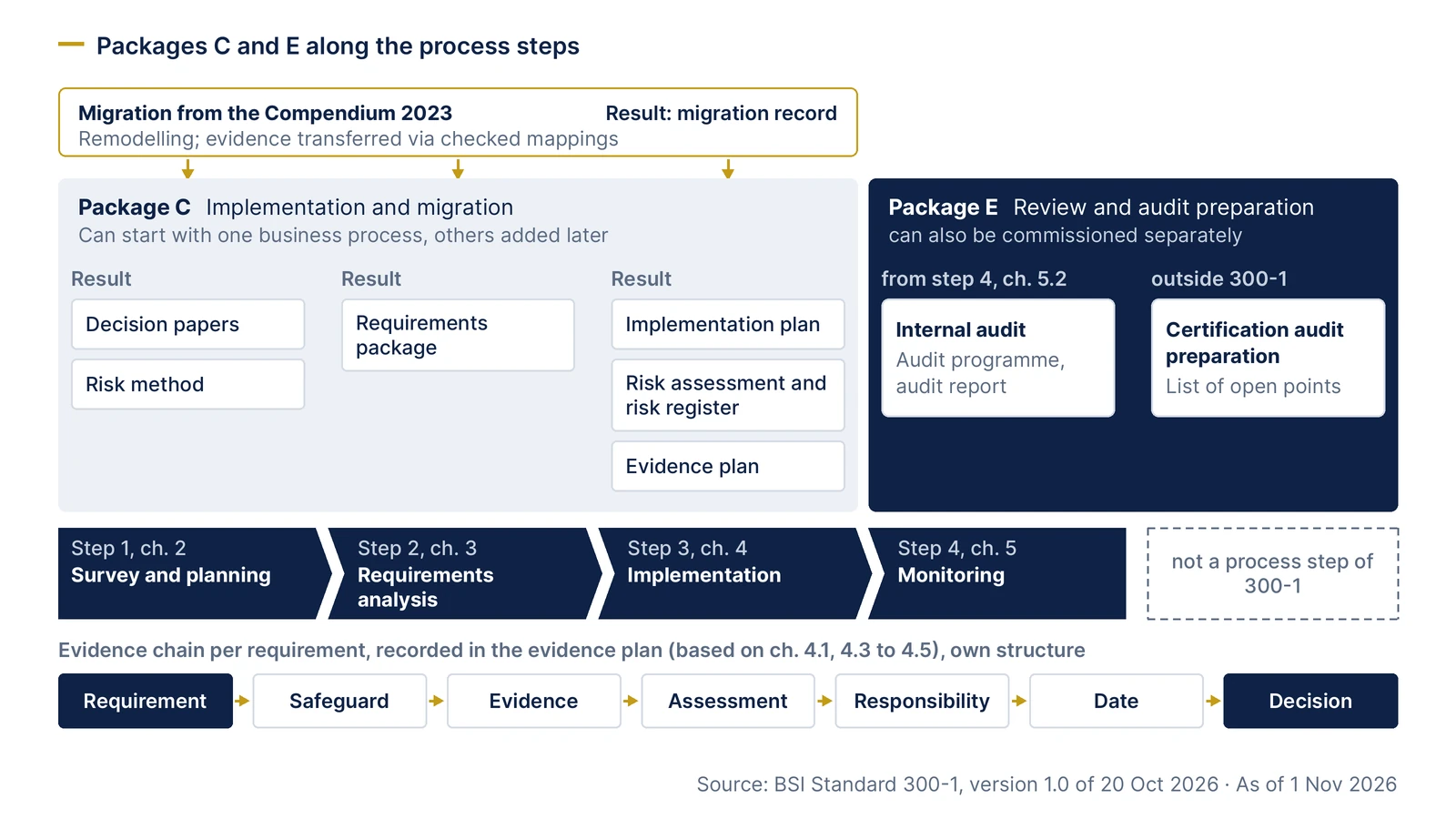
Format of results
You receive all documents in editable formats, with chapter references to 300-1 and the catalogue build used, so that your internal coordination can maintain them.
01
Decision papers (package C)
Papers on scope, protection requirements of the business processes, order, resources and information security policy, each with a proposed resolution.
02
Requirements package (package C)
Assignment of the assets to target object categories, the requirements derived from it and the parameter values set.
03
Implementation plan (package C)
Status per requirement, justification of each non-applicability, safeguards mapped to requirements, responsibility and deadline.
04
Risk method and risk register (package C)
Method document, register with the mandatory fields and one row per minimum criterion with reference.
05
Evidence plan (package C)
Chain from requirement to decision, with supplying and checking role. An extract is shown below as an example.
06
Migration record (package C)
For a migration: checked mappings from the Compendium 2023 with catalogue build, finding and transferred evidence.
07
Audit programme and audit report (package E)
Objectives, scope and schedule of the programme. For each audit, findings, assessment and recommendations.
08
List of open points (package E)
Result of the review before the certification audit, with responsibility and date for each point.
Example evidence chain
Fictitious example. The requirements come from the Grundschutz++ user catalogue (build 2026-10-29), safeguards, roles, dates and results are invented. Each row shows how a requirement becomes a traceable decision.
| Requirement | Safeguard | Evidence | Assessment | Responsibility | Date | Decision |
|---|---|---|---|---|---|---|
| BER.5.9: activate multi-factor authentication for far-reaching privileges (SOLLTE) | M-11 MFA for all administration accounts in the directory service | Export of the account settings with tool, time and result: 25 of 27 accounts with MFA, two emergency accounts deliberately without MFA | not fulfilled, permanent for the emergency accounts; risk assessment carried out | supplies: IT operations (identities); checks: ISB | Review within twelve months at the latest | Risk assessment carried out; residual risk submitted to top management for approval at the next management review (chapter 4.1.2; Annex 3, criteria 30 and 34) |
| KONF.8.1: monitor the availability of security updates (SOLLTE, IT systems) | M-03 Weekly report from software distribution | Report with tool, time and result, matched against the inventory of IT systems: 412 of 430 systems report, 18 servers without agent | not fulfilled, temporary; connection of the 18 servers planned | supplies: IT operations (servers); checks: ISB | Connection by 15 Jan 2027 | Residual risk reported to top management and approved by it for a limited period until 15 Jan 2027; follow-up at the deadline |
| NOT.4.16.1: check restoration [regularly] at least on the basis of representative samples (SOLLTE, data); parameter set to every six months | M-06 Restore test for three data sets | Test record with date, scope and result: one data set not fully restored | not fulfilled, temporary; retest planned | supplies: person responsible for data backup; checks: ISB | Retest by 31 Jan 2027 | Corrective action added to the implementation plan; residual risk reported to top management and approved by it for a limited period until 31 Jan 2027; follow-up at the deadline |
| PERF.3.1.3: instruct professionally qualified and independent auditors to ensure the objectivity and quality of the audits (MUSS, i.e. MUST) | M-20 Appoint the audit team for the internal audit, with no involvement in the build | Appointment with evidence of competence and declaration of independence | fulfilled | supplies: ISB; checks: top management | before each internal audit | Appointment confirmed by top management |
Fictitious example. Chapter references relate to BSI Standard 300-1, version 1.0 of 20 October 2026. On the second and third rows: how chapters 2.11, 4.1.1 and 4.1.2 fit together for temporarily unfulfilled SOLLTE requirements is an open question. The rows show the cautious route with time-limited approval by top management.
Process and acceptance
Each process step ends with a result that you accept before the next one begins.
1
Scoping and offer
Initial call, review of the documents, definition of starting process, information domain and package scope; then a binding offer.
2
Survey and planning
Workshops with top management, business process owners and ISB; acceptance with the decision papers and the approvals of top management.
3
Requirements analysis
Work on inventory data and modelling with IT operations and business units; acceptance with the requirements package.
4
Implementation
Status determination, risk assessment, implementation and evidence plan; acceptance with the plan and approval of the approach by top management (chapter 4.4).
5
Review (package E)
Internal audit or review before the certification audit; acceptance with audit report or list of open points.
Acceptance points, correction rounds and the scope of each process step are set out in the offer.

Your contact
Christian Gebhardt · Founder and managing director, Blackfort Technology
Christian Gebhardt, founder and managing director of Blackfort Technology, is happy to take your enquiry personally. In a free initial call you work out together what you need; the consulting is carried out by the Blackfort Technology team.
Who is responsible for what
Top management
Under 300-1, responsibility for the ISMS lies with top management (Institutionsleitung) and cannot be delegated (chapter 2.10). It approves scope, protection requirements, order, resources and information security policy, authorises the framework of the risk assessment and approves residual risks.
Internal coordination or ISB
Arranges dates, obtains documents, tracks progress and maintains the results after the project.
Business process owners
Assess the protection requirements of their process and, unless otherwise specified, are also the risk owners (chapter 4.2.1).
IT operations and service providers
Implement technical safeguards in your systems and supply the evidence. A suitable allocation of roles prevents a conflict of interest between implementation and progress tracking (chapter 4.5).
Blackfort Technology
We advise as a team: methodology, facilitation of the workshops, drafts of all documents, review on the merits of the mappings and evidence, and in package E the audits and audit preparation.
Exclusions
So that it is clear what packages C and E do not include:
- Technical implementation in your systems. It lies with your IT operations or your service providers.
- A tool-supported review with Blackfort Technology's own tools. Evidence comes from the tools and documents of your operation.
- Internal audits of an ISMS that we helped to build.
- The certification audit and any statement on whether you will pass it.
- Legal advice. We classify the requirements that you name or that appear in your documents. Whether they apply legally is for your legal department to assess.
- The selection or introduction of an ISMS tool.
- Ongoing operation and external ISB (package D). This service is described on the company website, link under "Further reading".
We do not publish prices on this website. After the initial call you receive a binding offer for the agreed scope.
Frequently asked questions
What does implementing Grundschutz++ involve?
Process steps 1 to 3 of BSI Standard 300-1: survey and planning with business processes and protection requirements, requirements analysis with target object categories and requirements package, implementation with implementation status, risk assessment and implementation plan. Monitoring and continual improvement then follow in ongoing operation.
Do we have to tackle all business processes at once?
No. For a first implementation, 300-1 recommends starting with the most important business process from the highest protection requirements category (chapter 2.6). Top management sets the order of the further processes (chapter 2.10).
Do you also carry out the internal audit?
Yes, as package E, but only for an ISMS that we did not help to build. 300-1 provides for objectivity and impartiality of the audit process to be ensured through the selection of the audit team (chapter 5.2.2). The user catalogue turns this into the MUSS requirement PERF.3.1.3. If we built your ISMS, another, independent body takes on the internal audit.
Can evidence from our tools be used?
300-1 names automated configuration checks and technical scans as possible methods (chapter 4.1). Tool, time of the check and result must then be documented (chapter 4.3). In the evidence plan we define with you which reports from your tools evidence a requirement and where they are not sufficient. More on this on the page "Automated evidence" under "Further reading".
From when can certification under Grundschutz++ take place?
According to the BSI milestone plan, applications for ISO 27001 certification on the basis of Grundschutz++ can be submitted from 1 January 2027. Classic IT-Grundschutz remains certifiable until 30 November 2031.
Further reading
- BSI Standard 300-1 in practice
- Grundschutz++ migration
- Evidence plan
- Automated evidence
- Security concept
- Minimum criteria for the risk assessment
- Understanding certification
- Readiness analysis and migration concept (packages A and B)
- All consulting packages
- External information security officer (company website)
Get in touch
Request implementation or migration
Tell us your starting point (new build, Compendium 2023 or ISO 27001), the planned starting process and preferred dates. In the free initial call we clarify the scope.
Request an initial callSources
- BSI Standard 300-1 „Methodik Grundschutz++“, version 1.0 of 20 October 2026, and milestone plan (as of October 2026) on the BSI Grundschutz++ topic page (German) (version 2026-10-20), retrieved 2026-11-01
- BSI State-of-the-Art Library (Stand-der-Technik-Bibliothek), Grundschutz++ user catalogue (build 2026-10-29, commit c3f37859), licence CC BY-SA 4.0 (version 2026-10-29), retrieved 2026-11-01
Quotations from BSI standards and BSI web pages are © Federal Office for Information Security (BSI) and are reproduced verbatim, in quotation marks and with source reference. This is an independent offering, not an offering of the BSI.
- Last updated
- 2026-11-06
- Technically reviewed
- 2026-11-06
- Catalogue version
- Grundschutz++ user catalogue, build 2026-10-29 (commit c3f37859); mapping IT-Grundschutz 2023 → Grundschutz++ status draft
Licence notice
This page contains excerpts from catalogue data published by the German Federal Office for Information Security (BSI), licensed under CC BY-SA 4.0. The excerpts are shared under the same licence. This licence covers only these catalogue excerpts; quotations from BSI standards are © BSI and reproduced as quotations with source reference.
- Requirement texts (statement) of BER.5.9, KONF.8.1, NOT.4.16.1 and PERF.3.1.3 with modal verb, rephrased as infinitive, shortened and translated into English: BSI State-of-the-Art Library, Grundschutz++ user catalogue (build 2026-10-29, commit c3f37859), licence CC BY-SA 4.0, retrieved 2026-11-01. Shortened, translated or edited by Blackfort Technology.
This content provides general technical and organisational information on IT-Grundschutz and Grundschutz++ and does not constitute legal advice (no legal services within the meaning of the German RDG). It replaces neither an audit nor a decision by the certification body.