

What the file contains
The mappings are held in the repository of the State-of-the-Art Library (Stand-der-Technik-Bibliothek) under control_layer/Mappings/IT-GS2023-zu-GSpp/ITGS-to-GS++-mapping_collection.json, in the OSCAL format "mapping-collection". At commit c3f37859 of 30 October 2026 it is the only file in this folder. The following details come from the file itself, the figures from our own count:
| Attribute | Value in the file | What it means for you |
|---|---|---|
| Status | draft on both mapping blocks and in the provenance details | Draft; no mapping is marked as approved |
| Date | last-modified 21 Jul 2026, generated on 9 Jun 2026 according to generated-at | matches the catalogue status of April 2026 (build 20 Apr 2026); 9 Jun 2026 is the export date. It does not match the build of 29 Oct 2026 you are working against today |
| Method | method: human, matching-rationale: semantic, generated with the tool "gsmap" | mapping by people based on content; no individual mapping is justified, and the remarks field is empty in all of them |
| Other flags | mode: draft, only_done: false | The file does not explain the flags. Going by the name, review decisions that are not yet completed are also included. |
| Mapping blocks | 1,013 mappings to the kernel catalogue, 172 to the methodology catalogue | 1,185 in total; the user catalogue merges both parts |
| Source | 824 different sub-requirements with the suffix -UA.n, such as NET.1.1.A2-UA.2, from 510 requirements of the 2023 edition | The wording of the sub-requirements is not in the file, and the referenced source file itgs-source-catalog.json is not in the folder. You therefore cannot tell which sentence of an old requirement is meant. |
| Target | 339 different identifiers, each with the UUID of the target requirement | The UUID is the more reliable key (see the comparison) |
| Threats | elementary threats on every mapping, 3,647 entries in total; on 207 mappings also protection goals (C, I, A) | helpful for checking the plausibility of a mapping via the threat |
Reading the five relationship types correctly
Each mapping links exactly one old sub-requirement (source) with exactly one new requirement (target) and names a relationship. The file does not explain the values. We read them literally, from source to target; this reading underlies the examples below.
| Relationship | Number | Our reading | What you check |
|---|---|---|---|
equal-to | 21 | old and new requirement have the same content | compare modal verb, security level and parameters all the same |
equivalent-to | 118 | equivalent, with different wording | whether the subject of the check is the same or only the topic |
subset-of | 464 | the old sub-requirement is part of the new one | what the new one additionally requires; the old safeguard is not enough on its own |
superset-of | 187 | the old one requires more than the new one | whether the rest of the old requirement is mapped elsewhere or dropped |
intersects-with | 395 | the two partly overlap | both directions; 156 of these mappings carry the attribute relationship_defaulted: true, so going by the name the relationship was preset and not decided |
In practice this means: only a small fraction of the mappings claims equality. For the rest, the normal case is that an old safeguard partly covers a new requirement. You have to determine the implementation status (Umsetzungsstatus) under Grundschutz++ afresh in every case; an old status "yes" is not a "fulfilled".
Comparison with the catalogue build: identifier or UUID
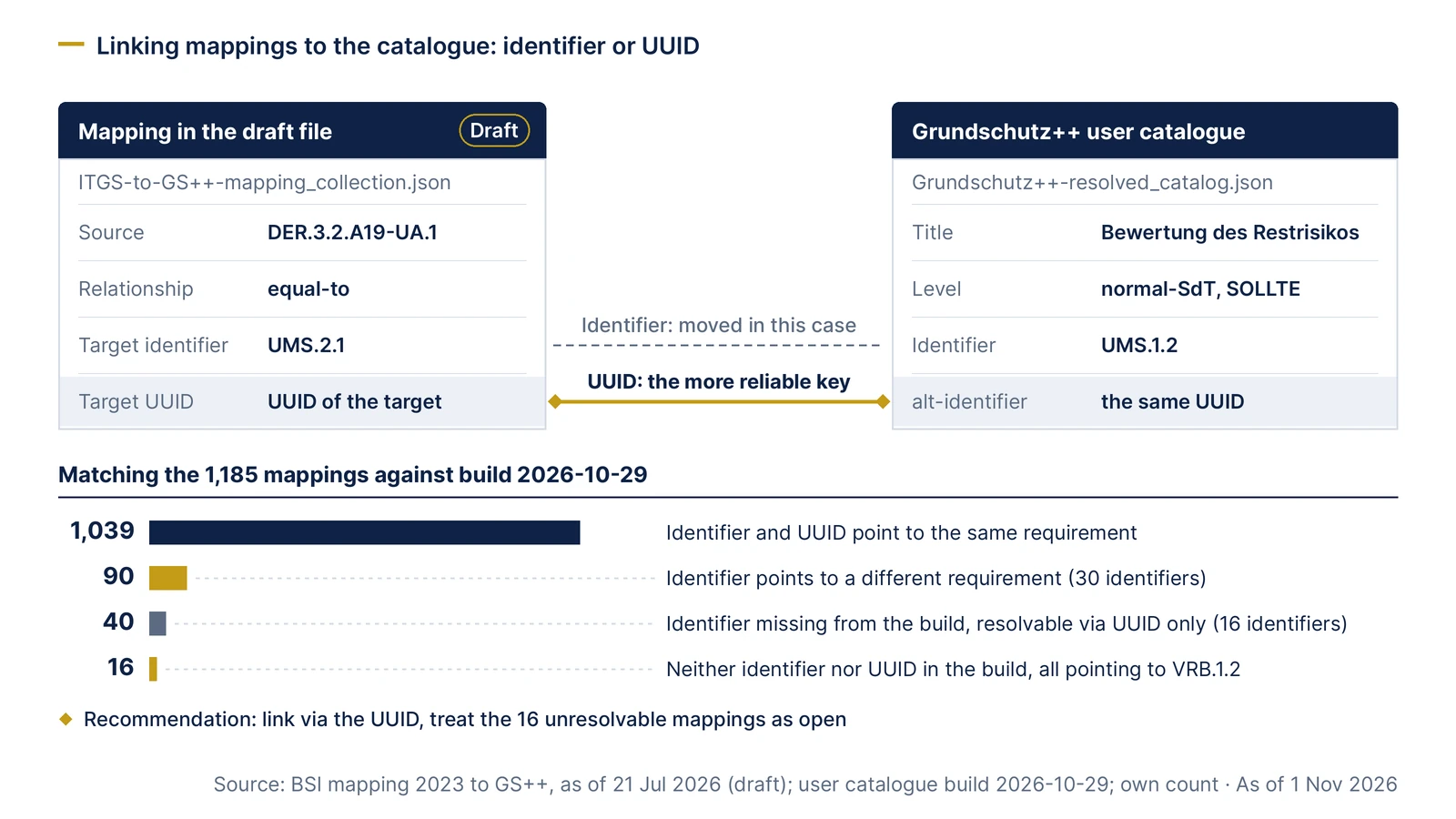
The mappings match the catalogue status of March and April 2026 completely: against the builds from 5 March to 20 April 2026, most recently build 20 April 2026 (commit 333c147), identifier and UUID point to the same requirement for all 1,185 mappings. According to its metadata, the file was exported on 9 June 2026. From the build of 28 May 2026 onwards, the BSI moved identifiers in the catalogue in five steps, most recently with the build of 26 July 2026; the UUIDs of the requirements stayed the same. Anyone linking the mappings to the current user catalogue via the identifier ends up at the wrong requirement in 90 cases. Alongside the identifier, however, the mappings also give the UUID of the target requirement, and the same UUID appears in the user catalogue as alt-identifier on the requirement. Our comparison with the build of 29 October 2026:
| Result | Mappings | Example |
|---|---|---|
| Identifier and UUID point to the same requirement | 1,039 | NET.1.1.A2-UA.2 → ARCH.2.5 „Netzplan“ (network plan) |
| Identifier exists, UUID belongs to a different requirement | 90 (30 identifiers) | Target TEST.3.1.10 is „Lasttest“ (load test) in the build; the UUID belongs to TEST.3.1.11 „Penetrationstest bei Änderungen“ (penetration test for changes) |
| Identifier missing from the build, UUID can be resolved | 40 (16 identifiers) | GC.8.1.1.1 no longer exists; the UUID belongs to GC.9.1.1.1 „Informationssicherheitsbeauftragter“ (information security officer) |
| neither identifier nor UUID in the build | 16 | all 16 point to VRB.1.2; in the build, VRB.1 contains only VRB.1.1 |
In the cases with a moved identifier that we looked at, the requirement found via the UUID matches the old requirement in content, and the one found via the identifier does not. Our recommendation: link via the UUID and treat the 16 unresolvable mappings as open. As early as the build of 28 May 2026, 35 mappings no longer matched; since the build of 26 July 2026 the position has not changed (our own comparison with all builds in this period).
Worked result: seven mappings checked
The mappings appear in the file as shown; we give requirements of the 2023 edition with their title and in our own words, Grundschutz++ requirements in the wording of the build of 29 October 2026, with parameters in square brackets. The "Check" column gives our professional assessment; the BSI has not confirmed it.
| No. | Mapping according to the file | Target in build 29 Oct 2026 | Check | Outcome |
|---|---|---|---|---|
| 1 | NET.1.1.A2-UA.2 „Dokumentation des Netzes“ (documentation of the network) (basic) equal-to ARCH.2.5 | ARCH.2.5 „Netzplan“ (network plan), normal-SdT: „Architektur für Netze SOLLTE einen Netzplan dokumentieren.“ (our translation: "Network architecture SHOULD document a network plan.") Identifier and UUID match. | Same content for the network plan part. The old requirement was a basic requirement with MUSS (MUST), the new one is a SOLLTE (SHOULD) requirement; non-fulfilment can now be classified as temporary or permanent. The file distributes the remaining parts of NET.1.1.A2 to ARCH.1.1, ARCH.1.1.1, ARCH.2.4 „Inventar der Netze“ (inventory of networks) and the unresolvable VRB.1.2. | adopt; assign the network plan as evidence for the safeguard, determine the status afresh |
| 2 | ISMS.1.A4-UA.1 „Benennung eines oder einer Informationssicherheitsbeauftragten“ (appointment of an information security officer) (basic) equal-to GC.8.1.1.1 | Identifier missing; via the UUID GC.9.1.1.1 „Informationssicherheitsbeauftragter“ (information security officer), normal-SdT: „Governance und Compliance MUSS die Zuständigkeit für Informationssicherheit [einer unabhängigen Person], welche unmittelbar der Institutionsleitung unterstellt ist, zuweisen.“ (our translation: "Governance and compliance MUST assign responsibility for information security to [an independent person] who reports directly to top management.") | The core matches. The new requirement requires a reporting line to top management and contains a parameter on independence; the old one names appointment, resources, a right to report when needed and early involvement. Whether "equal" applies depends on which part of the old requirement UA.1 refers to. | adopt with condition: check the organisation chart against the reporting line, set the parameter |
| 3 | DER.3.2.A19-UA.1 „Überprüfung der gewählten Risikobehandlungsoptionen“ (review of the selected risk treatment options) (standard) equal-to UMS.2.1 | UMS.2.1 is „Umsetzungsplanung“ (implementation planning) in the build; the UUID belongs to UMS.1.2 „Bewertung des Restrisikos“ (assessment of residual risk), normal-SdT: „Umsetzung SOLLTE das bestehende Restrisiko durch die nicht umgesetzten Anforderungen festlegen.“ (our translation: "Implementation SHOULD determine the existing residual risk arising from the requirements not implemented.") | Read via the identifier, the mapping does not fit. Via the UUID the topic fits: the old requirement has the audit team check whether the residual risks are appropriate and whether management has formally accepted them; the new one has implementation determine the residual risk. The checking party and the subject of the check differ; we treat this as an overlap. | correct: link to UMS.1.2, treat as an overlap; we assign the checking aspect to the internal audit under 300-1, ch. 5.2 |
| 4 | OPS.1.1.1.A23-UA.1 „Durchführung von Penetrationstests“ (conducting penetration tests) (elevated protection needs) equivalent-to TEST.3.1.10 and equivalent-to DET.5.4 | TEST.3.1.10 is „Lasttest“ (load test) in the build; the UUID belongs to TEST.3.1.11 „Penetrationstest bei Änderungen“ (penetration test for changes), elevated: „Änderungen und Tests KANN bekannte Schwachstellen bei kritischen Änderungen testen.“ (our translation: "Changes and testing MAY test for known vulnerabilities in critical changes.") DET.5.4 „Regelmäßige Penetrationstests“ (regular penetration tests), elevated: „Detektion für IT-Systeme KANN die tatsächliche Abwehrfähigkeit nach [einer anerkannten Vorgehensweise] [regelmäßig] überprüfen.“ (our translation: "Detection for IT systems MAY check the actual defensive capability according to [a recognised approach] [regularly].") | DET.5.4 fits as equivalent. TEST.3.1.11 only covers tests for critical changes; the old requirement calls for penetration tests of all IT components according to a concept with methods, test depth and success criteria. We read this as superset-of. Both new requirements are KANN (MAY) requirements. | adopt DET.5.4; link TEST.3.1.11 via the UUID and record the relationship as a superset; keep the test concept as a safeguard |
| 5 | NET.3.4.A9-UA.2 „Festlegung eines angepassten NAC-Regelwerkes“ (definition of an adapted NAC rule set) (standard) to eleven targets: ARCH.2.2, ARCH.2.2.1, ARCH.2.2.3, ARCH.5.1, ARCH.5.1.12 (subset-of), ARCH.2.2.2, ARCH.2.2.8, ARCH.2.2.9, ARCH.2.2.10 (intersects-with), ARCH.2.3 (equivalent-to), ARCH.4.1 (superset-of); also UA.3 and UA.4 to ARCH.4.1.1 | all eleven identifiers and UUIDs match; ARCH.2.3 „Mikrosegmentierung“ (microsegmentation), elevated: „Architektur für IT-Systeme KANN Verbindungen zu allen anderen IT-Systemen einschränken.“ (our translation: "Architecture for IT systems MAY restrict connections to all other IT systems.") ARCH.4.1.1 „Dynamische Netzzugangskontrolle“ (dynamic network access control), SOLLTE | A rule set for network access control determines which end devices can reach which segments. That touches on the segmentation requirements but is not microsegmentation of all IT systems; we consider equivalent-to for ARCH.2.3 too broad, and an overlap describes it better. The other relationships are plausible. | adopt with condition: create the NAC rule set as one safeguard and assign it to all suitable targets, as 300-1 requires for safeguards covering several requirements (ch. 4.3); determine the status separately for each target |
| 6 | ORP.2.A2 „Geregelte Verfahrensweise beim Weggang von Mitarbeitenden“ (orderly procedure when employees leave) (basic): UA.1 to PERS.6.1.2, UA.4 to BER.2.5 and PERS.6.1.1, UA.10 to PERS.6.1, all intersects-with with relationship_defaulted | PERS.6.1 „Vorgehensweise für den Weggang“ (procedure for leaving), PERS.6.1.1 „Entzug von Berechtigungen gemäß BER“ (withdrawal of authorisations in accordance with BER), PERS.6.1.2 „Neubesetzung“ (filling the position), BER.2.5 „Deaktivierung bei Weggang“ (deactivation on leaving), all SOLLTE; identifiers and UUIDs match | The targets cover the procedure, withdrawal of rights, deactivation of the identity and reallocation of responsibilities. Return of documents, keys, devices and ID cards and the reminder about trade and business secrets are not in the requirement text, but are in the guidance on PERS.6.1. For the return, SENS.8.9 „Rückgabe nicht mehr benötigter Assets“ (return of assets no longer required) is also a candidate, which the file does not link to ORP.2.A2. PERS.6.1.2 only partly covers the briefing of the successor; conflicts of interest, non-competition clauses and cooling-off periods have no target in the file. | confirm the relationships; evidence the return and the reminder about confidentiality as part of the safeguard for PERS.6.1, for example with the leaver checklist; check SENS.8.9 in addition; for conflicts of interest and non-competition clauses, find a target yourself or record them as a separate requirement |
| 7 | 16 mappings to VRB.1.2, for example ISMS.1.A12-UA.6 „Management-Berichte zur Informationssicherheit“ (management reports on information security), OPS.1.1.3.A1-UA.3 „Konzept für das Patch- und Änderungsmanagement“ (concept for patch and change management) and NET.1.1.A2-UA.4, almost all subset-of | neither identifier nor UUID in the build; VRB.1 contains only VRB.1.1 „Verfahren zur kontinuierlichen Verbesserung“ (procedure for continual improvement) | In the build of 28 May 2026, VRB.1.2 was called „Änderungen im ISMS“ (changes in the ISMS) (MUSS: „Verbesserung MUSS ein Verfahren zum Umgang mit Änderungen im ISMS verankern.“ (our translation: "Improvement MUST establish a procedure for handling changes in the ISMS.")). With the build of 24 June 2026 it was dropped, and in the build of 29 October 2026 no other requirement carries its UUID; which requirement has taken its place cannot be determined. | reassign: find and justify a separate target for each old requirement; check again with the next version of the mapping |
The seven cases show the three types of error to watch for in the transfer: moved or dropped identifiers (cases 2, 3 and 4 moved, case 7 dropped), relationships that are narrower or broader than the file states (cases 3, 4 and 5), and parts of the old requirement that have no resolvable target (case 1) or only appear in the guidance on a target (case 6).
How to check your own mappings
- Record the version. Note the commit and date of the mapping file and the build of the user catalogue. The two change independently of each other.
- Resolve via the UUID. Link the mapping's
oscal_uuidwithalt-identifierin the catalogue. Use identifiers for display only. - Collect all targets for each old requirement. A requirement of the 2023 edition can have several sub-requirements in the file, and 224 sub-requirements have more than one target; for 39 old requirements there are five or more different targets.
- Check each target on its content: subject of the check, modal verb, security level (normal-SdT or elevated), parameters, target object category (Zielobjektkategorie) and responsible role. Look closely at preset relationships (
relationship_defaulted). - Look for gaps. Read the old requirement sentence by sentence and check whether every part has a target. Assign requirements of the 2023 edition that have no entry in the file yourself.
- Document the outcome. One of four outcomes per mapping: adopt, adopt with condition, correct, reassign; with rationale and the person who did it. Then determine the status afresh under 300-1.
A table with the columns of the example table above, extended by the UUID, the date of the check and the person checking, is sufficient as a check record. Anyone importing the mappings into an ISMS tool should carry these columns over as well, so that the check can be repeated when a new version of the file appears.
What the mapping does not do
- No status. The file says which new requirement fits thematically, not whether you fulfil it. A "partially" from the old IT-Grundschutz Check no longer exists under 300-1; how to carry over old results is described on the IT-Grundschutz Check page.
- No modelling. Modules (Bausteine) were assigned to target objects, while Grundschutz++ requirements are attached to target object categories. How to assign assets to the categories is shown on the modelling page.
- No approved version. As long as the status reads "draft", every mapping is a proposal. Record your check results in a way that lets you compare them against a new version of the file.
- No ISO mapping. For ISO/IEC 27001 Annex A, the repository holds a separate mapping file; which files exist is shown on the Grundschutz++ user catalogue page.
How checking the mappings fits into an orderly transition is described on the migration page; the methodological differences between the two worlds in the comparison of IT-Grundschutz 2023 and Grundschutz++. If you would like your mappings for an existing ISMS to be checked, Blackfort Technology supports you as part of the assessment of the existing position, see consulting.
Rights notice: Requirement titles from the IT-Grundschutz-Kompendium, Edition 2023, © 2023 Reguvis Fachmedien GmbH and © 2023 Bundesamt für Sicherheit in der Informationstechnik, source: BSI page on the IT-Grundschutz Compendium (German). These titles are not licensed under CC BY-SA 4.0; the licence notice at the end of the page applies to the extracts from catalogue and mapping data.