
What the IT-Grundschutz Check is and what it requires
BSI Standard 200-2 describes the IT-Grundschutz Check as an „Organisationsinstrument, das einen schnellen Überblick über das vorhandene Sicherheitsniveau bietet“ (our translation: "organisational instrument that provides a quick overview of the existing security level") (ch. 7.7). The glossary of the IT-Grundschutz Compendium (IT-Grundschutz-Kompendium) explains the term as checking whether the recommended requirements are already met, adding „(früher: Basis-Sicherheitscheck)“ (our translation: "(formerly: basic security check)").
For Standard Protection, 200-2 requires structure analysis, protection requirements determination and modelling to be in place before the check. The modelling, i.e. the assignment of modules to target objects, serves as the check plan (200-2, ch. 8.4). Under 200-2 the work steps may run in parallel (ch. 8, „Reihenfolge der Bearbeitung“, our translation: "order of processing"), but only what has already been modelled can be checked. For Basic Protection, the initial survey and the selection of modules are sufficient and then serve as the check plan (ch. 6.3).
The check is part of each of the three classic approaches. With Basic Protection, only the basic requirements are checked. For Standard or Core Protection, a separate check with the standard requirements follows. 200-2 recommends preparing the results of Basic Protection so that they can be carried over into the later approach (ch. 6.3).
Step 1: Preparation
The organisational preparations are set out in 200-2, ch. 8.4.1. We have turned them into a checklist with the expected result for each:
| Preparation | Result that should be available before the first interview |
|---|---|
| Review existing rules and documentation on security procedures, including unwritten practice (200-2, ch. 8.4.1) | List of documents per module with the person responsible for each document |
| Clarify whether external bodies need to be involved, for example external data centres, superior authorities, outsourcing service providers or building authorities | List of external bodies with contact person and form of involvement (interview, written information, on-site appointment) |
| Define a main contact for each module used in the modelling; the roles named in the requirements help with this | Assignment of module and target object to main contact |
| Schedule for the interviews with fallback dates agreed in advance | Interview plan (see below) |
| Form interview teams; 200-2 names two people per interview, one asks the questions, one takes the minutes | Team allocation per appointment |
We recommend an advance request: anyone who knows which documents and which sample will be needed in the interview brings them along. 200-2 also recommends preparing checklists in advance depending on the subject area (action points for ch. 8.4.2).
Work result 1: Interview plan
Fictitious example. A public authority has modelled its information domain "Citizen services" (Bürgerservice) using Standard Protection. Modules, titles and examples of responsibilities are taken from the IT-Grundschutz Compendium, 2023 edition, and from 200-2, ch. 8.4.1. Target objects, dates and samples are invented.
| Block | Module and target object | Main contact (role) | Request in advance | Planned sample | Date / fallback date |
|---|---|---|---|---|---|
| 1 | ISMS.1 Security Management, information domain | Information security officer (ISB); for questions on overall responsibility, the head of the authority | Information security policy, security concept, latest management reports | Approval note for the policy, minutes of the last time top management dealt with the topic | Tue 10 Mar, 09:00 / Thu 12 Mar, 09:00 |
| 2 | ORP.2 Personnel, information domain | Human resources department | Onboarding and leaver checklist | Trace two leavers of the last six months from the checklist to the account being disabled | Tue 10 Mar, 13:00 / Fri 13 Mar, 09:00 |
| 3 | CON.3 Backup Concept, information domain | IT operations, responsible for data backup | Backup concept, backup plans | Backup logs of the last four weeks, evidence of the last restore test | Wed 11 Mar, 09:00 / Mon 16 Mar, 09:00 |
| 4 | OPS.1.1.3 Patch and Change Management, information domain | IT operations | Patch policy, extract from the ticket system | Patch level of three servers and five clients on the day of the interview | Wed 11 Mar, 11:00 / Mon 16 Mar, 11:00 |
| 5 | SYS.1.1 General Server, group S-01 to S-12 | Administration of the server group | Hardening specification, operational documentation | List of services on three servers against the hardening specification | Wed 11 Mar, 13:00 / Tue 17 Mar, 09:00 |
| 6 | NET.1.1 Network Architecture and Design, network N-01 | Network administration | Network plan, zone concept | Network plan against the configuration of a core switch | Thu 12 Mar, 13:00 / Tue 17 Mar, 13:00 |
| 7 | INF.2 Data Centre and Server Room, room R-0.14 | Facility management, plus the external building manager | Maintenance records for UPS and air conditioning | Walk-through of the server room with facility management | Fri 13 Mar, 10:00 / Wed 18 Mar, 10:00 |
Each block covers one module with its target objects, so that the main contact learns the result for their module at the end of the appointment, as 200-2 provides (ch. 8.4.2). For modules that concern many similar target objects, such as the twelve servers here, check one group and document which members you looked at as a sample.
Step 2: Survey in the interview
Go through the requirements of the module in order and let the interviewee first describe what has already been implemented. Keep the module text and the implementation notes to hand. Look at what is to be verified as a sample: the document, the room, the setting on the system (200-2, ch. 8.4.2).
For each requirement you assign one of four values (ch. 8.4.2):
| Status | Meaning under 200-2 | What the record must contain |
|---|---|---|
| yes (ja) | „Zu der Anforderung wurden geeignete Maßnahmen vollständig, wirksam und angemessen umgesetzt.“ (our translation: "Suitable safeguards for the requirement have been implemented completely, effectively and appropriately.") | the safeguard that meets the requirement, and the evidence |
| partially (teilweise) | only part of the requirement has been implemented | which part is missing and which safeguard still needs to be implemented |
| no (nein) | the requirement has not yet been met, suitable safeguards are largely missing | missing safeguards, responsible persons where already identifiable |
| dispensable (entbehrlich) | the requirement is not relevant in the information domain, for example because services are not activated, or is addressed by alternative safeguards | justification and the associated elementary threats from the cross-reference table; for alternative safeguards, also the justification why the risk of all threats concerned is adequately reduced |
Two limits apply to "dispensable". For basic requirements, the resulting risk cannot be accepted, and a requirement must not be set to dispensable by accepting or excluding the risk of a threat across the board via the cross-reference table (200-2, ch. 8.4.2; for Core Protection also ch. 7.7). The Compendium also makes clear that a requirement does not become obsolete merely because all threats assigned to it in the cross-reference table are not relevant in the individual case. The decision is made on the basis of the complete security concept.
The depth of questioning is initially based on the basic and standard requirements. Aspects of applications with high protection requirements that go beyond this level are considered only after the check has been completed (ch. 8.4.2).
Work result 2: Check record
For documentation, 200-2 specifies header data per target object and fields per requirement (ch. 8.4.3). The following record implements both. Fictitious example with real requirements from the module SYS.1.1 of the 2023 edition. Findings, names and dates are invented.
| Header data | |
|---|---|
| Target object | S-01 to S-12, group "Specialist application servers", module SYS.1.1 General Server |
| Location | Server room R-0.14, main building |
| Recording | 11 Mar (interview) and 13 Mar (walk-through), recorded by A. Beispiel (ISB team), minutes B. Muster |
| Interviewees | C. Admin (server administration), D. Vertretung |
| Requirement | Status | Implemented by | Evidence and sample | Implementation by | Responsible | Remark, deficit, risk |
|---|---|---|---|---|---|---|
| SYS.1.1.A6 Deactivation of Unnecessary Services (B) | partially | Hardening specification HV-SRV, version 3, with list of permitted services | List of services on S-03, S-07 and S-11 compared against HV-SRV on 11 Mar; on S-07 a print service is active for which there is no need | 30 Apr | C. Admin | Deactivate the service on S-07, check the other nine servers using the same procedure; until then the service enlarges the attack surface of S-07 |
| SYS.1.1.A15 Uninterruptible and Stable Power Supply (S) | yes | All twelve servers connected to the central UPS of the server room | Connection of S-01 and S-12 seen during the walk-through on 13 Mar; UPS maintenance record from January | The UPS itself is checked in module INF.2 (INF.2.A3) | ||
| SYS.1.1.A21 Operational Documentation for Servers (S) | yes | Operations manual per server in the wiki, changes are taken over automatically from the ticket system | Entries for S-03 reviewed, last configuration change of 2 Mar traceable with ticket number | |||
| SYS.1.1.A23 System Monitoring of Servers (S) | yes | Central monitoring with thresholds and alerting to the on-call service | Dashboard viewed on 11 Mar, thresholds configured for all twelve servers, alert of 4 Mar with acknowledgement | |||
| SYS.1.1.A25 Controlled Decommissioning of a Server (S) | no | no rule in place | confirmed in the interview: decommissioning without a checklist; no deletion record exists for the last server taken out of service | 30 Jun | still open, to be defined in implementation planning | Create a checklist for decommissioning; risk: data with protection needs on decommissioned storage media |
200-2 considers the field „Umsetzung bis“ (implementation by) useful, even though in the check it „im Allgemeinen nicht ausgefüllt wird“ (our translation: "is generally not filled in"). It serves as a placeholder for implementation planning, as does the field for responsible persons, which is filled in only if responsibility is already clear (ch. 8.4.3). For requirements that are not met or only partially met, 200-2 also requires the associated risk to be determined and the effort for remedying it to be estimated. The effort is best kept in a separate column or directly in the implementation planning.
Work result 3: weak and reliable findings
A check is worth as much as its findings. 200-2 requires documentation that is traceable for everyone involved and serves as the basis for implementation planning. With a view to certification, it should record the specific safeguards by which the requirements are met (ch. 8.4.3). From this we have derived a comparison as a working aid:
| Requirement | Weak finding | Reliable finding | What makes the difference |
|---|---|---|---|
| SYS.1.1.A6 | "According to the admin, unnecessary services are deactivated." Status yes. | List of services on S-03, S-07, S-11 compared on 11 Mar against HV-SRV, version 3; deviation on S-07. Status partially. | Sample with systems, date and target specification; deviation named |
| CON.3.A5 Regular Data Backup (B) | "Backups run daily." | Backup logs from 10 Feb to 10 Mar reviewed, two failed runs on 18 Feb and 25 Feb, both repeated the following day; frequency and scope of the runs match backup plan DSP-01 (daily, full backup on Sundays); staff informed of the rules on the intranet since 1 Dec; staff tasks for data backup described in service instruction DA-07, section 3. Status yes. | Period, reference, the negative is also in the record; every part of the requirement checked |
| Any requirement, status dispensable | "not relevant" | "Service X is not installed on any server of the group and is not needed, checked against the software inventory of 10 Mar; associated threats according to the cross-reference table: G 0.x, G 0.y; the decision is recorded in the security concept, section …." | Reason can be verified; threats named; decision in the security concept; source of the check, with date |
| ISMS.1.A4 Appointment of an Information Security Officer (B) | "ISB has been appointed." | Letter of appointment from the head of the authority dated 5 Jan is available and assigns the ISB the tasks of promoting information security and of co-steering and coordinating the security process; staff time allocation and own budget in the budget plan, chapter 4; direct right to report in the rules of procedure, section 4; involvement in new specialist procedures regulated in the project manual, evidenced for the last project in the minutes of 20 Feb. | every part of the requirement evidenced individually, from the first to the last sentence |
Check questions for every row before the record is closed:
- Where does the statement come from: interview, document, sample on the system or on site?
- Which systems, documents or processes were looked at, how many and on which day?
- Does the evidence cover the whole requirement or only one sentence of it?
- For "partially" and "no", is it stated what is missing, and for "dispensable", why?
- Would a third party, such as an audit team, reach the same status with the record and the evidence?
What changes with Grundschutz++
BSI Standard 300-1 does not use the term IT-Grundschutz Check. The corresponding work step is called determination of the implementation status (Ermittlung des Umsetzungsstatus) there and belongs to the process step implementation (Realisierung, ch. 4.1). As methods, 300-1 names a range from interviews and document reviews to automated configuration checks and technical scans. Three differences directly affect your record:
| Item | IT-Grundschutz Check (200-2) | Implementation status (300-1) |
|---|---|---|
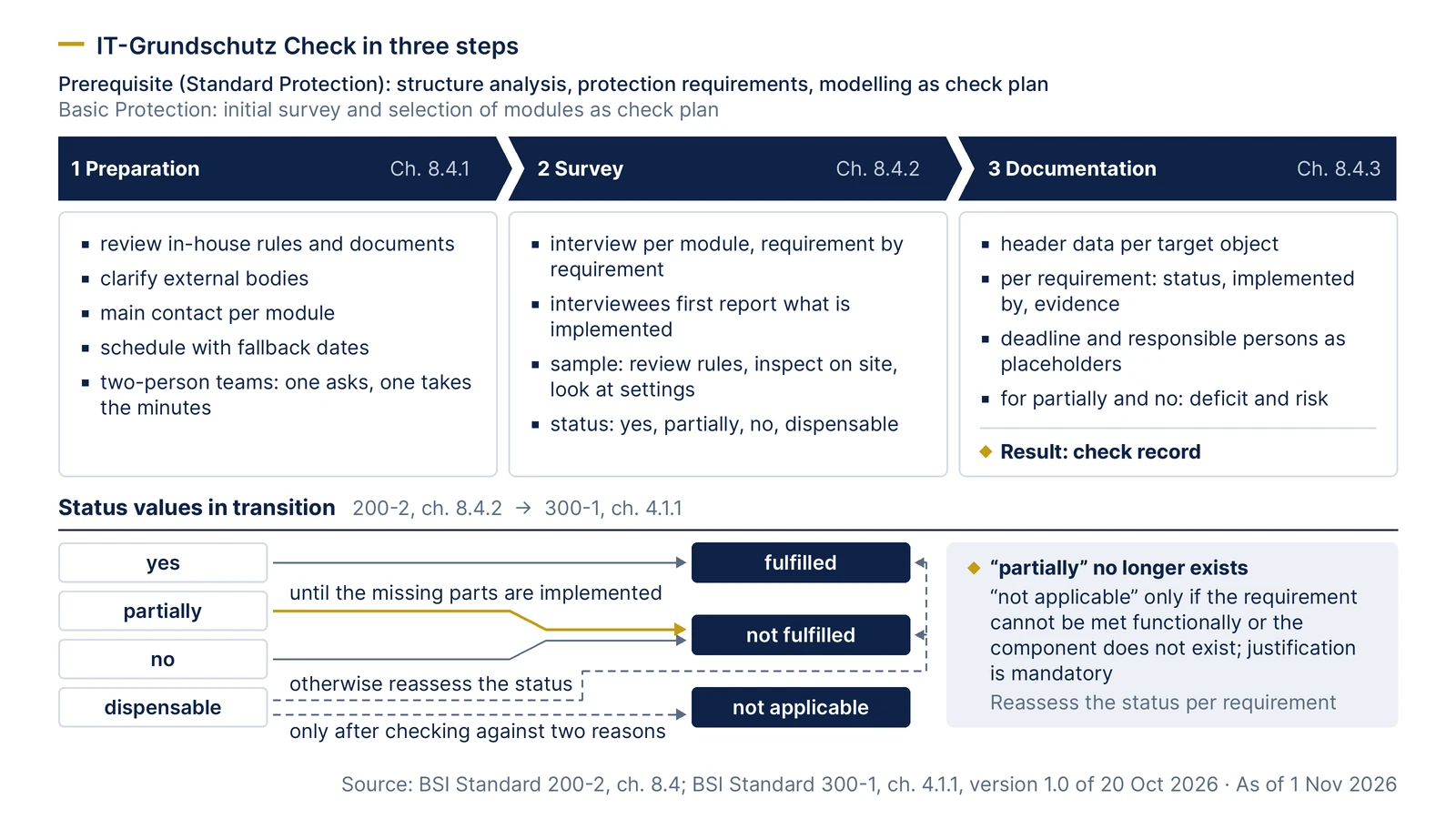
| Status values | yes, partially, no, dispensable | „erfüllt“ („ja“), „nicht erfüllt“ („nein“), „nicht anwendbar“ (our translation: "fulfilled" ("yes"), "not fulfilled" ("no"), "not applicable") (ch. 4.1.1); there is no "partially" value |
| Not applying a requirement | "dispensable", also when addressed by alternative safeguards, with justification | "not applicable" only if the requirement cannot be met functionally or the underlying component does not exist in the information domain; justification is mandatory (ch. 4.1.1) |
| Evidence | Remarks and justifications per requirement | Evidence is clearly assigned to the safeguard, the safeguard to the requirement; for automated checks with tool, time and result (ch. 4.3) |
For carrying over existing results, this means: under 300-1, a "partially" becomes "not fulfilled" until the missing parts have been implemented. Check a "dispensable" against the two reasons for "not applicable"; lack of relevance alone is not enough. If the requirement was addressed by an alternative safeguard, decide on the basis of the new requirement whether the safeguard meets it. A status cannot simply be rewritten anyway, because the old requirements are not mapped one to one to the new ones. The page Mapping IT-Grundschutz 2023 shows how the BSI mapping table helps with this and where it does not.
The user catalogue (Anwenderkatalog) of 29 October 2026 frames the step as requirement UMS.1.1: „Umsetzung MUSS den Umsetzungsstatus der Anforderungen im Anforderungspaket vollständig [regelmäßig] überprüfen.“ (our translation: "Implementation MUST check the implementation status of the requirements in the requirements package completely [regularly]"). The guidance on it still works with two values: „Der Umsetzungsstatus einer Anforderung kann grundsätzlich nur „umgesetzt“ („ja“) oder „nicht umgesetzt“ („nein“) sein.“ (our translation: "The implementation status of a requirement can in principle only be 'implemented' ('yes') or 'not implemented' ('no')"). The standard names three values. Follow the standard and note the catalogue build you are working with.
How to document status, deviations and non-applicability under 300-1 in detail is set out on the page Assessing requirements, documenting deviations. Who provides which evidence and when is laid down in the evidence plan.
After the check
Once the check is complete, you have the target/actual comparison on which implementation planning builds (200-2, ch. 6.4 and 9). Check two things beforehand: whether every target object from the modelling appears in the record, and whether every requirement with "partially" or "no" has a remark on the missing safeguard. If you are aiming for ISO 27001 certification on the basis of IT-Grundschutz, the record needs the specific safeguards per requirement (ch. 8.4.3). The procedure itself is described on the page Certification. If you are moving an ISMS based on the 2023 Compendium to Grundschutz++, you will find the order of the work packages on the page Migration. The standard itself is explained on the page BSI Standard 200-2, the choice of approach on the page Basic, Core or Standard Protection and the safe use of the 2023 edition on the page IT-Grundschutz Compendium.
If you want to determine the implementation status under 300-1 or transfer an existing IT-Grundschutz Check into the new status logic, Blackfort Technology can support you, see Consulting.
Rights notice: Short quotations from BSI-Standard 200-2 „IT-Grundschutz-Methodik“, version 1.0, © Bundesamt für Sicherheit in der Informationstechnik 2017, source: BSI page on BSI Standard 200-2 (German); module and requirement titles and a short quotation from the glossary of the IT-Grundschutz-Kompendium, Edition 2023, © 2023 Reguvis Fachmedien GmbH and © 2023 Bundesamt für Sicherheit in der Informationstechnik, source: BSI page on the IT-Grundschutz Compendium (German); from BSI-Standard 300-1 „Methodik Grundschutz++“, version 1.0 of 20 October 2026, © Bundesamt für Sicherheit in der Informationstechnik 2026, source: BSI page on Grundschutz++ (German). These quotations are not licensed under CC BY-SA 4.0. The licence notice at the end of the page applies only to the extract from the catalogue data.