

What 200-2 is and how it is structured
200-2 replaces BSI Standard 100-2. The new version added Basic and Core Protection alongside Standard Protection, as well as virtualisation, cloud, ICS and IoT. The running example has since been called RECPLAST GmbH, and the term „Aktiva“ was replaced by „Assets“ (ch. 1.1). The methodology builds on BSI Standard 200-1 and therefore on ISO 27001 (ch. 1.2).
The standard is divided into twelve chapters. Chapters 2 to 5 concern all approaches: basics, initiation, organisation and documentation. Chapters 6, 7 and 8 each describe one approach, chapters 9 and 10 implementation and maintenance, chapter 11 certification, and chapter 12 explains the damage scenarios. Many sections end with a list „Aktionspunkte zu …“ (our translation: "action points for …"), which works as a checklist for your own project.
200-2 states one prerequisite early and clearly: there must be an IT operation with clearly defined roles, which can range from a single administrator to several IT departments (ch. 1.3). If you do not meet this prerequisite, you read the following chapters with an open issue.
Reading path: chapter, decision, document
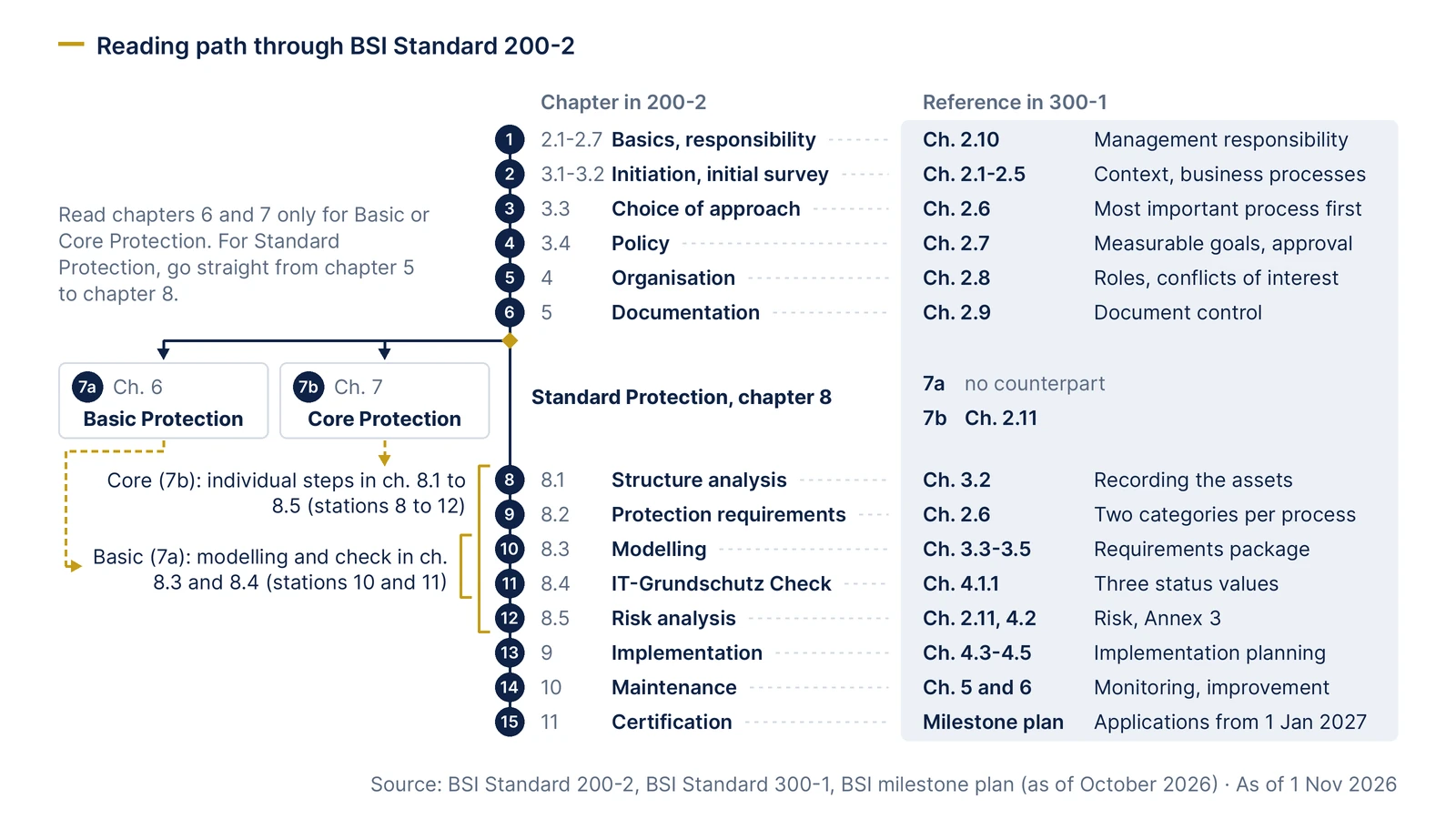
The reading path follows the order of the work. You read chapters 6 and 7 only if you have chosen Basic or Core Protection. For Standard Protection you jump straight from chapter 5 to chapter 8. You need chapter 8 in any case: for structure analysis, protection requirements determination, modelling, check and risk analysis, Core Protection refers to the individual steps in ch. 8.1 to 8.5 (ch. 7.4 to 7.8), and Basic Protection refers to ch. 8.3 and 8.4 for modelling and check (ch. 6.2, 6.3). After chapter 7 you continue reading at stations 8 to 12, after chapter 6 at stations 10 and 11. Both then continue with station 13 (chapter 9, to which ch. 6.4 refers for implementation) and station 14. Station 15 requires Standard or Core Protection. The column "Reading note" contains our comments, the column "In 300-1" the place where you will find the topic again for Grundschutz++.
| Station | Chapter | Decision or document | Reading note | In 300-1 |
|---|---|---|---|---|
| 1 | 2.1-2.7 Information security management with IT-Grundschutz | Understanding of responsibility, elements and process | Ch. 2.3 states that responsibility remains with top management „in jedem Fall“ (our translation: "in every case"). Ch. 2.6 gives an overview of the process. This overview is the structure for your project plan. | Ch. 2.10: responsibility cannot be delegated, decision papers go to top management |
| 2 | 3.1-3.2 Initiation, design and planning | General conditions, security objectives, security level of the business processes, initial survey | The initial survey in ch. 3.2.4 is a quick overview to help decide on the approach, explicitly „bei Weitem nicht so umfangreich“ (our translation: "nowhere near as extensive") as a structure analysis. Do not confuse the two. | Ch. 2.1-2.5: context, compliance, scope, interested parties, business processes |
| 3 | 3.3 Deciding on an approach | Management decision on which areas are protected with which approach and on which schedule | The pros and cons overview in ch. 3.3.5 is the basis of the management paper. The choice itself is covered on the page Basic, Core or Standard Protection. | No three approaches. For a first implementation, ch. 2.6 recommends starting with the most important business process in the highest protection requirements category, then gradually all business processes |
| 4 | 3.4 Information security policy | Policy with scope, content, announcement, updating | If there is no IS management team yet, ch. 3.4.2 provides for a development group whose draft is approved by top management. Plan this approval as a separate appointment. | Ch. 2.7: measurable goals, approval by top management |
| 5 | 4 Organisation of the security process | Roles: information security officer (ISB), IS management team, area and project security officers, ICS-ISB, IS coordination committee, data protection officers | Read ch. 4.4 and 4.9 together to separate the tasks of the ISB and data protection. Ch. 4.11 covers external security experts. | Ch. 2.8: avoid conflicts of interest between head of IT and ISB, DPO and ISB |
| 6 | 5 Documentation in the security process | Classification scheme, reports to top management, documentation requirements, reporting channels | Ch. 5.1 recommends a classification scheme for confidentiality, integrity and availability. Define it before you classify protection requirements in chapter 8, so that both classifications fit together. | Ch. 2.9: document control procedure |
| 7a | 6 Basic Protection | Scope, selection and prioritisation of the modules, check of the basic requirements only, implementation, choice of the follow-up approach | According to ch. 6, the fields of action do not form a closed cycle. Prepare the check results so that they can be carried over into a later check for Standard or Core Protection (ch. 6.3). | no counterpart |
| 7b | 7 Core Protection | Crown jewels, restricted information domain, complete basic and standard requirements, risk analysis | Ch. 7.1 assumes elevated protection requirements as a rule. The risk analysis therefore belongs firmly in the plan. | Ch. 2.11: risk assessment for high protection requirements |
| 8 | 8.1 Structure analysis | Business processes, applications, network plan, IT systems, ICS, other devices, rooms. Grouping | Ch. 8.1.1 on grouping determines the effort of all subsequent steps. The page Structure analysis shows how to use existing inventory data for it. | Ch. 3.2: recording the assets |
| 9 | 8.2 Protection requirements determination | Protection requirements categories, classification of processes and applications, derivation to IT systems, rooms and connections | The categories from ch. 8.2.1 and the explanations of the damage scenarios in ch. 12.1 belong together. How classification changes in Grundschutz++ is shown on the page Protection requirements determination. | Ch. 2.6: two categories per business process |
| 10 | 8.3 Modelling | Assignment of the modules to target objects, adaptation of the requirements, virtualisation and cloud, external service providers | Read ch. 8.3 together with the Compendium chapter „Schichtenmodell und Modellierung“ (layer model and modelling) and section 1.3 of each module. Ch. 8.3.6 provides for deriving specific safeguards from the requirements. Changes compared with the Compendium should be documented. | Ch. 3.3-3.5: blueprints, requirements package, parameters. See Modelling |
| 11 | 8.4 IT-Grundschutz Check | Target/actual comparison with the values „entbehrlich“ (dispensable), „ja“ (yes), „teilweise“ (partially), „nein“ (no) | For „entbehrlich“, ch. 8.4.2 requires a look at the cross-reference table. Since the 2023 edition of the Compendium, these tables are no longer included in the module and have to be obtained from the BSI website. | Ch. 4.1.1: „erfüllt“ (fulfilled), „nicht erfüllt“ (not fulfilled), „nicht anwendbar“ (not applicable) |
| 12 | 8.5 Risk analysis | Target objects for the risk analysis (examples according to ch. 8.5: high or very high protection requirements, cannot be adequately modelled with the modules, used in scenarios not provided for), timing of the analysis | Table 7 in ch. 8.5 compares the advantages and disadvantages of two sequences: risk analysis directly after the check, or only after the IT-Grundschutz requirements have been implemented. The procedure itself is set out in BSI Standard 200-3. | Ch. 2.11, 4.2, Annex 3. See Risk analysis |
| 13 | 9 Implementation of the security concept | Review of the results, costs and effort, implementation order, responsibility, measures accompanying implementation | This is where the implementation plan is drawn up, from which top management can read the resource requirements. | Ch. 4.3-4.5: implementation planning, responsibilities and deadlines, progress tracking |
| 14 | 10 Maintenance and improvement | Review with indicators, maturity model, review of the safeguards, suitability of the strategy | The maturity model in ch. 10.1.2 is an example. 200-2 offers it as a possible indicator. | Ch. 5 and 6: monitoring and continual improvement |
| 15 | 11 Certification | Decision on whether to seek ISO 27001 certification on the basis of IT-Grundschutz | Ch. 11 sets out the conditions: intended for Standard Protection, possible in principle for Core Protection, not sufficient for Basic Protection alone. Procedure and roles: Certification. | Milestone plan: applications on the basis of Grundschutz++ from 1 Jan 2027 |
Places where reading gets stuck
Some passages in 200-2 can only be understood properly with the Compendium or in the light of developments since 2017. The list summarises them. It is our assessment of the standard and not a list of errors by the BSI.
- Edition of the Compendium. 200-2 refers to the Compendium without naming an edition. You decide which edition you use and document it. According to the BSI Compendium page, the current edition is the 2023 edition. What to check is set out on the page IT-Grundschutz Compendium.
- Cross-reference tables. Ch. 8.4.2 assumes that every module has a cross-reference table. In the 2023 edition, the BSI removed the tables from the modules and published them separately (Compendium, chapter „Neues“, i.e. what is new). The obligation to use them to check the threats behind a requirement marked „entbehrlich“ (dispensable) remains.
- Initial survey and structure analysis. The initial survey from ch. 3.2.4 serves to choose the approach. For Standard Protection you then need the complete structure analysis from ch. 8.1. The initial survey can be its starting point.
- Two checks with Basic Protection. If you start with Basic Protection, you later carry out a separate check with the standard requirements for Standard or Core Protection (ch. 6.3). Documenting the results of the first check so that they can be built on straight away saves work.
- Timing of the risk analysis. 200-2 allows two sequences: for planned information domains or atypical usage scenarios, ch. 8.5 recommends the original sequence. According to ch. 8.5, the analysis after implementation is an option if the information domain is already in operation and can be adequately modelled with the existing modules. Record the chosen sequence in the risk policy.
- Designations. In ch. 2.3, 200-2 explains why it uses ISB instead of IT security officer. The 2023 Compendium renamed roles in gender-neutral form, for example „Informationssicherheitsbeauftragte (ISB)“ (information security officer). If needed, keep a mapping to your internal designations.
- References to other standards. The version history mentions an alignment with BSI Standard 100-4. For business continuity management, BSI Standard 200-4 applies today. It replaces 100-4 and has not been replaced by 300-1.
What lives on from 200-2 in Grundschutz++
300-1 does not mention 200-2, but describes the same work items differently. Business processes already existed in 200-2. What is new is that protection requirements are determined per business process with only two categories (300-1, ch. 2.6). Modelling assigns assets to target object categories (Zielobjektkategorien) and results in a requirements package. The IT-Grundschutz Check with four values becomes the determination of the implementation status with „erfüllt“ (fulfilled), „nicht erfüllt“ (not fulfilled) and „nicht anwendbar“ (not applicable). A requirement only counts as not applicable if the underlying component does not exist in the information domain or the requirement cannot be fulfilled functionally (ch. 4.1.1). Lack of relevance is no reason for this, unlike the old „entbehrlich“ (dispensable).
For risk assessment, 300-1 names three triggers: high protection requirements of a business process, assets that are not adequately covered and SOLLTE (SHOULD) requirements that are permanently not fulfilled, plus the residual risk assessment for SOLLTE requirements that are in the implementation planning but not yet fulfilled (ch. 2.11). For SOLLTE requirements temporarily not fulfilled, on the other hand, ch. 4.1.2 says that temporary non-fulfilment does not trigger a risk assessment. How the two passages fit together is an open question of interpretation. One obvious reading: temporary non-fulfilment does not trigger an explicit risk assessment under ch. 4.2, but the risk not yet mitigated has to be identified under ch. 4.1.1 and reported to top management. Agree your reading with the auditor and record it.
The full comparison is in the comparison of IT-Grundschutz 2023 and Grundschutz++, and how to carry out the transition is on the page Migration.
- Changes in detail: Comparison of IT-Grundschutz 2023 and Grundschutz++
- Status, modal verbs and deviations: Assessing requirements
- What 300-1 requires: BSI Standard 300-1
- Transition: Migration to Grundschutz++
When you still apply 200-2 today
Three situations come into question. An existing ISMS under 200-2 with ISO 27001 certification on the basis of IT-Grundschutz continues as long as classic IT-Grundschutz can be certified. According to the milestone plan, that ends on 30 November 2031, as a procedural date of the BSI and not as a statutory deadline. If a contract or an internal requirement expressly names 200-2, you work to it until the requirement is amended. Whether such a requirement continues to apply legally is for your legal department to check. And for bodies of the federal administration, Section 44(1) BSIG (BSI Act) refers to the BSI standards, the IT-Grundschutz Compendium and the federal minimum standards in their respective applicable versions. According to the wording of the Act, the BSI publishes which versions apply on its website. The sources evaluated do not expressly state from when Grundschutz++ applies in this sense. This is for the competent unit of the body to clarify.
If you are starting from scratch, make a deliberate choice between the classic approach and Grundschutz++, because certification applications on the basis of Grundschutz++ are possible from 1 January 2027. The page Deciding on the switch offers a decision table for each starting position. Blackfort Technology supports institutions with an existing 200-2 ISMS in assessing their current position and planning the switch.
- Choosing the timing: Deciding on the switch
- Dates: Timeline
- Consulting: Consulting on IT-Grundschutz and Grundschutz++
Rights notice: Quotations and information from BSI Standard 200-2 © Bundesamt für Sicherheit in der Informationstechnik, source: BSI Standard 200-2. Information from BSI Standard 300-1 © Bundesamt für Sicherheit in der Informationstechnik 2026, source: BSI, Grundschutz++. Information and quotations from the IT-Grundschutz Compendium, 2023 edition © 2023 Reguvis Fachmedien GmbH, © 2023 Bundesamt für Sicherheit in der Informationstechnik, Bonn (as stated in the imprint of the edition), source: BSI, IT-Grundschutz-Kompendium. They are not licensed under CC BY-SA 4.0.