

The three approaches in brief
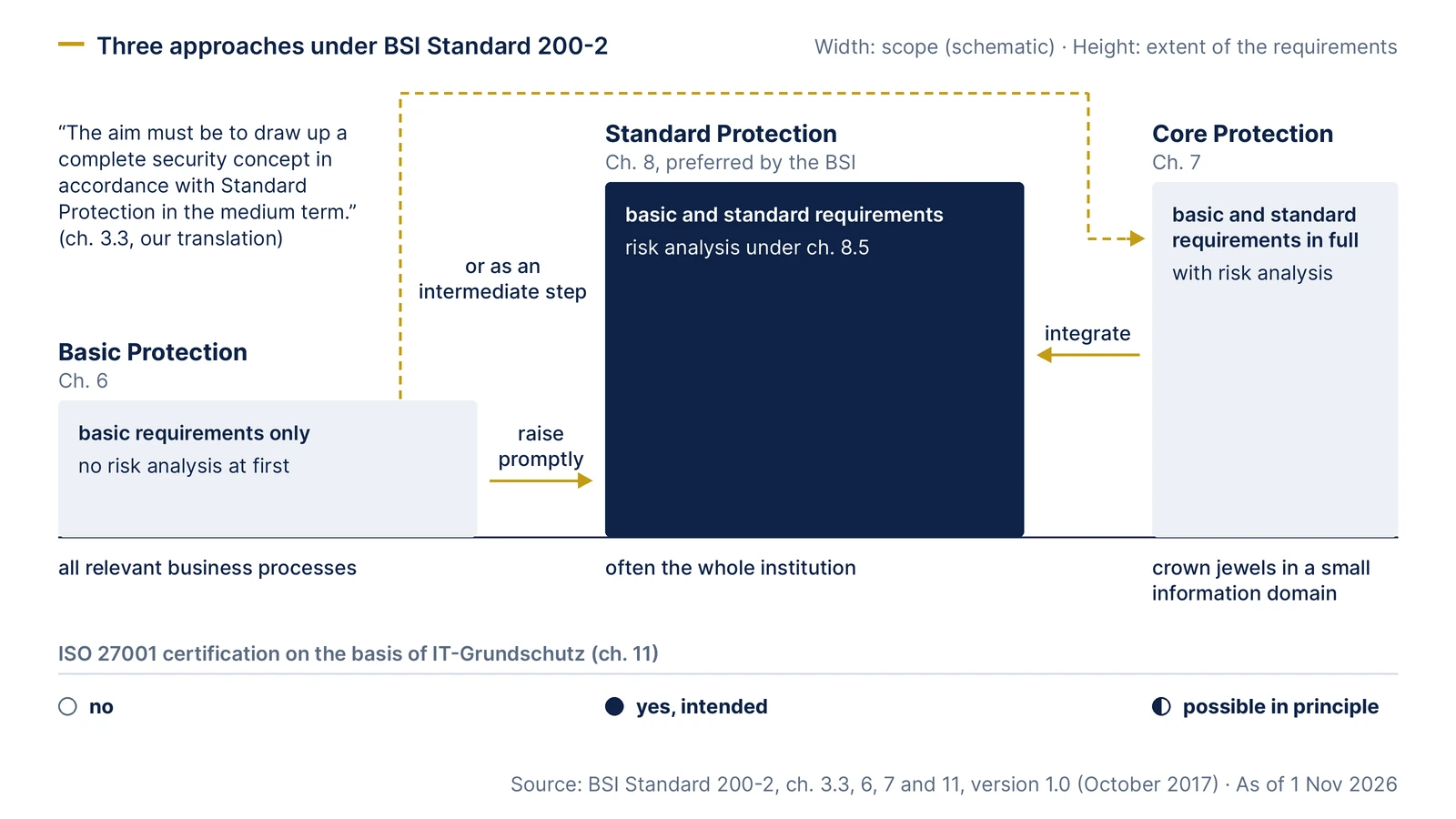
Basic Protection is the entry point for institutions whose information security is still in its early stages. It works with an initial survey instead of a complete structure analysis, assigns the modules and checks only the basic requirements in the IT-Grundschutz Check (200-2, ch. 6, 6.3). The fields of action do not form a closed cycle; at the end comes the choice of the approach with which the level is raised (ch. 6.5). A separate risk analysis is not provided for at first; according to 200-3 ch. 2, with Basic Protection only the basic requirements are implemented at first.
Core Protection concentrates on the "crown jewels": business processes and information that are most important for the continued existence of the institution (ch. 7.3). The information domain is deliberately kept small. Because elevated protection requirements are to be assumed here as a rule, the basic and standard requirements of the relevant modules must be implemented in full, and a risk analysis is part of it (ch. 7.1). Core Protection is part of the security process. According to 200-2, it can only be treated as a project if it is subsequently integrated into Standard Protection; until then it has to be reviewed and improved regularly.
Standard Protection essentially corresponds to the classic approach under BSI Standard 100-2 and is the one preferred by the BSI. For the entire information domain it comprises structure analysis, protection requirements determination, modelling and IT-Grundschutz Check, plus a risk analysis for the target objects for which it is needed under ch. 8.5 (ch. 3.3.3, 8). Basic and Core Protection are expressly entry points: „Ziel muss es sein, mittelfristig ein vollständiges Sicherheitskonzept gemäß der Standard-Absicherung zu erstellen“ (our translation: "The aim must be to draw up a complete security concept in accordance with Standard Protection in the medium term") (ch. 3.3).
Decision matrix
The matrix places side by side the criteria that 200-2 names for each approach in ch. 3.3.1 to 3.3.3 and adds certifiability, effort and risk analysis from ch. 3.3.5, 7.1 and 11. 200-2 phrases the criteria as a recommendation; for Core and Standard Protection expressly when the points „überwiegend zutreffen“ (our translation: "predominantly apply"). A single characteristic therefore does not decide. Our working rule: for each column, count how many of the first five rows (maturity to tolerance for security incidents) apply to your institution. For Basic Protection, according to 200-2, all five should apply, for Standard Protection most of them, for Core Protection most of rows two to five; maturity and security level in the Core column come from ch. 7 and 7.1 and are not counted. The remaining rows show what follows from the choice. Justify any deviation from the column with the most matches in writing in the management paper.
| Criterion | Basic Protection | Core Protection | Standard Protection |
|---|---|---|---|
| Maturity of information security | still in its early stages, low maturity | not specified; entry possible | sufficient maturity, safeguards in place in essential areas; work with IT-Grundschutz, or security concepts under IT-Grundschutz or ISO 27001 exist |
| Business processes with a significantly increased threat potential | none | a manageably small number, quickly identifiable and clearly delimitable | no need to secure individual processes as a priority |
| Target security level, protection requirements | normal security level | elevated protection requirements for the crown jewels as a rule | appropriate and comprehensive for all areas |
| Assets with damage potential that threatens the existence of the institution | none | clearly identifiable, to be protected as a priority | none that would cause damage directly threatening the existence of the institution and would have to be secured as a priority |
| Tolerance for security incidents | minor damage acceptable as long as, taken together, it does not endanger the institution | minor damage acceptable as long as none of it endangers the institution | even noticeable disruption of tasks is considered unacceptable |
| Scope | whole institution or a clearly delimited area | deliberately restricted information domain, as small as possible | often the whole institution |
| Requirements in the check | basic requirements only | basic and standard requirements of the relevant modules in full | basic and standard requirements |
| Risk analysis | none at first | required for elevated protection requirements | in particular for target objects with high or very high protection requirements, target objects that cannot be adequately modelled and usage scenarios not provided for (examples from ch. 8.5) |
| ISO 27001 certification on the basis of IT-Grundschutz | not possible | possible in principle for the delimited information domain | intended |
| Effort according to 200-2 | relatively low, quick entry | quicker than when all business processes are included | with low maturity higher than for the other two |
| Main risk according to 200-2 | the level reached may fall short of the actual need | other areas are left out at first, cumulative risks may be overlooked | no particular disadvantages named beyond the effort |
| Next step | Standard or Core Protection promptly | integration into Standard Protection | maintenance and improvement |
Sources of the rows: 200-2 ch. 3.3.1 to 3.3.3 (criteria; Core column maturity and security level from ch. 7 and 7.1), 3.3.4 (scope), 3.3.5 (pros and cons), 6.3 and 7.1 (check), 7.1 and 8.5 (risk analysis), 11 (certification).
Three examples worked through
The three institutions are invented. They show how the matrix leads to a justified decision; counting the matches is our working rule and not a BSI procedure.
| Criterion | A: professional association with head office (fictitious) | B: register operator (fictitious) | C: state authority (fictitious) |
|---|---|---|---|
| Starting position | 40 employees at the head office, membership administration and events, no ISMS, IT looked after by one administrator | Software company that operates an electronic register on behalf of an authority; the client requires a certificate for the register operation | Security concept under IT-Grundschutz for years, ISO 27001 certificate on the basis of IT-Grundschutz in place |
| Maturity | low: Basic | medium; high in the register operation | sufficient: Standard |
| Target security level | normal: Basic | elevated for the register operation: Core | appropriate and comprehensive for all areas: Standard |
| Processes with a significantly increased threat potential | none identifiable: Basic | one process, clearly delimitable: Core | several with elevated protection requirements, spread across the authority and already secured in the existing security concept; no need to secure individual ones as a priority: Standard |
| Assets threatening the existence of the institution | none: Basic | register data: Core | no individual outstanding ones: Standard |
| Tolerance for incidents | minor ones tolerable: Basic | minor ones acceptable outside the register: Core | impairment of the performance of tasks not acceptable: Standard |
| Certificate needed? | no | yes, for the register operation: Core or Standard | yes: Standard |
| Result | Basic Protection for the whole head office, Standard Protection as a fixed follow-up goal with a schedule | Core Protection for the delimited register operation with risk analysis, Basic Protection for the rest of the company | Continue Standard Protection; plan the switch to Grundschutz++ |
| Justification in the management paper | five of five criteria point to Basic; no certificate required | criteria point to Core; 200-2 ch. 3.3.4 names exactly this combination: Core Protection for a small area, Basic Protection for the rest | all criteria point to Standard; it is the basis for a certificate covering the whole authority (200-2, ch. 3.3.3) |
| Open points | An IT operation with clearly defined roles is a prerequisite (200-2, ch. 1.3); clarify who deputises for the administrator; before the follow-up goal of Standard Protection, check whether the expansion should go straight to Grundschutz++ (see below) | Crown jewels cannot always be considered in isolation (ch. 3.3.5); seal off the interfaces to the rest of the network; because the certificate will only be applied for later, weigh classic Core Protection against starting directly with Grundschutz++, as classic certifiability ends on 30 Nov 2031 according to the milestone plan | Align the timing of the switch with the term of the certificate |
In all three cases top management takes the decision. 200-2 ch. 3.3.5 provides that the person responsible appointed by top management prepares a proposal and top management decides which approach applies to which areas on which schedule; the decision has to be documented.
Combinations and transitions
The approaches are not mutually exclusive. 200-2 ch. 3.3.4 describes institutions that carry out Basic, Standard or Core Protection for several areas in parallel or one after the other, for example Core Protection for a small area with particularly endangered assets and Basic Protection for the rest, so that a minimum level of security exists there. 200-1 describes the same pattern as nuclei (Keimzellen): in breadth with Basic Protection, in depth with Core Protection, and from there quickly to the target level (200-1, ch. 4.1).
For the transition to Standard Protection: if you start with Basic Protection, you later carry out a separate check with the standard requirements; the results of the first check should be prepared so that they can be carried over directly (ch. 6.3). After Basic Protection, a prompt decision should be made on when the improvement process starts; Core Protection is possible as an intermediate step (ch. 6.5).
For the certificate, the position is clear. The Compendium states that for the chosen scope the basic and standard requirements must be met and that certification is only possible if all partial requirements with MUSS (MUST) are met (chapter „IT-Grundschutz - Basis für Informationssicherheit“, i.e. IT-Grundschutz as the basis for information security). Basic Protection alone is not sufficient for this (200-2, ch. 11). Procedure and documents are described on the page Certification.
What Grundschutz++ changes about the choice
BSI Standard 300-1 does not include the three approaches. It describes a procedure in five process steps. The closest counterpart to Core Protection is the recommendation, for a first implementation, to begin with the most important business process from the highest protection requirements category and gradually examine all business processes within the scope (300-1, ch. 2.6). The order in which they are dealt with is a decision paper for top management (ch. 2.10). 300-1 does not describe a broad initial protection with a reduced set of requirements as in Basic Protection.
For the choice today, this means weighing up the options. According to the milestone plan, certification applications on the basis of Grundschutz++ are possible from 1 January 2027, and classic IT-Grundschutz remains certifiable until 30 November 2031; that is a procedural date of the BSI and not a statutory deadline. If you are starting from scratch now and are aiming for a certificate in the medium term, you should check whether a classic entry with later transfer is worthwhile or whether starting directly with Grundschutz++ is a better fit. The decision table for each starting position is on the page Deciding on the switch.
The decision paper for top management on whether to continue classically with Basic, Core or Standard Protection or to start with Grundschutz++ is the subject of Package A "Decision and transition planning" from Blackfort Technology.
- Timing and route: Deciding on the switch
- Dates: Timeline
- Classic methodology: BSI Standard 200-2, new: BSI Standard 300-1
- Evidence: Certification
- Choosing the starting process: Protection requirements determination
- Commissioning the decision paper: Consulting, Package A
Rights notice: Quotations and information from BSI Standard 200-2 © Bundesamt für Sicherheit in der Informationstechnik, source: BSI Standard 200-2; information from BSI Standard 200-1, 200-3 and 300-1 © Bundesamt für Sicherheit in der Informationstechnik, sources: BSI Standard 200-1, BSI Standard 200-3, BSI, Grundschutz++. Information and quotations from the IT-Grundschutz Compendium, 2023 edition © 2023 Reguvis Fachmedien GmbH, © 2023 Bundesamt für Sicherheit in der Informationstechnik, Bonn (as stated in the imprint of the edition), source: BSI, IT-Grundschutz-Kompendium. They are not licensed under CC BY-SA 4.0.