

The document: structure, target group, changes
200-3 replaces BSI Standard 100-3. The new edition based the risk analysis on the elementary threats, introduced a matrix approach for assessment and added risk appetite and opportunity management. Version 1.0 also brought, among other things, the term "frequency of occurrence" (Eintrittshäufigkeit) in place of "probability of occurrence" (Eintrittswahrscheinlichkeit) and a comparison with ISO/IEC 31000 (chapter 1.1).
The standard is compact: chapter 1 provides the context, chapter 2 describes the preparatory work, chapter 3 lists the elementary threats, chapters 4 to 7 contain the four work steps and chapter 8 covers feeding the results back into the security process under 200-2. The annex deals with risk appetite, moderating the analysis, identifying additional threats and the interplay with ISO/IEC 31000. The examples are set in the fictitious companies RECPLAST GmbH and MUSTERENERGIE GmbH, among others a virtualisation server, a database management system and a smart meter gateway administration.
According to chapter 1.4, the standard is aimed at those responsible for security, security officers, security experts and security consultants, and it is a good fit when an organisation already works with 200-2 and wants the risk analysis to follow directly on from the IT-Grundschutz analysis. The standard itself concedes that, depending on the circumstances, another established procedure or an adapted method may be more appropriate. One term calls for care: in 200-3 "risk analysis" (Risikoanalyse) means the entire process of assessment and treatment, whereas in ISO 31000 and ISO 27005 it is only one sub-step of risk assessment (chapter 1.3).
The procedure in four steps, briefly placed in context
At the heart of the procedure is a before-and-after comparison. First, a threat overview is drawn up for each target object under consideration, made up of the elementary threats and additional threats specific to the use case (chapter 4). Then each risk is classified on the assumption that the safeguards from the basic and standard requirements have been implemented or are planned (chapters 1.2, 5). For risks that are not acceptable a treatment option is chosen, after which the risk is assessed again (chapter 6). Finally the security concept is consolidated: the safeguards are checked for suitability, interaction, user-friendliness and appropriateness (chapter 7).
200-3 also gives organisational advice on running the analysis, for example several short sessions instead of one long one, a named moderator and, towards the end, a representative of top management so that decisions on risk acceptance can be taken on the spot (chapter 9.2). A fully worked risk case under Grundschutz++ is shown on the page Risk analysis. This page stays with the document and its assumptions.
The assumptions behind 200-3
Every risk procedure presupposes something. For 200-3 it is above all the results of 200-2 and the structure of the Compendium. The table shows the assumptions that no longer automatically hold when switching to Grundschutz++. The right-hand column refers to the checklist further down.
| No. | Assumption in 200-3 | Reference | Position in Grundschutz++ | Check item |
|---|---|---|---|---|
| N1 | The preparatory work under 200-2 is in place: structure analysis, protection requirements in the levels normal, high and very high for processes, applications, IT systems, rooms and connections, modelling, IT-Grundschutz Check. | Ch. 2 | Protection requirements per business process in the two prescribed categories normal and high. Additional categories of your own are possible but must be mapped to these two (300-1, chapter 2.6). In addition, assignment to target object categories (Zielobjektkategorien) and an implementation status with three values. | P1, P2 |
| N2 | Target objects are analysed, grouped sensibly. Under Standard Protection, higher-level target objects such as business processes should be dealt with first, and an analysis at business process level is expressly possible. | Ch. 2 | Risks are identified primarily at the level of business processes, with critical assets as a supplement (300-1, chapter 4.2.1; criterion 13). | P2 |
| N3 | Triggers, given as examples: high or very high protection requirements, target objects that cannot be adequately modelled, use scenarios not provided for in IT-Grundschutz. | Ch. 1.2 | Three triggers: high protection requirements of a business process, assets not sufficiently covered, a SOLLTE (SHOULD) requirement that is permanently not fulfilled. In addition, a residual risk assessment for planned SOLLTE requirements not yet fulfilled (300-1, chapter 2.11). | P1 |
| N4 | The threat basis is the 47 elementary threats of the Compendium, supplemented by additional threats arising from the specific use scenario. | Ch. 1.2, 3, 4.1, 4.2 | The same identifiers G 0.1 to G 0.47 (300-1, Annex 4). There, as in 200-3, G 0.11 is called „Ausfall oder Störung von Dienstleistern“ (our translation: "failure or disruption of service providers"), in the 2023 edition of the Compendium „Ausfall oder Störung von Dienstleistungsunternehmen“ (our translation: "failure or disruption of service companies"). In the user catalogue (Anwenderkatalog) the G0 identifier is attached to the requirement. The methodological basis must be defined (criterion 10). | P4 |
| N5 | Qualitative categories, at most five per dimension recommended, levels and criteria freely adaptable. The BSI matrix serves only as an illustration. | Ch. 5.1, 5.2 | Frequency for a defined period, impact of damage justified, risk level from the combination (criteria 18 to 20). | P5 |
| N6 | The examples assume that "low" risks are generally accepted and higher ones only in exceptional cases. | Ch. 6.1 | The organisation sets its risk appetite and acceptance criteria itself, and top management authorises them (criteria 7 to 9). | P6 |
| N7 | Top management adopts a policy on handling risks. Whether risks are assigned to risk owners is a question within this policy. | Ch. 2 | Every risk has a risk owner, by default the business process owner unless otherwise specified (criterion 16; chapter 4.2.1). | P7 |
| N8 | A risk register is „in der Praxis üblich“ (our translation: "common in practice") but not mandatory. | Ch. 6.2 | The minimum details in the risk register are specified (criterion 15). | P8 |
| N9 | Results flow back via consolidation into the security concept and the 200-2 process. | Ch. 7, 8 | Results supplement the requirements package (300-1, chapters 3.4, 3.4.3). The risk owners authorise the implementation planning (criterion 31). | P10 |
| N10 | For business continuity management, reference is made to BSI Standard 100-4, whose risk analysis is said to differ only in a few terms. | Ch. 1.5 | 100-4 has been replaced by BSI Standard 200-4 (version 1.0, May 2023). 200-4 has not been replaced by 300-1. | P11 |
Scale examples: adapting the 200-3 categories
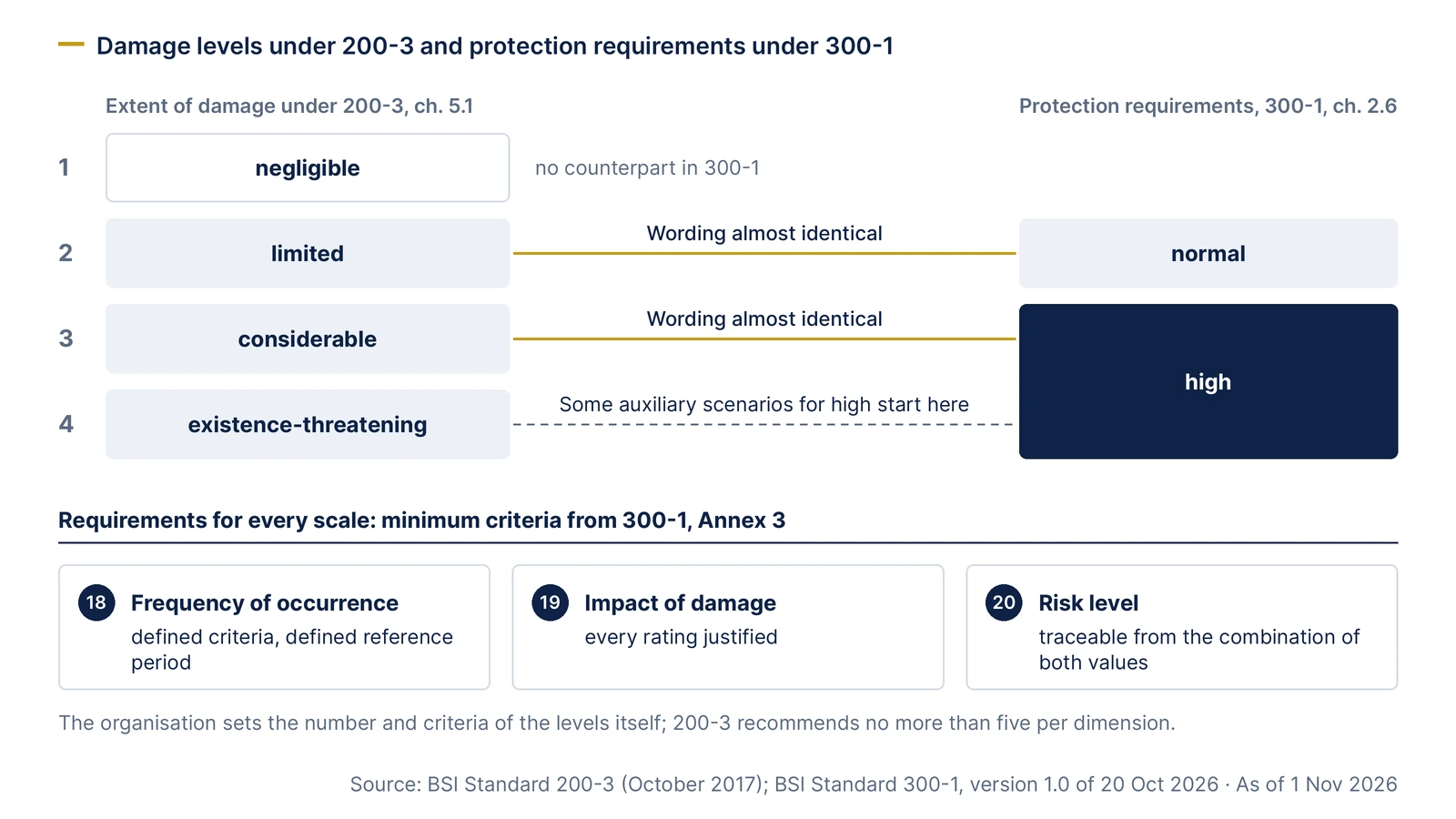
200-3 proposes four categories for each dimension: rare, medium, frequent and very frequent for the frequency of occurrence, and negligible, limited, considerable and existence-threatening for the extent of damage (chapter 5.1). The frequency levels there range from at most once every five years to several times a month. Every organisation may set the number and criteria of the levels itself, although 200-3 recommends choosing no more than five categories per dimension. As a test, the standard says that if two employees assess the same risk, „sollte dasselbe Ergebnis dabei herauskommen“ (our translation: "the same result should come out") (chapter 5.1, note).
One observation is useful for Grundschutz++: the descriptions of the damage levels "limited" and "considerable" in 200-3 table 9 match the definitions of the protection requirements categories normal and high in 300-1 chapter 2.6 almost word for word. If you adopt the scale, you can therefore link protection requirements and impact of damage in your wording. The three examples below are invented. They show how different organisations might calibrate the scales and are not a recommendation for your values.
Example S1 (fictitious): state authority (Landesamt), damage scale linked to protection requirements
| Level | Name (200-3) | Link to 300-1 | Calibration in the state authority (fictitious) |
|---|---|---|---|
| 1 | negligible | no counterpart | no external impact, resolved in day-to-day business |
| 2 | limited | wording as for protection requirements normal | specialist application (Fachverfahren) impaired for up to one working day, individual citizen enquiries delayed |
| 3 | considerable | wording as for protection requirements high | deadlines towards applicants cannot be met, report to the supervisory authority, press enquiries |
| 4 | existence-threatening | some of the auxiliary scenarios for high in chapter 2.6 start here | statutory mandate cannot be fulfilled for several weeks, danger to persons |
Consequence: a business process with protection requirements high can have risks at levels 3 and 4. The state authority stipulates that level 4 is never accepted without an exception approval from top management (criterion 27).
Example S2 (fictitious): IT service provider, five frequency levels with a reference period
| Level | Name | Definition (fictitious, expected events, estimated for the next twelve months) |
|---|---|---|
| 1 | rare | less than once in five years (probability per year below 20 %) |
| 2 | medium | once in five years to once a year |
| 3 | frequent | several times a year to once a month |
| 4 | very frequent | several times a month, but less than weekly |
| 5 | continuous | weekly or more often, for example automated attack attempts on publicly accessible services |
Consequence: the fifth level separates constant background noise from genuine events. Five levels are in line with the recommendation in 200-3 chapter 5.1 to choose no more than five categories per dimension. The criteria and fixed reference period are in line with criterion 18.
Example S3 (fictitious): small municipality, three levels per dimension
| Frequency / damage | limited | considerable | existence-threatening |
|---|---|---|---|
| rare (at most once every five years) | low | medium | high |
| occasional (more often than once every five years, at most once a year) | low | high | high |
| frequent (more often than once a year) | medium | high | high |
Consequence: the municipality does without "negligible" and works with a small matrix approved by top management. Acceptance criterion (fictitious): low is accepted and documented (criterion 29), medium only for a limited period with a review date (criterion 28), high only with an exception approval from top management (criterion 27). The justification for each damage rating is recorded in the register (criterion 19).
Checklist: what to re-examine in a 200-3 procedure for Grundschutz++
The checklist is aimed at organisations whose risk policy is based on 200-3. Each item names the place in 300-1 it is checked against. The complete reference of all 35 minimum criteria with the evidence required is on the page Risk minimum criteria. Here we only cover the points at which a 200-3 procedure has to be adapted because its assumptions no longer fit.
- P1 Triggers. Does the policy name the triggers under 300-1 chapter 2.11 (high protection requirements of a business process, assets not sufficiently covered, a SOLLTE requirement that is permanently not fulfilled) and the residual risk assessment for planned SOLLTE requirements not yet fulfilled? Does it set out how the old triggers are classified, in particular "very high" and "use scenarios not provided for"? Assigning the use scenarios to "assets not sufficiently covered" is an interpretation and must be marked as such (criteria 32 to 34).
- P2 Objects of analysis. Are risks identified primarily at the level of business processes, with critical assets considered only as a supplement? Are the objects of analysis documented for each risk assessment, and is each risk assigned the protection goals concerned (criteria 11, 13, 14)?
- P3 Existing safeguards. Does the assessment take into account implemented and planned safeguards with their implementation status (criterion 12)? 200-3 does this in the first assessment step. Check whether the status is documented.
- P4 Threat basis. Is the methodological basis of risk identification defined, for example the elementary threats under 300-1 Annex 4 or risk scenarios (criterion 10)? For SOLLTE requirements that are permanently not fulfilled, are the assigned elementary threats from the catalogue used (criterion 17)?
- P5 Scales. Is the frequency of occurrence estimated using defined criteria for a defined period, is every damage rating justified, and does the risk level follow traceably from the combination (criteria 18 to 20)? Has the example matrix from 200-3 been replaced by your own approved matrix?
- P6 Risk appetite and acceptance. Are risk appetite and acceptance criteria defined separately and authorised by top management together with the procedure, roles and criteria (criteria 7 to 9)? The assumption in 200-3 chapter 6.1 that low risks are generally accepted is no substitute for this.
- P7 Risk owners. Does every risk have a risk owner, is the business process owner set as the default, and is a lead owner designated for risks that span several processes (criteria 5, 16; chapter 4.2.1)?
- P8 Risk register. Does the register contain, for each risk, ID, object of analysis, description, protection goals, risk level, risk owner and, for risks to be treated, priority, treatment option and a reference to safeguards (criterion 15)?
- P9 Treatment and approvals. 200-3 already covers the iteration of assessment and treatment, top management's consent to the residual risk and its documentation (chapter 6.1). 200-3 contains no rule on time limits for temporary acceptance (criterion 28). It deals with exceptions only in general terms (chapter 2: exceptional cases „sollten abgestimmt und dokumentiert werden“ (our translation: "should be agreed and documented")). 200-3 does not specifically name a separate exception approval for risks that do not meet the acceptance criteria and are not treated further. It does, however, require top management to be involved in the decision and to consent to the residual risk (chapter 6.1). Check whether your policy marks this case as an exception (criterion 27) and covers criteria 28 and 29. The other treatment criteria are checked on the page Risk minimum criteria.
- P10 Feeding back. Do results flow into the requirements package as supplementary requirements (300-1 chapter 3.4.3), and do the risk owners authorise the implementation planning (criterion 31)? Consolidation under 200-3 chapter 7 remains useful as a quality check of the safeguards.
- P11 Review and interfaces. Is the risk assessment reviewed at least once a year and whenever significant changes are planned or have occurred (criterion 35)? Does the policy refer to BSI Standard 200-4 rather than 100-4 for business continuity management?
- P12 SOLLTE requirements temporarily not fulfilled. 300-1 chapter 2.11 requires a residual risk assessment for SOLLTE requirements in the implementation planning, while chapter 4.1.2 states that temporary non-fulfilment does not trigger a risk assessment. This is an open question of interpretation. Record how you proceed and mark it as an interpretation.
Further reading: carrying out the risk assessment on the page Risk analysis, all minimum criteria with check question and evidence on the page Risk minimum criteria, the distinction between temporary and permanent on the page Assessing requirements.
Can I keep using 200-3 for Grundschutz++?
300-1 leaves the procedure for risk identification, risk evaluation and risk treatment open, provided the minimum criteria are met, and names common standards such as ISO/IEC 27005 and ISO 31000 as possible bases (chapter 2.11). 200-3 is not mentioned there, but it is not excluded either. Whether your 200-3 procedure is sufficient is decided by the criteria. The treatment options already match: 200-3 provides for avoidance, reduction, transfer and acceptance (chapter 6.1), and criterion 23 names the same four.
For classic IT-Grundschutz, 200-3 remains the recommended procedure: for cases in which an explicit risk analysis is required, 200-2 chapter 8.5 recommends a risk analysis on the basis of IT-Grundschutz under 200-3. If you run both tracks until classic certification ends on 30 November 2031, you can aim for a common policy that incorporates the items on the checklist. Whether it satisfies both frameworks only becomes clear when it is checked against 200-3 and against the minimum criteria.
Blackfort Technology checks existing risk policies against the minimum criteria and provides a gap list with proposals for the policy and the register. This is part of the Readiness and migration concept package.
- The method as a whole: BSI Standard 300-1, classic: BSI Standard 200-2
- Having your risk method checked: Readiness and migration concept
- All services: Consulting
Rights notice: Quotations and information from BSI Standard 200-3 © Bundesamt für Sicherheit in der Informationstechnik, source: BSI Standard 200-3. Information from BSI Standard 300-1 © Bundesamt für Sicherheit in der Informationstechnik 2026, source: BSI, Grundschutz++. They are not licensed under CC BY-SA 4.0.