

What the Compendium contains and what it does not
The Compendium bundles security requirements for processes, applications, IT systems, networks and rooms in modules. By its own account, edition 2023 contains 111 modules: ten new ones and 101 from edition 2022. Three modules of the previous edition have been dropped and 21 have been revised (chapter „Neues im IT-Grundschutz-Kompendium“, i.e. what is new in the Compendium). The modules are divided into process modules (ISMS, ORP, CON, OPS, DER) and system modules (APP, SYS, IND, NET, INF). Before the modules come an introduction, notes on the layer model and on modelling, a description of roles, a glossary and the 47 elementary threats G 0.1 to G 0.47.
Three things are not in the Compendium, although people look for them there. The methodology, i.e. how structure analysis, protection requirements determination, modelling and IT-Grundschutz Check are carried out, is set out in BSI Standard 200-2. The introduction of the Compendium itself refers there. The implementation notes (Umsetzungshinweise) with descriptions of safeguards „sind nicht Bestandteil des IT-Grundschutz-Kompendiums“ (our translation: "are not part of the IT-Grundschutz Compendium"). The BSI publishes them as aids to the modules (chapter „IT-Grundschutz - Basis für Informationssicherheit“). And the cross-reference tables, which map requirements to the elementary threats, have been removed from the modules since edition 2023 and are published separately on the BSI website (chapter „Neues“).
According to the Compendium, the modules „[bilden] den Stand der Technik ab, basierend auf den Erkenntnissen zum Zeitpunkt der Veröffentlichung“ (our translation: "[reflect] the state of the art, based on the findings at the time of publication") (chapter „IT-Grundschutz - Basis für Informationssicherheit“). The BSI Compendium page adds: „Bei der Erstellung der Bausteine wurde bereits eine Risikobewertung für Bereiche mit normalem Schutzbedarf durchgeführt.“ (our translation: "When the modules were drawn up, a risk assessment for areas with normal protection requirements was already carried out.") Under BSI Standard 200-2 chapter 8.5, a separate risk analysis is needed in particular if target objects have high or very high protection requirements, cannot be adequately represented by the existing modules, or are operated in deployment scenarios that IT-Grundschutz does not provide for. The procedure for this is described in BSI Standard 200-3.
The role of the Compendium since Grundschutz++
With BSI Standard 300-1 „Methodik Grundschutz++“ (Grundschutz++ methodology, version 1.0 of 20 October 2026, according to the BSI published on 26 October 2026 and presented at it-sa on 27 October 2026), the BSI has redefined the methodology. The requirements are in the Grundschutz++ user catalogue of the State-of-the-Art Library. About this library the BSI writes on its topic page: „Sie löst das IT-Grundschutz-Kompendium ab.“ (our translation: "It replaces the IT-Grundschutz Compendium.")
In practice the milestone plan applies: from 1 January 2027, applications for ISO 27001 certification based on Grundschutz++ can be submitted, and the certifiability of classic IT-Grundschutz ends on 30 November 2031. This is a procedural date set by the BSI and not a statutory deadline. Until then, alongside ISO 27001 and the approach under BSI Standard 200-2, the Compendium remains a set of criteria for ISO 27001 certification on the basis of IT-Grundschutz (200-2, chapter 11).
For bodies of the federal administration, Section 44(1) of the BSI Act (BSIG) sets minimum requirements that follow from the BSI standards and the Grundschutz Compendium (Grundschutzkompendium, IT-Grundschutz) and from the federal minimum standards (Mindeststandards des Bundes) in the versions in force at the time. According to the wording of the Act, the BSI publishes the versions in force on its website. This page does not determine which version applies to your organisation at a given time. That is for the responsible office in your organisation to clarify, and on the legal side for your legal department.
The BSI has published the mapping of the edition 2023 requirements to Grundschutz++ in the State-of-the-Art Library. It has the status "draft" (as of 21 July 2026) and should therefore be treated as a draft. If you are maintaining concepts under the Compendium now, keep the module numbers clean: they allow every mapping to be checked later.
Edition check: are you working with the right version?
Some errors arise before the first module: an older edition in the tool, a cross-reference table from the previous year in the folder or a renamed module in the security concept. The checklist covers this in ten points. It is our own working aid, and the references show what each point is based on.
| No. | Check item | How to recognise it | Reference |
|---|---|---|---|
| A1 | Edition | Footer of the modules „IT-Grundschutz-Kompendium: Stand Februar 2023“ (our translation: "IT-Grundschutz Compendium: as of February 2023"). On retrieval on 1 Nov 2026, the BSI Compendium page lists edition 2023 as the current edition. | Compendium edition 2023; BSI Compendium page |
| A2 | Dropped modules | The model contains no modules that were dropped in 2023: SYS.2.2.2 Clients under Windows 8.1, OPS.2.1 Outsourcing for customers (replaced by OPS.2.3), OPS.3.1 Outsourcing for service providers (replaced by OPS.3.2). | Chapter „Neues“, dropped modules |
| A3 | New modules | The ten new modules have been checked against the model: CON.11.1 Classified information protection (VS-NfD), OPS.1.1.1 General IT operations, OPS.2.3, OPS.3.2, APP.5.4 UCC, SYS.1.2.3 Windows Server, SYS.1.9 Terminal server, SYS.2.5 Client virtualisation, SYS.2.6 Virtual Desktop Infrastructure, NET.3.4 Network Access Control. | Chapter „Neues“, new modules |
| A4 | Renamings | APP.2.2 is called „Active Directory Domain Services“, SYS.2.2.3 is called „Clients unter Windows“ (Clients under Windows) and covers Windows 10 and 11. | Chapter „Neues“, revised modules |
| A5 | Change documents | For the 21 extensively revised modules, the edition 2023 change document is available and has been compared with any security concept based on edition 2022. | Chapter „Neues“; BSI Compendium page |
| A6 | Errata | The „Errata zur Edition 2023“ (errata for edition 2023) have been reviewed. According to the Compendium they „ersetzen“ „anderslautende Aussagen im IT-Grundschutz-Kompendium“ (our translation: "replace" "statements to the contrary in the IT-Grundschutz Compendium"). | Chapter „Neues“, errata |
| A7 | Cross-reference tables | They come from edition 2023 and are kept separately from the module. Since 2023 they only show direct relationships between requirement and threat. Tables from older editions with indirect relationships are not mixed in. | Chapter „Neues“, cross-reference tables |
| A8 | Drafts | If drafts of revised modules are used, which can appear during the year, this is marked in the concept. Whether an audit accepts a draft as the basis for checking is something to clarify in advance with the auditor and the certification body. | Chapter „Neues“, errata and revised modules |
| A9 | Role names | The role assignment uses the names of edition 2023, such as „Informationssicherheitsbeauftragte (ISB)“, „Benutzende“, „Compliance-Beauftragte“ (our translation: "information security officers (ISB)", "users", "compliance officers"). If you use other names internally, keep a mapping table. | Chapter „Neues“, revision of roles; chapter „Rollen“ (roles) |
| A10 | Tool and data set | The Grundschutz tool documents which edition has been imported. The BSI also provides edition 2023 as an XML version, and the import status belongs in the security concept. | BSI Compendium page |
For bodies of the federal administration there is an eleventh point: which version the BSI publishes as being in force under Section 44(1) BSIG. The assessment is made by the responsible office in your organisation.
Module reading example: CON.3 Backup Concept
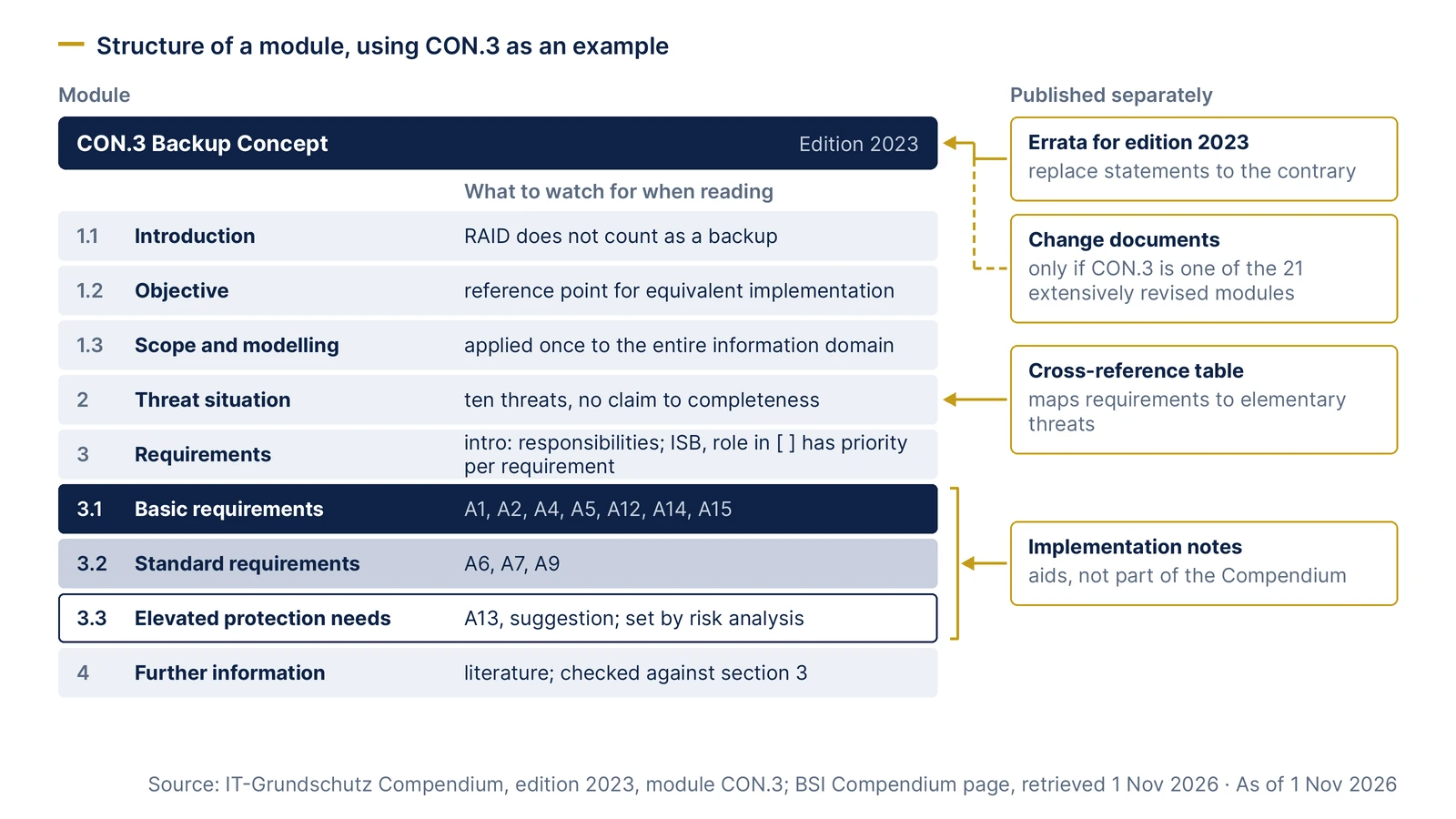
All modules have the same structure: a description with introduction, objective and scope and modelling, then the threat situation, requirements at three levels and further information. Module CON.3 shows at which points the way you read it has consequences for modelling and the check. The table gives the content in our own words. Only the short phrases in quotation marks are verbatim from edition 2023.
| Part of the module | What it says (our own summary) | What to watch for when reading |
|---|---|---|
| 1.1 Introduction | Definition of terms: the term IT system covers „in diesem Baustein alle Formen von IT-Komponenten, die schützenswerte Informationen speichern“ (our translation: "in this module all forms of IT components that store information worth protecting"), expressly including routers, switches and IoT devices. Data mirroring via RAID is „nicht als Datensicherung verstanden“ (our translation: "not understood as a backup"). | The introduction defines terms that count later in the check. If you report RAID as a backup, you do not fulfil CON.3 under this definition. |
| 1.2 Objective | The module is meant to show how a backup concept is drawn up and protects data against loss. | Our reading: if you implement a requirement in an equivalent way, you measure the solution against the objective of the module. 200-2 chapter 8.3.6 describes the requirements as sub-goals that contribute to the goals of the module. |
| 1.3 Scope and modelling | The module is „einmal auf den gesamten Informationsverbund anzuwenden“ (our translation: "to be applied once to the entire information domain"). Archiving is covered in OPS.1.2.2, system-specific backup in the modules of the NET, SYS and APP layers, deletion of backups in CON.6. | This is where modelling is decided: CON.3 once, the system modules per target object, CON.6 in addition. One CON.3 per server is a modelling error. |
| 2 Threat situation | Ten specific threats, from missing backups and missing restore tests to ransomware. | The list describes assumed scenarios and, according to the Compendium, makes no claim to completeness. Which elementary threats lie behind it is only shown by the separately published cross-reference table. |
| 3 Requirements (introduction: responsibilities) | The ISB is responsible in principle. Other roles are the specialist owners, IT operations and staff. | The role named in square brackets after a requirement has primary responsibility for that requirement. This tells you whom to talk to for the target/actual comparison. |
| 3.1 Basic requirements | CON.3.A1, A2, A4, A5, A12, A14 and A15. A3 has been dropped. The introduction says the requirements „MÜSSEN für diesen Baustein vorrangig erfüllt werden“ (our translation: "MUST be fulfilled as a priority for this module"). | The numbers do not run in ascending order. A12, A14 and A15 were added later and still sit under basic requirements. The Compendium keeps numbers when modules are revised. Alongside MUSS (MUST) parts, A2 also contains SOLLTE (SHOULD) parts, for example on separating particularly sensitive backup media from the network. |
| 3.2 Standard requirements | CON.3.A6 Backup concept, A7 Procurement, A9 Online backup. A8, A10 and A11 have been dropped. | The requirements are worded as SOLLTE. For ISO 27001 certification on the basis of IT-Grundschutz, the basic and standard requirements must be fulfilled for the scope. A requirement marked „ENTFALLEN“ (our translation: "DROPPED") no longer contains anything to implement, so there is nothing to record for it in the check. Our advice: keep the number in the tool so that older references can still be found. |
| 3.3 Elevated protection needs | CON.3.A13 Encryption of backups with keys backed up separately. | These are suggestions. According to the module, the specific requirements are set in an individual risk analysis. If the key is stored in the same backup it is meant to decrypt, the last sentence of A13 is not fulfilled. |
| 4 Further information | References to ISO/IEC 27002:2013, a Bitkom guide, the ISF standard and NIST SP 800-53. | The references lead to further reading. The check is made against the requirements in section 3. Check which version of the standard your own ISMS refers to. |
Two details from the example apply to other modules as well: section 1.3 of a module is the actual modelling instruction, and the table of responsibilities together with the roles in square brackets tells you whom to talk to for the target/actual comparison. How to prepare and record the target/actual comparison is shown on the page IT-Grundschutz Check. Its place in the methodology is explained under BSI Standard 200-2.
Misapplications and how to avoid them
Each of the following misapplications contradicts an explicit statement in the Compendium or in BSI Standard 200-2. The reference is given so that you can look up the passage in the original and cite it internally.
- Reading the Compendium as a methodology. The Compendium provides requirements. How you arrive at a security concept is described in BSI Standard 200-2. The introduction of the Compendium expressly refers there.
- Implementing only the basic requirements and expecting a certificate. For ISO 27001 certification on the basis of IT-Grundschutz, the basic and standard requirements must be fulfilled for the scope (chapter „IT-Grundschutz - Basis für Informationssicherheit“). Basic Protection alone is not sufficient under 200-2 chapter 11. The approaches are compared on the page Basic, Core or Standard Protection.
- Excluding a MUSS sub-requirement by accepting the risk. According to the Compendium, MUSS denotes unconditional requirements „für die keine Risikoübernahme möglich ist“ (our translation: "for which no risk acceptance is possible") (section on modal verbs). For the status "dispensable" (entbehrlich), too, 200-2 chapter 8.4.2 states that for basic requirements the resulting risk cannot be accepted.
- Justifying "dispensable" with the cross-reference table alone. According to the Compendium, note „dass eine Anforderung nicht automatisch hinfällig wird, wenn alle in der Tabelle zugeordneten Gefährdungen in einem bestimmten Anwendungsfall nicht relevant sind“ (our translation: "that a requirement does not automatically become obsolete if all threats assigned to it in the table are not relevant in a particular use case") (section on cross-reference tables). 200-2 chapter 8.4.2 rules out „entbehrlich“ (dispensable) if the risk is accepted or excluded across the board via the table. You still need the table: under 200-2 chapter 8.4.2 it is used to identify the associated elementary threats.
- Reading R1, R2 and R3 as importance. The marking suggests an order in time and „stellt keine Gewichtung der Bausteine untereinander dar“ (our translation: "does not represent a weighting of the modules against each other"). All relevant modules must be implemented, including R3 (chapter „Schichtenmodell und Modellierung“, layer model and modelling, order of processing).
- Applying a specific module without the general one. SYS.2.3 Clients under Linux and Unix supplements SYS.2.1 General client, but does not replace it. Specific modules „sind stets in Verbindung mit den allgemeinen Bausteinen anzuwenden“ (our translation: "are always to be applied in conjunction with the general modules") (chapter „Schichtenmodell und Modellierung“).
- Leaving out a target object without a suitable module. If no module adequately represents a target object, the Compendium requires a risk analysis, for which general modules provide a basis (chapter „Schichtenmodell und Modellierung“).
- Treating implementation notes as the audit benchmark. They are aids and not part of the Compendium. The check is made against the requirement, and the safeguard in the implementation note is one possible way to meet it.
- Working through requirements in case of elevated protection needs as a mandatory list. The modules give them as exemplary suggestions. What applies in case of elevated protection needs is set by the risk analysis, see BSI Standard 200-3.
- Copying requirement texts unchanged into the security concept. 200-2 chapter 8.3.6 requires the concise requirements to be turned into safeguards that are adapted to your circumstances and specific enough. Deviations from the Compendium should be documented.
- Treating the module list and the Grundschutz++ catalogue as the same. The user catalogue is structured differently, with practices (Praktiken) and target object categories (Zielobjektkategorien). The BSI mapping is a draft. What changes is shown in the comparison of IT-Grundschutz 2023 and Grundschutz++, and the catalogue is explained on the page Grundschutz++ user catalogue.
Running the Compendium and Grundschutz++ side by side
If you have a security concept based on edition 2023, you can keep it going until classic certifiability ends. But the earlier the data is kept in good order, the easier the transfer will be: module numbers and requirement identifiers in the concept, the implementation status per requirement with date and justification, and for every "dispensable" the justification in its exact wording. You will need this information when you check the BSI mapping to Grundschutz++.
Dates and what they mean are in the timeline, the transfer process is described on the migration page, and which point in time suits your situation is assessed on the page Deciding on the switch. Blackfort Technology supports the assessment of existing Grundschutz concepts and the planning of the switch.
- Dates: Grundschutz++ timeline
- Transferring an existing ISMS: Migration to Grundschutz++
- Choosing the time: Deciding on the switch
- Checking the BSI mapping: Mapping IT-Grundschutz 2023 to Grundschutz++
- Commissioning an assessment of the existing set-up: Readiness and migration concept
If you work with an IT-Grundschutz Profile, first check which edition of the Compendium it refers to. Which edition the published profiles name and how they can continue to be used under Grundschutz++ is shown in the overview IT-Grundschutz Profiles.
Rights notice: Quotations from the IT-Grundschutz-Kompendium, Edition 2023 © 2023 Reguvis Fachmedien GmbH, © 2023 Bundesamt für Sicherheit in der Informationstechnik, Bonn (as stated in the imprint of the edition), source: BSI, IT-Grundschutz-Kompendium. Quotation from the Compendium page © Bundesamt für Sicherheit in der Informationstechnik, source: BSI, IT-Grundschutz-Kompendium. Quotation from the Grundschutz++ topic page © Bundesamt für Sicherheit in der Informationstechnik, source: BSI, Grundschutz++. Quotations from the terms of use © Bundesamt für Sicherheit in der Informationstechnik, source: BSI, Nutzungsbedingungen. The quotations are not licensed under CC BY-SA 4.0.