

What Section 30 BSIG requires and what it does not
The obligations for particularly important and important entities are set out in the BSI Act (BSIG). Section 30 expressly refers to the NIS 2 Directive. Under Section 28(5) and (6) BSIG, the exemptions include operators of public telecommunications networks and providers of publicly available telecommunications services, operators of energy supply networks and energy installations subject to Sections 5c to 5e of the Energiewirtschaftsgesetz (German Energy Industry Act), and financial entities within the scope of Regulation (EU) 2022/2554 (DORA). For them, Sections 30, 32, 38 and 39 BSIG, among others, do not apply. Their obligations are set out in the respective sector-specific rules. Section 28(5) contains exceptions to these exemptions. Whether an exemption applies is part of the legal assessment, which this page does not carry out. For the ISMS, Section 30 is the core. It obliges these entities to take „geeignete[n], verhältnismäßige[n] und wirksame[n] technische[n] und organisatorische[n] Maßnahmen“ (our translation: "appropriate, proportionate and effective technical and organisational measures") (Section 30(1) sentence 1 BSIG). Three points from it determine what a framework has to provide:
- Proportionality: Account must be taken of the extent of risk exposure, the size of the entity, the implementation costs, the likelihood and severity of security incidents and their societal and economic impact (subsection 1 sentence 2).
- Documentation: „Die Einhaltung der Verpflichtung nach Satz 1 ist durch die Einrichtungen zu dokumentieren.“ (our translation: "Compliance with the obligation under sentence 1 shall be documented by the entities.") (subsection 1 sentence 3)
- State of the art and standards: The measures „sollen den Stand der Technik einhalten, die einschlägigen europäischen und internationalen Normen berücksichtigen und müssen auf einem gefahrenübergreifenden Ansatz beruhen“ (our translation: "should comply with the state of the art, take into account the relevant European and international standards and must be based on an all-hazards approach") (subsection 2 sentence 1). This is followed by ten areas that the measures must cover „zumindest“ (our translation: "at least").
Section 30 does not name a specific framework, neither IT-Grundschutz nor ISO/IEC 27001. For companies, Grundschutz++ is therefore one possible way of structuring and documenting the measures. It is not mandatory. For some types of entity, such as cloud computing service providers, data centre services and managed service providers, the implementing act of the European Commission under Article 21(5) of the NIS 2 Directive takes precedence under subsection 3. If you belong to one of these types, map against this implementing act first and use Grundschutz++ as the working framework around it.
Special case of the federal administration: Under Section 44(1) BSIG, federal administration bodies must meet minimum requirements derived from the BSI standards, the IT-Grundschutz Compendium (Grundschutzkompendium) and the federal minimum standards (Mindeststandards des Bundes). Under Section 44(2), implementing them ensures compliance with the requirements of Section 30, unless an implementing act under the second subparagraph of Article 21(5) of the NIS 2 Directive imposes further requirements. This link between Grundschutz and Section 30 applies only to the federal administration.
Where 300-1 itself addresses NIS2
BSI Standard 300-1 mentions NIS-2 explicitly in one place. When establishing the context, chapter 2.1.1 counts legal and regulatory conditions among the factors acting on the organisation from outside and names NIS-2 and DORA as examples. This does not result in a dedicated NIS2 module. The standard deals with legal obligations through compliance management: under chapter 2.2, legal registers, laws and requirement catalogues are to be analysed, legal obligations documented and contractual obligations compiled. The resulting requirements feed into the requirements package (Anforderungspaket, chapter 3.4.3).
In the user catalogue, the same appears as a methodology requirement. GC.3.1.1 requires analysing legal obligations that affect the processing of information by the organisation (MUST, German: MUSS). STM.2.1.7 requires adding further requirements to the requirements package for the individual compliance environment (MUST). For NIS2 this means: whatever Section 30 requires and the user catalogue does not already contain, you add as a requirement of your own. You then have to word it in the format of the catalogue, as chapter 3.4.3 provides.
A second point of contact is the risk assessment. Section 30(2) no. 1 requires concepts for risk analysis. For normal protection requirements, Grundschutz++ relies on the general BSI risk assessment already contained in the catalogue and requires a separate, explicit risk assessment (Risikobetrachtung) in three cases: for high protection requirements of a business process, for assets that the target object categories (Zielobjektkategorien) do not adequately cover, and for SHOULD requirements (SOLLTE) that are permanently not met (chapter 2.11). For SHOULD requirements not yet met, a residual risk assessment is added. Whether this model reflects the proportionality test under Section 30(1) sentence 2 for your entity is something you should clarify with your legal department. For the work itself, the standard sets a verifiable framework with the 35 minimum criteria (Mindestkriterien) in Annex 3.
Mapping: the ten areas of Section 30(2) and Grundschutz++
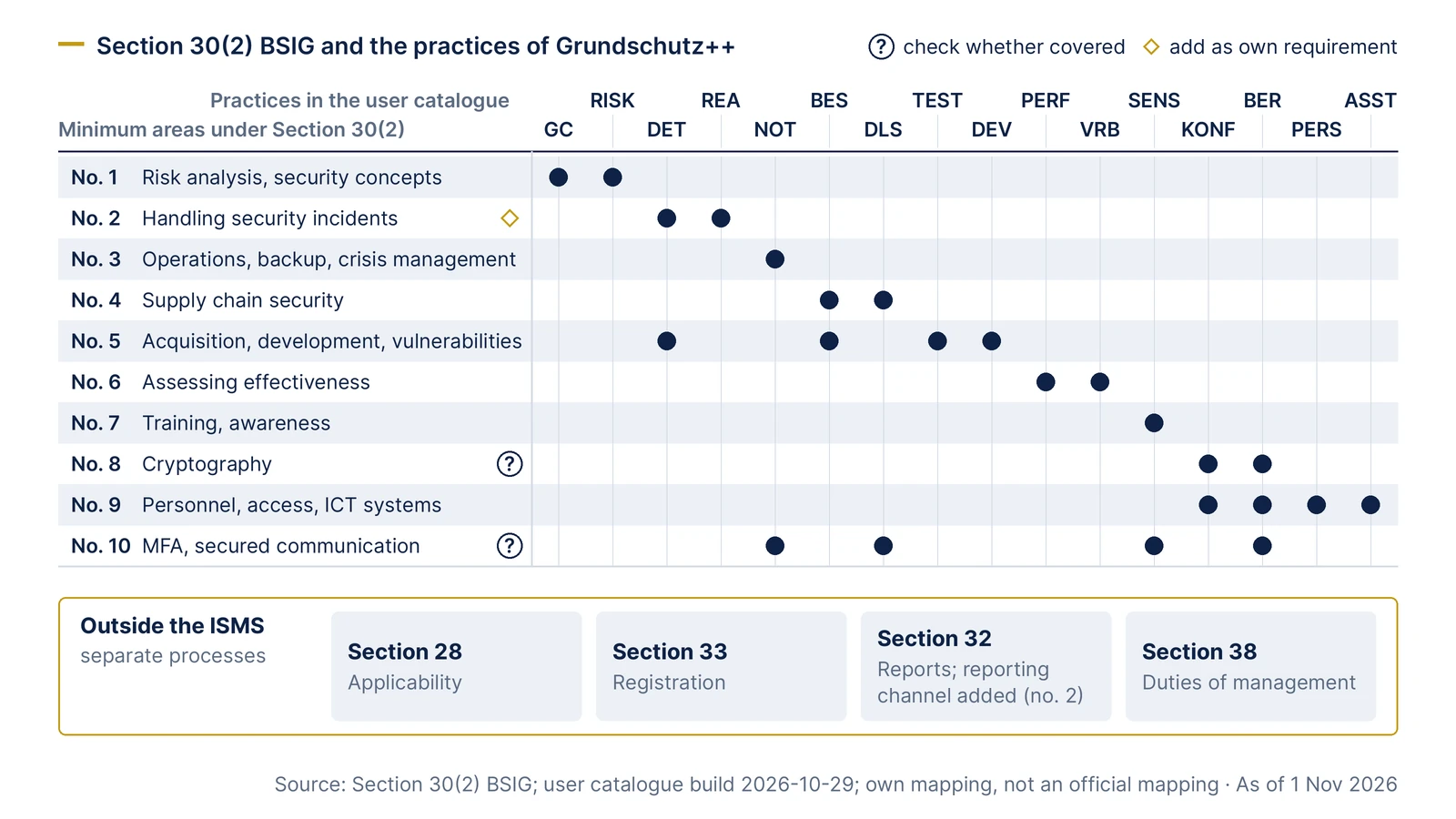
Our own mapping, not an official one. In the sources evaluated (as of 1 November 2026), the BSI has not published a mapping of Section 30 BSIG to Grundschutz++. The table assigns to each area the passages in 300-1 and examples from the user catalogue (build 2026-10-29) that match in content. The table does not decide whether implementing these passages fulfils the statutory obligation. Requirement texts are shortened.
| Section 30(2) sentence 2 BSIG | Passages in BSI Standard 300-1 | Examples in the user catalogue | What you also need to clarify |
|---|---|---|---|
| No. 1 Concepts for risk analysis and for information technology security | ch. 2.11 and 4.2 (risk assessment), Annex 3 (35 minimum criteria), ch. 2.7 (policy) | RISK.1.1 establish uniform methods based on a recognised standard (MUST); GC.5.1.3 define the security policy (MUST) | Whether your risk method makes the proportionality criteria from subsection 1 sentence 2 visible |
| No. 2 Handling of security incidents | ch. 5.4 (procedure for detecting security incidents) | Practices (Praktiken) DET (82 requirements) and REA (23); REA.1.1 procedure for handling security incidents (MUST), REA.2.1 assign a priority to reports (SHOULD) | Reporting to the joint reporting office (gemeinsame Meldestelle) under Section 32 BSIG, with its deadlines, is a separate statutory obligation. It belongs in the package as an added requirement. The point of contact in the catalogue is REA.2.6.2 (communication during incidents taking compliance obligations into account, SHOULD). It does not contain the deadlines and report contents under Section 32. |
| No. 3 Maintaining operations, backup management, recovery, crisis management | no dedicated methodology passage; BCM is governed by BSI Standard 200-4, which 300-1 does not replace | Practice NOT (37); NOT.1.1 emergency preparedness (MUST), NOT.2.1 special organisational structure for emergencies and crises (SHOULD), NOT.1.1.4 BCMS under BSI Standard 200-4 (MAY, German: KANN, security level elevated) | Whether a BCMS is needed or emergency preparedness within the ISMS is sufficient |
| No. 4 Supply chain security | ch. 2.3 and 3.1 (service providers and outsourcing when defining the scope) | Practices BES (109) and DLS (18); BES.3.1 assign supplier relationships to a class (SHOULD), DLS.1.1 management and termination of service contracts (MUST) | Which direct suppliers and service providers are covered |
| No. 5 Security in acquisition, development and maintenance, vulnerability management and disclosure | ch. 5.4 (procedure for handling vulnerabilities) | Practices BES, TEST (36), DEV (34); DET.5.1 detection and handling of vulnerabilities (SHOULD), TEST.1.1 management of new introductions and changes (MUST), DEV.1.1 development of IT products (MUST) | Whether and how you disclose vulnerabilities |
| No. 6 Assessing the effectiveness of risk management measures | ch. 5.1 (performance evaluation), 5.2 (internal audit), 5.3 (management review), 6.4 (evaluation) | Practices PERF (24) and VRB (10); PERF.1.1 measuring and evaluating the performance of the ISMS (MUST), PERF.2.1 check compliance with obligations (SHOULD) | The BSI has announced the concept for performance measurement for 26 Feb 2027 and performance indicators for the methodology requirements for 31 Mar 2027. Until then, you define the performance evaluation yourself |
| No. 7 Training and awareness | ch. 2.7 (communicate the policy to all staff) | Practice SENS (87); SENS.1.1 role-specific training and awareness (MUST), SENS.11.1 awareness of top management (SHOULD) | The training obligation for management under Section 38(3) BSIG stands on its own and goes beyond a SHOULD requirement |
| No. 8 Cryptography | no dedicated methodology passage | KONF.2.2 cryptographic methods based on recognised standards (SHOULD), BER.5.4 only established cryptography for authentication means (SHOULD) | Whether the scattered requirements are sufficient as a "concept" within the meaning of No. 8 or a separate cryptography concept is needed |
| No. 9 Personnel security, access control, management of ICT systems | ch. 2.8 (roles and responsibilities) | Practices PERS (30), BER (92), ASST (58), KONF (157); PERS.1.1 personnel management (MUST), BER.1.1 identity and access management (MUST) | Alignment with HR and operational processes outside the information domain |
| No. 10 Multi-factor authentication, secured voice, video and text communication, emergency communication | no dedicated methodology passage | BER.5.9 MFA for far-reaching privileges (SHOULD) and further MFA requirements in BER and DLS; for communication, individual requirements such as SENS.7.17 (awareness against unencrypted telephony, SHOULD); for emergency communication, NOT.3.5 establish alternative telecommunications services (SHOULD) and NOT.2.1.2 establish alerting of the special organisational structure (BAO, SHOULD) | Whether alternative telecommunications and alerting cover secured emergency communication or an added requirement is needed |
The figures in brackets are the requirements per practice in the build of 29 October 2026 (own count across all levels, 1,000 in total). How to assign assets to the target object categories and build the package from them is shown in Modelling and target object categories.
What Grundschutz does not cover under NIS2
An ISMS based on Grundschutz++ organises safeguards, responsibilities and evidence. Several NIS2 obligations lie outside it and need processes of their own:
| Obligation | Provision | Relationship to Grundschutz++ |
|---|---|---|
| Classification as a particularly important or important entity | Section 28 BSIG | Not addressed in the standard. The classification is a legal question and comes before any ISMS work. |
| Registration with the BSI, at the latest three months after first being classified | Section 33 BSIG | Not addressed in the standard. You may find some of the details, such as public IP address ranges, in your inventory documentation. |
| Reports of significant security incidents: early initial report without undue delay, at the latest 24 hours after becoming aware; report at the latest after 72 hours; final report at the latest one month after that report, with a progress report first if the incident is ongoing | Section 32 BSIG | REA and DET provide detection and handling. REA.2.6.2 (communication during incidents, SHOULD) is the point of contact. You include the reporting channel, deadlines and report contents as an added requirement (ch. 3.4.3). |
| Implementation and supervision by management, liability, regular training for management | Section 38 BSIG | 300-1 establishes the non-delegable responsibility of top management (ch. 2.10) and provides for management reviews (ch. 5.3). Statutory liability and the training obligation are governed by the law alone. |
| Evidence for operators of critical facilities through security audits, inspections or certifications, at a time set by the BSI and every three years thereafter | Section 39 BSIG | Applies only to operators of critical facilities. The BSI can specify which evidence is suitable (Section 39(2)). According to the milestone plan, a certificate under ISO 27001 based on Grundschutz++ can be applied for from 1 Jan 2027. Whether it is recognised as evidence follows from these specifications. |
For these questions, the page NIS2 implementation on https://www.blackfort-tec.de/en is the right place to start. We classify the rules that you name or that appear in your documents. Whether they apply legally is checked by your legal department.
For hospitals, Section 391 SGB V (Book Five of the German Social Code) contains its own IT security requirements. How they relate to the obligations under the BSI Act is set out on the page IT-Grundschutz in hospitals, together with the work on clinical dependencies.
KRITIS IT-Grundschutz Profiles: what they are and what they are not
Alongside the general IT-Grundschutz Profiles, the BSI publishes four KRITIS IT-Grundschutz Profiles (KRITIS-IT-Grundschutz-Profile, KRITIS meaning critical infrastructure) on its KRITIS page, together with a template (Schablone) from which further profiles can be developed. The BSI describes them as documents „die auf Basis der Methodik des IT-Grundschutzes unter Berücksichtigung branchenspezifischer Besonderheiten und KRITIS-spezifischer Anforderungen den Stand der Technik für KRITIS in ihrem jeweiligen Geltungsbereich konkretisieren“ (our translation: "which, on the basis of the IT-Grundschutz methodology and taking into account sector-specific characteristics and KRITIS-specific requirements, specify the state of the art for KRITIS in their respective scope"). According to the same page, the approach corresponds to Standard Protection under BSI Standard 200-2 with KRITIS-specific additions. It is based on the IT-Grundschutz Compendium 2022. Operators can use a suitable profile but must adapt it to their own circumstances.
| Document (publisher BSI) | Version and date according to change history | Compendium according to document | Classification here |
|---|---|---|---|
| KRITIS-IT-Grundschutz-Profil ÖSPV (Öffentlicher Straßenpersonenverkehr, public road passenger transport) | 1.0 of 14 Feb 2025 | February 2022 | ÖSPV profile |
| KRITIS-IT-Grundschutz-Profil für Raffinerien (refineries) | 1.0 of 5 Dec 2025 | 2022 | Refineries profile |
| KRITIS-IT-Grundschutz-Profil für Tankstellennetze (filling station networks) | 1.0 of 5 Dec 2025 | not stated explicitly | Filling station networks profile |
| KRITIS-IT-Grundschutz-Profil für Mineralölfernleitungen (oil pipelines) | 1.0 of 5 Dec 2025 | 2022 | Oil pipeline profile |
| Schablone zur Erstellung von KRITIS-IT-Grundschutz-Profilen (template for creating KRITIS IT-Grundschutz Profiles) | no version stated, © 2023; cited in the profiles as the October 2023 version | February 2022 | Overview of IT-Grundschutz Profiles |
Historical legal reference: The BSI page justifies the need with Section 8a(1) BSIG. The template and the profiles also refer to Section 8a(1a) and to the BSI guidance (Orientierungshilfe) on sector-specific security standards (B3S) under Section 8a(2). The template and the profiles for ÖSPV, refineries and oil pipelines additionally refer to the guidance on evidence under Section 8a(3). These references relate to the BSI Act as worded before 6 December 2025, the date on which the newly enacted act came into force. This also applies to the three profiles of 5 December 2025, which appeared one day earlier.
Section 39(3) of the BSI Act currently in force still refers twice to the old Section 8a(3). Sentence 1 reads: „Abweichend von Absatz 1 Satz 1 legt das Bundesamt für Betreiber kritischer Anlagen, die bis zum Inkrafttreten dieses Gesetzes Betreiber Kritischer Infrastrukturen waren nach § 2 Absatz 10 des BSI-Gesetzes vom 14. August 2009 (BGBl. I S. 2821), das zuletzt durch Artikel 12 des Gesetzes vom 23. Juni 2021 (BGBl. I S. 1982) geändert worden ist, den Zeitpunkt der Nachweiserbringung auf frühestens drei Jahre nach Erbringung des letzten Nachweises nach § 8a Absatz 3 des BSI-Gesetzes vom 14. August 2009 (BGBl. I S. 2821), das zuletzt durch Artikel 12 des Gesetzes vom 23. Juni 2021 (BGBl. I S. 1982) geändert worden ist, fest.“ (our translation: "By way of derogation from subsection 1 sentence 1, for operators of critical facilities that until the entry into force of this Act were operators of critical infrastructures under Section 2(10) of the BSI Act of 14 August 2009 (Federal Law Gazette I p. 2821), as last amended by Article 12 of the Act of 23 June 2021 (Federal Law Gazette I p. 1982), the Federal Office shall set the time for providing evidence at the earliest three years after the last evidence was provided under Section 8a(3) of the BSI Act of 14 August 2009 (Federal Law Gazette I p. 2821), as last amended by Article 12 of the Act of 23 June 2021 (Federal Law Gazette I p. 1982).") Sentence 2 reads: „Betreiber kritischer Anlagen, die bis zum Inkrafttreten dieses Gesetzes Betreiber Kritischer Infrastrukturen waren, und deren Nachweisfrist nach § 8a Absatz 3 des BSI-Gesetzes vom 14. August 2009 (BGBl. I S. 2821), das zuletzt durch Artikel 12 des Gesetzes vom 23. Juni 2021 (BGBl. I S. 1982) geändert worden ist, innerhalb von zwölf Monaten nach Inkrafttreten dieses Gesetzes abgelaufen wäre, können in diesem Zeitraum einen Nachweis nach den bisher geltenden Vorgaben erbringen.“ (our translation: "Operators of critical facilities that until the entry into force of this Act were operators of critical infrastructures, and whose deadline for evidence under Section 8a(3) of the BSI Act of 14 August 2009 (Federal Law Gazette I p. 2821), as last amended by Article 12 of the Act of 23 June 2021 (Federal Law Gazette I p. 1982), would have expired within twelve months after the entry into force of this Act, may provide evidence in accordance with the previously applicable requirements during this period.") The evidence obligation itself is in the table above, in the row on Section 39. This page does not interpret who falls under the transitional rule, which deadlines result from it or which provisions apply to your facility.
No evidential effect: We found no statement, neither in the profiles nor in the template nor on the BSI page, that applying a KRITIS IT-Grundschutz Profile counts as evidence or replaces a B3S. A profile, a sector-specific security standard, an audit and statutory evidence are different things. Whether and how an operator must demonstrate implementation follows from the law and the specifications of the BSI. For the path to Grundschutz++ there is one more point: the profiles are based on the 2022 edition, the mapping of the Compendium to Grundschutz++ (draft) on the 2023 edition. Check module identifiers against the 2023 edition first. The profile pages go into this in detail.
Rights notice: Quotation from the BSI page KRITIS-IT-Grundschutz-Profile © Bundesamt für Sicherheit in der Informationstechnik, source: BSI page KRITIS-IT-Grundschutz-Profile, retrieved on 2 November 2026. It is not licensed under CC BY-SA 4.0. Statutory text of Section 39(3) BSIG from https://www.gesetze-im-internet.de/bsig_2025/__39.html, retrieved on 2 November 2026.
Documentation obligation: what a Grundschutz ISMS provides
Section 30(1) sentence 3 requires compliance to be documented but does not say in what form. An ISMS under 300-1 produces several documents you can draw on for this: the defined scope (ch. 2.3), the documented business processes with protection requirements (ch. 2.5 and 2.6), the requirements package (ch. 3.4), the implementation status of each requirement with a justification for "not applicable" (ch. 4.1.1), the implementation plan with safeguards, evidence and responsibilities (ch. 4.3 and 4.4), the risk register (Annex 3, criterion 15), and audit reports and management reports (ch. 5.2 and 5.3).
The assignment that 300-1 requires anyway helps with the mapping: each safeguard is assigned to the requirements it addresses, and each piece of evidence to the safeguard (ch. 4.3). If you attach the ten areas from Section 30(2) as tags to the requirements in the package, you can see for each area which safeguards and evidence exist. How to build such a matrix is shown on the Evidence plan page.
You should know the limits. The status model of 300-1 only knows fulfilled, not fulfilled and not applicable. "Not applicable" is only permitted if the underlying component does not exist in the information domain or the requirement cannot be met functionally (ch. 4.1.1). Lack of relevance is not a reason. If you set a NIS2 requirement to "not applicable" on that argument, you have a gap in your documentation. MAY requirements (KANN) with the security level "elevated" (erhöht) are optional (ch. 3.4.2). An area from Section 30 that is covered in the catalogue only by MAY requirements is not yet captured by the package alone.
How to use Grundschutz++ as a framework for Section 30
- Complete the legal classification. Your legal department clarifies whether your entity falls under Section 28 and whether an implementing act under Section 30(3) takes precedence. The result goes into the context analysis as a compliance obligation (300-1, ch. 2.1 and 2.2).
- Define the scope to fit. The scope under ch. 2.3 should include the services to which Section 30 applies. How to define the boundaries is shown in Information domain.
- Build and supplement the package. Generate the requirements package from the user catalogue, then add the obligations the catalogue does not cover, such as reporting channels under Section 32 (STM.2.1.7, ch. 3.4.3).
- Tag the areas. Each requirement is given the area from Section 30(2) to which it belongs. Areas without a MUST or SHOULD requirement are candidates for additions.
- Align the risk assessment with the statutory criteria. You choose the method yourself, as long as it meets the 35 minimum criteria (ch. 2.11, Risk minimum criteria). Include the criteria from Section 30(1) sentence 2 in your evaluation criteria.
- Measure effectiveness. Performance evaluation, internal audit and management review (ch. 5) cover No. 6. The results are also your documentation for management under Section 38.
Blackfort Technology supports you in setting up the ISMS under Grundschutz++ or migrating it, see Consulting. NIS2 implementation as a project of its own is described at https://www.blackfort-tec.de/en.
Grundschutz++ or ISO 27001 for NIS2?
Section 30(2) requires relevant European and international standards to be taken into account and thereby refers to no particular standard. ISO/IEC 27001 is one such international standard. 300-1 describes Grundschutz++ as compatible with it: according to the standard, the methodology requirements cover chapters 4 to 10 of DIN EN ISO/IEC 27001 (ch. 3.4), and the BSI calls an ISMS implemented under Grundschutz++ „zur ISO/IEC 27001 kompatibel“ (our translation: "compatible with ISO/IEC 27001") (press release of 26 October 2026).
The law does not prescribe a framework. The choice depends on your evidence goal and your starting position. The criteria that count here are shown in the decision matrix on the page ISO 27001 or Grundschutz.
On the decision matrix: ISO 27001 or IT-Grundschutz: choosing the evidence path. On the evidence plan: Evidence plan.