
The profile at a glance
| Original title | „KRITIS-IT-Grundschutz-Profil für Mineralölfernleitungen“ (cover page and ch. 1); on the BSI page and in the list of KRITIS profiles „KRITIS-IT-Grundschutz-Profil Mineralölfernleitung“ |
|---|---|
| Publisher | Bundesamt für Sicherheit in der Informationstechnik; author given as „(ohne Namensnennung)“ (our translation: "(not named)"), in the change history division W 13 |
| Version and date | Version 1.0 of 5 Dec 2025, „Initiale Veröffentlichung“ (our translation: "initial publication") according to the change history; the BSI page gives the same date |
| Revision cycle | „2-jährig“ (our translation: "every two years") according to ch. 1; we did not find a newer version on 2 Nov 2026 |
| Compendium edition | IT-Grundschutz Compendium 2022 according to the bibliography; the module designations match this edition (for example OPS.2.1 „Outsourcing für Kunden“, SYS.2.2.3 „Clients unter Windows 10“). The BSI page on the KRITIS profiles also names 2022 as the basis. |
| Methodology | BSI Standard 200-2, Standard Protection; requirements in case of elevated protection needs where the protection requirements determination calls for them (ch. 3.4). Protection requirements in three categories and for four protection goals including authenticity (Tab. 8, 9) |
| Size | 56 pages (PDF, 1 MB according to the BSI page), 10 chapters, 15 tables, one network plan, annex assigning all modules to target objects |
| Accessibility | freely available via the BSI page on the profile, without registration; confidentiality according to ch. 1 „öffentlich“ (our translation: "public") |
| Licence and rights | „© Bundesamt für Sicherheit in der Informationstechnik 2025“, no open licence. We quote briefly and with references and otherwise render the content in our own words; we do not reproduce tables or the network plan. |
| Type | KRITIS IT-Grundschutz Profile of the BSI, created according to the template for creating KRITIS IT-Grundschutz Profiles (Schablone zur Erstellung von KRITIS-IT-Grundschutz-Profilen; cited in the profile as the October 2023 version) |
| Reference | BSI page „KRITIS-IT-Grundschutz-Profil Mineralölfernleitung“, retrieved on 2 Nov 2026 |
All profiles with publisher, date and Compendium edition are listed in the overview of IT-Grundschutz Profiles; what KRITIS profiles are in general, and what they are not, is covered on the page NIS2 and IT-Grundschutz.
Scope: control centre, stations, field technology
The critical service is the transport of crude oil, motor fuel, aviation fuel or heating oil (ch. 3.2). The pipelines can run between oil production facilities, refineries, product depots and end consumers such as power stations or airports. The profile works with the same six business processes as the refinery profile of the same date, from operations (G1) through asset management (G2), maintenance (G3), IT/OT services (G4) and commercial processing (G5) to operations planning (G6). For the pipeline they are shaped by the transport order: operations run according to the pumping programme and the batch request plan, and the dispatchers in operations planning derive this programme from capacities, contracts and the volumes nominated by the transport customers (ch. 5.1.1).
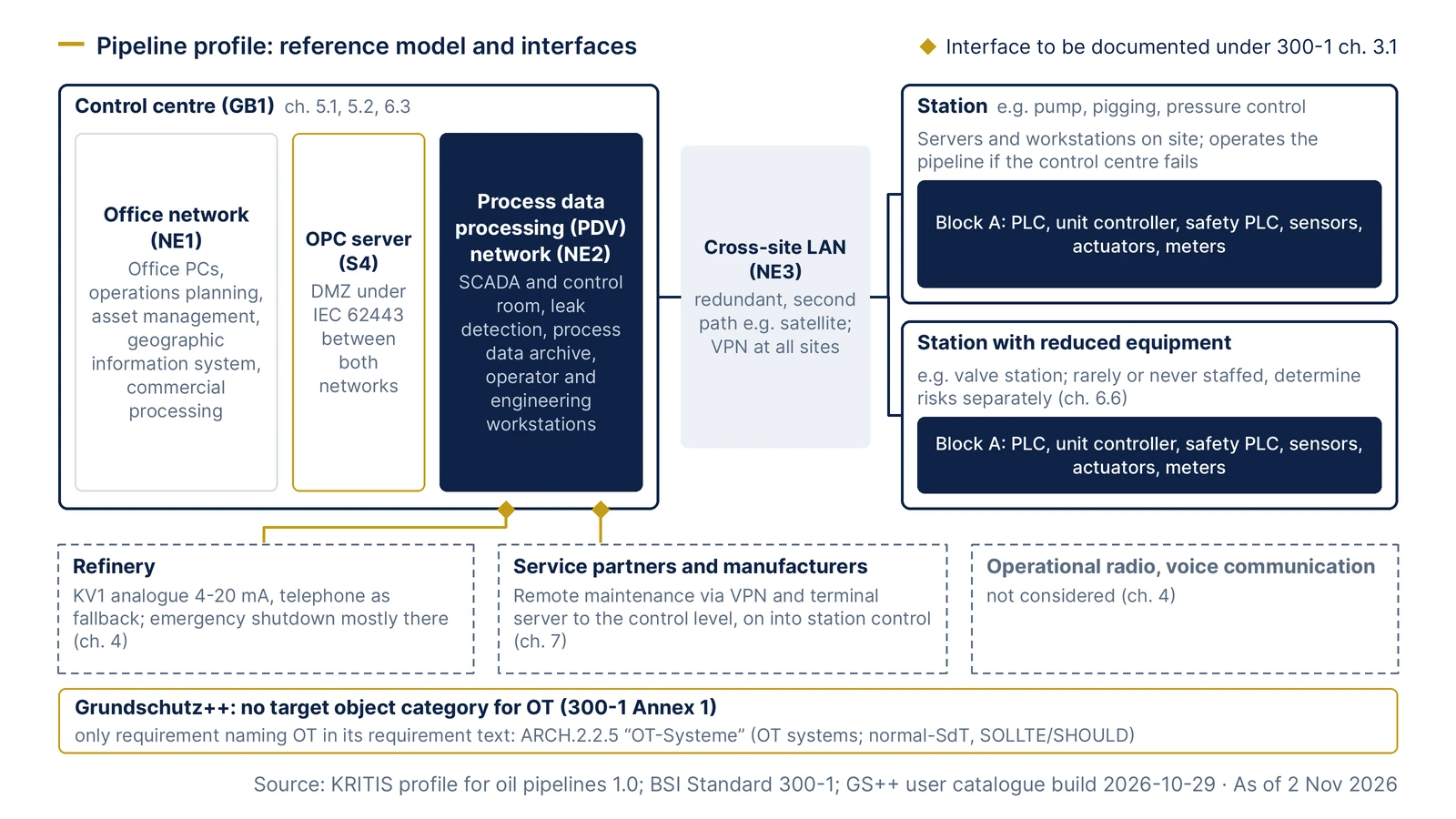
The reference architecture separates a control centre from stations (ch. 5.2). The control centre houses the office network and, separated from it, the process data processing network (PDV network) with the central control room. Between them sits an OPC server through which both networks exchange data; the profile requires it to serve as a demilitarised zone under IEC 62443 (ch. 6.3). Along the pipeline there are pumping, valve, pigging and pressure control stations (ch. 5.1.2) in two variants: a „Station mit reduzierter Ausstattung“ (our translation: "station with reduced equipment"), for example a valve station, contains sensors, actuators, unit controllers and programmable logic controllers; a fully equipped station also has operator workstations and process data servers with which the pipeline can still be operated if the control centre fails.
The model covers 16 applications, from office and email through operations planning, asset management and geographic information system to SCADA/control room, leak detection, process data archive and station control (Tab. 2), five server groups and six types of workstation up to the engineering workstation, which is only connected to unit controllers from time to time (Tab. 3), eight types of industrial component from the PLC through safety-related controllers to meters, sensors and actuators (Tab. 4), switches, firewalls and VPN at all sites and a perimeter router in the control centre (Tab. 5), four networks and an analogue connection to the refinery (Tab. 6), and the control centre, station buildings, control room and technical rooms (Tab. 7). As a particular feature, the profile notes that the stations are far apart and that the pipeline does not run on the operator's own site (ch. 5.2); the route is typically flown over every 14 days, driven along monthly and walked annually (ch. 5.1.1).
Components of voice communication such as operational radio are expressly not considered (ch. 4). Towards the refinery the profile draws a boundary with a caveat: the emergency shutdown is „in den meisten Fällen auf Seite der Raffinerie“ (our translation: "in most cases on the refinery's side"); if that is so, „muss dieser mitberücksichtigt werden“ (our translation: "it must be taken into account as well") (ch. 4). The profile does not describe which transmission technology connects the control centre and the stations. For this it uses a „LAN (übergreifend)“ (our translation: "cross-site LAN"), which „sollte“ (our translation: "should") be designed redundantly and, to protect against sabotage, use a second transmission path, for example via satellite (ch. 6.5). For the connection between control centre and stations it names neither telecontrol technology nor a transmission protocol; in general terms it only speaks of networks based on TCP/IP down to field level (ch. 7).
Does the profile fit your pipeline?
The profile fits if …
- you operate a pipeline with its own control centre, in which the office network and the PDV network are separated and the control room controls the stations;
- your stations can be divided into fully equipped ones and ones with reduced equipment, and at least some of them can operate the pipeline if the control centre fails;
- your pipeline ends at a refinery and a signal connection for the handover exists there;
- service partners or manufacturers maintain pumps, controllers and control systems remotely: this is the main topic of the residual risks in ch. 7;
- you are building or auditing a security concept under BSI Standard 200-2 and are looking for a ready-made module selection with an OT component as a starting point; the profile expressly names audit organisations as users as well (ch. 2).
The profile does not fit, or only partly, if …
- the control centre is run by a service provider or several operators share a pipeline or control centre: the profile only knows one operator with its own control centre;
- your pipeline leads to tank farms, airports or power stations: a handover interface is only modelled towards the refinery (KV1);
- you run servers and clients mainly on Linux: the reference model assumes Windows, and Linux modules have to be added (footnote 6);
- operational radio or voice communication is indispensable for your operations: these components are excluded (ch. 4);
- you need to model the transmission technology between the sites, for example your own cables along the route, leased lines or radio links: the profile combines everything into a cross-site LAN;
- you start directly with Grundschutz++: then you mainly use the two station types, the interfaces to the refinery and service partners and the reasoning on integrity, for example on manipulating limit values for the emergency shutdown; you set up protection requirements and the requirements package afresh and treat controllers and field devices without a target object category of their own separately (see below).
What makes the profile distinctive
Protection requirements measured against supply: the three categories are based on the effect on the critical service, not on the damage to the company. „Sehr hoch“ (very high) means: „Schäden können zu einem Ausfall der kritischen Dienstleistung führen“ (our translation: "damage can lead to a failure of the critical service") (Tab. 8). Availability, integrity, confidentiality and authenticity are assessed. Operations (G1) are very high for availability, integrity and authenticity, IT/OT services (G4) very high for integrity and authenticity and high for availability; confidentiality is normal for all six processes (Tab. 9). As the reason for integrity the profile cites the targeted manipulation of limit values, for example „für die Notabschaltung“ (our translation: "for the emergency shutdown"), and for the availability of commercial processing the attack on Colonial Pipeline in 2021, after which the pipeline was shut down (ch. 5.3). Through the maximum principle, SCADA/control room, leak detection, station control, all controllers, sensors and actuators, all network components, the PDV network, the cross-site LAN and the station networks as well as the control centre, stations, control room and technical rooms become very high for availability, integrity and authenticity (Tab. 10 to 15). Justified deviations include office, email, browser and geographic information system, which remain normal despite being used in processes rated higher, the process data archive, which holds historical data and is therefore normal, and the engineering workstation, whose availability is high, and normal for the device that is only connected from time to time.
OT with modules of its own: the control technology in the stations is modelled with the industrial IT modules, IND.2.1 for all ICS components, plus IND.2.2 for PLCs, IND.2.3 for sensors and actuators, IND.2.7 for safety-related systems and IND.3.2 for remote maintenance in the industrial environment (ch. 6.4). For the safety-related components the profile refers to DIN EN 61511, the DIN IEC 61508 series of standards and the NAMUR worksheet NA 163, as well as to inspections required by law. The pipeline's specialist applications, i.e. SCADA/control room, leak detection and station control, have no module of their own; they appear in the model as „Allgemeine Software“ (general software, APP.6) (ch. 6.2). The profile therefore requires checking for each target object whether the existing modules have it „hinreichend abgebildet“ (our translation: "adequately covered") (ch. 6).
Much from the template, some beyond it: a large part of the additional requirements is taken word for word or almost word for word from the template for KRITIS profiles, including group IDs, the emergency stop switch for a wider group of people, legacy systems without patches and without up-to-date authentication, the parameterisation of controllers as a development activity, virus protection only after a risk analysis, maintenance laptops, offline backup, samples in the audit programme and an on-call service around the clock. According to our comparison, the following do not come from the template: protection zones under IEC 62443 for the process data servers in control centre and station, the OPC server as a demilitarised zone, the second transmission path for the cross-site LAN, the redundant design of the controllers, sensors and actuators important for operations, an encrypted cloud connection of the unit controller to the manufacturer, the annual physical inventory of the spare parts store, rules on subcontractors of manufacturers and outsourcing partners, and „kugelsichere Verglasung“ (our translation: "bulletproof glazing") for the control centre (ch. 6.1 to 6.6). Apart from the second transmission path, these points also appear in the KRITIS profile for refineries of the same date; only the second transmission path is specific to pipelines.
Residual risks from maintenance: chapter 7 describes how external service partners usually dial in via VPN and terminal server „über die zentrale Leitebene auf die Stationssteuerungsebene“ (our translation: "via the central control level to the station control level"). From this it derives three scenarios: faulty updates or configurations, deliberate compromise by insiders, and malware. Patches are said to be tested first in a separate network, but malware could become active with a delay. Added to this are the end-to-end networking via TCP/IP down to field level and spoofed spare parts stocks in the ERP system, which can prolong a disruption.
Inconsistencies you should clarify when adopting the profile:
- OPS.1.2.6 NTP time synchronisation appears in ch. 6.1 as a module for the whole information domain, and in the annex as „Nicht Gegenstand des KRITIS-IT-Grundschutz-Profils“ (our translation: "not covered by the KRITIS IT-Grundschutz Profile").
- SYS.1.3 Servers under Linux and Unix is modelled in ch. 6.4 for station control and unit controller, but is not covered in the annex; footnote 6 explains that the profile assumes Windows servers and Windows 10 clients.
- NET.3.3 VPN is assigned in ch. 6.5 to the VPN component N4, but in the annex to station control IND1 and the perimeter router N3.
- IND.1 Process control and automation technology, INF.9 Mobile workplace and OPS.3.1 Outsourcing for service providers apply to the whole information domain according to the annex, but ch. 6 does not model them; IND.1 is mentioned there only through individual requirements.
- The ID NE2 stands in Tab. 6 for the PDV network, in Tab. 14 for the „LAN-Zentrale“ (control centre LAN) and in ch. 6.5 for control centre LAN and station LAN; station buildings and technical room inherit their protection requirements in Tab. 15 from NE2 instead of from the station network NE4.
- Ch. 5.3 justifies the normal integrity of the „restlichen Prozesse“ (our translation: "remaining processes"; according to Tab. 9 only G2) partly on the grounds that they „Informationen aus G4 benutzen (wie G1)“ (our translation: "use information from G4 (like G1)"); G1 uses the same information and is very high for integrity.
- Tab. 10 and 11 mark some values as maximum principle although a process rated higher is missing: database and commercial processing also serve operations (G1) but are only high; web server, web application and asset management also serve IT/OT services (G4) but are only high for integrity. The OPC server S4 is high in Tab. 11, although SCADA and leak detection run on it according to Tab. 3; Tab. 13 counts it among the systems rated very high.
- On attack detection the profile refers to Section 8a(1a) BSIG for DER.1 and to Section 31(2) BSIG for OPS.1.1.5; it does not say which version of the Act is meant in each case.
- Tab. 3 lists process data servers and operator and engineering workstations for stations with reduced equipment as well, while ch. 5.2 describes these stations without them.
- Ch. 7 names an ERP system „z. B. SAP“ (our translation: "e.g. SAP") for the spare parts, while the annex lists APP.4.2 SAP ERP system as not covered.
Working tool: checklist for your pipeline against the reference model
Chapter 8 of the profile requires the model assumptions on architecture, applications, IT systems, industrial IT, network components, rooms and residual risks to be checked against your own situation and security-relevant deviations to be documented. The checklist starts where a real pipeline is most likely to deviate. Every yes is an object, an interface or a decision that you document. The right-hand column shows how you record a yes in Grundschutz++. For a pipeline these are mostly stations as sites, the handovers to refinery, service partners and manufacturers as interfaces (300-1 chapter 3.1), and controllers and field devices without a suitable target object category as the subject of a risk assessment (chapter 2.11) or of supplementary requirements (chapter 3.4.3).
| No. | Question | What the profile says | If yes: how to record it in Grundschutz++ |
|---|---|---|---|
| 1 | Do you have stations that fit neither the full nor the reduced variant, such as handover or metering stations at customers? | two station types, examples pumping, valve, pigging, pressure control station (ch. 5.1.2, 5.2) | record each station as a site; document equipment and controllability per type |
| 2 | Which transmission technology connects the control centre and the stations, and who owns it? | „LAN (übergreifend)“, redundant, second transmission path for example via satellite (Tab. 6, ch. 6.5); manage all communication links, „IP- oder nicht-IP“ (IP or non-IP), centrally (on CON.9, ch. 6.1); technology not described | record your own lines as internal network segments, third-party carriers as external network connections and services; redundancy in the core network via ARCH.8.1 (SOLLTE, i.e. SHOULD), alternative paths for emergencies via NOT.3.5 (SOLLTE), the second transmission path as a supplementary requirement |
| 3 | Is the emergency shutdown on your side, at the refinery or at both? | „in den meisten Fällen auf Seite der Raffinerie“ (in most cases on the refinery's side), then to be taken into account (ch. 4) | document the interface organisationally and technically, record responsibilities with the refinery operator |
| 4 | Do you exchange signals with facilities other than the refinery, such as tank farms, airports or neighbouring pipeline operators? | only KV1 to the refinery, analogue 4-20 mA with telephone fallback (Tab. 6, 14) | document each connection as an interface to a third-party information domain; include the fallback in emergency planning |
| 5 | How do service partners and manufacturers dial in, and does their access reach into station control? | via VPN and terminal server to the control level, on to station control (ch. 7); jump server recommended (ch. 6.1) | record access as an external network connection, maintenance as a service; partner staff can count as users (Annex 1) |
| 6 | Do unit controllers have a connection to a manufacturer's cloud? | encryption of the cloud connection required (ch. 6.4, IND2); OPS.2.2 Cloud usage modelled without additions | record the connection as a cloud service and external network connection; answer the outsourcing delimitation under chapter 3.1 |
| 7 | Are there systems that cannot be patched or cannot support state-of-the-art authentication? | identify, document, mitigate depending on risk (additions to ORP.4.A13, OPS.1.1.3.A15, CON.1.A1) | as permanent non-fulfilment of a SOLLTE requirement in the risk assessment (chapter 2.11); example below |
| 8 | Do technicians connect their own laptops to stations or controllers? | the profile states that uncontrolled laptops from outside „MUSS“ (MUST) be prevented (ch. 6.3, C3, C5, C6) | record laptops as mobile end devices; regulate network access, example below |
| 9 | Do you use group IDs at operator workstations or an emergency stop switch without key or PIN? | justify and document, mitigate; emergency stop may be open to a wider group of people (additions to ORP.4.A1, A2) | justify and authorise the deviation from BER.2.1 „Person-Identität“ (person identity; SOLLTE) as an exception (UMS.5.1, UMS.5.2; our proposal) |
| 10 | Are stations rarely or never staffed? | „nur selten oder gar nicht besetzt“ (only rarely or never staffed), risks to be determined (ch. 6.6, GB2) | stations as sites with their own risk assessment; check the physical requirements of the GEB practice for sites |
| 11 | Do you manage spare parts in an ERP system? | residual risk of spoofed stocks (ch. 7), annual inventory (ch. 6.2, A8); SAP module not covered in the annex | record the ERP system as an application; adopt the inventory as a supplementary requirement |
| 12 | Which of your specialist applications and field devices are not adequately covered by any module or target object category? | check required for every target object (ch. 6); specialist applications only as „Allgemeine Software“ (general software) | draw up your own list, explicit risk assessment (chapter 2.11), and from it supplementary requirements in the Grundschutz++ format (chapter 3.4.3) |
The assignment to target object categories is our proposal; the definitions in Annex 1 of 300-1 apply. How to define boundaries and interfaces in general is described on the page Defining the information domain. The KRITIS IT-Grundschutz Profile for refineries describes the handover at the refinery from the other side: it lists the same analogue connection KV1 and names the data interface to the crude oil pipeline in its scope delimitation (there ch. 4, Tab. 6). Compare both descriptions when you agree responsibilities with the refinery operator.
Route to Grundschutz++: what the profile brings and what is missing
The profile is based on BSI Standard 200-2 and the 2022 Compendium. We did not find a version for Grundschutz++ in the sources we evaluated (as of 2 November 2026). Four things change in the transfer.
First, the categories. For business processes Grundschutz++ knows two categories, normal and high; custom categories are allowed, and they „sind hierbei auf die Schutzbedarfskategorien des GS++ zu mappen“ (our translation: "are to be mapped to the GS++ protection requirement categories") (300-1 chapter 2.6). You can keep the supply-related categories of the profile as custom categories. Mapped across, operations, maintenance, IT/OT services, commercial processing and operations planning are then high, and only asset management is normal. A risk assessment is therefore required for five of the six processes (chapter 2.6, 2.11). Authenticity does not appear in the protection requirements determination of 300-1, which covers confidentiality, integrity and availability. In the profile, integrity and authenticity are rated and justified identically for all six processes (Tab. 9, ch. 5.3); our proposal is to carry the reasoning on authenticity over into the assessment of integrity.
Second, the requirements in case of elevated protection needs. The profile carried out its own risk analysis on the assumption that, for high and very high protection requirements, these requirements „weitgehend erfüllt sind“ (our translation: "are largely fulfilled") (ch. 6). In Grundschutz++, requirements at the security level elevated (erhöht) carry the modal verb KANN (MAY) and are optional (300-1 chapter 3.4.2). You therefore have to make this basic assumption of the profile afresh in your own risk assessment, otherwise the basis on which the profile's additional requirements rest is missing.
Third, the control technology, and this is where the gap is largest. The target object categories in Annex 1 of 300-1 contain no category for industrial controllers, field devices or safety-related systems; the user catalogue (Anwenderkatalog) build 2026-10-29 contains no further one. The only requirement that names OT in its requirement text is ARCH.2.2.5 „OT-Systeme“ (OT systems; normal-SdT, SOLLTE, target object category (Zielobjektkategorie) networks): connections between OT systems and other IT systems are to be restricted. Its guidance text recommends allowing access only via designated sources such as jump servers. Three further requirements mention OT only in their guidance (BES.2.1.4.1, ARCH.2.4, DET.4.2); DET.4.2, for example, suggests a combination of network and log analysis for OT systems on which nothing can be installed. The pipeline's specialist applications fit into the applications category, whose definition expressly includes the control and monitoring of „technischen Anlagen“ (our translation: "technical installations") (300-1 Annex 1). In our proposal you assign PLCs, unit controllers and safety-related controllers to IT systems, and sensors, actuators and meters as well where they process data. In our assessment the categories and their requirements do not adequately cover these assets; for such assets an explicit risk assessment is required (300-1 chapter 2.11). The protection zones under IEC 62443 that the profile requires can be set in the criteria that ARCH.2.2 „Einschränkung von Verbindungen zwischen Segmenten“ (restriction of connections between segments) leaves open as a parameter (our proposal).
Fourth, the modules. For the 66 modules that the profile's annex assigns to target objects, we counted the draft mapping IT-Grundschutz 2023 → Grundschutz++. Beforehand we converted the IDs to the 2023 edition: OPS.2.1 „Outsourcing für Kunden“ is called OPS.2.3 „Nutzung von Outsourcing“ there, OPS.3.1 „Outsourcing für Dienstleister“ is OPS.3.2 „Anbieten von Outsourcing“, and SYS.2.2.3 is now just „Clients unter Windows“. SYS.2.2.2 for Windows 8.1 was dropped in 2023; the profile mentions it only as an option, and we did not count it. Also not counted are OPS.1.2.6 and SYS.1.3, which appear only in the text (see inconsistencies); together they bring 22 valid requirements, one of them with an entry. The mapping file has status „draft“ (as of 21 July 2026), and we resolved the targets in the user catalogue build 2026-10-29. The result is a draft and not an official mapping.
| Metric (66 modules of the profile, IDs of the 2023 edition) | Value |
|---|---|
| Requirement IDs in the 2023 Compendium | 1,265, of which 186 marked as dropped, i.e. 1,079 valid |
| Requirements with at least one entry in the draft mapping | 355 (around 33 % of the valid ones) |
| distinct Grundschutz++ requirements as targets | 297 from 18 practices; most in DET (74), ARCH (57), KONF (40) and TEST (32) |
| of which industrial IT (IND.1, IND.2.1, IND.2.2, IND.2.3, IND.2.7, IND.3.2) | 67 valid requirements, 25 with an entry, 48 targets; ARCH.2.2.5 is the target of five of them (IND.1.A8, IND.3.2.A5, A7, A8, A12); one further reference (from IND.1.A6) also points to VRB.1.2 |
| Modules without a single entry | 12: ORP.4 Identity and access management, CON.2 Data protection, CON.3 Data backup concept, CON.6 Deletion and destruction, OPS.1.2.4 Telework, SYS.1.2.2 Windows Server 2012, IND.2.2 Programmable logic controller, IND.2.3 Sensors and actuators, INF.5 Room and cabinet for technical infrastructure, INF.6 Data media archive, INF.7 Office workplace, INF.9 Mobile workplace |
| Target references that cannot be resolved in the catalogue | 13 references, all to the same ID VRB.1.2, which does not occur in the catalogue build 2026-10-29 |
An entry in the mapping does not mean that the requirement is fully covered; the relationships range from equivalent to partial overlap. We traced individually three points that the profile highlights for pipelines:
| Profile reference | Requirement, 2023 Compendium | Target in Grundschutz++ (catalogue build 2026-10-29) | Gap |
|---|---|---|---|
| Ch. 6.1 on OPS.1.2.5: jump server recommended „als Verbindungsglied zum Prozessnetz“ (our translation: "as a link to the process network"); ch. 7: service partners dial in via the control level into station control | IND.3.2.A7 „Technische Entkopplung von Zugriffen“ (technical decoupling of access; standard, SOLLTE): every remote access into an OT zone decoupled, via a jump server or a comparable application layer gateway in a separate security segment | Mapping: sub-requirements 1, 2 and 4 as a subset (subset-of) of ARCH.2.2.5 „OT-Systeme“ (normal-SdT, SOLLTE); sub-requirement 4 also as a superset (superset-of) of ARCH.2.2.12 „Sprungserver“ (jump server; elevated, KANN) | The jump server becomes optional; ARCH.2.2.5 only requires connections to be restricted. The multi-factor authentication that the profile describes as state of the art for remote access sits in module ORP.4, which has no entry at all; own search: BER.5.8 „Mehr-Faktor-Authentisierung am Perimeter“ (multi-factor authentication at the perimeter; normal-SdT, SOLLTE) and KONF.4.3 and KONF.4.4 for remote maintenance functions |
| Ch. 6.1, addition to OPS.1.1.3.A15: „Viele Altsysteme lassen sich nicht mehr patchen.“ (our translation: "Many legacy systems can no longer be patched.") Identify, document, mitigate depending on risk | OPS.1.1.3.A15 „Regelmäßige Aktualisierung von IT-Systemen und Software“ (regular updating of IT systems and software; basic): assess and install patches promptly; for products no longer supported, check whether they can nevertheless be operated securely | Mapping: three sub-requirements as a superset (superset-of) of DET.5.10 „Zeitnahes Patchmanagement“ (timely patch management; normal-SdT, SOLLTE), DET.5.10.5 „Test gemäß Änderungsmanagement“ (testing in line with change management) and DET.5.10.3 „Automatisierte Überwachung von Anwendungsupdates“ (automated monitoring of application updates; both elevated, KANN) | We did not find a requirement on products without vendor support in the catalogue. Our proposal: a legacy system that cannot be patched is a permanent non-fulfilment of a SOLLTE requirement and triggers an explicit risk assessment (300-1 chapter 2.11); you authorise and justify the exception under UMS.5.1 and UMS.5.2 (both MUSS) |
| Ch. 6.3, identically worded for C3 in the control centre and for C5 and C6 in the stations, C6 only connected to unit controllers from time to time (Tab. 3): „Die unkontrollierte Anwendung von Laptops von außerhalb des Geltungsbereichs MUSS deshalb unterbunden werden.“ (our translation: "The uncontrolled use of laptops from outside the scope MUST therefore be prevented.") According to ch. 6.6, stations with reduced equipment are rarely or never staffed; there, a third-party device on site goes unnoticed (our note) | SYS.3.1.A8 „Sicherer Anschluss von Laptops an Datennetze“ (secure connection of laptops to data networks; standard, SOLLTE): only approved laptops should be able to log on to the internal network | Mapping: no entry for A8; of the whole module SYS.3.1, only A1 is mapped. Own search: ARCH.4.1 „Netzzugangskontrolle“ (network access control; normal-SdT, SOLLTE, target object category internal network segments), plus ARCH.4.1.2 „Quarantäne“ (quarantine; elevated, KANN) | The assignment is ours, not the draft's. The profile's MUSS becomes a SOLLTE; if you want to keep it mandatory, write it into the package as a supplementary requirement, and for service partners' laptops also into the agreement with the service provider |
Profile-specific requirements appear in no mapping, because the draft only links requirements from the Compendium. This applies to all points that ch. 6 lists as „Zusätzliche Anforderungen“ (additional requirements), and to the notes there, whether taken from the template or specific to pipelines. In some places Grundschutz++ now goes further than the profile: the catalogue already requires an offline copy of the data backup at the normal level (NOT.4.14, SOLLTE), the profile only „abhängig von der Risikoeinschätzung“ (our translation: "depending on the risk assessment"). In others there is no exact counterpart: for emergencies the catalogue requires alternative telecommunications services (NOT.3.5, SOLLTE) and its guidance also mentions satellite connections; it does not require a second transmission path for the operational network that is independent against sabotage. Redundancy exists there for the core network (ARCH.8.1, SOLLTE) and for telephone connections (ARCH.8.2, KANN). And one point creates friction: the profile advises securing „eher die Integrität“ (our translation: "integrity rather") than confidentiality for communication links (refinement of CON.1.A3), while the catalogue requires connections to the wide area network to be encrypted (ARCH.6.2, SOLLTE). If you follow the refinement, justify the deviation. How to check individual mappings from the draft is described on the page Checking the IT-Grundschutz 2023 mapping; how to set up a risk assessment for assets without a suitable category, on the page Carrying out a risk analysis.
Rights notice: Module and requirement titles and paraphrased requirement content from the IT-Grundschutz Compendium, 2023 edition, © 2023 Reguvis Fachmedien GmbH and © 2023 Bundesamt für Sicherheit in der Informationstechnik, source: BSI page on the IT-Grundschutz Compendium. Quotations from the KRITIS-IT-Grundschutz-Profil für Mineralölfernleitungen © Bundesamt für Sicherheit in der Informationstechnik 2025 (according to the document), source: BSI page on the profile. Short quotations and references from BSI Standard 300-1 „Methodik Grundschutz++“, version 1.0 of 20 October 2026, © Bundesamt für Sicherheit in der Informationstechnik 2026, source: BSI page on Grundschutz++. These titles and quotations are not licensed under CC BY-SA 4.0; the licence notice at the end of the page applies to the excerpts from catalogue and mapping data.
What this page does not decide
The table shows what the pipeline profile itself says about the profile, the sector-specific security standard (branchenspezifischer Sicherheitsstandard, B3S), audits and statutory evidence. It contains no statement that applying it counts as statutory evidence or replaces a B3S.
| Level | What the profile says | What does not follow from it |
|---|---|---|
| Profile | Information „um ihren Betrieb nach IT-Grundschutz abzusichern“ (our translation: "to secure their operations in line with IT-Grundschutz"); every operator has to adapt structure and risks itself (ch. 2, 8) | The profile contains no statement that implementing it counts as evidence; it does not mention certification. This page does not interpret what significance it has for your company's obligations. |
| Sector-specific security standard (B3S) | only in the bibliography, via the BSI guidance on B3S under Section 8a(2) BSIG | The profile does not describe itself as a B3S and does not say that it replaces one |
| Audit and inspection | It can support audit organisations, in the profile's words „bei der Herleitung einer geeigneten Prüfgrundlage im KRITIS-Kontext unterstützen“ (our translation: "support in deriving a suitable audit basis in the KRITIS context") (ch. 2); audits under the IS audit guideline (Leitfaden IS-Revision) are said to be „i. A. nicht verpflichtend“ (our translation: "generally not mandatory") for KRITIS operators (on DER.3.2) | The profile does not describe itself as an audit basis; this page does not determine which audit basis applies. |
| Statutory evidence | only in the bibliography, via the guidance on evidence under Section 8a(3) BSIG | no statement that applying the profile provides evidence |
The general classification, including the question of evidential effect, is on the page NIS2 and IT-Grundschutz, section KRITIS IT-Grundschutz Profiles.
Legal references of the profile: The profile is dated 5 December 2025. Its references to Section 8a(1) and (1a), Section 8b, the IT Security Act (IT-Sicherheitsgesetz) of 2015 and the BSI Critical Infrastructure Ordinance (BSI-Kritisverordnung) of 2016 with the 2017 amendment (ch. 2, 3.1, 3.5, 6.1, bibliography) relate to the BSI Act (BSIG) as in force before 6 December 2025; the same applies to the table rows on B3S and evidence. For former operators of critical infrastructure (KRITIS), Section 39(3) of the current BSI Act contains a transitional rule that still refers to the old Section 8a(3); the page NIS2 and IT-Grundschutz gives the wording. This page does not interpret who falls under it and which deadlines follow from it. In one place the profile names Section 31(2) BSIG (on OPS.1.1.5); we do not interpret this reference either. Whether your pipeline falls under the BSI Act today and which obligations follow from it is not decided on this page. The same applies to the other regulations the profile names, including the Pipeline Ordinance (Rohrfernleitungsverordnung), the Technical Rule for Pipeline Installations (Technische Regel für Rohrfernleitungsanlagen), IEC 62443, DIN EN 61511 and the Major Accidents Ordinance (Störfall-Verordnung): we name them but have not checked their content.
Support with the transfer
If you want to convert a security concept based on the pipeline profile to Grundschutz++, the team at Blackfort Technology supports you with the gap analysis, the risk assessment for controllers and field devices without a suitable target object category and the requirements package. Process and scope of services are described on the page Consulting on IT-Grundschutz and Grundschutz++. Information on securing control technology, remote maintenance and zones under IEC 62443 beyond Grundschutz is available on the company website at https://www.blackfort-tec.de/en. Further profiles for other sectors can be found in the overview of IT-Grundschutz Profiles.