

The profile at a glance
| Original title | „KRITIS-IT-Grundschutz-Profil für Raffinerien“ (KRITIS IT-Grundschutz Profile for refineries) |
|---|---|
| Publisher | Bundesamt für Sicherheit in der Informationstechnik; author according to chapter 1 „ohne Namensnennung“ (our translation: "not named"), the change history names division W 13 |
| Version and date | Version 1.0 of 5 Dec 2025, „Initiale Veröffentlichung“ (our translation: "initial publication") according to the change history; the BSI page on the profile gives the same date |
| Revision cycle | „2-jährig“ (our translation: "every two years") according to chapter 1; we did not find a newer version on the BSI page on 2 Nov 2026 |
| Compendium edition | IT-Grundschutz Compendium 2022 (bibliography no. 4); some module names still come from this edition, for example SYS.2.2.2 Clients under Windows 8.1 and OPS.2.1 Outsourcing for customers |
| Methodology | Standard Protection under BSI Standard 200-2, requirements in case of elevated protection needs depending on the result of the protection requirements determination (ch. 3); additional requirements from a risk analysis already carried out under BSI Standard 200-3 (ch. 6) |
| Size | 57 pages (PDF, 1 MB according to the BSI page), 10 chapters, 15 numbered tables, one network plan, modelling table in the annex |
| Accessibility | freely available via the BSI page on the profile, without registration; confidentiality according to chapter 1 „öffentlich“ (our translation: "public") |
| Licence and rights | © Bundesamt für Sicherheit in der Informationstechnik 2025; the document does not state an open licence. We therefore quote only briefly and with a reference and otherwise render the content in our own words; we do not reproduce the network plan or the tables. |
| Type | KRITIS IT-Grundschutz Profile of the BSI, created using the „Schablone zur Erstellung von KRITIS-IT-Grundschutz-Profilen“ (template for creating KRITIS IT-Grundschutz Profiles; cited in the profile as the October 2023 version) |
| Reference | BSI page „KRITIS-IT-Grundschutz-Profil für Raffinerien“, retrieved on 2 Nov 2026 |
What KRITIS IT-Grundschutz Profiles are in general and how they relate to NIS2 is covered on the page NIS2 and IT-Grundschutz. The other profiles, including the three other KRITIS profiles, are listed on the page Finding and reusing IT-Grundschutz Profiles.
Scope and reference refinery
According to the profile, the critical service is the production of fuel, aviation fuel or heating oil from crude oil (ch. 2, 3). Other products such as bitumen are not included, but the profile points out that all products are made from the same crude oil in continuous production and that a disruption affecting the other products has knock-on effects on the relevant ones through logistics and the supply chain (ch. 3). It names delivery as the most time-critical point: internal tank farms can absorb failures in procurement and processing for a while, but a failure of delivery can only be absorbed by the customers’ storage.
Six business processes are considered: operations (G1), asset management (G2), maintenance (G3), IT/OT services with process control, telecommunications and IT services (G4), commercial processing (G5) and operations planning (G6). One special feature on the commercial side: the operator generally does not buy the crude oil itself, it is supplied by the client; billing is based on a volume and mass balance from the metering data of operations (ch. 5.1.1).
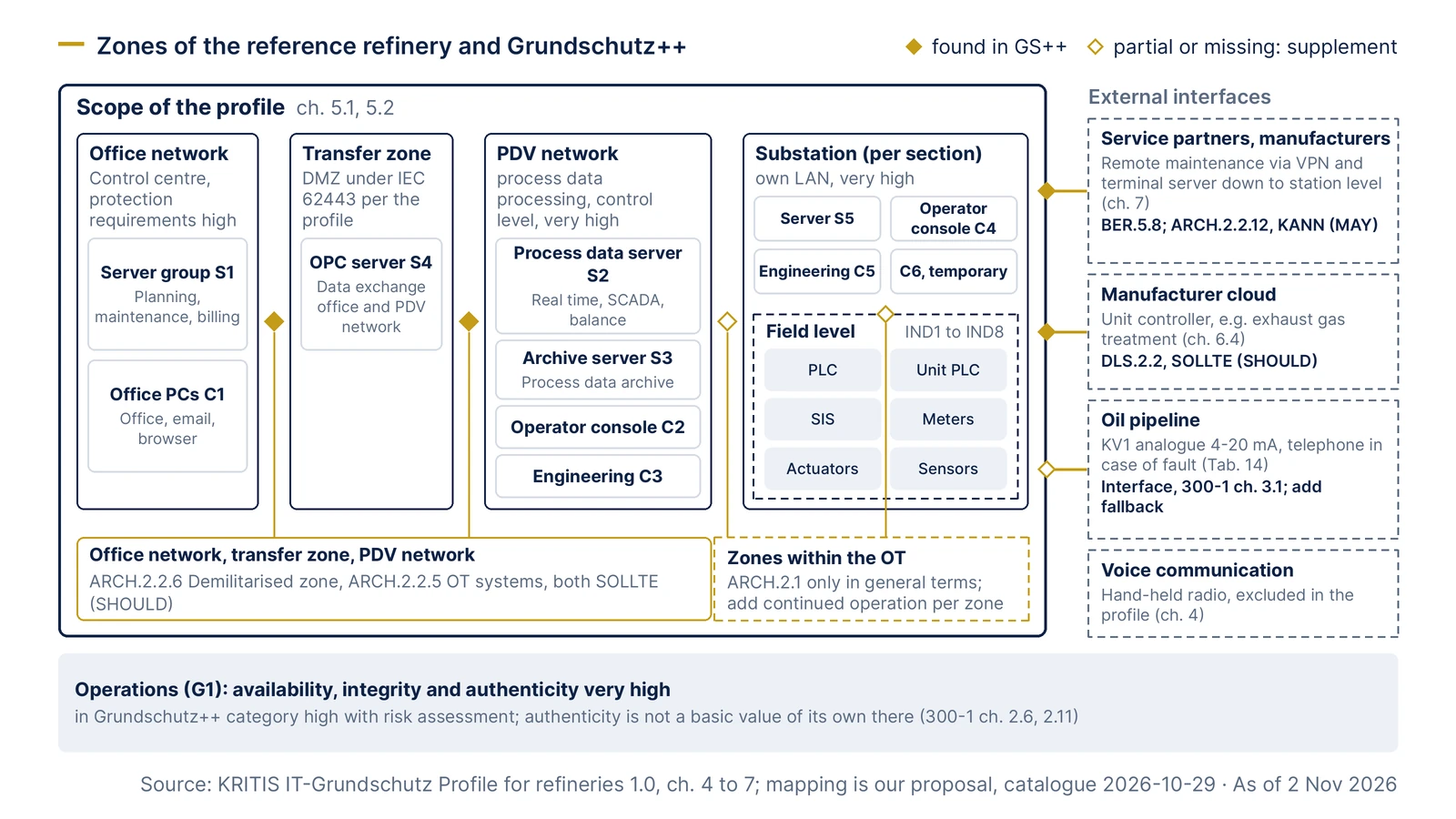
The reference architecture consists of a control centre and several substations, by which the profile means plant sections such as the tank farm, distillation or individual processing steps (ch. 5.1.2). The control centre houses an office network with servers for planning, maintenance and commercial processing and, separate from it, the process data processing network (PDV network) with real-time process data server, archive server, operator and engineering workstations of the control level. Between the two networks sits an OPC server with a database for the exchange of information. Each substation has its own LAN with process data and application server, operator and engineering workstations, an engineering workstation for unit controllers that is only connected temporarily and, below that, the industrial IT: PLCs, unit controllers, safety-related controllers, meters, actuators and sensors, the last two also in safety-related versions (ch. 5.1.3, 5.1.4). Ring topologies may occur at field level and between the substations, for example with Profibus (ch. 5.2).
Components for voice communication are excluded, including the hand-held radios common in refineries (ch. 4). As a boundary, the profile names the oil pipeline to which a refinery is usually connected for its crude oil supply. The link to it is in scope as communication link KV1: an analogue signal used, for example, to confirm that the path into the tank is clear and the transfer can begin; if the signal fails, the pipeline operator sees a message and agrees the next steps with the refinery by telephone (Tab. 14). The profile for oil pipelines describes the same link from the other side and states that in most cases the emergency shutdown lies on the refinery side (there ch. 4). Anyone who operates both facilities or regulates the handover by contract should therefore describe the interface in the same way in both security concepts.
The profile expressly does not require your own refinery to match the model. Operators are to check architecture, applications, IT systems, industrial IT, network components, rooms and the residual risks against their own situation; „sicherheitsrelevante Abweichungen sollten dokumentiert und in ihrer Auswirkung betrachtet werden“ (our translation: "security-relevant deviations should be documented and their impact considered") (ch. 8).
How the profile for oil pipelines models the same handover from the pipeline side is covered on the page on the KRITIS IT-Grundschutz Profile for oil pipelines.
Does the profile fit your refinery?
The profile fits if …
- your refinery operates a central control centre and several substations with their own LAN, and the office network and the PDV network are separated;
- you are building or continuing a security concept under BSI Standard 200-2 and are looking for a selection of modules for the industrial IT as a starting point;
- manufacturers or service partners support your process control systems by remote maintenance: the profile names the outsourcing of service and maintenance as one of the two particular residual risks (ch. 2, 7);
- as an audit organisation or internal audit you need a starting point for the audit basis of a refinery and survey the deviations of the audited plant yourself.
The profile does not fit, or only partly, if …
- your process control systems run mainly on Linux servers or other platforms: the reference assumes Windows servers and Windows 10 clients (annex, footnote 6);
- radio, telephony or alerting are security-relevant for your operations: voice communication is excluded (ch. 4), and emergency communication as in the template is missing;
- you use WLAN, wireless sensors, smartphones or tablets in the plant: the modules for these are „Nicht Gegenstand“ (our translation: "not covered") (annex);
- your process control system is run as a service by a manufacturer or significant parts are outsourced: the profile lists cloud usage and outsourcing as modules, but describes only a single cloud connection of one unit controller;
- you operate tank farms, product pipelines or loading as separate facilities: the profile mentions them only as a substation or as a customer; there is a separate profile for the pipeline;
- you start directly with Grundschutz++: in that case take over the zone model of office network, OPC transfer zone, PDV network and substations and the additional requirements in the checklist; rebuild protection requirements and the requirements package under BSI Standard 300-1 (see below).
What makes the profile distinctive
Protection requirements tied to the supply mandate: the three categories relate to the critical service. Normal means damage has no influence on its provision, high means it can impair it, very high: „Schäden können zu einem Ausfall der kritischen Dienstleistung führen“ (our translation: "damage can lead to a failure of the critical service") (Tab. 8). Four protection goals are assessed, authenticity as well as confidentiality, integrity and availability. Operations (G1) is very high for availability, integrity and authenticity, the IT/OT services (G4) for integrity and authenticity; as an example the profile cites manipulated limit values for the emergency shutdown (ch. 5.3). Confidentiality is normal for all processes. Through the maximum principle, SCADA and the control room, the volume and mass balance, the station control, all operator stations, the entire industrial IT, all network components, the PDV network and substation LAN, as well as the control centre, substation, control room and technical room become very high (Tab. 10 to 15). There are few justified deviations: office application, email client, browser and laboratory documentation remain normal for integrity and authenticity because they are only used for non-critical activities; the process data archive has normal protection requirements because it holds only historical data; the engineering workstations have only high or normal for availability.
Modelling of the process control systems: the profile models the industrial IT with the modules IND.2.1 General ICS component, IND.2.2 PLC, IND.2.3 Sensors and actuators, IND.2.7 Safety instrumented systems and IND.3.2 Remote maintenance in industrial environments; the process control applications such as SCADA, station control and engineering software, on the other hand, only with APP.6 General software, where appropriate supplemented by APP.7, APP.3.1 and APP.4.3 (ch. 6.2, 6.4). For the networks the profile refers to IEC 62443: according to the profile, process data servers of the control and the station level must be placed in their own protection zone, the OPC server is to serve as a demilitarised zone between the office and the PDV network, and depending on the zone concept, PLCs or unit controllers within a substation can also have their own zones (ch. 5.2, 6.3).
What comes from the template and what is new: a large part of the additional requirements in chapter 6.1 appears almost word for word in the template for creating KRITIS IT-Grundschutz Profiles, for example the rules on legacy systems without current authentication or cryptography, on configuring controllers as a development activity, on anti-virus protection on control systems, on offline backup and on multi-factor authentication for remote maintenance. The same applies to the ban on uncontrolled maintenance laptops. According to our comparison, the following are specific to refineries: the protection zones for the process data servers, the OPC server as transfer zone, the duty to know the subcontractors of manufacturers and outsourcing partners, the encrypted cloud connection of unit controllers to manufacturers, for example for exhaust gas treatment, the redundancy of servers, operator stations, controllers, actuators, sensors and networks for operations, the standards and the legally required inspection for safety-related components, calibrated meters with an alarm on failure, the annual stocktake of the spare parts store and structural protection of the control centre; in addition it describes a telephone fallback at the handover to the pipeline. The checklist further down takes up exactly these points.
What the template recommends and the profile omits: among other things, the template supplements NET.1.1.A2 with a cleaned-up network plan that clearly shows the scope and the external interfaces, requires a directory service separate from the rest, expressly refers to IND.1.A4 and IND.1.A5 for the reference architecture and recommends alternative communication channels in the event of an incident. The refinery profile does not take over these supplements; it describes zones under IEC 62443 (ch. 5.2, 6.3) without naming IND.1.A5. It even declares the directory service and the WLAN modules „Nicht Gegenstand“ (our translation: "not covered") (annex). If you adopt the profile, keep the template next to it.
Contradictions between text and annex: the modelling table in the annex does not match chapter 6 in several places. OPS.1.2.6 NTP time synchronisation appears as a module in chapter 6.1, in the annex as „Nicht Gegenstand“ (our translation: "not covered"). SYS.1.3 Servers under Linux and Unix is intended in chapter 6.3 for all servers and in 6.4 for station control and unit controllers, but in the annex it is not covered, with the footnote that the reference assumes Windows servers; the same applies to SYS.2.3 and SYS.2.4 for the clients. Chapter 6.5 assigns NET.3.3 VPN to the VPN component N4, the annex to the perimeter router N3. In the text APP.3.2 Web server belongs to the web server A4, in the annex to six other applications. IND.1 Process control and automation technology, INF.9 Mobile workplace and OPS.3.1 appear only in the annex. There are also identifier errors: IND1 is called „SPS“ (our translation: "PLC") in table 4 and „Stationssteuerung“ (our translation: "station control") elsewhere; the PDV network NE2 is called „LAN Zentrale“ (our translation: "central LAN") in table 14; chapter 6.3 introduces the station server a second time as „S2“ instead of S5; and KV1 is a „Datenschnittstelle“ (our translation: "data interface") in chapter 4 and an analogue communication in table 6. For each of these points, decide which reading you adopt before transferring the modelling into a tool.
Keeping profile, B3S, audit and evidence apart
The profile states itself what it is intended for: it offers operators information to secure their operations in line with IT-Grundschutz, and operators without a Grundschutz ISMS can also take requirements from it (ch. 2). For auditors it says: „Prüforganisationen kann dieses KRITIS-IT-Grundschutz-Profil bei der Herleitung einer geeigneten Prüfgrundlage im KRITIS-Kontext unterstützen.“ (our translation: "This KRITIS IT-Grundschutz Profile can support audit organisations in deriving a suitable audit basis in the KRITIS context.") (ch. 2). The document says nothing more on this. The following table keeps apart what is often mixed up.
| Term | What the refinery profile contains on it | What does not follow from it |
|---|---|---|
| KRITIS IT-Grundschutz Profile | reference model, protection requirements, modelling and additional requirements for a typical refinery; to be adapted to your own plant (ch. 8) | that your own refinery is thereby fully described or secured |
| Sector-specific security standard (B3S, branchenspezifischer Sicherheitsstandard) | only a bibliographic reference to the BSI guidance for authors of a B3S (bibliography no. 7) | that the profile is a B3S or replaces a B3S |
| Audit or inspection | the quoted sentence on audit organisations; on your own audit programme, a supplement taken over from the template on sampling across the substations (on DER.3.1.A7) | an audit scheme, audit scope or assessment standard for audits |
| Statutory evidence | bibliographic reference to the guidance on evidence under Section 8a(3) BSIG in the version before 6 Dec 2025 (bibliography no. 8) | that implementing the profile counts as evidence towards the BSI |
The general classification, including the question of evidential effect, is on the page NIS2 and IT-Grundschutz, section KRITIS IT-Grundschutz Profiles.
Working tool: checklist of the refinery-specific additional requirements
The checklist contains nine refinery-specific additional requirements of the profile, three provisions from the template that the profile applies to particular target objects of the refinery (no. 3, 4 and 11), and, as no. 12, an interface that the profile only describes. Go through each row with those responsible in the role named. The right-hand column shows where the provision ends up in Grundschutz++: with a requirement we found in the user catalogue build 2026-10-29, as an external obligation under STM.2.1.7, or as a supplementary requirement under BSI Standard 300-1 chapter 3.4.3. Roles and mappings are our proposal; MUSS, SOLLTE and KANN are the German modal verbs (MUST, SHOULD, MAY), and KANN means security level elevated (erhöht), i.e. optional.
| No. | Provision in the profile | Check question for your plant | Role | In Grundschutz++ |
|---|---|---|---|---|
| 1 | Process data servers of the control and station level in their own protection zone under IEC 62443; further zones in substations possible (ch. 5.2, 6.3) | Which zones have you defined within the PDV network and per substation, and where are the transitions? | OT operations, planners | ARCH.2.1 Network segments (SOLLTE) requires segments according to protection requirements and names industrial control systems in its guidance; ARCH.2.2.5 OT systems (SOLLTE) separates OT from the rest of IT. Zones by plant section and their independent continued operation as a supplementary requirement |
| 2 | OPC server as demilitarised zone between office and PDV network (ch. 6.3) | Does every data exchange between office network and PDV network run via this transfer zone, without direct connections? | IT operations and OT operations together | ARCH.2.2.6 Demilitarised zone (SOLLTE), whose guidance targets publicly reachable services; record the purpose as a transition between IT and OT yourself |
| 3 | Uncontrolled maintenance laptops „MUSS“ (our translation: "MUST") be prevented (ch. 6.3, on C3, C5, C6) | Can an external laptop obtain a connection in the PDV network or in the LAN of a substation? How is the temporary engineering workstation C6 authorised? | OT operations, maintenance | ARCH.4.1 Network access control and ASST.2.2.1 Detection of unauthorised IT systems (SOLLTE); mandatory character as a supplementary requirement |
| 4 | Remote maintenance: multi-factor authentication as state of the art, jump server as the link to the process network (ch. 6.1); service partners dial in via the control level down to station control (ch. 7) | By which route does each manufacturer and service partner reach which level, with which second factor? | IT operations, OT operations | BER.5.8 Multi-factor authentication at the perimeter, KONF.4.4 Restriction of remote maintenance functions (SOLLTE); ARCH.2.2.12 Jump server (KANN) |
| 5 | Encrypted cloud connection of unit controllers to manufacturers or outsourcing partners, e.g. exhaust gas treatment (ch. 6.4, on IND2) | Which controllers have a connection to the outside, and who operates the remote end? | OT operations, supplier management | Record the remote end as an asset in the category cloud services or outsourcing; DLS.2.2 Transport encryption (SOLLTE) |
| 6 | Know the subcontractors of manufacturers and outsourcing partners, same security level, contractual agreement (ch. 6.1, on OPS.2.1) | Do you know which subcontractors your process control supplier uses for maintenance and support? | Procurement, supplier management | BES.5.6 Awarding of subcontracts, BES.5.6.1 Passing on the procurement criteria (SOLLTE); BES.5.6.2 Authorisation of subcontractors (KANN) |
| 7 | Redundancy for operations: servers S2, S3, S5 (recommended), operator stations, station and unit controllers, safety-related controllers, actuators and sensors, PDV network and substation LAN (ch. 6.3 to 6.5) | Which component of the operations process G1 exists only once? | OT operations, planners | ARCH.8.1 Redundancy in the core network (SOLLTE); ARCH.8.3 Redundant servers, KONF.9.3 Alternative components for critical functions (KANN); for field devices a supplementary requirement |
| 8 | Safety-related controllers, actuators and sensors: standards DIN EN 61511, IEC 61508, NA 163, legally required inspection, „normalerweise jährlich“ (our translation: "normally annually") (ch. 6.4) | Are the inspection dates of the safety devices aligned with the patch and change windows of the process control systems? | Plant safety, OT operations | STM.2.1.7 Due to external obligations (MUSS): assign obligations from your compliance environment to the requirements package; the content is not in the catalogue |
| 9 | Flow meters calibrated, alarm on malfunction or failure; if all meters fail, operations may have to stop for legal reasons (ch. 6.4, on IND4) | Does the control room report the failure of a meter, and is there a substitute measuring point? | OT operations, metering | Calibration duty via STM.2.1.7; alarm as a supplementary requirement (DET.4.13 only monitors the network reachability of host systems) |
| 10 | Physically take stock of the spare parts store at least once a year so that faked stock levels are noticed in the event of an incident (ch. 6.2, 7) | Does the spare parts stock in the ERP system match the store? | Maintenance | no matching requirement found: supplementary requirement |
| 11 | Depending on staffing levels and operational needs, an on-call service in the control centre, reachable and ready for action 24/7 (ch. 6.1, on ORP.2, „sollte“ (our translation: "should")) | Is the control room staffed or reachable around the clock, including when the process control systems are disrupted? | Plant management | DET.2.3 Permanent on-call service (KANN) covers only security-relevant alarms; operational readiness as a supplementary requirement |
| 12 | Description in the profile, not an additional requirement: analogue link KV1 to the oil pipeline, telephone coordination if the signal fails (Tab. 14) | Are the signal, fallback and responsibilities agreed in writing with the pipeline operator? | OT operations, pipeline operator | Document the interface under 300-1 ch. 3.1; ARCH.2.4 Inventory of networks (SOLLTE) names external network connections; fallback as a supplementary requirement |
| 13 | Further measures against attacks from outside on the control centre, e.g. „kugelsichere Verglasung“ (our translation: "bullet-proof glazing") (ch. 6.6) | Is the structural protection of the control centre designed for threats from outside? | Plant security, facility management | no matching requirement found in building management: supplementary requirement |
How to define boundaries and interfaces in general is described on the page Defining the information domain; how to derive supplementary requirements from a risk assessment, on the page Carrying out a risk analysis.
Route to Grundschutz++: what the OT modelling carries over
For a refinery, three things change when moving to Grundschutz++: the very high values for operations and IT/OT services fall into the category high, there are neither IND modules nor a target object category (Zielobjektkategorie) of their own for the process control systems, and of the 1,129 valid requirements of the 70 modules, 357 have an entry in the draft mapping. We did not find a Grundschutz++ version of the profile on 2 November 2026; it is based on BSI Standard 200-2 and the 2022 Compendium.
First, the protection requirements. Grundschutz++ determines them for business processes, with the basic values confidentiality, integrity and availability and two categories, normal and high; own categories „sind hierbei auf die Schutzbedarfskategorien des GS++ zu mappen“ (our translation: "are to be mapped to the protection requirements categories of GS++") (300-1 ch. 2.6). As we understand it, the profile’s high and very high therefore both fall into the category high. For operations, IT/OT services, maintenance, commercial processing and operations planning, a risk assessment is then required (ch. 2.6, 2.11). Authenticity is not a basic value of its own in Grundschutz++; our proposal is to carry the profile’s justifications for authenticity over to integrity, because the profile rates and justifies both in the same way. Replace inheritance via the maximum principle with the assignment of assets to processes (300-1 ch. 3.4.2).
Second, the target objects. For PLCs, unit controllers, safety-related controllers, meters and field devices of the substations, Annex 1 of 300-1 has no category of its own; we assign them to IT systems. SCADA, station control and engineering software fit the applications, which according to the definition in Annex 1 also include software for „Steuerung, Konfiguration, Überwachung oder Administration von Hardware, technischen Anlagen“ (our translation: "control, configuration, monitoring or administration of hardware, technical installations"). Whatever these categories do not cover for the substations, you deal with through the risk assessment and supplementary requirements (ch. 2.11, 3.4.3). From the user catalogue, ARCH.2.2.5 OT systems (normal-SdT, SOLLTE), the only requirement whose requirement text names OT, fits the transitions between office network, OPC transfer zone and PDV network. For zones within a substation, ARCH.2.1 Network segments remains, whose guidance names industrial control systems as separate segments; it does not require the continued operation of one zone if the others fail (see graphic). For the interplay between firmware updates on controllers and the annual inspections of the safety-related devices (checklist no. 8), TEST.3.2 Test coverage (normal-SdT, SOLLTE) is a suitable point of attachment; its guidance cites as an example an insufficiently tested firmware update on an industrial control system.
Third, the modules. Chapter 6 and the annex together yield 70 modules under the identifiers of the 2023 edition. For this we replaced OPS.2.1 with OPS.2.3 and OPS.3.1 with OPS.3.2, left out SYS.2.2.2 Clients under Windows 8.1 because the module was dropped in the 2023 edition, and counted SYS.2.2.3 under its new title Clients under Windows. SYS.1.2.2 Windows Server 2012 still exists in the 2023 edition; for current servers, SYS.1.2.3 Windows Server has been added there. Modules that appear only in the text or only in the annex were included in the count. We counted with the mapping file with status "draft" of 21 July 2026 and resolved the targets against the user catalogue build 2026-10-29; all figures below therefore describe a draft and not an official mapping.
You can reuse the profile’s justifications from chapter 5.3, for example on manipulated limit values of the emergency shutdown, for your own classification; the procedure is described on the page Assessing protection requirements with justification.
| Metric | all 70 modules | of which industrial IT (IND.1, IND.2.1, IND.2.2, IND.2.3, IND.2.7, IND.3.2) |
|---|---|---|
| Requirement identifiers in the 2023 Compendium | 1,326, of which 197 dropped, i.e. 1,129 valid | 76, of which 9 dropped, i.e. 67 valid |
| Requirements with at least one entry in the draft mapping | 357 (around 32 % of the valid ones) | 25 (around 37 % of the valid ones) |
| distinct Grundschutz++ identifiers as targets | 299, of which 298 resolvable in the catalogue, from 18 of the 20 practices (Praktiken); most in DET (74), ARCH (57), KONF (41) and TEST (32) | 49, of which 48 resolvable; most in DET (17), ARCH (8) and TEST (8) |
| Modules without a single entry | 14: ORP.4, CON.2, CON.3, CON.6, OPS.1.2.4, SYS.1.2.2, SYS.1.3, SYS.2.4, IND.2.2, IND.2.3, INF.5, INF.6, INF.7, INF.9 | IND.2.2 Programmable logic controller and IND.2.3 Sensors and actuators |
| Target references that cannot be resolved in the catalogue | 13, all to the same identifier VRB.1.2, which does not exist in catalogue build 2026-10-29 | 1 (from IND.1.A6, also VRB.1.2) |
For the field level of the refinery, i.e. PLCs, meters, actuators and sensors, the draft therefore provides not a single mapping; the requirements of the modules IND.2.1 and IND.2.7 are only partly linked. Even where there is an entry, it may cover only a partial requirement or a partial overlap, as the second example shows. We traced individually three requirements on which the profile particularly relies for the process control systems:
| Profile reference | Requirement in the 2023 Compendium | Target in Grundschutz++ (catalogue build 2026-10-29) | Gap |
|---|---|---|---|
| Ch. 6.3 on S2 and S5: process data servers in a protection zone under IEC 62443; ch. 5.2: zones also within a substation | IND.1.A5 „Entwicklung eines geeigneten Zonenkonzepts“ (our translation: "Development of a suitable zone concept") (standard, SOLLTE): segment OT horizontally by plant as well; zones that control the process should continue to run for a while if other zones fail | Mapping: no entry. In the draft, ARCH.2.2.5 OT systems (normal-SdT, SOLLTE) is the target of IND.1.A8, IND.2.4.A1, four requirements from IND.3.2 and INF.14.A18, but not of IND.1.A5. Our own search: ARCH.2.2.5 and ARCH.2.1 Network segments | ARCH.2.1 requires network segments according to protection requirements and names production network and industrial control systems in its guidance, ARCH.2.2.5 the separation of OT from the rest of IT. No requirement we found requires dividing the OT by plant section or the continued operation of one zone if the others fail; treat both as supplementary requirements. The mapping is ours |
| Ch. 6.1 on OPS.1.2.5: take IND.2.1.A1 into account for OT components | IND.2.1.A1 „Einschränkung des Zugriffs auf Konfigurations- und Wartungsschnittstellen“ (our translation: "Restriction of access to configuration and maintenance interfaces") (basic, MUSS): change default passwords, only authorised persons at maintenance interfaces, change configuration only after approval or authentication | Mapping: only partial requirement 1 (password change) overlapping (intersects-with) with KONF.2.3 Default credentials in IT systems (normal-SdT, SOLLTE). Our own search for the rest: KONF.4.4 Restriction of remote maintenance functions and TEST.1.3 Restriction of changes (both SOLLTE) | The modal verb drops from MUSS to SOLLTE. Approval before every configuration change on a controller is not in any requirement we found; our proposal: as a supplementary requirement, aligned with the profile’s supplement on CON.8.A2 (configuration as a development activity) |
| Ch. 6.3 on C3, C5, C6: „Die unkontrollierte Anwendung von Laptops von außerhalb des Geltungsbereichs MUSS deshalb unterbunden werden.“ (our translation: "The uncontrolled use of laptops from outside the scope MUST therefore be prevented.") | SYS.3.1.A8 „Sicherer Anschluss von Laptops an Datennetze“ (our translation: "Secure connection of laptops to data networks") (standard, SOLLTE): only approved laptops should be able to log on to the internal network | Mapping: no entry; of the module SYS.3.1 only one of 15 valid requirements is linked. Found in the catalogue: ARCH.4.1 Network access control for internal network segments and ASST.2.2.1 Detection of unauthorised IT systems (both normal-SdT, SOLLTE) | The profile’s obligation remains a SOLLTE in Grundschutz++. Many control networks cannot do network access control; in that case the organisational authorisation of maintenance laptops belongs in the package as a supplementary requirement. The mapping is ours |
The additional requirements of the profile are profile-specific provisions. The draft links only Compendium requirements; the checklist items and the supplements taken over from the template therefore do not appear anywhere in it. Whatever of these is to apply to your refinery belongs in the requirements package as a supplementary requirement, ideally with a reference to the passage in the profile. You can check individual mappings with the guide on the page Checking the IT-Grundschutz 2023 mapping.
Rights notice: Requirement titles from the IT-Grundschutz Compendium, 2023 edition, © 2023 Reguvis Fachmedien GmbH and © 2023 Bundesamt für Sicherheit in der Informationstechnik, source: BSI page on the IT-Grundschutz Compendium. Quotations from the KRITIS-IT-Grundschutz-Profil für Raffinerien © Bundesamt für Sicherheit in der Informationstechnik 2025, source: BSI page on the profile. These titles and quotations are not licensed under CC BY-SA 4.0; the licence notice at the end of the page applies to the extracts from catalogue and mapping data.
What this page does not decide
The profile relies on the BSI Act (BSIG) and the BSI Critical Infrastructure Ordinance (BSI-KritisV) in their versions at the time: by its own account it takes into account Section 8a(1) and (1a) BSIG, refers to Section 8b BSIG for the point of contact for the BSI and determines the facility category refinery via the BSI Critical Infrastructure Ordinance of 2016 and its first amendment of 2017 (ch. 3, 6.1). The revised BSI Act entered into force on 6 December 2025, one day after the date of the profile. These references therefore relate to the BSI Act in the version before 6 December 2025. The BSI Critical Infrastructure Ordinance itself remains in force in amended form, now under the title „Verordnung zur Bestimmung kritischer Anlagen nach dem BSI-Gesetz“ (Ordinance on determining critical facilities under the BSI Act). This page does not interpret whether and with which obligations current law covers your refinery.
The same applies to the other rules the profile names: IEC 62443, DIN EN 61511 and IEC 61508, the NAMUR worksheet NA 163, the Hazardous Incident Ordinance (Störfall-Verordnung), environmental protection regulations, calibration regulations for meters and legally required inspections of safety-related devices. We name them as the profile names them, but have not checked their content.
The profile contains no statement that implementing it counts as statutory evidence (see table above); no certification is associated with the profile. The profile itself requires the described structure to be adapted to your own plant and the risks to be treated accordingly (ch. 2, 8). This page does not interpret what significance the profile has for the obligations of your refinery.
For former operators of critical infrastructure, Section 39(3) of the current BSI Act contains a transitional rule that still refers to the old Section 8a(3); the wording is given on the page NIS2 and IT-Grundschutz. This page does not interpret who falls under it and which deadlines follow from it.
The general classification is on the page NIS2 and IT-Grundschutz, section KRITIS IT-Grundschutz Profiles.
Support with the transfer
If you want to move a security concept based on the refinery profile to Grundschutz++ or adapt the profile to your plant, the team at Blackfort Technology supports you with gap analysis, zone concept, protection requirements and requirements package. The phases and scope of this support for refinery operators are described on the page Consulting on IT-Grundschutz and Grundschutz++. What we offer operators in energy and KRITIS beyond Grundschutz is described on the sector page Cybersecurity for energy and KRITIS. The transfer route for profiles in general is described in the overview of IT-Grundschutz Profiles.