
The profile at a glance
| Original title | „KRITIS-IT-Grundschutz-Profil für Tankstellennetze“ (KRITIS IT-Grundschutz Profile for filling station networks) |
|---|---|
| Publisher | Bundesamt für Sicherheit in der Informationstechnik; author according to ch. 1 „ohne Namensnennung“ (our translation: "not named"), in the change history the division W 13 |
| Version and date | Version 1.0 of 5 Dec 2025 according to the change history („Initiale Veröffentlichung“, our translation: "initial publication"); the BSI page on the profile gives the same date. The rights notice in the document reads „© Bundesamt für Sicherheit in der Informationstechnik 2026“. |
| Revision cycle | „2-jährig“ (our translation: "every two years") according to ch. 1 |
| Compendium edition | not stated in the profile; the module names correspond to the status before the 2023 edition (examined in the section "Which Compendium edition is it based on?" further below) |
| Methodology | BSI Standard 200-2, Standard Protection; requirements in case of elevated protection needs where the protection requirements determination and the risk analysis call for them (ch. 3). Three protection requirements categories, assessed for availability, integrity, confidentiality and authenticity (ch. 5.3) |
| Size | 50 pages (PDF, about 1 MB according to the BSI page), 10 chapters, 15 tables, one network plan, modelling table in the annex |
| Accessibility | freely available via the BSI page on the profile; confidentiality according to ch. 1 „öffentlich“ (our translation: "public") |
| Licence and rights | BSI rights notice, no open licence. We quote only briefly and with a reference and otherwise reproduce the content in our own words; we do not reproduce tables or the network plan. |
| Type | KRITIS IT-Grundschutz Profile of the BSI, by its own account a profile based on the template for creating KRITIS IT-Grundschutz Profiles (Schablone zur Erstellung von KRITIS-IT-Grundschutz-Profilen, reference [2], „Oktober 2023“, our translation: "October 2023"); not an association profile, not a thesis |
| Reference | BSI page „KRITIS-IT-Grundschutz-Profil für Tankstellennetze“, retrieved on 2 Nov 2026 |
What KRITIS IT-Grundschutz Profiles are in general, why their references to Section 8a BSIG refer to the BSI Act (BSIG) as in force before 6 December 2025, and what profiles, template and the BSI page say about the profiles' value as evidence is covered on the page NIS2 and IT-Grundschutz. An overview of all profiles is available under Finding and reusing IT-Grundschutz Profiles.
Scope and reference architecture
The target group is filling station network operators. The profile adopts the definition from the BSI Critical Infrastructure Ordinance (BSI-Kritisverordnung, BSI-KritisV) in its 2016 version and its first amendment of 2017: a filling station network as a facility or system connecting independent filling stations by means of central components (ch. 3). The critical service is supplying end customers with fuel for motor vehicles. According to ch. 5.3, the KRITIS protection objective is „die Verfügbarkeit und Abgabe ausreichender Mengen Kraftstoff an den Tankstellen“ (our translation: "the availability and dispensing of sufficient quantities of fuel at the filling stations").
Five business processes are considered: operations (procurement and pricing centrally, sales at station level), asset management, maintenance, IT/OT services and commercial processing (ch. 3, 5.1.1). Operations is regarded as the most important prerequisite for the critical service, IT/OT services as an essential prerequisite for operations. The structure analysis lists 22 applications, six IT systems, ten components of industrial IT, four network components, three networks as well as road tankers, head office, station, office room and data centre (Tab. 2 to 7). Each application and each system is given a location: head office, station or road tanker.
Excluded are transport by aggregators, product depots and tank farms as a separate facility category, and the trading systems that set prices and control the value chain from crude oil to sale (ch. 4). Also not considered are filling stations for ships, boats and rail vehicles, airfield fuelling facilities, shop and car wash, and voice communication; according to the profile, landline and mobile networks are sufficient for making contact in an emergency. Worth noting: delivery by aggregators lies outside the scope, while the operator's own road tankers with onboard unit, tanker control and tanker network lie inside it. If your stations are supplied only by third-party hauliers, you remove this part and document the interface instead.
The profile itself admits that its reference architecture does not represent all operators (ch. 5.2). It distinguishes company-owned filling stations (company-operated site, tenant without ownership, agent with ownership, commission agent with own filling station) and independent filling stations such as unbranded filling stations, supermarket filling stations and multi-site operators. Depending on the operating model, services are outsourced, for example fleet management or maintenance of the fuel dispensers; for each service provider the profile requires the outsourcing module. According to ch. 8, deviations of your own situation are to be documented and their impact considered, in particular for architecture, applications, IT systems, industrial IT and residual risks.
Does the profile fit your filling station network?
The profile fits if …
- you connect many road or motorway filling stations through central components and process prices, stock levels, till and payment data centrally;
- tank and fuel dispenser control, till and price display at the station are networked and manufacturers support them via remote maintenance or a cloud connection; this is where the profile has most of its own requirements;
- you are building or continuing a security concept under BSI Standard 200-2 and are looking for a structure analysis and modelling as a starting point;
- you are an audit organisation deriving an audit basis; the profile names this role explicitly in ch. 2.
The profile does not fit, or only partly, if …
- your filling stations are not connected through central components, for example a single unbranded filling station; the profile's definition presupposes a network;
- you mainly operate tank farms, product depots or trading systems: these are excluded (ch. 4);
- you operate boat filling stations, rail filling stations or airfield fuelling facilities (ch. 4);
- till and payment processing run on your own systems in the station: the profile then lacks the matching IT system, and the protection requirements of head office and office network turn out differently than in Tab. 11 to 15;
- you run only individual stations of a group as tenant, agent or commission agent: the profile is written from the network operator's perspective; your tasks follow from the division of work with the group, which the profile does not cover;
- you start directly with Grundschutz++: you then mainly use the assignment of technology to head office, station and road tanker, the outage times in the justification of protection requirements (up to 4 hours at the station, up to 2 days for central components) and the three manufacturer scenarios from ch. 7; protection requirements and requirements package you set up anew (see below).
Head office or station: how the profile splits the technology
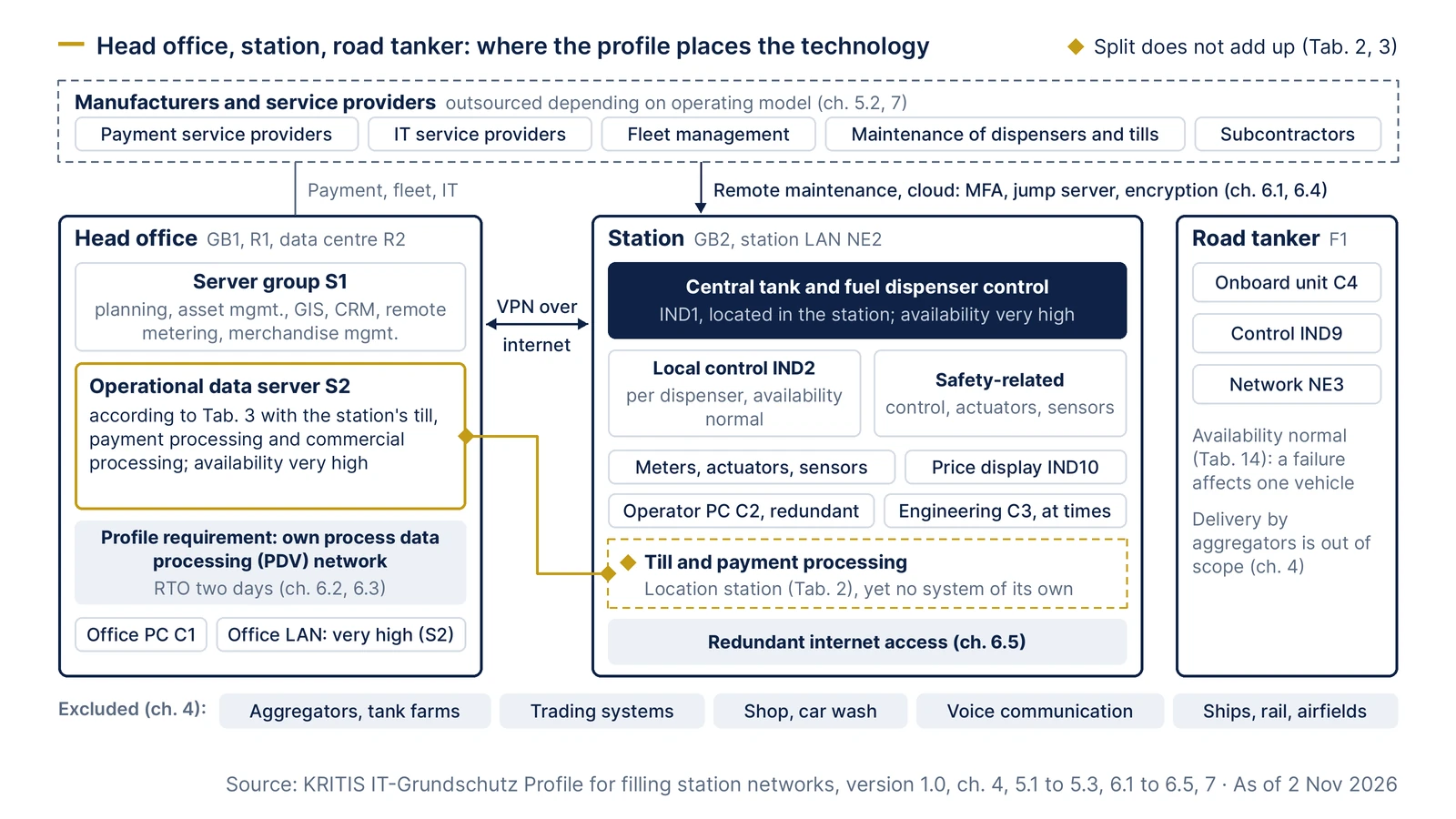
At the station the profile places the station control, the operator software, the process data archive, the engineering station, payment processing, till and POS system and commercial processing (Tab. 2), plus the operator workstation, an engineering workstation that is connected only at times, and all of the industrial IT: the central and the local tank and fuel dispenser control, the safety-related control with its actuators and sensors, meters, actuators, sensors and the price display (Tab. 3, 4). For control IND1, „Zentrale“ (our translation: "central") means central within the station; the local control IND2 belongs to a single fuel dispenser. If it fails, according to the profile only that dispenser is affected, which is why its availability is normal and that of the central control very high (Tab. 12).
The head office houses the server group with database, web applications, operations planning, asset management, geographic information system, fleet management, CRM for the filling station cards, remote meter reading centre and merchandise management, as well as office PCs, office network and data centre. The split does not, however, run neatly along the property boundary. According to Tab. 3, payment processing, till and POS system, operator software, process data archive and commercial processing of the station run on the operational data server S2 at the head office; the profile lists no separate IT system for the till at the station. The consequence shows in the protection requirements tables: S2 inherits very high availability from the till system, and via S2 the office network, the head office building and the data centre also become very high for availability (Tab. 11, 14, 15).
For S2 the profile additionally provides for a separate network segment, the „PDV-Netz“ (our translation: "process data processing network", PDV network), justified by the risk of compromise, because such a network has no internet access or only strictly regulated access. In addition, S2 is to be designed for a recovery time objective (RTO) of two days; the profile derives this requirement from payment processing and also sets it for commercial processing and the network connection of the office network (ch. 6.2, 6.3). In the profile's network plan, however, S2 still sits in the office network next to the server group (fig. 1). Read the additional requirement as a target state: if till and payment data of the stations are processed centrally in your organisation, this server should be operated separately from the office network.
According to ch. 7, the connections between head office, stations and service providers mostly run over the internet, secured by VPN. Without a working station network, according to the profile, no price reporting, remote maintenance or card payment is possible; the station's internet access should therefore be redundant (ch. 6.5), as should the operator workstation (ch. 6.3). A single station could keep working for a certain time if internet access fails; in the longer term, disruptions to payment processing, pricing and commercial processing would impair the critical service (ch. 7).
Remote maintenance is the third location in the split. According to ch. 3, maintenance firms service the station's systems „vor Ort, per Fernwartung oder in der Cloud“ (our translation: "on site, by remote maintenance or in the cloud"). For the central control IND1 the profile requires an encrypted cloud connection to the manufacturer or outsourcing partner, physical tamper protection of the fuel dispenser with intrusion detection, and updates that are first tested on one device (ch. 6.4). It describes multi-factor authentication for remote access as „mittlerweile als Stand der Technik anzusehen“ (our translation: "now to be regarded as state of the art"); for OT components it refers to requirements IND.2.1.A1 and A2 and recommends a jump server at the operator (ch. 6.1 on OPS.1.2.5). It bases the residual risk on the market situation: fuel dispenser controls and till systems usually come from the same manufacturer, who also maintains them, and in Germany there are „nur zwei namhafte Hersteller vertreten“ (our translation: "only two well-known manufacturers represented") (ch. 7). From this it derives three scenarios: faulty updates or configurations, an insider at the service provider and malware brought in, each with the risk that many stations fail at the same time.
What makes the profile distinctive
Protection requirements measured by supply failure: the three categories are defined by their effect on the critical service. In the profile, high stands for a possible impairment with limited effects, very high for a possible failure with far-reaching effects; the profile explicitly considers these levels suitable for filling station networks (Tab. 8 and the explanation below it). Only the availability of operations is very high; availability, integrity and authenticity of IT/OT services and the availability of commercial processing are high; confidentiality is normal throughout, because according to the profile measurement and control data are not confidential (Tab. 9 and justification in ch. 5.3). In its justification the profile distinguishes the failure of a single filling station, which remains locally limited, from the failure of many stations or entire networks. At station level, a failure of fuel dispenser control, till or actuators and sensors would impair supply „sehr kurzfristig (bis 4 Stunden)“ (our translation: "at very short notice (up to 4 hours)"), a failure of central components such as merchandise management or fleet management „kurzfristig (bis zu 2 Tagen)“ (our translation: "at short notice (up to 2 days)").
Integrity before confidentiality: consistently, the profile requires communication links to secure integrity rather than confidentiality (refinement of CON.1.A3), and points out that communication between central control, local control and till often runs over proprietary manufacturer protocols, in part unencrypted (ch. 7).
Additional requirements from a risk analysis under BSI Standard 200-3 (ch. 6): depending on staffing levels and operational needs, an on-call service at the head office „der 24/7 erreichbar und einsatzfähig ist“ (our translation: "which is reachable and ready for action 24/7"), justified by the very short-term impairment if fuel dispenser control, actuators, sensors and meters fail (on ORP.2); justified and documented group IDs where operations force them (on ORP.4.A1); an emergency stop switch that the persons who notice the emergency may operate, even against the principle of least privilege (on ORP.4.A2); identifying legacy systems that do not support up-to-date authentication, cryptography or patches and securing them according to risk (on ORP.4.A13, CON.1.A1, OPS.1.1.3.A15); an offline backup of critical data (on CON.3.A12); treating the parameterisation of industrial controls as a development activity with a documented procedure (on CON.8.A2); virus protection on controls only after a risk analysis (on OPS.1.1.4.A3); spot checks in the audit programme, because many external sites belong to the scope (on DER.3.1.A7); an emergency concept aligned with security of supply for the general public (on DER.4.A7). For the station, calibrated flow meters with an alarm on malfunction, regular testing of actuators and sensors and the legally required tests of safety-related controls are added (ch. 6.4). Under „benutzerdefinierte Bausteine“ (our translation: "user-defined modules") there is a rule on handling information from inventory to return (ch. 6.1).
Inconsistencies to watch for when adopting the profile: IND.3.2 Remote maintenance in industrial environments and OPS.1.2.6 NTP time synchronisation appear in ch. 6.1 as modules to be applied, but in the modelling table of the annex as „Nicht Gegenstand des Profils“ (our translation: "not covered by the profile"). Conversely, the annex lists APP.1.4 Mobile applications, OPS.3.1, SYS.3.2.2 Mobile device management, IND.1 and INF.9 Mobile workplace, which are not modelled in ch. 6. NET.3.3 VPN is assigned in ch. 6.5 to the VPN component N4, in the annex to the perimeter router N3. The relational database A5 has no module in ch. 6.2. Tab. 2 places office software, e-mail and browser only at the head office, ch. 6.2 and Tab. 3 also at the station. The office room R1 has the value normal for availability, with the justification that the office network has very high protection requirements (Tab. 15). Merchandise management and fleet management have normal availability in Tab. 10, although ch. 5.3 names precisely their failure as the reason for the high protection requirements of IT/OT services. Camera surveillance of the fuel dispensers is to take place „nötigenfalls unter Berücksichtigung von SYS.4.4“ (our translation: "where necessary taking SYS.4.4 into account") (ch. 6.4), while the annex lists SYS.4.4 as not covered by the profile.
Working tool: responsibility matrix for head office, station, manufacturer
The profile specifies where a target object is located, but not who operates and maintains it. That is exactly what differs between company-operated site, tenant, agent and independent operator. For each row, note who in your organisation operates (O), maintains (M) and is contractually responsible (R): head office (H), station operator (S) or manufacturer and service provider (P). Every row in which P appears is an interface to the outside and a case for the outsourcing module that the profile requires for every service provider (ch. 5.2). The right-hand column names the check question on which the assignment usually depends.
| No. | Target object according to profile | Location and protection requirements A / I according to profile | What the profile requires | O / M / R in your organisation | Check question |
|---|---|---|---|---|---|
| 1 | Central tank and fuel dispenser control (IND1), station control (A12) | Station; very high / high (Tab. 10, 12) | encrypted cloud connection, tamper protection of the fuel dispenser, test updates on one device first (ch. 6.4) | Who installs updates, and who approves them? | |
| 2 | Local control per fuel dispenser (IND2) | Station; normal / high (Tab. 12) | modules IND.2.1, IND.2.2 (ch. 6.4) | Does the dispenser belong to the network operator or to the station operator? | |
| 3 | Safety-related control, actuators and sensors (IND3, IND7, IND8) | Station; very high / high (Tab. 12) | legally required testing, protection against unauthorised changes (ch. 6.4) | Who commissions the recurring tests, and who keeps the results? | |
| 4 | Meters, actuators, sensors, price display (IND4 to IND6, IND10) | Station, meters, actuators and sensors also in the road tanker (Tab. 4); very high / high (Tab. 12) | calibrated flow meter, alarm on malfunction, regular testing (ch. 6.4) | Where does the alarm go, and who responds outside opening hours? | |
| 5 | Till and POS system, payment processing (A13, A14) | according to Tab. 2 station, according to Tab. 3 on S2 at the head office; till very high / high, payment processing high / normal (Tab. 10) | RTO two days for payment processing (ch. 6.2) | Does your till run on its own system in the station, centrally or at the manufacturer? | |
| 6 | Operational data server (S2) | Head office; very high / high (Tab. 11) | own PDV network, RTO two days (ch. 6.3) | Is the server separated from the office network, and who operates it? | |
| 7 | Station operator workstation (C2) | Station; high / high (Tab. 11) | redundant design (ch. 6.3) | Who provides the replacement device, and how quickly? | |
| 8 | Engineering workstation (C3), maintenance laptops | Station, connected at times; normal / high (Tab. 11) | prevent uncontrolled laptops from outside (ch. 6.3) | Does the technician bring their own devices, and who checks them before they are connected? | |
| 9 | Remote maintenance access and cloud connection of the manufacturers | Interface to the outside | multi-factor authentication, IND.2.1.A1 and A2, jump server recommended (ch. 6.1); subcontractors with the same security level and a contract (on OPS.2.1) | Who enables access, and who sees the logs? | |
| 10 | Station network, station firewall, perimeter router, switch (NE2, N1 to N3) | Station; very high / high (Tab. 13, 14) | redundant internet access (ch. 6.5) | Who is the contracting party for the station's internet connection? | |
| 11 | VPN between head office and station (N4) | Head office and station; very high / high (Tab. 13) | module NET.3.3 (ch. 6.5) | Who manages keys and certificates at both ends? | |
| 12 | Road tanker with onboard unit, tanker control, tanker network (C4, IND9, NE3, F1) | Road tanker; normal / high (Tab. 11, 12, 14) | legally required maintenance of the tanker control (ch. 6.4) | Own fleet or haulier? With a haulier: only the interface to fleet management |
The check questions are our suggestion; locations, protection requirements and requirements come from the profile. In Grundschutz++ you record each row as an asset and assign it to target object categories (Zielobjektkategorien) under BSI Standard 300-1 Annex 1; the annex has no category of its own for control technology, while requirements such as ARCH.2.2.5 „OT-Systeme“ (our translation: "OT systems"; restrict connections between OT and other IT systems) are in the catalogue. Rows with P answer the outsourcing delimitation that 300-1 requires in ch. 3.1. How to define boundaries and interfaces is described on the page Defining the information domain; how to involve manufacturers and service providers contractually, in the practice case Procurement and service providers.
Which Compendium edition is it based on?
The profile does not name an edition of the IT-Grundschutz Compendium. We searched the entire text, the modelling table and the list of references: the Compendium appears only without a year, and it is missing entirely from the twelve references. This sets the filling station profile apart from its siblings. The profiles for refineries and oil pipelines published at the same time and the ÖSPV profile (public road passenger transport) each list „IT-Grundschutz-Kompendium 2022“ in their references.
The edition can be narrowed down indirectly. The BSI page on the KRITIS profiles gives the 2022 Compendium as the basis, and the template that the profile cites as its model is based on the Compendium „Stand Februar 2022“ (our translation: "as of February 2022") (template ch. 2.1). The profile itself contains modules that no longer exist in the 2023 edition: OPS.2.1 Outsourcing für Kunden and OPS.3.1 Outsourcing für Dienstleister (outsourcing for customers and for service providers), which were replaced in 2023 by OPS.2.3 Nutzung von Outsourcing and OPS.3.2 Anbieten von Outsourcing (using and offering outsourcing), and SYS.2.2.2 Clients unter Windows 8.1, which was dropped in 2023. The 2023 Compendium explicitly lists all three as modules „aus der Edition 2022“ (our translation: "from the 2022 edition") that have been dropped. SYS.2.2.3 is called „Clients unter Windows 10“ in the profile and „Clients unter Windows“ in 2023. Requirement titles and roles also follow the older version, for example CON.3.A12 „Geeignete Aufbewahrung der Datenträger von Datensicherungen“ (our translation: "suitable storage of backup media") and the role „[Benutzer]“ instead of „[Benutzende]“ (both meaning users).
Our conclusion: the profile works with names from the period before the 2023 edition, and all indications point to the 2022 edition. This is only indirectly substantiated; an explicit statement is missing. For the transfer this means: check every module ID in the profile against the 2023 edition before you use the draft mapping. Two additions in the profile also refer to requirements marked as dropped in the 2023 edition: OPS.1.1.2.A20 (alongside ORP.1.A8 and IND.1.A4 for the inventories) and CON.1.A3 (encryption of communication links).
Route to Grundschutz++: what remains of the profile
We have not found a version of the profile for Grundschutz++ in the sources we evaluated (as of 2 November 2026). In the transfer, the protection requirements change first. Grundschutz++ determines them for business processes, knows the categories normal and high and requires your own categories to be mapped onto them: they „sind hierbei auf die Schutzbedarfskategorien des GS++ zu mappen“ (our translation: "are to be mapped onto the protection requirements categories of GS++") (300-1 ch. 2.6). In our classification, the profile's „hoch“ (high) and „sehr hoch“ (very high) both fall into the category high, because both describe an impairment or failure of the critical service (Tab. 8). Operations, IT/OT services and commercial processing then have high protection requirements, and for these processes a risk assessment is required (ch. 2.6, 2.11). Asset management and maintenance remain normal. 300-1 names confidentiality, integrity and availability as basic values; authenticity, which the profile assesses separately, we suggest you carry under integrity, because the profile assesses it on the same grounds (ch. 5.3). You can use the risk analysis from which the profile derives its additional requirements, and the outage times in the justification, as material for this risk assessment. Note its premise: the profile assumed that for target objects with high or very high protection requirements the requirements in case of elevated protection needs „weitgehend erfüllt sind“ (our translation: "are largely fulfilled") (ch. 6). In Grundschutz++ the corresponding requirements with the security level elevated (erhöht) are optional. If you do not implement them, the profile's additional requirements alone are not sufficient, and your risk assessment has to evaluate the gap itself.
For the module part we counted 75 modules: all that the profile assigns to a target object in ch. 6 or in the modelling table, including those marked „ggf.“ (our translation: "if applicable"). We replaced OPS.2.1 and OPS.3.1 by their successors OPS.2.3 and OPS.3.2; SYS.2.2.2 Windows 8.1 has no equivalent in the 2023 edition and is not counted. The mapping file IT-Grundschutz 2023 → Grundschutz++ has the status „draft“ (as of 21 July 2026); we resolved the targets in the user catalogue (Anwenderkatalog) build 2026-10-29. The result is a draft and not an official mapping.
How to justify the classification is described on the page Assessing protection requirements with justification.
| Metric | 75 modules of the profile | of which 6 modules of industrial IT (IND.1, IND.2.1, IND.2.2, IND.2.3, IND.2.7, IND.3.2) |
|---|---|---|
| Requirement IDs in the 2023 Compendium | 1,443, of which 235 marked as dropped, leaving 1,208 valid | 76, of which 9 dropped, leaving 67 valid |
| Requirements with at least one entry in the draft mapping | 369 (about 31 % of the valid ones) | 25 (about 37 %) |
| Distinct Grundschutz++ requirements as targets | 297 from 18 practices, most of them in DET (73), ARCH (57), KONF (40) and TEST (32) | 48, most of them in DET (17), ARCH (8) and TEST (8) |
| Modules without a single entry | 13: ORP.4, CON.2, CON.3, CON.6, OPS.1.2.4, SYS.1.2.2, SYS.1.3, SYS.2.4, SYS.3.2.3, IND.2.2, IND.2.3, INF.7, INF.9 | 2: IND.2.2 Speicherprogrammierbare Steuerung (programmable logic controller), IND.2.3 Sensoren und Aktoren (sensors and actuators) |
| References in the draft to targets that cannot be resolved in the catalogue | 13, all to the same ID VRB.1.2 | 1 (VRB.1.2) |
The same six IND modules are also modelled by the profiles for refineries and oil pipelines; the values in the right-hand column are therefore the same there. The difference lies in what the modules represent: here fuel dispenser, tank and tanker control, there the controls in the substations of a refinery or in the stations along the pipeline.
For the station this means: the modules with which the profile models meters, actuators, sensors, price display and the controls have either no entries or only a few in the draft. An entry also does not mean that the requirement is fully covered; the relationships range from equivalent to partial overlap. We traced individually three requirements on which the profile explicitly relies:
| Profile reference | Requirement, 2023 Compendium | Target in Grundschutz++ (catalogue build 2026-10-29) | Gap |
|---|---|---|---|
| Ch. 6.1 on OPS.1.2.5: take IND.2.1.A1 into account for OT components; here this mainly concerns the fuel dispenser control IND1, which the manufacturer supports via remote maintenance or cloud and whose updates are to be tested on one device first (ch. 6.4) | IND.2.1.A1 „Einschränkung des Zugriffs auf Konfigurations- und Wartungsschnittstellen“ (our translation: "restricting access to configuration and maintenance interfaces") (basic, MUSS, i.e. MUST): change default passwords, maintenance interfaces only for authorised persons, configuration changes only after approval or authentication | Mapping: only the first part, overlapping (intersects-with) with KONF.2.3 „Default-Zugangsdaten in IT-Systemen“ (our translation: "default credentials in IT systems"), normal-SdT, SOLLTE (SHOULD) | Access restriction and approval before configuration changes have no entry. Our suggestion: check ARCH.2.2.5 „OT-Systeme“ for the network side; keep the approval rule for updates at the fuel dispenser as a supplementary requirement |
| Ch. 6.1 on OPS.1.2.5: take IND.2.1.A2 into account; ch. 7: proprietary, partly unencrypted protocols between control and till | IND.2.1.A2 „Nutzung sicherer Übertragungs-Protokolle für die Konfiguration und Wartung“ (our translation: "use of secure transmission protocols for configuration and maintenance") (basic, MUSS) | Mapping: second part (protected transmission) equivalent (equivalent-to) to ASST.4.2 „Vertraulichkeit und Integrität beim Transport“ (our translation: "confidentiality and integrity in transit") and KONF.14.1 „Verschlüsselung beim Transport“ (our translation: "encryption in transit"), both normal-SdT, SOLLTE; first part (secure protocols) without an entry | The modal verb drops from MUSS to SOLLTE. The situation the profile describes is a case for the risk assessment: where manufacturer protocols do not allow encryption, document the exception and the compensating safeguard |
| Ch. 6.1 on CON.3.A12: offline backup of critical data, because malware can infect several redundant systems at once | CON.3.A12 „Sichere Aufbewahrung der Speichermedien für die Datensicherungen“ (our translation: "secure storage of the storage media for backups") (basic, MUSS spatially separated, SOLLTE a different fire compartment); it does not require an offline backup | Mapping: no entry, the entire module CON.3 is missing from the draft. Our own search in the catalogue: NOT.4.14 „Offline-Kopie“ (our translation: "offline copy") and NOT.4.10 „Getrennte Aufbewahrung“ (our translation: "separate storage"), both normal-SdT, SOLLTE | The assignment is ours, not the draft's. Grundschutz++ already requires the offline copy at the normal security level; the profile limits it to „abhängig von der Risikoeinschätzung“ (our translation: "depending on the risk assessment"). You set the interval in the parameter of NOT.4.14 |
On remote maintenance via a jump server, which the profile recommends: the draft maps OPS.1.2.5.A25 „Entkopplung der Kommunikation bei der Fernwartung“ (our translation: "decoupling communication during remote maintenance") (standard, SOLLTE) twice. The first part, avoiding direct remote maintenance access, as a subset (subset-of) of ARCH.5.1.6 „Blockieren direkter Management-Verbindungen“ (our translation: "blocking direct management connections") (normal-SdT, SOLLTE), and the third part, using a jump server, as equivalent to ARCH.2.2.12 „Sprungserver“ (our translation: "jump server") with the security level elevated (erhöht) and the modal verb KANN (MAY). Such requirements „sind optional zu erfüllen“ (our translation: "are optional to fulfil") (300-1 ch. 3.4.2). Blocking direct management connections therefore remains required at the normal level; whether you use a jump server for it you justify from the risk assessment.
The profile's additional requirements are profile-specific provisions. They appear in no mapping, because the draft links only requirements of the Compendium. This concerns, among others, the round-the-clock on-call service (depending on staffing), the separate PDV network for the operational data server, the recovery time of two days, the redundant internet access and operator workstations, the tamper protection of the fuel dispensers, calibrated meters with alarm, spot checks in the audit programme and the rules for legacy systems. If you want to keep them, write them as supplementary requirements in the Grundschutz++ format into your requirements package (300-1 ch. 3.4.3). How to check mappings from the draft individually is described on the page Checking the IT-Grundschutz 2023 mapping.
Rights notice: Requirement titles from the IT-Grundschutz Compendium, Edition 2023, © 2023 Reguvis Fachmedien GmbH and © 2023 Bundesamt für Sicherheit in der Informationstechnik, source: BSI page on the IT-Grundschutz Compendium. Quotations from the KRITIS-IT-Grundschutz-Profil für Tankstellennetze © Bundesamt für Sicherheit in der Informationstechnik 2026. Neither is licensed under CC BY-SA 4.0; the licence notice at the end of the page applies to the excerpts from catalogue and mapping data.
What this page does not decide
Profile, sector-specific security standard, audit and statutory evidence are four different things. The profile is guidance from the BSI: according to ch. 2, its requirements are intended to provide „eine nutzbringende Hilfestellung“ (our translation: "useful guidance"), and it could support audit organisations in deriving an audit basis. It contains no statement that it replaces a sector-specific security standard or that applying it counts as evidence. Whether your network is subject to obligations under the BSI Act, which evidence you have to provide and whether an audit is sufficient for that is not decided on this page.
Legal references of the profile: the profile relies on Section 8a(1) and (1a) BSIG, refers to Section 8b BSIG for the contact point and adopts the definition of the filling station network from the BSI Critical Infrastructure Ordinance of 2016 as amended by the first amendment of 2017 (ch. 2, 3, 6.1, references [4], [5], [9]). The references to Section 8a and Section 8b refer to the BSI Act as in force before 6 December 2025. The BSI Critical Infrastructure Ordinance continues to apply in amended form; its current definition of the filling station network names airfield refuelling facilities alongside filling stations, which the profile excludes (BSI-Kritisverordnung, retrieved on 2 November 2026). Whether and with which facilities your network falls under it is not decided on this page.
For former operators of critical infrastructures, Section 39(3) of the current BSI Act contains a transitional rule that still refers to the old Section 8a(3); the wording is reproduced on the page NIS2 and IT-Grundschutz. Who falls under it and which deadlines result from it is not interpreted on this page.
The other regulations the profile names, for example the 10th, 20th and 21st BImSchV (ordinances under the Federal Immission Control Act), the Wasserhaushaltsgesetz (Federal Water Act), TRBS 3151 and the Technische Regeln Flüssiggas (technical rules for liquefied petroleum gas), it lists in its own words only as a pointer without any claim to completeness (ch. 3). We have not examined them and do not interpret them. The same applies to the standards on functional safety and the NAMUR worksheet to which the profile refers for the safety-related controls.
Support with the transfer
If you want to move a security concept based on the filling station profile to Grundschutz++ or document the division between head office, stations and manufacturers properly, the team at Blackfort Technology supports you with delimitation, protection requirements and requirements package. Approach and scope of services are described on the page Consulting on IT-Grundschutz and Grundschutz++. On information security in the energy sector and in critical infrastructures in general, the company website has the sector page Cybersecurity for energy and KRITIS. Further profiles and the general transfer route are in the overview of IT-Grundschutz Profiles.