

What BES and DLS cover in the catalogue
Own count in the Grundschutz++ user catalogue, build 2026-10-29, recursively across all nesting levels:
| Practice | Sub-practices | Requirements | MUSS / SOLLTE / KANN (MUST / SHOULD / MAY) | Target object categories (number of requirements) |
|---|---|---|---|---|
| BES procurement management (Beschaffungsmanagement) | 8 (basics, needs assessment, selection of suppliers, selection of products and services, cooperation, termination, acceptance, compensating control mechanisms) | 109 | 5 / 73 / 31 | Purchases 39, outsourcing 22, services 21, IT products 14, cloud services 8; 5 without target object category |
| DLS service provider management (Dienstleistersteuerung) | 4 (basics, use of digital services, control of service providers, decommissioning) | 18 | 5 / 9 / 4 | Services 10, outsourcing 6, data 2 |
Two observations help in practice. First, 70 of the 109 BES requirements have the value "Beschaffungskriterien" (procurement criteria) in the documentation field. Most procurement requirements therefore end up in a single document, the criteria that are fixed before the contract is awarded. Second, the verb in 84 of the 109 requirements is "vereinbaren" (agree, 52) or "dokumentieren" (document, 32). A requirement with "vereinbaren" is fulfilled when the agreement is in the contract. Whether the provider complies with it is checked later under DLS.
The target object categories of these practices build on one another. According to the definitions in Annex 1 of BSI Standard 300-1, published by the Bundesamt für Sicherheit in der Informationstechnik (BSI), the German Federal Office for Information Security, IT products and services are each purchases, outsourcing is a service and cloud services are outsourcing. Chapter 3.4.2 requires an asset to be assigned to the higher-level target object categories as well. A cloud service therefore receives the requirements for cloud services, outsourcing, services and purchases.
The case: a funding portal as a cloud service (fictitious)
The Landesamt für Förderverfahren (LFV, a state office for funding procedures) is invented, as are all names, figures and results in this case; the identifiers and requirements are taken from the catalogue. The LFV wants to move business process GP-07 "Processing funding applications" from a specialist application it operates itself to a software-as-a-service solution. Provider P operates the solution in the data centre of a subcontractor U1, and second-level support is provided by a second subcontractor U2. Top management has approved the protection requirements of GP-07 as normal for all protection goals (approval of the protection requirements as per chapter 2.10).
During modelling, asset A-31 "Funding portal (SaaS contract with provider P)" is created. The LFV assigns it to the target object category (Zielobjektkategorie) cloud services and therefore, as per chapter 3.4.2, also to outsourcing, services and purchases. The LFV examines an assignment to IT products and rejects it with a justification: what is supplied is not software that the LFV installs and operates itself. The application data are assigned as a separate asset D-12 to the target object category data.
BES and DLS thus yield the following for the funding portal: 5 MUSS requirements without target object category (BES.1.1 with sub-requirements and BES.1.2), which are mandatory in the package anyway as per chapter 3.4.1, 5 MUSS requirements of service provider management (DLS.1.1 with sub-requirements and DLS.1.2), 72 SOLLTE requirements with security level normal-SdT (normal, state of the art), the SOLLTE requirement BES.1.4 with security level "elevated" (erhöht; see below) and 28 KANN requirements, which remain optional for normal protection requirements. The data asset adds DLS.2.2 (transport encryption, SOLLTE) and DLS.2.3 (full encryption before transmission, KANN). The 14 requirements for IT products do not belong in the package because the asset is not assigned to this category. They never enter the package and therefore need no justification as "not applicable".
If the LFV later procures a second cloud service, the same requirements enter the package only once as per chapter 3.4. We nevertheless recommend keeping evidence per contract so that the status of a requirement remains traceable for each cloud service.
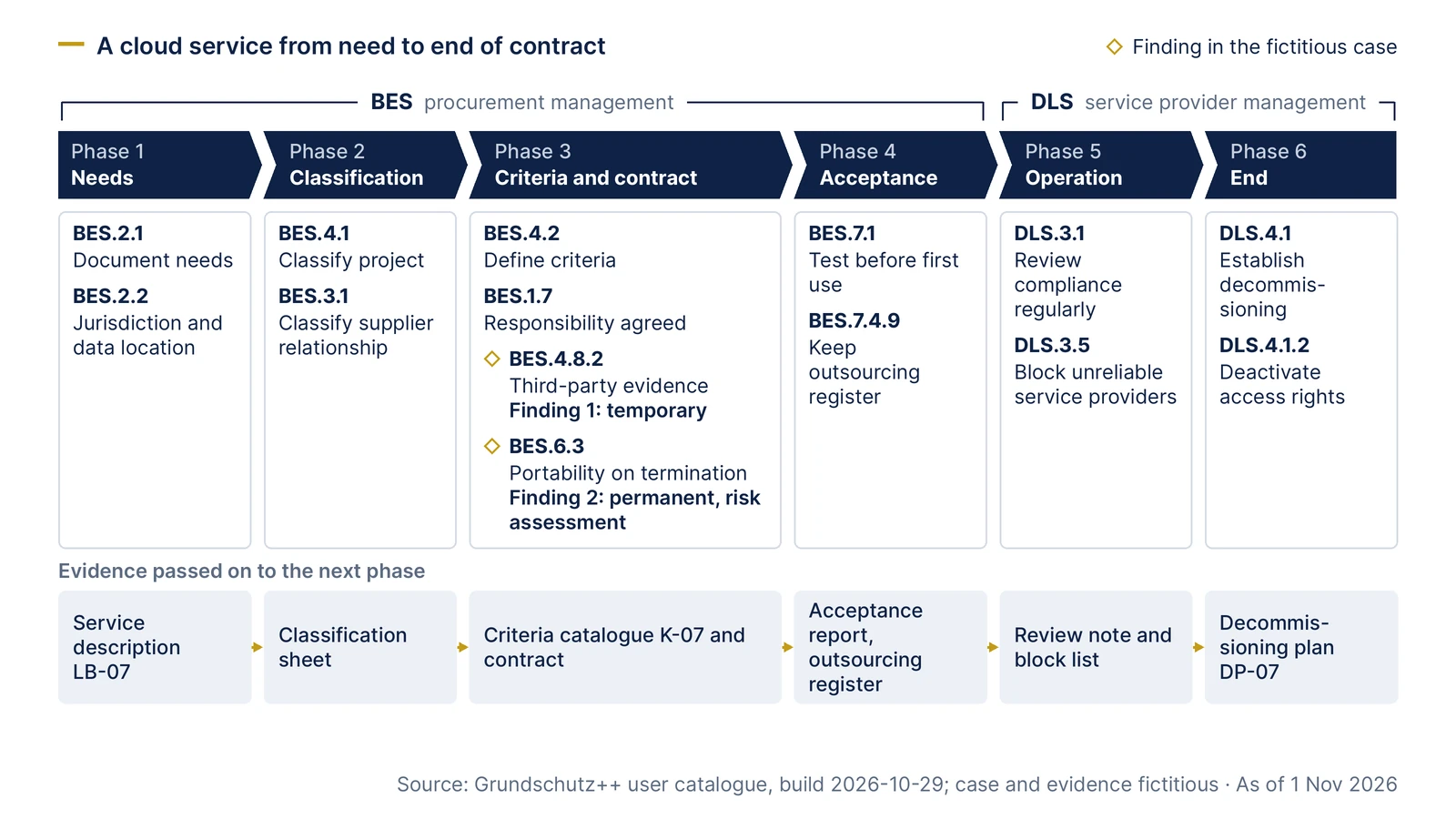
Process with requirements, review questions and evidence
Fictitious example. Requirements from the Grundschutz++ user catalogue (build 2026-10-29), shortened to the verb phrase, parameters in square brackets. Review questions, evidence, roles and results are invented. The table is a selection along the process, not a complete list of the 83 MUSS and SOLLTE requirements with security level normal-SdT in the package of the case.
| Phase | Requirement (modal verb, target object category) | Review question | Evidence in the case | Handed over to |
|---|---|---|---|---|
| 1 Needs | BES.2.1 Document needs on the basis of a service description or implementation strategy (SOLLTE, purchases) | Does the service description also cover non-functional needs such as data backup and integration into monitoring? | Service description LB-07, section 4 "Security and operation" | Procurement office |
| 1 Needs | BES.2.1.2 Document business process profiles of outsourced processes with function, information, framework conditions, interfaces, dependencies, protection requirements and criticality (SOLLTE, outsourcing) | Is each of these items available for GP-07? | Process profile GP-07 from the protection requirements determination, supplemented by the interface to the budget application | Information security officer (ISB) |
| 1 Needs | BES.2.2 Document jurisdiction and data location (SOLLTE, cloud services) | Where are the data stored, which law is provider P subject to, and does this also apply to U1 and U2? | Section "Jurisdiction and data location" in LB-07; assessment by the legal department attached | Legal department, data protection |
| 1 Needs | BES.2.4 and BES.2.5 Consult users and administrators during needs assessment (SOLLTE, purchases) | Who was consulted when, and what was adopted? | Two sets of workshop minutes with attendance list | Business unit |
| 2 Classification | BES.4.1 Assign procurement projects to a class; BES.3.1 Assign supplier relationships to a class (SOLLTE, purchases) | Does the class determine which criteria and evidence are required? | Classification sheet: project class 2 of 3, supplier relationship "cloud with personal data" | Procurement office |
| 3 Criteria and contract | BES.4.2 Document [criteria] for the procurement (SOLLTE, purchases); BES.4.4 Document criteria for outsourcing in a standardised contract policy (SOLLTE, outsourcing) | Are the criteria fixed before award and derived from the contract policy? | Criteria catalogue K-07 (annex to the tender documents), contract policy for outsourcing, version 2 | Procurement office, bidders |
| 3 Criteria and contract | BES.1.5 to BES.1.7 Authorise the deployment model, document it with shared responsibilities and agree it with the provider (SOLLTE, cloud services) | Does the contract state which safeguards lie with the LFV and which with provider P? | Responsibility matrix as contract annex 3, authorised by the head of IT | Provider P |
| 3 Criteria and contract | BES.4.7 Agree an ISMS at the service provider (SOLLTE, outsourcing); BES.4.8.2 Agree third-party evidence of conformity (SOLLTE, cloud services) | Does the scope of the evidence cover the service used and the subcontractors? | Contract clause in place; evidence covers U1 but not U2 (finding 1) | ISB |
| 3 Criteria and contract | BES.5.6 Agree rules for subcontracting and BES.5.6.1 Agree that the procurement criteria are passed on to subcontractors (SOLLTE, purchases) | Are U1 and U2 named, and do K-07 and annex 3 also apply to them? | Contract section 9 with list of subcontractors | Procurement office |
| 3 Criteria and contract | BES.5.10.2 Agree an obligation to inform the client without delay of incidents affecting it (SOLLTE, purchases); BES.5.11 Agree a right to audit (SOLLTE, outsourcing); BES.5.12 Agree regular information on the effectiveness of the security safeguards (SOLLTE, services) | Is there a reporting channel with availability, an audit right and a reporting cycle? | Contract sections 11 to 13; reporting address adopted into the LFV's operating process | LFV incident handling |
| 3 Criteria and contract | BES.6.1 to BES.6.3 For the event of termination, agree withdrawal of access authorisations, deletion of all data and portability of data, configurations and functionality (SOLLTE, services) | Is the export complete, i.e. including configurations and functionality? | Contract section 15; export agreed only for application data and documents (finding 2) | ISB, risk owner |
| 4 Acceptance | BES.7.1 Test services against [acceptance criteria] before first use (SOLLTE, purchases); BES.7.1.1 Test compatibility of interfaces, network connection, administration model and data management model (SOLLTE, outsourcing) | Is every acceptance criterion recorded with its result? | Acceptance report AP-07 with 23 acceptance criteria from K-07, of which 22 passed and one passed after rework | IT operations |
| 4 Acceptance | BES.7.4.9 Keep an outsourcing register (SOLLTE, outsourcing); BES.7.4.10 Document a service profile per cloud service (SOLLTE, cloud services); BES.7.4.6 Document the distribution and delimitation of responsibilities (SOLLTE, services) | Is the contract entered with criticality, agreements and later changes? | Entry A-31 in the outsourcing register; service profile SP-07 | Service provider management |
| 5 Operation | DLS.2.1 Enable multi-factor authentication for login to online services (SOLLTE, services); DLS.2.2 Encrypt transport to the provider according to [a recognised standard] (SOLLTE, data) | Is MFA active for all LFV accounts in the portal, and is the transport standard defined? | Configuration export of the tenant settings; parameter for DLS.2.2 in the definition of parameters | IT operations |
| 5 Operation | DLS.3.1 Review compliance with the security requirements [regularly] (SOLLTE, services); DLS.3.1.1 Review it [regularly] on the basis of an [audit, certificate or comparable security evidence] (SOLLTE, outsourcing) | Is the current evidence available, and has it been evaluated? | Review note in the outsourcing register; parameter "regularly" set to annually | ISB |
| 5 Operation | DLS.3.5 Block unreliable service providers or sub-service providers (SOLLTE, services) | Is there a block list, and is it checked for every procurement? | Block list in the procurement process, check recorded in the award note | Procurement office |
| 6 End | DLS.4.1 Establish the decommissioning procedure before the end of the contract; DLS.4.1.2 Deactivate access rights needed for the contract without delay at the end of the contract (SOLLTE, services); DLS.4.1.1 Test independence of processing before decommissioning (SOLLTE, outsourcing) | Is decommissioning described before it is needed? | Decommissioning plan DP-07 as an annex to the operations manual, trial run of the export scheduled | IT operations, access rights management |
What the table does not show for reasons of space: as per chapter 4.3 of 300-1, the assigned safeguard, the date of implementation or review and the reviewing person belong in the implementation plan for each row. How to organise this is shown in the evidence plan.
What is not fulfilled in the case and what follows from it
Finding 1, BES.4.8.2 (SOLLTE, cloud services): third-party evidence of conformity. The contract clause has been agreed. The catalogue guidance, however, asks for more than the evidence itself: „Hierbei ist zu prüfen, ob der Geltungsbereich und der Schutzbedarf die genutzten Clouddienste erfasst (Auswertung des Nachweises). Dies gilt auch für Subdienstleister.“ (our translation: "In doing so, it must be checked whether the scope and the protection requirements cover the cloud services used (evaluation of the evidence). This also applies to sub-service providers.") The evaluation shows that provider P's evidence includes U1's data centre but not the support provided by U2. The LFV sets the status to "not fulfilled" and classifies the non-fulfilment as temporary: provider P has undertaken to include U2 in the scope by the next audit, and the deadline is in the implementation plan.
Whether a temporarily unfulfilled SOLLTE requirement triggers a risk assessment is answered differently in two places in 300-1. Chapter 4.1.2 says: „Eine temporäre Nichterfüllung löst keine Risikobetrachtung aus.“ (our translation: "A temporary non-fulfilment does not trigger a risk assessment.") Chapter 2.11 requires a residual risk assessment for SOLLTE requirements that are included in implementation planning but not yet fulfilled, and top management must approve the identified risk. Chapter 4.1.1 requires the risk that has not yet been mitigated to be identified and communicated to management. How these passages fit together is an open question of interpretation. The LFV takes the cautious route: it describes the residual risk (support access by U2 without verified evidence), communicates it to management and has it approved for a limited period until the deadline expires.
Finding 2, BES.6.3 (SOLLTE, services): portability of data, configurations and functionality in the event of termination. Only the export of application data and documents has been agreed. The workflows and notice templates created in the portal cannot be transferred, and provider P refuses to add this. Fulfilment is therefore not planned for the foreseeable future: a permanent non-fulfilment. As per chapters 2.11 and 4.1.2, this triggers a risk assessment. As per chapter 4.2.1, the risk owner is the owner of GP-07, because nothing else has been specified. For risk treatment, the LFV draws on a KANN requirement, which chapter 3.4.2 expressly allows: BES.8.2 (KANN, outsourcing) requires a procedure for transferring business processes in the event of planned or unplanned termination of the contract. The LFV documents the workflows and templates outside the portal and updates them with every change. The remaining residual risk is submitted to management for approval (chapter 4.2.3). What this looks like in the register is shown in the risk register; approval is described under risk acceptance and residual risk.
A MUSS finding would have looked different: as per chapter 4.1.2, safeguards must be defined for unfulfilled MUSS requirements, a risk assessment does not replace them, and an exemption or risk acceptance is not possible. In the case, this applies for example to DLS.1.1 (MUSS, services), the procedure for managing and terminating service contracts in an orderly way. Without this procedure, there would be no framework for DP-07.
Handovers between procurement, operations and the ISMS
The phases depend on documents that pass from one office to the next. If one of them is missing, the next phase lacks the basis for its review:
- Criteria catalogue → acceptance report. The acceptance criteria for BES.7.1 are the procurement criteria from BES.4.2 or their refinement. If the criteria are not fixed before award, there is nothing to test against at acceptance.
- Contract → outsourcing register. What was agreed under BES.5 is entered in the register (BES.7.4.9) and there forms the list of what DLS.3.1 later reviews. The catalogue guidance on BES.7.4.9 says: „Hierzu genügt ein zentrales Auslagerungsregister“ (our translation: "A central outsourcing register is sufficient for this").
- Review result → block list. If the review under DLS.3.1 finds that violations are to be expected in future, DLS.3.5 applies. The guidance defines a service provider as unreliable „wenn zukünftig mit Verstößen gegen die Schutzziele Vertraulichkeit, Verfügbarkeit oder Integrität durch ihn zu rechnen ist“ (our translation: "if violations of the protection goals of confidentiality, availability or integrity by it are to be expected in future"). The procurement office checks the block list for every new procurement (BES.3.3). Whether a listed provider may be excluded from an award procedure is governed by public procurement law, which the procurement office and the legal department examine.
- Reporting channel → incident handling. The reporting address from BES.5.10.2 belongs in the reporting procedure of detection, otherwise the provider's report ends up in a functional mailbox without anyone responsible. How such a report is handled further is shown in detection and incident handling.
- End of contract → access rights management. DLS.4.1.2 requires the access rights needed for the contract to be deactivated without delay. This is only possible if the accounts of the provider's staff are in the inventory of access rights. The process for joiners, movers and leavers is shown in access rights and personnel.
- Findings → management review. Finding 1 and finding 2 go into the management report with status, deadline and risk decision; see management review and indicators.
Catalogue finding: BES.1.4 with SOLLTE and security level "elevated"
BSI Standard 300-1 states in chapter 3.4.2: „Anforderungen mit dem Sicherheitsniveau „erhöht“ beinhalten das Modalverb „KANN“ und sind optional zu erfüllen.“ (our translation: "Requirements with the security level 'elevated' contain the modal verb 'KANN' and are optional to fulfil.") In the build of 29 October 2026, this applies to 224 of 227 requirements with security level "elevated". Three, however, have the modal verb SOLLTE (own count): BES.1.4 „Outsourcing-Strategie“ (outsourcing strategy), DET.4.12.1 „Auslastung des Netzes“ (network utilisation) and REA.2.5 „IT-Forensik“ (IT forensics). BES.1.4 affects every cloud service because the requirement is assigned to the target object category outsourcing. Its sub-requirement BES.1.4.1 (approval of the strategy by top management), by contrast, is at normal-SdT with SOLLTE.
Chapter 3.4.2 classifies requirements with "elevated" as optional; the standard provides no separate rule for the combination with SOLLTE. For normal protection requirements, the LFV selects the requirements for the security level normal-SdT (chapter 3.4.2), treats BES.1.4 like an elevated requirement and records the deviation from the standard. It includes BES.1.4 in the package voluntarily: without a strategy, management would have nothing to approve under BES.1.4.1.
How we document the three cases in principle is set out on the page Grundschutz++ user catalogue. Record your decision with justification and catalogue version, and review it with every new build, because the catalogues are updated continuously.
Review questions for your next procurement
- Assignment: Which target object categories is the new asset assigned to, including the higher-level ones? Is a rejected assignment, for example to IT products, justified?
- Parameters: Are the parameters of the requirements involved defined, for example "regularly" in DLS.3.1 and DLS.3.1.1 or [acceptance criteria] in BES.7.1 (chapter 3.5)?
- Criteria before award: Are the procurement criteria fixed before bids come in, and do they follow the contract policy (BES.4.2, BES.4.4)?
- Shared responsibility: Is the distribution of safeguards agreed in the contract and not just described internally (BES.1.7)?
- Subcontractors: Are they named, do the criteria also apply to them, and does the evidence cover them (BES.5.6, BES.5.6.1, BES.4.8.2)?
- Plan for the end: Are deletion, withdrawal of access and portability agreed for the event of termination (BES.6.1 to BES.6.3)?
- Acceptance: Is every acceptance criterion recorded with its result before the service is used in production (BES.7.1)?
- Operation: Is the contract in the outsourcing register with a review cycle, and is the evidence evaluated in the defined cycle (parameter "regularly" in DLS.3.1.1) and not merely filed (BES.7.4.9, DLS.3.1.1)?
Blackfort Technology supports you with package C of implementation under Grundschutz++: status determination per requirement, including BES and DLS, and an evidence plan that links the criteria catalogue, acceptance report and outsourcing register. We assess contract clauses from a technical perspective. The legal review remains with your legal department.
Where procurement sits in the ISMS
Procurement relies on results from earlier steps and delivers results for later ones:
- The protection requirements of GP-07 come from the protection requirements determination; for high protection requirements, an explicit risk assessment would be due as per chapter 2.11, and KANN requirements such as BES.4.8.1 (certificate or attestation according to [a suitable security standard]) would be available for selection.
- How an asset is assigned to target object categories is described in modelling and target object categories.
- How status and deviations are assigned is covered under assessing requirements, documenting deviations.
- Anyone wishing to assess cloud providers against the C5 criteria catalogue or looking for an external ISB will find this on the company website https://www.blackfort-tec.de/en.