

What DET and REA cover in the catalogue
Own count in the Grundschutz++ user catalogue, build 2026-10-29, recursively across all nesting levels:
| Practice | Sub-practices | Requirements | MUSS / SOLLTE / KANN (MUST / SHOULD / MAY) | without target object category | with parameter |
|---|---|---|---|---|---|
| DET Detection | 6 (fundamentals, reporting of events, logging, monitoring of activities, vulnerability management, incident detection) | 82 | 5 / 38 / 39 | 43 | 35 |
| REA Security incident handling | 3 (fundamentals, response, follow-up) | 23 | 5 / 13 / 5 | 23 | 6 |
Three characteristics shape the work. REA does not have a single requirement with a target object category (Zielobjektkategorie). Under chapter 3.4.1 of BSI Standard 300-1, all 23 belong in the requirements package without being assigned to assets. Which of them apply depends on the security level and the modal verb (chapters 3.4.2 and 4.1.2): 17 are at the level "normal-SdT" (SdT = Stand der Technik, state of the art) (5 MUSS, 12 SOLLTE), and the six at "elevated (erhöht)" are five KANN requirements and REA.2.5 (see the catalogue finding below). In DET almost half are KANN (39 of 82): a security operations centre (DET.2.2), a permanent on-call service (DET.2.3), threat hunting (DET.5.6) or red teaming (DET.5.5) are optional with normal protection requirements. And with 35 requirements with parameter, DET has many open values, such as deadlines, criteria, thresholds and the "automated mechanism". Under chapter 3.5 the institution sets them. Without defined criteria, DET.6.1 cannot be audited.
BSI Standard 300-1 itself addresses the topic in chapter 5.4: „Im Rahmen des Monitorings müssen folgende Verfahren verankert werden“ (our translation: "As part of monitoring, the following procedures must be established"), including a procedure for detecting security incidents which, depending on the size and complexity of the institution, can range from manual processes to automated detection systems. Chapter 5.2.1 names the performance of detection and security incident handling as an aspect that the objectives of the internal audit programme should take into account, and chapter 5.3 names security incidents as a subject of the management review.
The case: suspicious logins at the remote access (fictitious)
The Statistisches Amt Westmark (SAW), a statistics office, is invented, as are all persons, times, figures and results. Identifiers and requirements are taken from the catalogue. The SAW has around 600 employees, remote access via a VPN cluster of two nodes with multi-factor authentication by push confirmation, and a SIEM that brings together the logs of the remote access, the directory service and the file servers. An on-call service for incident handling is staffed on working days from 07:00 to 19:00. The business processes of the SAW have normal protection requirements for all security objectives.
Defined in advance are (fictitious): the logging retention period for DET.3.1 at 180 days, agreed with data protection; the criteria under DET.6.1 and DET.6.1.1 in a rule list of the SIEM; the on-call service as the role to be alerted under DET.6.1.2; and for REA.2.5, as the criterion for a forensic analysis, "indications of successful access by unauthorised persons to information requiring protection". Triage under REA.2.1 works with three priorities.
Triage criteria of the SAW (fictitious)
REA.2.1 (SOLLTE) requires reports to be assigned a priority. The catalogue guidance describes triage as a procedure for determining „welche Vorfälle sofortige Aufmerksamkeit benötigen, welche weiter analysiert oder beobachtet werden oder irrelevante Fehlalarme sind“ (our translation: "which incidents require immediate attention, which are analysed further or observed, or are irrelevant false alarms"). The SAW has defined the following:
| Priority | Criterion (selection) | Response | Escalation under REA.2.6.5 |
|---|---|---|---|
| 1 | Indications of successful unauthorised access, malware on servers, failure of a business process | Initial response immediately, handling without interruption | Information security officer (ISB) and head of IT immediately, head of the office on confirmation |
| 2 | Attempted attack without indications of success, malware on a client, failure of logging | Handling on the same working day | ISB on the same day |
| 3 | Single report without recognisable impact, suspected false alarm | Handling in normal operations | none; feedback to the reporting person |
Incident log: from event to handling
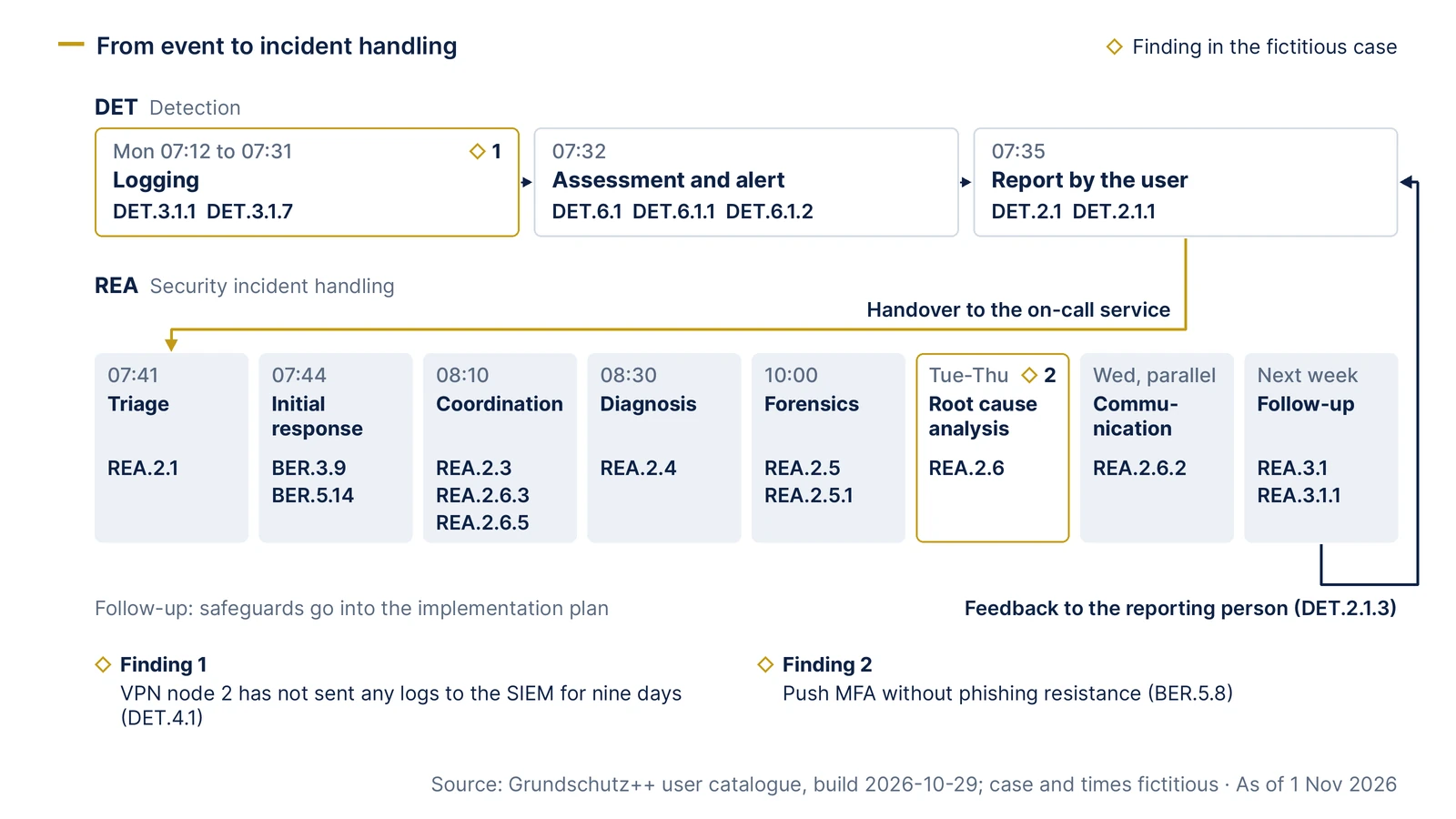
Fictitious example. Requirements from the Grundschutz++ user catalogue (build 2026-10-29), shortened to the infinitive, parameters in square brackets, modal verb and target object category in round brackets ("none" = without target object category). Times, audit questions and evidence are invented.
| Time | Step | Requirement | Audit question | Evidence in the case | Handover to |
|---|---|---|---|---|---|
| Mon 07:12 to 07:31 | Logging | DET.3.1.1 log successful and failed authentications (SOLLTE, IT systems); DET.3.1.7 log at least the time, source and target object for each event (SOLLTE, applications) | Are failed attempts and the successful login in the SIEM with time, source IP and account? | 38 failed attempts on the account of a clerk, followed by a successful login from a previously unused source address with a confirmed push request | SIEM |
| 07:32 | Assessment and alert | DET.6.1 procedure for assessment on the basis of [criteria]; DET.6.1.1 log critical incidents on the basis of [criteria] by [an automated mechanism]; DET.6.1.2 alerting of [persons or roles responsible for incident handling] by [an automated mechanism] (all SOLLTE, none) | Did the rule fire, and did the alert reach the on-call service? | SIEM alert from the rule "success after more than 20 failed attempts", delivery confirmation to the on-call service | On-call service |
| 07:35 | Report | DET.2.1 establish a reporting procedure; DET.2.1.1 establish rules for immediate measures by users (SOLLTE, none) | Did the clerk know where and how to report and what to do immediately? | Call to the service desk: several push requests received, one confirmed by mistake; report form completed, work on the device stopped | On-call service (merged with the alert) |
| 07:41 | Triage | REA.2.1 assign reports a priority (SOLLTE, none) | Does the priority match the defined criteria? | Priority 1 in the incident ticket, reason "login after failed attempts, confirmation by the user unintentional" | ISB and head of IT (escalation) |
| 07:44 | Initial response | BER.3.9 deactivate access accounts on an event-driven basis; BER.5.14 establish the blocking of compromised authentication means; BER.5.3 establish a procedure for revoking authentication means (all SOLLTE, none) | Are the account, active sessions and registered MFA devices blocked? | Blocking log from the identity service; VPN session terminated at 07:46 | Access rights management |
| 08:10 | Documentation, coordination | REA.2.3 document the incident; REA.2.6.3 establish coordination for incidents; REA.2.6.5 establish an escalation ladder (SOLLTE, none) | Is a person named as coordinator, and does everything run through one ticket? | Incident ticket with timeline, coordination by the ISB, data protection involved at 08:20 | All parties involved |
| 08:30 | Diagnosis | REA.2.4 establish diagnostic methods if the incident cannot be analysed sufficiently with the information recorded as standard (SOLLTE, none) | Are the standard logs enough to say what the other side did in 15 minutes? | No: file server access only in aggregated form; log level raised temporarily, raw data exported. In the process it becomes apparent that node 2 of the VPN cluster has not sent any logs to the SIEM for nine days (finding 1) | IT operations |
| 10:00 | Decision on forensics | REA.2.5 carry out a forensic analysis for incidents that meet [certain criteria] (SOLLTE, security level elevated (erhöht), none); REA.2.5.1 document legally relevant evidence in a legally sound manner (SOLLTE, none) | Is the criterion met, and is evidence secured with a checksum? | Criterion met: 214 file names listed, 3 files opened. Commissioning of the forensics service provider agreed in advance (REA.2.5.3, KANN); preservation log with hash values and a copy kept separately | Forensics service provider, legal department |
| Tue to Thu | Root cause analysis and handling | REA.2.6 establish a procedure for root cause analysis and handling; REA.2.6.1 document the activities carried out for handling (SOLLTE, none) | Has the cause been found, and have other accounts with the same weakness been checked? | Cause: password from a third-party data leak, push MFA without protection against unintended confirmation (finding 2). Handling: new credentials, all accounts checked against known leaks, no further hits | ISB, head of IT |
| Wed | Communication | REA.2.6.2 establish a procedure for communication in the event of incidents, taking into account compliance obligations, the needs of interested parties and the business objectives; REA.2.6.2.1 inform the competent authorities in line with compliance obligations (SOLLTE, none) | Has the responsible unit checked whether and to whom a report must be made, and is the decision documented? | Memo from the legal department and data protection with decision and date; communication to the affected specialist department | Head of the office |
| Fri | Feedback | DET.2.1.3 establish a procedure for feedback (SOLLTE, none) | Does the reporting person know what became of their report? | Conversation with the clerk, note in the ticket | Staff development (practical example for instruction, see awareness) |
| Following week | Follow-up | REA.3.1 review existing safeguards [regularly] on the basis of findings from incidents; REA.3.1.1 document findings including type, extent and damage (SOLLTE, none) | Are type, extent and damage recorded, and are the safeguards in the implementation plan? | Final report: unauthorised access, one account, 15-minute session, 3 files opened, no exfiltration detectable; two safeguards in the implementation plan | Management report |
The times in the log are only comparable if all systems have the same time. The guidance on DET.3.1.7 names a uniform time source as a prerequisite, and KONF.4.5 (SOLLTE, IT systems) requires time sources to be authorised. This belongs in the baseline configuration, see configuration and assets.
What the incident says about the status of the requirements
An incident is also an audit under real conditions. The SAW transfers the findings into the implementation status (fictitious):
| Requirement | Status after the incident | Reason and consequence |
|---|---|---|
| DET.6.1.2 alerting of the responsible role by an automated mechanism (SOLLTE) | fulfilled | Alert delivered after one minute, delivery confirmation in the SIEM |
| REA.2.1 assign reports a priority (SOLLTE) | fulfilled | Priority assigned according to the defined criteria and justified |
| DET.4.1 monitor the functioning of logging (SOLLTE, none) | not fulfilled, temporary | Finding 1: failure of log forwarding from node 2 unnoticed for nine days. The guidance names as possible criteria the activation or deactivation of logging and the volume of incoming logs in a period. Safeguard: SIEM rule for missing logs per source, deadline two weeks |
| BER.5.8 activate phishing-resistant multi-factor authentication for all externally accessible interfaces (SOLLTE, applications and external network connections) | not fulfilled, temporary | Finding 2: push confirmation is not phishing-resistant. Safeguard: switch the remote access to phishing-resistant methods with a deadline in the implementation plan; handover to access rights management |
| BER.6.6 monitor credentials for compromise by [an automated mechanism] (SOLLTE, none) | previously not fulfilled, now fulfilled | Comparison against known leaks had not been set up before; since the handling, run weekly |
For the temporarily unfulfilled SOLLTE requirements, the known open question of interpretation applies: under chapter 4.1.2 a temporary non-fulfilment does not trigger a risk assessment, under chapter 2.11 a residual risk assessment is to be carried out for SOLLTE requirements in implementation planning and the risk is to be approved by top management, and chapter 4.1.1 requires the risk to be identified and communicated to top management. The SAW describes the residual risk until the remote access has been switched over, communicates it and has it approved for a limited period. If the switchover were not to take place in the foreseeable future, the non-fulfilment would be permanent and a risk assessment under chapter 2.11 would be due; see risk analysis.
How the statuses are recorded with date, reviewing person and evidence under chapter 4.3 is shown in the evidence plan. The rules for status and deviations are set out under assessing requirements, documenting deviations.
Catalogue finding: REA.2.5 and DET.4.12.1
Under chapter 3.4.2 of 300-1, requirements with the security level "elevated (erhöht)" contain the modal verb KANN and are optional. In the build of 29 October 2026 this does not apply to three requirements that combine SOLLTE with "elevated" (own count): REA.2.5 „IT-Forensik“ (IT forensics), DET.4.12.1 „Auslastung des Netzes“ (network utilisation) and BES.1.4 „Outsourcing-Strategie“ (outsourcing strategy). Two of them belong to this practice bundle.
The standard does not say how this combination is to be treated. REA.2.5 has no target object category and would be mandatory in the package under chapter 3.4.1. However, it is assigned to the security level "elevated", which is not selected under chapter 3.4.2 for normal protection requirements. The SAW nevertheless includes REA.2.5, because its sub-requirement REA.2.5.1 (legally sound preservation of evidence) is at the level "normal-SdT" and is difficult to fulfil without criteria for forensics. Record your decision with the reasons and the catalogue version, and review it with every new build.
Handovers between detection, handling and the ISMS
- DET to REA: The handover is the alert or report that reaches the role responsible for incident handling (DET.6.1.2, DET.2.1). Define who accepts it, including outside on-call hours. A permanent on-call service is a KANN requirement under DET.2.3. Without one, what happens to alerts at night belongs in the rules.
- Service provider to REA: If a provider reports an incident that affects the SAW, the report arrives via the contractually agreed reporting channel (BES.5.10.2) and then goes through the same triage. The procurement part is shown in procurement and service providers.
- REA to access rights management: Blocking, revocation and reissue of authentication means. The standard procedure for accounts is shown in access rights and personnel.
- REA to the legal department and data protection: The question of reporting obligations. The catalogue guidance on REA.2.6.2 refers to reporting obligations towards supervisory or investigating authorities and to informing data subjects, and recommends internal or external legal advice in case of doubt. We classify the requirements that you name or that are in your documents. Whether they apply legally is examined by your legal department. Questions on the implementation of NIS2 are covered on the company website https://www.blackfort-tec.de/en.
- REA to the ISMS: Under chapter 6.2 of 300-1, the evaluation of security incidents is one of the ways of identifying potential for improvement. Under chapter 6.3, the corrective and improvement plan is included in the implementation plan. Security incidents feed into the management review (chapter 5.3); see management review and indicators.
- Incident to awareness: A real case such as the push request confirmed by mistake is suitable as an example in instruction. How to plan instruction and check its effectiveness is shown in awareness.
- Incident to emergency planning: If a business process fails for a longer period, the practice NOT (Notfallplanung, emergency planning) applies. BSI Standard 200-4 on business continuity management has not been superseded by 300-1.
Audit questions on detection and incident handling
- Are the parameters in DET and REA defined: logging retention period (DET.3.1), assessment criteria (DET.6.1, DET.6.1.1), role to be alerted (DET.6.1.2), criteria for forensics (REA.2.5)?
- Is it monitored whether every log source is delivering, and is it defined after what time a failure must be noticed (DET.4.1)?
- Do users know the reporting channel and the immediate measures, and do they receive feedback (DET.2.1, DET.2.1.1, DET.2.1.3)?
- Are there triage criteria with priorities and an escalation ladder that reaches top management (REA.2.1, REA.2.6.5)?
- Is the initial response prepared for the types of case defined in advance, such as blocking the account, terminating sessions and revoking authentication means (BER.3.9, BER.5.3, BER.5.14)?
- Are there diagnostic methods for cases where the standard logs are not sufficient (REA.2.4)?
- Is evidence secured in such a way that it is traceable how it was collected, and is it protected against inspection and modification (REA.2.5.1)? The guidance names cryptographic signatures or checksums kept separately as means.
- Is communication regulated, including the examination of possible reporting obligations by the responsible unit (REA.2.6.2, REA.2.6.2.1)?
- Do the type, extent and damage of each incident feed into the review of the safeguards and into the management report (REA.3.1, REA.3.1.1)?
Blackfort Technology supports you with package C of implementation under Grundschutz++: status determination per requirement, including DET and REA, definition of the parameters together with you, and an evidence plan that maps logging, alerting and incident tickets to the requirements.