

The practice SENS in the user catalogue
In the catalogue of 29 October 2026, SENS comprises 87 requirements, counted recursively across all levels: 4 MUSS (MUST), 72 SOLLTE (SHOULD) and 11 KANN (MAY). Five of them have no target object category (Zielobjektkategorie) and, under chapter 3.4.1 of BSI Standard 300-1 of the Bundesamt für Sicherheit in der Informationstechnik (BSI), the German Federal Office for Information Security, are to be included in every requirements package. These are the procedural requirements: SENS.1.1 requires procedures and rules for role-specific training and awareness raising to be established, SENS.1.1.1 to SENS.1.1.3 documentation, assignment of the tasks and communication, SENS.1.2 the measurement of success. The other 82 are aimed at groups of people and enter the package through the assignment of target object categories.
A look at the action words is worthwhile. 58 requirements call for „sensibilisieren“ (our translation: "raise awareness"), 12 for „untersagen“ (our translation: "prohibit"), 11 for „anweisen“ (our translation: "instruct"), 2 for „informieren“ (our translation: "inform"). Prohibiting and instructing are rules of conduct: SENS.4.1.2 prohibits the reuse of passwords, SENS.8.1 instructs users to lock IT systems before leaving the workplace. The documentation field in the catalogue fits this: 56 requirements name a training plan, 26 a work instruction. A rule of conduct needs a communicated instruction, awareness raising needs a learning objective. If you bundle both into an annual training session, it will later be hard to show which requirement is fulfilled by what.
SENS does not stand alone in the catalogue. PERS.4.2 requires role-specific training and awareness raising on joining and regularly, in line with the requirements of the practice SENS. NOT.3.3 requires users to be made aware of how to act in emergencies and crises. SENS.12.1, as a KANN requirement, provides for raising awareness of the high risks identified in the risk analysis. The requirements on joining, changing roles and leaving are covered by the practice page on BER and PERS.
Deriving target groups from the target object categories
The target groups are already set in the catalogue. According to the definitions in Annex 1 of 300-1, the target object categories for people build on one another: employees are users employed by the institution; managers and administrators are employees with particular tasks; top management belongs to the managers. Users expressly include external parties who regularly use the assets for the institution, with external consultants as the example in the annex. Under chapter 3.4.2 of 300-1, the higher-level categories are also to be assigned to an asset. An administrator therefore receives all SENS requirements for users, for employees and for administrators.
Of the 70 requirements for users, 41 apply without any further condition. 29 are additionally linked to a category for assets and, by their wording, are aimed at users of a particular asset, such as „Nutzende von Mobilen Endgeräten“ (our translation: "users of mobile devices") or „Nutzende von Interpersoneller Kommunikation“ (our translation: "users of interpersonal communication"); they only come into consideration if these assets exist in the information domain. The table shows the maximum number of SENS requirements per group of people, excluding the five procedural requirements.
| Target group (target object category) | own SENS requirements | inherited | at most in total | examples of own requirements |
|---|---|---|---|---|
| Users (Nutzende), including external parties | 70 (41 without condition, 29 only when particular assets are used) | none | 70 | SENS.2.8 reporting of events, SENS.7.8 fake emails, SENS.8.1 screen lock |
| Employees (Mitarbeitende) | 4 | Users | 74 | SENS.8.7 supervision of external parties in sensitive areas, SENS.8.11 fire protection equipment |
| Administrators (Administrierende) | 5 | Employees, Users | 79 | SENS.10.2 privileged permissions, SENS.10.5 no internet access via administration accounts |
| Managers (Führungskräfte) | 2 | Employees, Users | 76 | SENS.11.2 role model function, SENS.11.3 targeted attacks on managers |
| Top management (Institutionsleitung) | 1 | Managers, Employees, Users | 77 | SENS.11.1 importance of information security for protecting business processes |
Counted in the Grundschutz++ user catalogue, build 2026-10-29; the column "at most in total" assumes that all linked assets are present and includes the 11 KANN requirements of the security level "elevated (erhöht)" (9 for users, 2 for employees), which are optional under chapter 3.4.2 of 300-1. With normal-SdT (SdT = Stand der Technik, state of the art) only: users 61, employees 63, administrators 68, managers 65, top management 66.
From the requirement text to the learning objective
A SENS requirement names a topic. It usually does not describe observable behaviour. „Sensibilisierung für Nutzende von E-Mailn [sic] SOLLTE zum Erkennen von gefälschten E-Mails sensibilisieren“ (our translation: "Awareness raising for users of emails SHOULD raise awareness of recognising fake emails") (SENS.7.8) says what it is about, but not how you can see success. The learning objective turns this into behaviour that can be checked: the person recognises from typical features that a message may be fake, opens neither link nor attachment and reports the message via the known reporting channel. This also touches on SENS.2.2, which informs about the reporting channels, and SENS.2.8, which instructs users to report security-relevant events.
Three questions help with the wording. What should the person do or refrain from doing? In which situation, that is, with which asset and in which role? How can you tell that they are doing it? The third question leads directly to the effectiveness check. If it cannot be answered, the learning objective is too general. Several requirements can be bundled into one learning objective if the behaviour is related, such as recognising and reporting. The assignment remains visible in the matrix so that every requirement has evidence.
Checking effectiveness: objective criteria under SENS.1.2
SENS.1.2 requires the success of awareness raising to be checked regularly against objective criteria; both specifications are parameters that you define under chapter 3.5 of 300-1. The guidance in the catalogue names quantitative and qualitative criteria that can be independently traced and verified, and ties success to two things: the knowledge acquired by the target groups and the practice actually put into effect. An attendance list proves neither. It shows whom a safeguard has reached; that is a precondition for measurement.
For knowledge, short questions before and after an exercise are suitable, or case discussions in which the group has to resolve a situation. For practice, observations and data from operations are suitable: a walk-through after working hours with a fixed checklist for screen lock and tidy workplaces, analyses from the ticket system on reports, technical analyses, for example of internet access with administration accounts, practice emails with measurement of the reports. Each criterion needs to be defined in advance: what is measured, how, from which value the objective is reached and what happens if it is missed.
Measuring the behaviour of staff touches on data protection and co-determination. Clarify in advance with data protection, the staff council or works council and your legal department whether and in what form practice emails and their analysis, for example, are permissible. SENS.1.2 does not mention any analysis per person. An analysis per target group or department that does not attribute results to individuals and aggregates them for small groups keeps the intrusion lower and still shows whether awareness raising works. According to chapter 5.1 of 300-1, uniform specifications for performance evaluation are still outstanding; the BSI milestone plan announces a concept for measuring ISMS performance for 26 February 2027 and performance indicators for the requirements of the methodology practices for 31 March 2027. The methodology catalogue of the State-of-the-Art Library (Stand-der-Technik-Bibliothek) contains the practices GC, STM, UMS, VRB and PERF; SENS is not one of them. As things stand, you therefore set the criteria for SENS.1.2 yourself and adjust them once the concept for performance measurement is available.
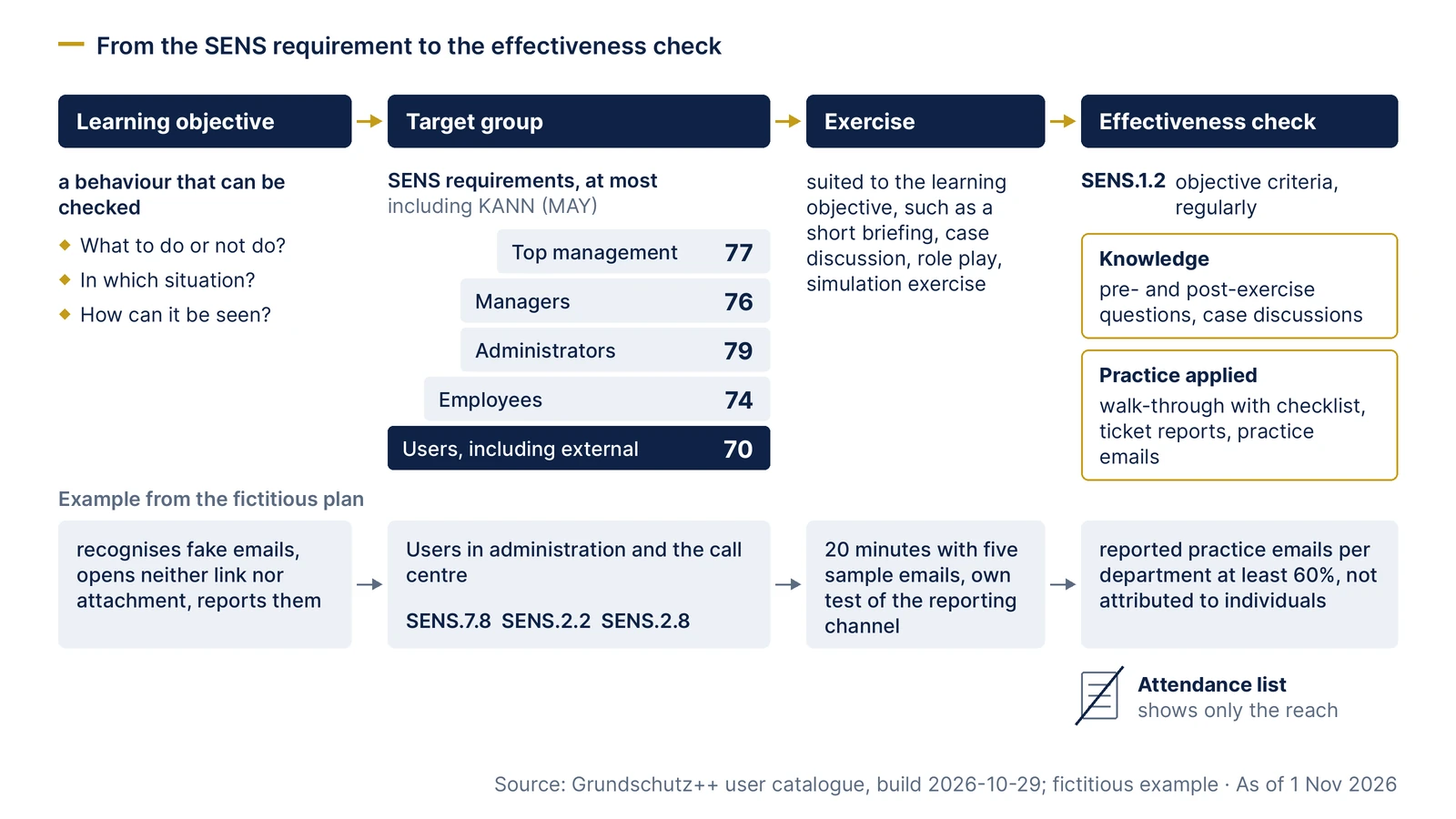
Work result: matrix of learning objective, target group, exercise and effectiveness check (fictitious)
The Wohnungsgesellschaft Musterland (WGM), a housing company, is invented. It has an administration, a caretaker service with work smartphones, a small IT administration and an external call centre that takes tenant enquiries and therefore counts among the users. The matrix shows an extract from its awareness plan. Thresholds and results are invented and are not a recommendation for your values.
| Learning objective | Target group | Requirements | Exercise | Effectiveness check (criterion, threshold) | Evidence |
|---|---|---|---|---|---|
| recognises fake emails, opens neither link nor attachment, reports via the reporting address | Users (administration, call centre) | SENS.7.8, SENS.2.2, SENS.2.8 | 20 minutes with five sample emails, then trying out the reporting channel themselves | share of reported practice emails per department at least 60%, time to first report under 30 minutes | analysis per department without attribution to individuals, comparison with the previous quarter |
| locks the computer when leaving, does not leave confidential documents lying open | Users (administration) | SENS.8.1, SENS.8.2 | short briefing in the team meeting, work instruction communicated | walk-through after working hours with checklist, at least 90% of workplaces without findings | walk-through record per department |
| reports loss of the smartphone immediately, does not leave it unattended and uses public Wi-Fi only via the work VPN | Users of mobile devices (caretaker service) | SENS.8.3, SENS.9.3, SENS.7.12 | case discussion "device left in the stairwell" | loss reports within two hours according to the ticket system; three check questions, one of them on public Wi-Fi, at least two correct | ticket analysis, result of the check questions per group |
| gives information only after verifying the caller's identity | Users (external call centre) | SENS.7.15, SENS.7.20 | call guide, role play with three call patterns | agreed test calls, at least 9 out of 10 handled correctly | report on the test calls, contractually agreed |
| uses each password only once and stores passwords only in the password manager | Users | SENS.4.1.2, SENS.4.1.4 | setting up the password manager during the session | share of active password manager accounts at least 95%; short questions after three months | usage statistics of the password manager, question results per department |
| does not browse with administration accounts, uses privileged rights only when needed | Administrators | SENS.10.2, SENS.10.5 | workshop with demonstration in the test network | internet access by privileged accounts according to the proxy log: 0 per month | monthly analysis of the proxy log |
| verifies unusual payment or data requests via a second, known channel | Managers | SENS.11.3, SENS.7.20 | simulation exercise with a fake instruction by email and phone | observation sheet: call-back via a known number in all runs | simulation exercise record |
| can name the risks to its own business processes and takes reasoned decisions on them | Top management | SENS.11.1 | 30 minutes in the management meeting with a scenario from its own risk assessment | qualitative: decisions on residual risks contain reasoning and a reference to the business process | meeting minutes, decision papers |
| knows what to do when alerted and confirms availability | Users | NOT.3.3 | alerting test with feedback | feedback within 30 minutes from at least 80% of those alerted | alerting record |
Fictitious example. Identifiers from the Grundschutz++ user catalogue, build 2026-10-29. Values and thresholds are invented; clarify measurements of staff behaviour in advance with data protection, the staff council or works council and the legal department.
Evaluating the result and adjusting the plan
In the first run, WGM misses two objectives. The reporting rate for the practice emails in the call centre is well below the threshold, and the walk-through finds document folders left open in one department. Both are usable results: in the call centre, follow-up questions show that the reporting address was not known there because the service provider's staff have no access to the intranet. WGM adds the reporting channel to the call guide and includes its communication in the agreement with the service provider. In the second case, lockable cabinets are missing; the safeguard lies with facility management.
The evaluation feeds into the monitoring of the ISMS. Comparing the results per target group over several runs shows whether an exercise works or needs to be replaced. The success of awareness raising thus becomes part of the performance evaluation, which under chapter 5.1 of 300-1 should be presented to top management in a traceable way; the page on management review and indicators shows what such a presentation looks like.
Audit questions for your awareness plan
The questions are aimed at the person responsible for the procedure under SENS.1.1. They do not replace the assessment of each individual requirement in your requirements package.
- Are procedures and rules for role-specific training and awareness raising documented, the tasks assigned and communicated to those responsible (SENS.1.1 to SENS.1.1.3)?
- Are the target groups derived from the target object categories, including external users and the groups that inherit requirements?
- Are rules of conduct (prohibit, instruct) documented as a communicated instruction, and is each awareness measure backed by a learning objective?
- Does every learning objective have observable behaviour, and does every requirement in the matrix have evidence?
- Are the parameters of SENS.1.2 set: which objective criteria, with which threshold, at what interval?
- Does at least one criterion per target group measure the practice put into effect and one the knowledge?
- Are measurements of behaviour agreed in advance with data protection, the staff council or works council and the legal department, and are they analysed without attribution to individuals?
- Do high risks from the risk analysis feed into awareness raising where you implement SENS.12.1?
- Is there a rule on what happens if a threshold is missed, and is the last run documented accordingly?
Related topics: status and deviations per requirement on the page Assessing requirements, planning evidence on the page Evidence plan, indicators for top management on the page Management review and indicators, awareness of how to act in an emergency in the scenario on the page Buildings and emergency preparedness, training on joining and on role changes on the page Access rights and personnel. The qualification of ISMS staff, that is, training and personnel certification as IT-Grundschutz practitioner or consultant, is a different topic and is covered on the page IT-Grundschutz practitioner and consultant.
Blackfort Technology supports you with package C of Implementation under Grundschutz++: determining the status of each requirement of the practice SENS, setting the parameters together with you and an evidence plan that maps training planning, attendance and effectiveness check to the requirements.
Rights notice: Information from BSI Standard 300-1 and the milestone plan © Bundesamt für Sicherheit in der Informationstechnik 2026, source: BSI, Grundschutz++; it is not licensed under CC BY-SA 4.0. The licence notice at the end of the page applies to the extracts from the catalogue data.