

What a scenario achieves and what a BCMS achieves
A scenario checks whether existing precautions fit together for a specific outage. It answers questions such as: are the backups stored somewhere other than the servers? Who alerts whom if the telephones in the building fail? It does not answer which business processes are time-critical, how long they may be down and at what emergency operation level they must keep running. In business continuity management (BCM), these values are determined by the business impact analysis: maximum tolerable period of disruption, required recovery time, maximum tolerable data loss and emergency operation level (BSI Standard 200-4, chapter 7). The business impact analysis assumes the total failure of a business process and does not ask about the cause; a scenario, conversely, starts from a specific cause.
The user catalogue draws the same line. The guidance on NOT.3.1 (recovery plan) says in essence: if there is a BCMS, the critical resources and recovery times come from the business impact analysis; if there is none, time-critical IT resources can be identified through the protection requirements determination (elevated (erhöht) protection requirements for availability, high under 300-1), but the recovery time can only be roughly estimated. The guidance on NOT.3.2 assigns business continuity plans to the responsibility of a BCMS; in the ISMS the requirement is optional as KANN (MAY). If you need or want to set up a BCMS, you will find the classification on the BSI Standard 200-4 page.
The terms are also precisely defined in 200-4 (chapter 2.1). A disruption is resolved in normal operation. Under 200-4, an emergency is „eine Unterbrechung des Geschäftsbetriebs, die mindestens einen zeitkritischen Geschäftsprozess betrifft, der nicht im Normalbetrieb innerhalb der maximal tolerierbaren Ausfallzeit wiederhergestellt werden kann“ (our translation: "an interruption of business operations affecting at least one time-critical business process that cannot be restored in normal operation within the maximum tolerable period of disruption") (chapter 2.1); unlike a crisis, plans exist for it or can be adapted. 200-4 describes a crisis as a damaging event „das sich in erheblicher Weise negativ auf die Institution auswirkt und dessen Auswirkungen auf die Institution nicht im Normalbetrieb bewältigt werden können“ (our translation: "that has a significant negative impact on the institution and whose effects on the institution cannot be handled in normal operation") (chapter 2.1); there are no specific emergency plans for handling it, or existing ones do not work. Without a business impact analysis, it therefore cannot be said with certainty whether a site outage is an emergency within the meaning of 200-4. The scenario on this page therefore only assumes what is already established in the ISMS.
GEB and NOT in the requirements package
In the catalogue of 29 October 2026, the practice GEB comprises 75 requirements (5 MUSS (MUST), 35 SOLLTE (SHOULD), 35 KANN), counted recursively across all levels. All of them have a target object category (Zielobjektkategorie), 55 of them the category sites (53 exclusively, two together with users), others including rooms, server rooms, rooms for technical infrastructure and IT systems. They therefore enter the requirements package through the assignment of assets. Because the parent target object categories must also be assigned to an asset under chapter 3.4.2 of 300-1, a server room also receives the requirements for rooms for technical infrastructure, rooms and sites.
The practice NOT comprises 37 requirements (5 MUSS, 25 SOLLTE, 7 KANN). 25 of them have no target object category and must be included in the requirements package under chapter 3.4.1 of 300-1, among them the emergency preparedness procedure (NOT.1.1, MUSS), the special organisational structure (Besondere Aufbauorganisation, NOT.2.1), the recovery plan (NOT.3.1), alternative telecommunications (NOT.3.5) and 9 of the 20 requirements on data backup. The catalogue lists a BCMS under 200-4 in NOT.1.1.4 as a KANN requirement. The guidance on it recommends meeting the requirements of the practice ideally through a BCMS and refers to the tiered model in chapter 2.6 of 200-4.
The scenario: main site closed for three days (fictitious)
Musterhafen Logistik GmbH (MHL) is invented. It has one site with an office building, with the server room in the basement containing the virtualisation hosts, storage system, telephone system and backup library. The dispatch business process has high protection requirements for availability. There is no business impact analysis.
The scenario: after heavy rain, there is water in the basement. The grid operator disconnects the building and the fire brigade closes it. The closure is expected to last three days, and it is initially unclear whether water has reached the server room. Employees can work from home if the services are reachable. Personal injury, a simultaneous cyber attack and the failure of service providers are deliberately excluded. This limitation makes the scenario testable; it is also the reason why it does not replace an emergency concept.
Before the event: what GEB requires at the site
GEB.1.4 requires assets worth protecting or associated infrastructure to be placed only outside exposed or particularly endangered areas. The guidance explicitly names a basement at risk of flooding as an example. At MHL the requirement is not fulfilled, and moving the server room is not planned for the foreseeable future. This is a permanent non-fulfilment of a SOLLTE requirement; under chapters 2.11 and 4.1.2 of 300-1, a risk assessment must be carried out for it, and the residual risk after treatment goes to top management for approval. A risk assessment is due at MHL anyway: dispatch has high protection requirements for availability, and under chapter 2.11 that is a trigger in its own right.
The risk assessment leads to safeguards from other GEB requirements. GEB.10.3 (SOLLTE) requires at least one physical safeguard against water between assets and water hazards; the guidance mentions water from above and from below and, as safeguards, for example sealing, drainage or raised installation. GEB.10.3.2 provides for leak sensors as a KANN requirement. MHL places the racks on a plinth, has a backflow preventer installed and installs water sensors that report to the on-call service. For the power supply, GEB.9.1 requires a supply that meets standards and needs, and GEB.9.1.3 and GEB.9.1.4 provide for redundant supply for a shorter or longer bridging time as KANN. At MHL a UPS bridges the orderly shutdown; it does not provide continued operation while the building is closed.
Two further GEB requirements become visible in the scenario: GEB.1.5 requires structural plans to be documented; according to the guidance, these include supply lines, network connections and emergency exits and entrances. In the scenario they show where cable and pipe routes and the server room are located. GEB.6.2.1 requires host systems to be placed exclusively in server rooms. At MHL a host for time recording stands in an office on the ground floor; it is also affected by the closure.
During the event: what NOT requires
Who decides when the building is closed? NOT.2.1 requires procedures and rules for a special organisational structure (BAO) for handling emergencies and crises, NOT.2.1.1 the assignment of roles including the crisis management team (Stab) and emergency teams, NOT.2.1.2 alerting. NOT.2.1.3 provides for a crisis management room as KANN; the guidance also allows a virtual working environment. At MHL the alerting list is only on the file server in the server room. Finding: the list exists but cannot be reached in the scenario; alerting is therefore treated as not fulfilled for this outage.
The telephone system is in the server room. NOT.3.5 requires alternative telecommunication services to be established; the guidance has in mind mobile networks, other providers or satellite connections and the reachability of the responsible persons and service providers. NOT.3.6 requires alternative security mechanisms that take effect in emergencies, such as deposited one-time passwords, without undermining the precautions of normal operation. NOT.3.3 requires users to be made aware of how to proceed in emergencies and crises; in the scenario this means: everyone knows that they should not travel to the site and where they can get information.
The scenario hits data backup hardest. NOT.4.10 requires the data backup to be placed separately from the original data; the guidance gives fire, water damage or burglary as reasons, which can hit systems and backups at the same time. At MHL the backup library stands next to the hosts. NOT.4.14 requires a regular offline copy, and NOT.4.12 provides for a geo-redundant copy as KANN. Without a copy outside the building, the recovery plan under NOT.3.1 does not help either, and the documented restore procedure (NOT.4.15) assumes that backups and replacement systems are reachable. NOT.4.16.1 requires the restore to be checked regularly, at least on the basis of representative samples; at MHL it has so far only been tested in the same server room.
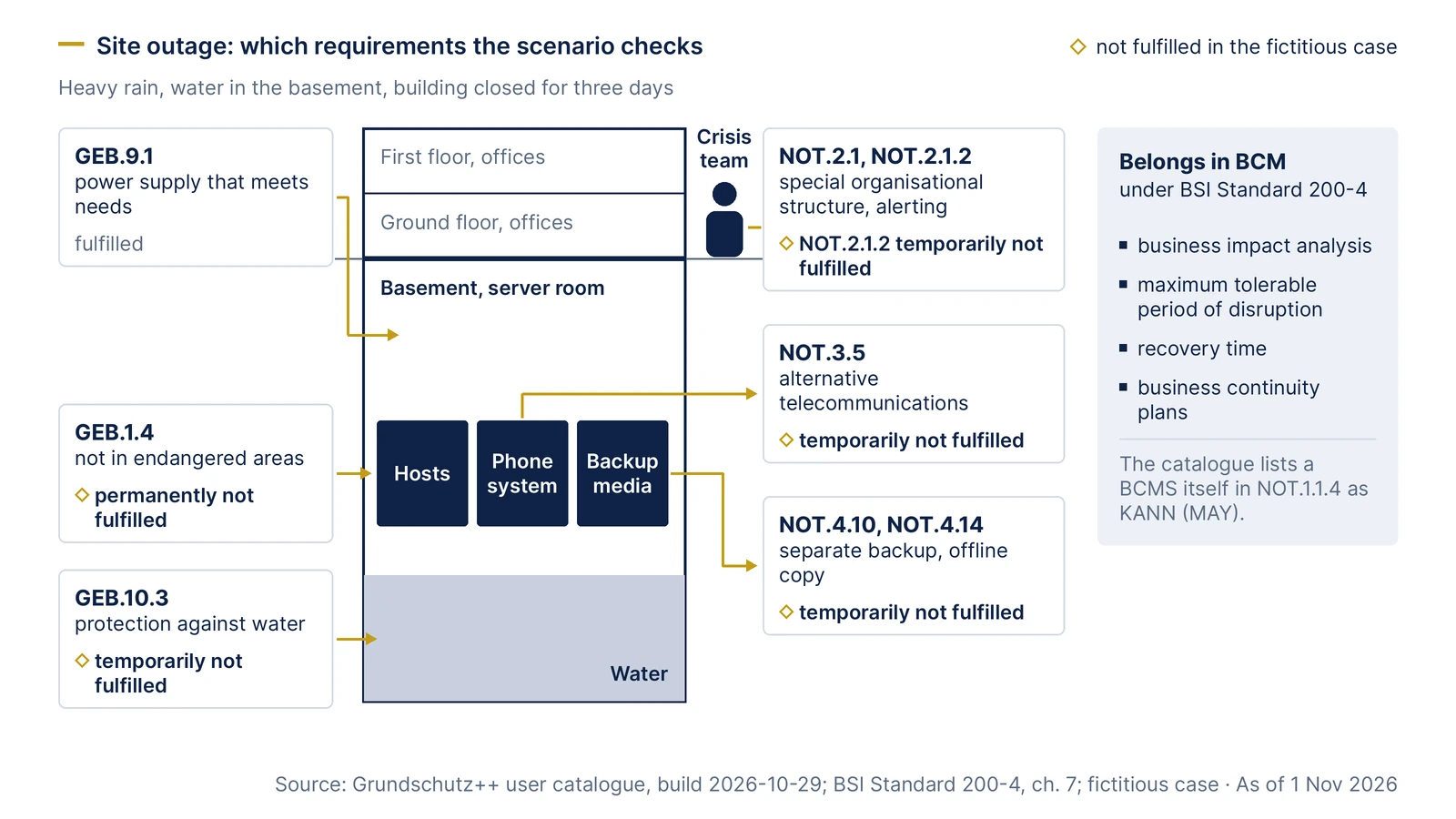
Result: scenario sheet for a site outage (fictitious)
The scenario sheet summarises the run-through. You can adopt it for your own scenario: column three contains the audit question you put to your own situation, column four the finding in the case, column five the consequence in the requirements package. All findings are invented.
| Phase | Requirement (modal verb) | Audit question | Finding at MHL (fictitious) | Consequence |
|---|---|---|---|---|
| Preparedness | GEB.1.4 (SOLLTE) | Are assets worth protecting located in exposed or endangered areas? | Server room in a basement at risk of flooding, no move planned | permanently not fulfilled, risk assessment, residual risk to top management for approval |
| Preparedness | GEB.10.3 (SOLLTE), GEB.10.3.2 (KANN) | Is there at least one physical safeguard against water, and is water ingress detected? | none so far; plinth, backflow preventer and sensors decided | not fulfilled, temporary: safeguards with deadline in the implementation plan |
| Preparedness | GEB.9.1 (SOLLTE), GEB.9.1.3 (KANN) | Is the power supply sufficient for an orderly shutdown? | UPS in place, bridging time sufficient for shutdown | fulfilled; continued operation during closure is not a matter for the UPS |
| Preparedness | GEB.1.5 (SOLLTE) | Are structural plans documented and available outside the building? (scenario-related) | Plans documented, but only on paper inside the building | fulfilled; as a self-defined rule, also deposit a copy outside the building |
| Preparedness | GEB.6.2.1 (SOLLTE) | Are all host systems located in server rooms? | one host in an office on the ground floor | not fulfilled, temporary: move to the server room planned |
| Response | NOT.2.1, NOT.2.1.1 (SOLLTE) | Are the tasks for the crisis management team and emergency teams assigned? Is there a deputy? (deputy scenario-related) | Roles assigned, no deputy for the head of IT | fulfilled; as a self-defined rule, appoint a deputy |
| Response | NOT.2.1.2 (SOLLTE) | Does alerting work without the building and without the internal network? | Alerting list only on the file server, not reachable in the scenario | not fulfilled, temporary: provide the list offline and on mobile devices |
| Response | NOT.3.5 (SOLLTE) | Are there alternative telecommunications for the crisis management team, emergency teams and service providers? | Telephone system in the server room, no alternative | not fulfilled, temporary: set up a mobile call group |
| Response | NOT.3.6 (SOLLTE) | Are there emergency accesses that work without the building? | Emergency passwords in the safe inside the building, not reachable in the scenario | not fulfilled, temporary: second deposit at another location |
| Response | NOT.3.3 (SOLLTE) | Do employees know what to do in the event of a closure? | no information available | not fulfilled, temporary: short briefing, plan awareness under SENS |
| Recovery | NOT.4.10 (SOLLTE), NOT.4.14 (SOLLTE) | Is the backup separate from the original data, is there an offline copy? Is a backup held outside the building? (building scenario-related) | Backup library next to the hosts | not fulfilled, temporary: implement as a priority |
| Recovery | NOT.3.1 (SOLLTE) | Is there a recovery plan for the time-critical systems? | Plan for dispatch in place, target infrastructure not defined | fulfilled; as a self-defined rule, add alternative operation; recovery time only roughly estimated without BIA |
| Recovery | NOT.4.15, NOT.4.16.1 (SOLLTE) | Is the restore documented and checked by samples? At another location too? (location scenario-related) | Procedure documented, samples only tested in the same server room | fulfilled; as a self-defined rule, plan a sample test on replacement systems elsewhere |
| Exercising | NOT.1.2 (MUSS), NOT.3.4 (KANN) | Are the rules reviewed regularly and when there is cause, and are the plans tested? | Annual review, no functional test | NOT.1.2 fulfilled; NOT.3.4 (KANN) not implemented, plan review of the scenario as next step |
Status values under chapter 4.1.1 of 300-1, classification as "temporary" under chapter 4.1.2. Audit questions marked "scenario-related" go beyond the requirement text and arise from the closed building. For the temporarily unfulfilled SOLLTE requirements, the remaining risk must be reported to top management and approved by it (chapters 2.11 and 4.1.1); at the same time, chapter 4.1.2 says that a temporary non-fulfilment does not trigger a risk assessment. This is an open question of interpretation; MHL presents the residual risk to top management.
What the scenario sheet leaves open (questions for BCM under BSI Standard 200-4):
- Which business processes are time-critical, and how long may each be down (maximum tolerable period of disruption)?
- Which recovery time and which maximum tolerable data loss follow from this for the individual resources?
- At what emergency operation level does dispatch continue, and which business continuity plan describes emergency operation?
- What dependencies on staff, service providers and other sites exist in emergency operation?
- At what point does the event become a crisis, and who decides?
Fictitious example. Identifiers and modal verbs from the Grundschutz++ user catalogue, build 2026-10-29; parameters of the business impact analysis under chapter 7 of BSI Standard 200-4.
Exercising the scenario: from plan review to functional test
NOT.1.2 requires, as a MUSS requirement, that procedures and rules be reviewed for currency regularly and when there is cause. Whether the plans actually work is checked by NOT.3.4, as a KANN requirement: the guidance means also checking the specific resources where possible, for example whether reporting channels work and replacement devices can be used. If the maturity for this has not yet been reached, it names plan reviews as a first step, in which a plan is only walked through mentally, and refers to chapters 13.5 and 13.9 of 200-4. NOT.2.1.4 provides as KANN for checking the functionality of the BAO through crisis management team exercises.
For MHL, a plan review of the scenario is the next step: the crisis management team, IT operations and facility management go through the scenario sheet row by row and check whether the safeguards decided close the findings. 200-4 recommends coordinating BCM exercise planning with other exercises, for example fire and evacuation drills or restore tests (chapter 13.3). This also applies without a BCMS: if alerting the crisis management team is added to an evacuation drill, alerting under NOT.2.1.2 can be checked without a separate exercise date.
Next steps
The findings enter the assessment of the requirements package as status. For planned SOLLTE requirements not yet fulfilled, the remaining risk must be reported to top management and approved by it; permanent non-fulfilments and the high protection requirements of dispatch go into the risk assessment (300-1 chapters 2.11, 4.1.1, 4.1.2). Whether a BCMS under 200-4 is worthwhile is a decision for top management; the catalogue leaves it open with NOT.1.1.4 as a KANN requirement, and the requirements of the practice NOT remain in the requirements package in any case.
- Combining BCM under 200-4 with Grundschutz++: BSI Standard 200-4
- Documenting status and deviations: Assessing requirements
- Risk assessment for permanent non-fulfilment: Risk analysis, approval of the residual risk: Risk acceptance and residual risk
- Justifying protection requirements for availability: Protection requirements determination
- Making employees aware of how to proceed in an emergency: Planning awareness and checking its effect
Blackfort Technology supports you with package C of implementation under Grundschutz++: status determination for each requirement, including GEB and NOT, classification of the findings in the requirements package and risk assessment, and an evidence plan that maps the precautions at the site and emergency preparedness to the requirements.
Rights notice: Information from BSI Standard 300-1 © Bundesamt für Sicherheit in der Informationstechnik 2026, source: BSI, Grundschutz++. Information from BSI Standard 200-4 © Bundesamt für Sicherheit in der Informationstechnik 2023, source: BSI Standard 200-4. It is not licensed under CC BY-SA 4.0; the licence notice at the end of the page applies to the extracts from the catalogue data.