

What 200-4 is and where it stands
According to its change history, 200-4 is a redesign based on 100-4, aligned with ISO 22301:2019. New compared with 100-4 are, among other things, the tiered model, the term business continuity management (BCM) instead of emergency management, the process steps preliminary analysis (Voranalyse), now the BIA pre-filter (BIA-Vorfilter), and target/actual comparison (Soll-Ist-Vergleich), consideration of the interfaces to information security, IT service continuity management and crisis management, and a more detailed description of the response organisation. Version 1.0 of May 2023 adjusted the definition of recovery time (Wiederanlaufzeit), introduced the response time of the special organisational structure (Besondere Aufbauorganisation, BAO) and renamed the preliminary analysis to BIA pre-filter.
A BCMS can be built in three tiers: reactive BCMS (Reaktiv-BCMS), build-up BCMS (Aufbau-BCMS) and standard BCMS (Standard-BCMS) (ch. 2.6). The reactive BCMS is meant to enable an organisation quickly to respond to emergencies and is to be developed further after one cycle; the build-up BCMS initially covers a limited set of business processes; the standard BCMS considers all business processes in scope. According to ch. 1.3, the standard BCMS tier conforms to ISO 22301:2019, and a fully implemented and operated standard BCMS reaches the maturity for ISO 22301 certification. On the standard itself, the BSI states on its website: „Derzeit ist noch keine Zertifizierung zu dem Standard geplant.“ (our translation: "No certification for the standard is planned at present.") (retrieved on 1 November 2026). For experienced users, the BSI offers a requirements catalogue with the MUSS and SOLLTE requirements (must and should) of the standard BCMS and a mapping to ISO 22301:2019.
For the connection with Grundschutz, one sentence from ch. 1.3 matters: „Ein ISMS wird explizit für diesen BSI-Standard nicht vorausgesetzt.“ (our translation: "An ISMS is explicitly not a prerequisite for this BSI standard.") 200-4 continues the series 200-1 to 200-3 and, in many places, points to synergy potential with the ISMS in dedicated boxes. The examples there refer to an ISMS under BSI Standard 200-2 or ISO 27001. The standard does not yet contain such notes for Grundschutz++; the transfer to 300-1 in the tables below is our assessment.
Relationship to BSI Standard 300-1 and the user catalogue
300-1 mentions a BCMS in one place: according to ch. 2.5, process maps and existing management systems such as a BCMS can be used when identifying the business processes. 300-1 contains no sentence that replaces 200-4 or sets it aside for Grundschutz++. The BSI milestone plan (Meilensteinplan, as of October 2026) lists the integration of other management systems into Grundschutz++ for 2027 and later; which ones and in what form is not stated there.
The Grundschutz++ user catalogue (build of 29 October 2026) makes the connection in the practice NOT. NOT.1.1.4 provides, as a KANN requirement (may), for establishing a BCMS under BSI Standard 200-4; its parameters are the tier (reactive, build-up or standard BCMS) and the standard. The guidance recommends ideally meeting the requirements of the practice through a BCMS, with a reactive BCMS as the first step. The guidance on eight further NOT requirements refers to individual chapters of 200-4. A BCMS is therefore optional, the practice NOT is not: 25 of its 37 requirements have no target object category (Zielobjektkategorie) and, under 300-1 ch. 3.4.1, must be included in the requirements package.
In classic IT-Grundschutz, module DER.4 Emergency Management of the IT-Grundschutz Compendium is to be applied once for the entire information domain. In Edition 2023 (as of February 2023), it still refers to BSI Standard 100-4 for the phases of emergency management; version 1.0 of 200-4 dates from May 2023. Since, according to its change history, 200-4 replaces Standard 100-4, 200-4 is today the current version for this content. How the Compendium continues to be used until classic certifiability ends is described on the page IT-Grundschutz Compendium.
What BCMS and ISMS can share and what stays separate
Both management systems ask about business processes, resources, damage and risks. They ask with a different aim, though. An ISMS protects normal operations in all three protection goals, BC safeguards above all limit the extent of a damaging event that has occurred (200-4 ch. 2.4.1). 200-4 gives an example: an application with high availability in the ISMS can remain without a continuity requirement in BCM if emergency operations manage without it; for another one, the business impact analysis can tighten the requirement because the process has to run again after a few hours. The table sorts the points of contact. The references for 200-4 are the synergy boxes and the related body text of the standard, those for Grundschutz++ the chapters of 300-1.
| Topic | BCM under 200-4 | ISMS under Grundschutz++ | Can be shared | Keep separate |
|---|---|---|---|---|
| Scope | Orienting towards the ISMS scope can make sense but must fit the objectives (ch. 3.3) | Scope of application and information domain (300-1 ch. 3.1) | Delimitation and known resources as a starting point | Objectives of the BCMS, which may require a different cut |
| Business processes | Processes from the ISMS as a basis; the same level of detail as in the ISMS can make sense (ch. 7.1.1) | Business processes are to be identified and documented, a BCMS may be used (ch. 2.5) | one joint process list, in both directions | Classification as time-critical: BCM focuses on the time-critical business processes (ch. 2.1), which only the BIA determines |
| Stakeholders | Check whether to adopt the stakeholder analysis (ch. 4.2) | Analysis of interested parties (ch. 2.4) | List of parties and their requirements | Expectations that concern continuity only |
| Damage categories | Damage scenarios and categories from the protection requirements determination as a basis (ch. 7.1.2) | two categories, normal and high, per business process (ch. 2.6) | Description of the damage scenarios | Time grading and intolerability level of the BIA; two categories are not enough for that |
| Assessment | The BIA looks at resources for emergency operations, the protection requirements determination at normal operations; a joint survey is not advantageous in all cases (ch. 7.1.5) | Protection requirements determination per business process (ch. 2.6) | joint appointments and tools where the same categories apply | Results: availability in normal operations and continuity in emergency operations are different values |
| Resources | Adopt names from the structure analysis; its grouping will probably not match the BCM resource clusters (ch. 7.1.3) | Assets and dependencies (ch. 3.2) | Asset and resource names, responsible persons (ch. 8.1) | Clusters and groups |
| Risk | no method of its own; focus on risks to the availability of time-critical resources (ch. 9.1, 9.3); the same categories as in the ISMS make a lot of sense (ch. 9.5) | Free choice of method, minimum criteria (Mindestkriterien) from Annex 3 binding (ch. 2.11) | Method, scales, risk categories, one integrated risk treatment plan (ch. 2.4.1) | Selection of threats: confidentiality and integrity remain a task of the ISMS |
| Roles | The information security officer (ISB) and the BC officer can be the same person if there are no conflicting topics and resources suffice; the standard advises against combining the role with IT service continuity management (ch. 3.5) | Roles and responsibilities (ch. 2.8) | Coordination and deputising | Process ownership per management system |
| Emergency operations and protection goals | Define the interfaces between BCMS and ISMS early, because protection goals can compete in emergency operations (ch. 4.2.3) | alternative security mechanisms for emergencies (NOT.3.6) | a joint rule for exceptions in emergency operations | the decision during an incident lies with the BAO |
| Exercises and reports | Coordinate the annual exercise plan with other exercises (ch. 13.3); joint reporting has advantages (ch. 2.4.1) | Performance evaluation and management review (ch. 5) | one exercise calendar, one report to top management in two parts | Objectives and indicators per management system |
Column "BCM under 200-4": synergy boxes and body text in BSI Standard 200-4, version 1.0; the synergy boxes refer to an ISMS under 200-2 or ISO 27001. Column "ISMS under Grundschutz++": BSI Standard 300-1, version 1.0. The columns "Can be shared" and "Keep separate" are our own assessment.
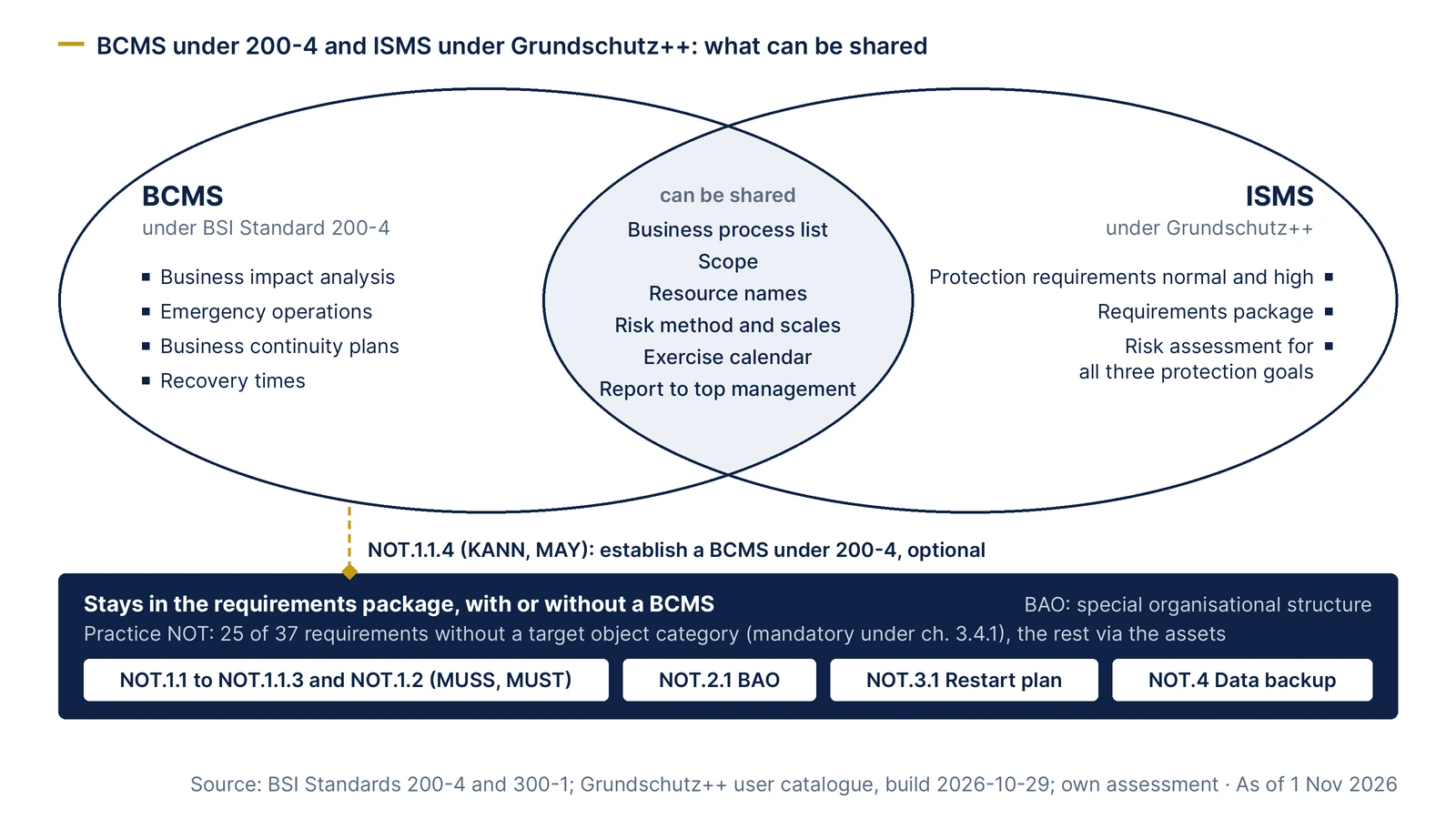
What stays in the requirements package even with a BCMS
A BCMS under 200-4 can give substance to many NOT requirements. The guidance on NOT.2.1 says, in essence, that with a BCMS under 200-4, whatever its tier, the requirements for the special organisational structure (BAO) are generally met. The status must nevertheless be checked and evidenced for each requirement: under 300-1 ch. 4.1.1, the current implementation status of every requirement must be fully reviewed. The table shows where the guidance in the catalogue points and what then remains in the ISMS.
| Requirement (modal verb) | Reference in the guidance to 200-4 | What a BCMS provides | What remains in the ISMS |
|---|---|---|---|
| NOT.1.1.4 BCMS (KANN) | ch. 2.6 tiered model | the management system itself, in the chosen tier | the decision whether and in which tier, and its status in the package |
| NOT.2.1 BAO (SOLLTE) | ch. 5 setting up and enabling the BAO | Crisis team, core team, response teams, rules of procedure | Evidence of the status; interface to the handling of security incidents |
| NOT.2.1.1 Roles (SOLLTE) | ch. 5.1 | Staffing of the BAO | Evidence of the assignment |
| NOT.2.1.2 Alerting (SOLLTE) | ch. 5.2 | Detection, reporting, classification, alerting | Connection of the reporting channels for security events |
| NOT.2.1.3 Crisis team room (KANN) | ch. 5.6.3 | Designation and equipment of the crisis team room | Protection of the crisis team room, including a virtual one |
| NOT.2.1.4 Crisis team exercise (KANN) | ch. 13.6 | Exercise planning, execution, evaluation | Scenarios related to information security, such as malware |
| NOT.3.1 Restart plan (SOLLTE) | ch. 12 restart and recovery planning | critical resources and recovery times from the BIA, framework from the BC strategies | without a BCMS: time-critical IT resources from the protection requirements determination, recovery time only roughly estimated |
| NOT.3.2 Business continuity plan (KANN) | ch. 11 business continuity planning | Emergency operations per time-critical business process | according to the guidance only optional in the ISMS |
| NOT.3.4 Functional test (KANN) | ch. 13.9 functional test and 13.5 plan walkthrough | Tests of the plans and emergency operation resources | Check whether security precautions are effective in emergency operations |
| NOT.1.1 to NOT.1.1.3 and NOT.1.2 (MUSS) | none | Policy and procedures of the BCMS | Procedure for emergency preparedness in information security, documentation, assignment, communication, review |
| NOT.3.5, NOT.3.6 (SOLLTE) | none | Alternative communication as a BC solution | Alternative telecommunications and alternative security mechanisms in an emergency |
| NOT.3.3 (SOLLTE), NOT.4 Data backup (20 requirements) | none | Requirements for recovery time and permissible data loss | Raising users' awareness of the procedure in an emergency; concept, retention, encryption, offline copy and tests of the data backup |
Column "Reference": guidance in the Grundschutz++ user catalogue, build 2026-10-29. The columns "What a BCMS provides" and "What remains in the ISMS" are our own assessment.
What an ISMS under Grundschutz++ does not take over
Conversely, the requirements package does not replace a BCMS. The user catalogue does not require a business impact analysis with maximum tolerable downtime, required recovery time, maximum permissible data loss and emergency operation level (200-4 ch. 7); the business continuity plan is a KANN requirement there. The two protection requirements categories normal and high do not say how long a process may be down. And the risk assessment of the ISMS cannot be handed over to the BCM risk analysis: according to 200-4 ch. 9.1, the latter generally considers the risks to availability, whereas 300-1 ch. 2.11 already requires an explicit risk assessment when a business process has high protection requirements in at least one protection goal, including confidentiality or integrity.
How far an organisation needs a BCMS depends on its business processes and on the rules that apply to it. We classify the rules you name or that appear in your documents; whether they apply legally is checked by your legal department. For getting started where there are legal or regulatory requirements, 200-4 recommends the build-up or standard BCMS rather than the reactive BCMS (ch. 2.6.1). How gaps show up in a specific outage is played through for a site failure on the page Buildings and emergency preparedness.
Reading path through 200-4 for Grundschutz users
200-4 is extensive and structured along the BCM process. From chapter 3 onwards, each chapter heading states which tier the chapter applies to: R for reactive BCMS, A for build-up BCMS, S for standard BCMS, AS for build-up and standard BCMS together (ch. 1.3). If you initially want to implement only a reactive BCMS, read only the chapters marked R. The following order is tailored to readers who operate or are building an ISMS under Grundschutz++.
- Terms and tiers first: ch. 2.1 (disruption, emergency, crisis; time-critical business processes; BAO), 2.3 (timeline of the response) and 2.6 (tiered model). The standard itself recommends these three chapters as minimum reading for everyone with prior BCM experience.
- Interface to the ISMS: ch. 2.4.1, with the differences between availability in normal operations and continuity in emergency operations. Then ch. 2.4.2 on IT service continuity management, if IT operations keep their own emergency plans.
- For top management: ch. 3, initiation by top management with objectives, scope, choice of tier and appointment of the BC officer.
- Put next to NOT.2.1: ch. 5 on the BAO, in particular 5.1, 5.2 and 5.6.
- Put next to the protection requirements determination: ch. 6 (BIA pre-filter, for reactive and build-up BCMS) and ch. 7 (business impact analysis). This is where you decide which data you collect jointly.
- Put next to Annex 3 of 300-1: ch. 9 (BCM risk analysis, for build-up and standard BCMS). Check whether your risk method covers both purposes.
- For NOT.3.1 and NOT.3.2: ch. 12 (restart planning, AS) and ch. 11 (business continuity planning).
- For NOT.2.1.4 and NOT.3.4: ch. 13 on exercising and testing, with plan walkthrough, crisis team exercise, alerting exercise and functional test.
- For a final cross-check: the requirements catalogue for the standard, which summarises the MUSS and SOLLTE requirements of the standard BCMS in compact form, and for operation ch. 14 and 15.
Further reading: protection requirements per business process on the page Protection requirements determination, checking the risk method on the page Checking the risk method, the classic risk method on the page BSI Standard 200-3, the site failure as a scenario on the page Buildings and emergency preparedness, the method as a whole on the page BSI Standard 300-1, module DER.4 in context on the page IT-Grundschutz Compendium.
Placing existing BCM documents in Grundschutz++
If you already have an emergency manual, a BAO or a BCMS under 100-4 or 200-4, you do not have to start again for Grundschutz++. The documents are evidence for the status of the NOT requirements, provided they are current and cover the requirement. In the Readiness and migration concept package, Blackfort Technology checks which requirements of the practice NOT existing documents already evidence and where gaps remain.
- Have your existing documents reviewed: Readiness and migration concept
- Document the status per requirement: Assessing requirements
- All services: Consulting
Rights notice: Quotations and information from BSI Standard 200-4 © Bundesamt für Sicherheit in der Informationstechnik 2023, source: BSI Standard 200-4; the quotation on certification comes from this web page. Information from BSI Standard 300-1 and the milestone plan © Bundesamt für Sicherheit in der Informationstechnik 2026, source: BSI, Grundschutz++. Information from the IT-Grundschutz Compendium, Edition 2023 © 2023 Reguvis Fachmedien GmbH, © 2023 Bundesamt für Sicherheit in der Informationstechnik, Bonn (as stated in the imprint of the edition), source: IT-Grundschutz Compendium. They are not licensed under CC BY-SA 4.0; the licence notice at the end of the page applies to the extracts from the catalogue data.