

Risk acceptance, residual risk, exception approval: what 300-1 distinguishes
| Term | Meaning in 300-1 | Reference |
|---|---|---|
| Risk appetite | to be defined by the organisation. The risk acceptance criteria build on it (300-1 contains no definition; it means how much risk the organisation is willing to take) | Ch. 2.11; criterion 7 |
| Risk acceptance criteria | yardstick against which every evaluated risk is measured, defined taking the risk appetite into account | Criteria 8, 22 |
| Risk acceptance | one of the four treatment options alongside reduction, avoidance and transfer | Criterion 23 |
| Temporary risk acceptance | acceptance for a limited period. A time limit has to be set | Criterion 28 |
| Residual risk | the risk remaining after risk treatment. It is submitted to top management for approval | Ch. 4.2.3; criterion 30 |
| Exception approval | authorisation by top management of a risk that does not meet the acceptance criteria and is not to be treated any further | Criterion 27 |
| Residual risk assessment | for SOLLTE (SHOULD) requirements that are planned but not yet fulfilled. Top management approves the risk | Ch. 2.11 |
Top management authorises the framework, that is procedures, roles, criteria for identification, evaluation and acceptance, and the risk appetite, before the first decision (criterion 9). Without this framework, no acceptance has a yardstick. The user catalogue sums this up as RISK.1.5: „Risikomanagement MUSS Verfahren, Rollendefinitionen und Kriterien durch die Institutionsleitung autorisieren.“ (our translation: "Risk management MUST have procedures, role definitions and criteria authorised by top management.")
Who decides what
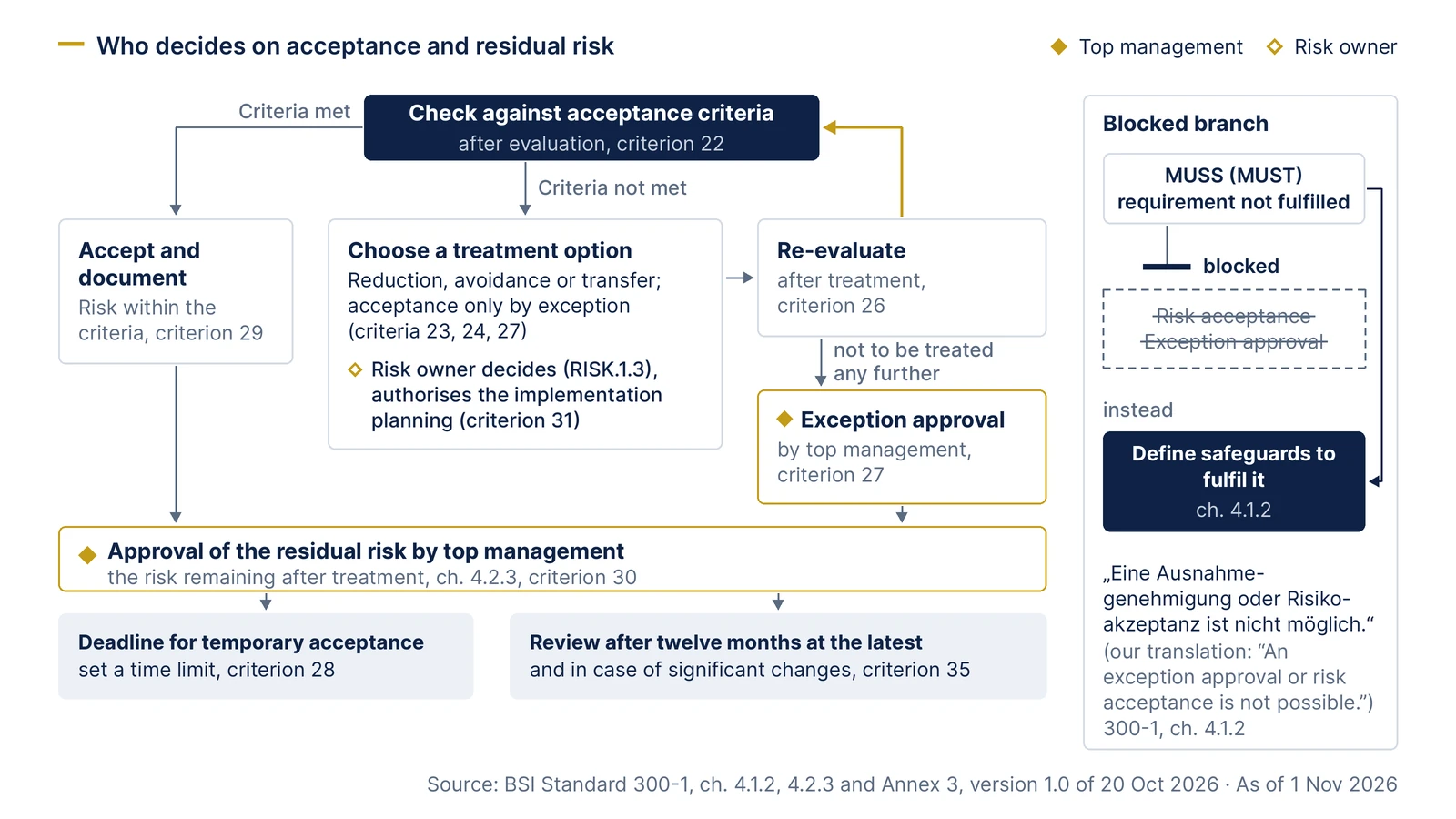
The matrix assigns the decision, the decision-maker and the reference to each situation. It is the basis for the fields in the decision record.
| Situation | Decision | Who | Reference |
|---|---|---|---|
| Framework for risk assessment | authorise procedures, roles, criteria and risk appetite | Top management | Ch. 2.11; criterion 9; RISK.1.5 |
| Risk meets the acceptance criteria | accept and document | Risk owner. Top management authorises the residual risk | Criteria 22, 29, 30 |
| Risk does not meet the acceptance criteria and therefore has to be treated | decide on the treatment option, and for reduction the safeguards | the organisation (ch. 4.2.3). According to the guidance on RISK.1.3, the risk owner has the authority to decide on treatment | Ch. 4.2.3; criteria 23, 24; RISK.1.3 |
| Risk still does not meet the acceptance criteria after treatment | evaluate and treat again | the organisation, following its procedure | Criterion 26 |
| Risk does not meet the criteria and is not to be treated any further | exception approval | Top management | Criterion 27 |
| Risk is accepted temporarily | set a time limit, document | Risk owner proposes. As residual risk, top management authorises it | Criteria 28, 29, 30 |
| Risk remaining after treatment | authorise residual risk | Top management | Ch. 4.2.3; criterion 30 |
| Safeguards decided | authorise implementation planning | Risk owner | Ch. 4.2.3; criterion 31; RISK.1.10 |
| SOLLTE requirement permanently not fulfilled | risk assessment, residual risks submitted for approval | Top management for the residual risks | Ch. 4.1.2; criteria 30, 34 |
| SOLLTE requirement planned, not yet fulfilled | identify the risk not yet mitigated and report it to top management, which must bear it under ch. 4.1.1; residual risk assessment | Top management | Ch. 2.11, 4.1.1; open question of interpretation, see below |
| MUSS requirement not fulfilled | no acceptance possible. Define safeguards to fulfil it | Implementation planning | Ch. 4.1.2 |
| KANN (MAY) requirement not fulfilled | no decision needed, implementation is optional | Ch. 4.1.2 | |
| Requirement not applicable | no risk decision. Document the justification, only where the requirement is functionally impossible to fulfil or the component is absent | whoever determines the status | Ch. 4.1.1 |
On MUSS requirements, 300-1 is unambiguous: „Die Durchführung einer Risikobetrachtung kann die Erfüllung einer MUSS-Anforderung nicht ersetzen. Eine Ausnahmegenehmigung oder Risikoakzeptanz ist nicht möglich.“ (our translation: "Carrying out a risk assessment cannot replace the fulfilment of a MUSS requirement. An exception approval or risk acceptance is not possible.") (chapter 4.1.2). If permanent non-fulfilment of SOLLTE requirements accumulates, 300-1 states that a significant deviation (erhebliche Abweichung) may be found in the course of a certification. How to classify requirements correctly beforehand is explained on the page Assessing requirements, documenting deviations.
Work product: decision record
One record per decision makes it traceable and auditable. 300-1 does not prescribe a form. The fields below implement the criteria from Annex 3 and add what is needed for a later review. Mandatory content under 300-1 is marked (M).
Template
| Field | Content |
|---|---|
| Record no., date | unique, with a reference from the risk register |
| Risk ID, object of analysis (M) | from the register (criteria 11, 15) |
| Trigger | high protection requirements, asset not covered, SOLLTE requirement permanently or temporarily not fulfilled |
| Risk description, protection goals | in one sentence; C, I, A |
| Evaluation | frequency, impact, level before and after treatment; comparison with the acceptance criteria (criteria 20, 22, 26) |
| Type of decision (M) | approval of the residual risk (criterion 30) / temporary acceptance with deadline (criterion 28) / exception approval (criterion 27) |
| Justification | why the risk is accepted and which alternatives were examined |
| Time limit (M for temporary acceptance) | date until which the acceptance applies |
| Conditions | conditions under which the decision applies, such as an accompanying safeguard or a threshold |
| Monitoring | how to tell that the risk is rising, and which safeguard then takes effect |
| Related safeguards | identifiers in the implementation plan, approval of the implementation planning by the risk owner with date (criterion 31) |
| Risk owner | name, function, date, signature |
| Top management (M) | name, function, date, signature (criteria 27, 30) |
| Acknowledged by | information security officer (ISB); where applicable data protection, affected departments |
| Review (M) | next date, twelve months at the latest; triggers for an earlier review (criterion 35) |
Completed decision record (fictitious)
Continuation of the case from the page Risk register: a grant-making foundation has reduced risk R-03-01 for its business process GP-03 from "high" to "medium". Under its acceptance criteria, "medium" is acceptable for no more than twelve months. Names and dates are invented.
| Field | Entry |
|---|---|
| Record no., date | E-2026-07, 15 Dec 2026 |
| Risk ID, object of analysis | R-03-01, GP-03 Receive, review and pay out grant applications |
| Trigger | high protection requirements for integrity |
| Risk description, protection goals | Manipulation of approvals via a misused caseworker account, resulting in incorrect payments; integrity |
| Evaluation | before treatment medium × considerable = high, not acceptable; after M-03-01 and M-03-02 rare × considerable = medium, acceptable for a limited period |
| Type of decision | approval of the residual risk "medium" as temporary acceptance |
| Justification | Four-eyes approval applies above a threshold amount. Approvals below it remain with one person, because a full double check would delay processing by weeks. Examined and rejected: four-eyes approval for all amounts, outsourcing of the payment. |
| Time limit | 15 Dec 2027 |
| Conditions | monthly log evaluation (M-03-02) is in place; the threshold amount will not be raised |
| Monitoring | anomalies in the monthly evaluation, accumulation of approvals just below the threshold amount; then lowering of the threshold amount, prepared as M-03-08 |
| Related safeguards | M-03-01, M-03-02; implementation planning approved by the Head of Grants on 14 Dec 2026 |
| Risk owner | E. Beispiel, Head of Grants, 15 Dec 2026, signed |
| Top management | F. Muster, Executive Board, 15 Dec 2026, signed |
| Acknowledged by | ISB, 15 Dec 2026 |
| Review | 15 Dec 2027 at the latest; earlier in the event of an incident, a change to the threshold amount or a switch of the case management system |
Variant: exception approval. Had the foundation rejected M-03-01 and left R-03-01 at "high", the risk would have remained outside the acceptance criteria. The type of decision is then "exception approval" under criterion 27, the justification has to explain why the risk is not treated any further although the criteria are not met, and top management signs. No deadline is expressly required for this. We still recommend one, so that the exception comes back onto the table at the annual review at the latest.
Review and decide again
The risk assessment has to be reviewed at least annually and whenever significant changes are planned or have occurred, and updated where necessary (chapter 4.2.3; criterion 35). For decision records this means: every record has a review date, and once a time limit expires the risk is re-evaluated. There is no tacit extension.
Suitable triggers for an earlier review are the events that 300-1 names elsewhere: new vulnerabilities and threats from monitoring (chapter 5.4), security incidents, changes in the organisation or in the threat situation. Incidents and changes, together with the status of risk treatment and the status of earlier management decisions, are also among the items of the management review (chapter 5.3). An extract of all open records with their deadlines is a useful document for it.
BSI Standard 200-3 describes a helpful practice here: risks that are acceptable today but are likely to rise are monitored, and additional safeguards are prepared so that they can take effect quickly when needed (chapter 6.2). The "Monitoring" field in the decision record takes up this idea.
Open questions of interpretation in the standard and the catalogue
- SOLLTE requirements temporarily not fulfilled. For SOLLTE requirements that are included in the implementation planning but not yet fulfilled, chapter 2.11 requires a residual risk assessment with approval by top management. Chapter 4.1.1 requires the risk not yet mitigated to be identified and reported to top management, and adds: „Das durch die nicht erfüllte Anforderung bestehende Risiko muss von der Institutionsleitung getragen werden.“ (our translation: "The risk arising from the unfulfilled requirement must be borne by top management.") Chapter 4.1.2, by contrast, says: „Eine temporäre Nichterfüllung löst keine Risikobetrachtung aus.“ (our translation: "Temporary non-fulfilment does not trigger a risk assessment.") The standard leaves open how these passages fit together. We recommend documenting the residual risk briefly and having it approved, without carrying out a full risk assessment under Annex 3, and recording this reading in your risk policy.
- Reference in the note on criterion 30. The note names criterion 31 as the place that „ausdrücklich die Ausnahmegenehmigung“ (our translation: "expressly the exception approval") governs. Going by its heading and wording, criterion 27 governs the exception approval. Criterion 31 concerns the approval of the implementation planning by the risk owners. For the decision record this makes no difference: in both cases top management authorises the exception approval and the residual risk.
- Modal verb in the catalogue. The catalogue frames the residual risk assessment as a SOLLTE requirement: „Umsetzung SOLLTE das bestehende Restrisiko durch die nicht umgesetzten Anforderungen festlegen.“ (our translation: "Implementation SHOULD determine the existing residual risk resulting from the requirements not implemented.") (UMS.1.2, build of 29 October 2026). In chapter 2.11, 300-1 uses „muss“ (must). We follow the standard.
- Risk appetite in the catalogue. RISK.1.5 names procedures, role definitions and criteria, criterion 9 also the risk appetite. Have the risk appetite authorised as well.
For comparison: risk acceptance in classic IT-Grundschutz
BSI Standard 200-3 lists risk acceptance as the fourth option after avoidance, reduction and transfer and requires: „Das Restrisiko muss anschließend der Leitungsebene zur Zustimmung vorgelegt werden (Risikoakzeptanz).“ (our translation: "The residual risk must then be submitted to management for approval (risk acceptance).") As reasons for accepting even higher risks, 200-3 cites, for example, damage that occurs only under very specific conditions, the lack of effective countermeasures, or costs that exceed the value to be protected (chapter 6.1).
In the IT-Grundschutz Compendium, MUSS denotes an unrestricted requirement „für die keine Risikoübernahme möglich ist“ (our translation: "for which no assumption of risk is possible"). BSI Standard 200-2 does not provide for accepting a residual risk for basic requirements (chapter 9.2). This principle remains in place in Grundschutz++ for MUSS requirements (300-1, chapter 4.1.2). 200-2 also advises documenting the decision on where residual risks are accepted „auch aus juristischen Gründen sorgfältig“ (our translation: "carefully, also for legal reasons") (chapter 9.3). Your legal department will assess what legal effect a risk decision has in your organisation.
What 300-1 regulates explicitly are the separate approvals: the risk owner authorises the implementation planning, top management the residual risk and every exception. Top management was already responsible for information security under 200-2 (chapter 2.3). 300-1 adds that decision papers are submitted to it, in particular on scope, protection requirements, sequence, resources and policy (chapter 2.10). The decision record is the appropriate form for risk decisions.
The page BSI Standard 200-3 places the procedure and assumptions of 200-3 in context. How risks are evaluated and treated up to this decision is shown on the page Risk analysis. Whether the procedure as a whole meets the 35 minimum criteria is covered on the page Risk minimum criteria. If you want to prepare decision papers for your top management or convert your risk policy to 300-1, Blackfort Technology can support you, see Consulting.
Rights notice: Short quotations from BSI Standard 300-1 „Methodik Grundschutz++“, version 1.0 of 20 October 2026, © Bundesamt für Sicherheit in der Informationstechnik 2026, source: BSI page on Grundschutz++ (German); from BSI Standards 200-2 and 200-3, version 1.0, © Bundesamt für Sicherheit in der Informationstechnik 2017, source: BSI page on the BSI Standards (German); from the IT-Grundschutz Compendium, 2023 edition, © 2023 Reguvis Fachmedien GmbH and © 2023 Bundesamt für Sicherheit in der Informationstechnik, source: BSI page on the IT-Grundschutz Compendium (German). These quotations are not licensed under CC BY-SA 4.0. The licence notice at the end of the page applies only to the extracts from the catalogue data.