

What content 300-1 requires for the risk register
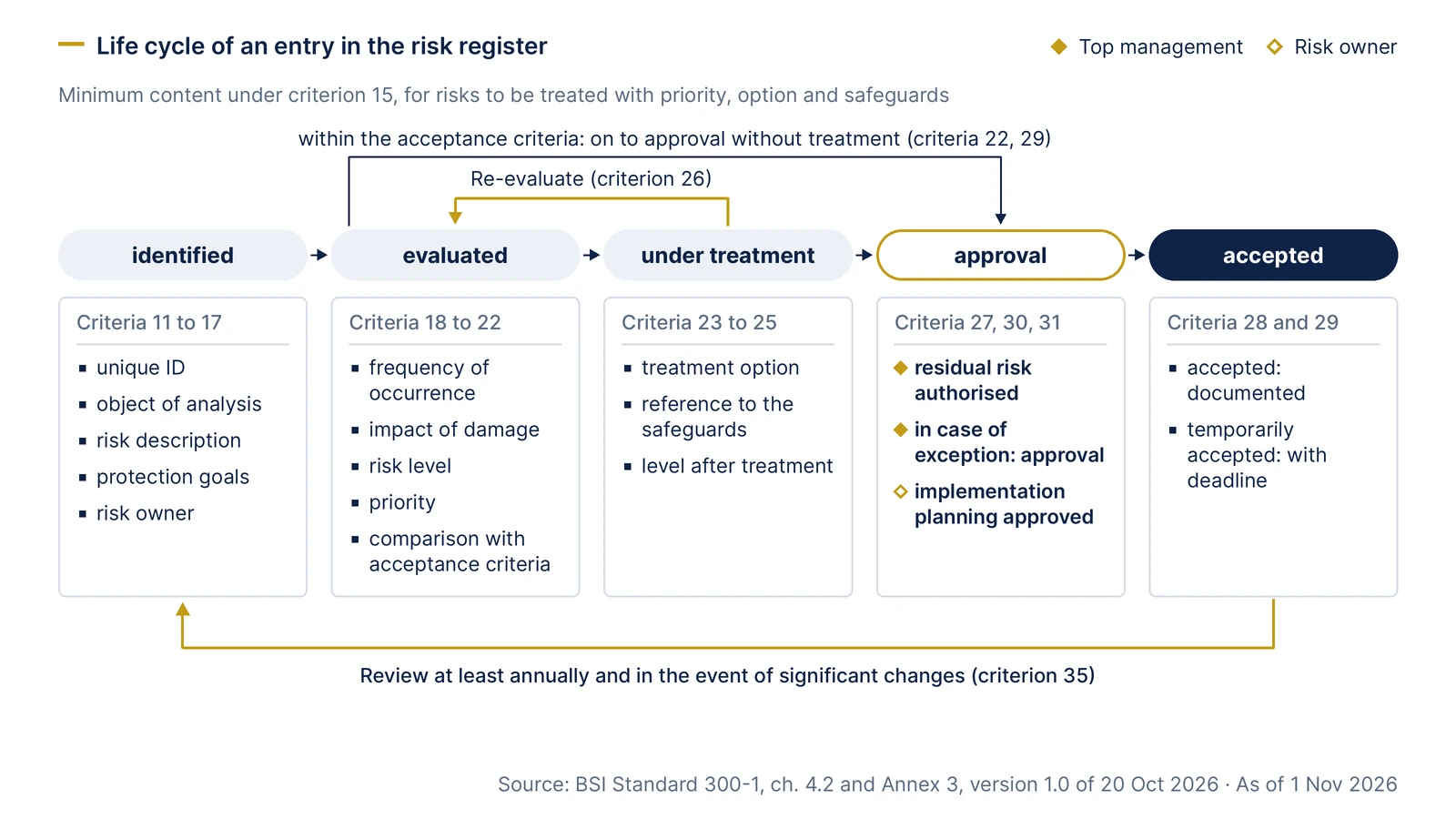
300-1 mentions the risk register in two places. Under risk identification it states that the identified risks „werden einem Risikoeigentümer zugewiesen und im Risikoregister dokumentiert“ (our translation: "are assigned to a risk owner and documented in the risk register") (ch. 4.2.1). Minimum criterion 15 sets out the minimum content and adds: „Das Risikoregister wird im weiteren Verlauf um die Angaben aus Risikobewertung und Risikobehandlung ergänzt.“ (our translation: "As the process continues, the risk register is supplemented with the information from risk evaluation and risk treatment.") Further criteria from Annex 3 determine what has to be recorded for a risk. In summary:
| Item | Obligation | Reference in 300-1 |
|---|---|---|
| Unique ID | minimum content | Criterion 15 |
| Object of analysis (business process, critical asset) | minimum content; to be documented for each risk assessment | Criteria 11, 13, 15 |
| Risk description | minimum content | Criterion 15 |
| Protection goals affected, at least confidentiality, integrity, availability | minimum content | Criteria 14, 15 |
| Risk owner; unless otherwise specified, the business process owner | minimum content | Criteria 15, 16; ch. 4.2.1 |
| Frequency of occurrence for a defined period and impact of damage, with justification | from the evaluation | Criteria 18, 19 |
| Risk level | minimum content | Criteria 15, 20 |
| Comparison with the risk acceptance criteria | for every risk | Criterion 22 |
| Priority | minimum content for risks to be treated | Criteria 15, 21 |
| Risk treatment option: reduction, avoidance, transfer or acceptance | minimum content for risks to be treated | Criteria 15, 23 |
| Reference to the assigned safeguards, traceable | minimum content for risks to be treated | Criteria 15, 25 |
| Time limit for temporary acceptance | mandatory for temporarily accepted risks | Criterion 28 |
| Documentation of accepted risks | mandatory | Criterion 29 |
| Authorisation of the residual risks by top management, for exceptions under criterion 27 | mandatory; the register is an obvious place for the reference | Criteria 27, 30 |
| Approval of the implementation planning by the risk owner | mandatory; in the register as a reference | Criterion 31 |
| Date of the last and next review | review at least annually and in the event of significant changes; the date field is our recommendation | Criterion 35 |
The user catalogue (Anwenderkatalog) adds the role: „Risikomanagement MUSS die Rolle des Risikoeigentümers mit den notwendigen Aufgaben und Befugnissen verankern.“ (our translation: "Risk management MUST establish the role of the risk owner with the necessary tasks and authorities.") (RISK.1.3). According to the guidance, the risk owner is responsible for the treatment and has the authority to decide on risk treatment. 300-1 does not specify who maintains the register technically; settle this in your risk policy, for example with the information security officer (ISB). Each risk owner is accountable for their entries.
Work product 1: risk register template
The template arranges the columns in the order in which they are filled in during the process. Columns mandatory under 300-1 are marked (M), the others are our recommendation so that the register supports decisions without follow-up questions.
| Column | Content and permitted values | Filled in during |
|---|---|---|
| ID (M) | permanently unique, never reused, for example R-[process]-[sequential number] | identification |
| Trigger | high protection requirements / asset not adequately covered / SOLLTE (SHOULD) requirement permanently not fulfilled / residual risk of a planned SOLLTE requirement (ch. 2.11) | identification |
| Object of analysis (M) | business process with identifier, where applicable critical asset | identification |
| Risk description (M) | cause, event, consequence in one sentence | identification |
| Elementary threats | G 0.1 to G 0.47; for SOLLTE requirements permanently not fulfilled, those assigned in the catalogue (criterion 17) | identification |
| Related requirement | identifier of the catalogue requirement or own requirement, if the trigger is a requirement | identification |
| Protection goals (M) | C, I, A, other goals where applicable | identification |
| Risk owner (M) | role and person | identification |
| Existing safeguards | implemented and planned safeguards with status (criterion 12) | identification and evaluation |
| Frequency of occurrence with justification | level on your scale, reference period | evaluation |
| Impact of damage with justification | level on your scale | evaluation |
| Risk level (M) | from frequency and impact according to your matrix | evaluation |
| Comparison with acceptance criteria | acceptable / acceptable for a limited period / not acceptable | evaluation |
| Priority (M if treated) | ranking | evaluation |
| Treatment option (M if treated) | reduction / avoidance / transfer / acceptance | treatment |
| Safeguards (M if treated) | identifiers of the safeguards in the implementation plan | treatment |
| Risk level after treatment | expected level after implementation of the safeguards | re-evaluation (criterion 26) |
| Decision | reference to the decision record: approval of residual risk, temporary acceptance with deadline, exception approval; date, decision-maker | approval |
| Approval of implementation planning | date, risk owner | approval |
| Status | identified / evaluated / under treatment / temporarily accepted / accepted / closed | ongoing |
| Last and next review | date; no later than twelve months after the last one, earlier in the event of a significant change | ongoing |
| Change history | date, person, what changed | ongoing |
300-1 leaves open whether you keep the register as a spreadsheet, in an ISMS tool or in a ticketing system. What matters is that the mapping between risks and safeguards remains traceable in both directions (criterion 25): the register refers to the safeguards, the implementation plan to the risks.
Work product 2: completed risk register (fictitious)
Fictitious example. A grant-making foundation accepts grant applications through an online portal, reviews them in its case management system and pays out approved funds (business process GP-03). For GP-03, integrity is "high": manipulated approvals could trigger incorrect payments on a scale that would be considerable for the foundation and cause lasting damage to its reputation. This matches the definition of "high" and one of the scenarios that 300-1 offers as guidance (ch. 2.6). Confidentiality and availability are "normal". The Executive Board authorised the scales, matrix and acceptance criteria in advance. They correspond to the case on the risk analysis page: "low" is accepted, "medium" is acceptable for a limited period of at most twelve months, "high" and "very high" must be treated. Requirements from the user catalogue are real, everything else is invented.
| Column | R-03-01 | R-03-02 | R-03-03 | R-03-04 |
|---|---|---|---|---|
| Trigger | high protection requirements (integrity) | SOLLTE requirement permanently not fulfilled | asset not adequately covered | high protection requirements (integrity) |
| Object of analysis | GP-03 | GP-03, asset grants case management system | GP-03, asset proposal module for grant amounts | GP-03, asset online portal |
| Risk description | Approvals are manipulated via a misused caseworker account because one person alone can approve and release the payment; consequence: incorrect payments | Passwords of accounts in the case management system are found by repeated guessing because the legacy module cannot lock accounts after failed attempts | Rules of the in-house proposal module are changed unnoticed, grant amounts turn out systematically too high | Office documents uploaded with applications contain malicious code that runs when opened in the grants department |
| Elementary threats | G 0.32 Misuse of authorisation, G 0.22 Manipulation of information | according to the catalogue for BER.3.11: G 0.36 Identity theft, G 0.30 Unauthorised use or administration of devices and systems, G 0.32 | G 0.22, G 0.46 Loss of integrity of sensitive information | G 0.39 Malware |
| Related requirement | none | BER.3.11 „Anmeldeversuchsgrenze an der Anwendung“ (login attempt limit on the application) (SOLLTE): „Berechtigung für Anwendungen SOLLTE weitere Anmeldeversuche nach Erreichen von [einem maximalen Schwellwert an] fehlgeschlagenen Versuchen vorübergehend blockieren.“ (our translation: "Authorisation for applications SHOULD temporarily block further login attempts once [a maximum threshold of] failed attempts has been reached.") | none; gap from the modelling | none |
| Protection goals | integrity | integrity, confidentiality | integrity | integrity, availability |
| Risk owner | Head of Grants (process owner) | Head of Grants | Head of Grants | Head of Grants |
| Existing safeguards | role concept in the case management system, logging of approvals (evaluated only when there is cause) | password rules, login only from the internal network | no approval of rule changes | virus scanner on the portal |
| Frequency, justification | medium: twelve people with full rights, no check before payment | rare: internal access only, personal accounts | medium: rules are maintained by the specialist unit without the four-eyes principle | frequent: upload open to all applicants |
| Impact, justification | considerable: incorrect payments, recovery claims, reputational damage | considerable: access to approval functions | considerable: many grant notices affected before it is noticed | limited: workstations isolated, recovery within one day |
| Risk level | high | medium | high | medium |
| Comparison | not acceptable | acceptable for a limited period | not acceptable | acceptable for a limited period |
| Priority | 1 | 3 | 2 | 4 |
| Treatment option | reduction | reduction | reduction | reduction |
| Safeguards | M-03-01 four-eyes approval above a threshold amount; M-03-02 monthly evaluation of the approval logs | M-03-05 monitoring of failed logins with an alert to IT operations and account lockout by operations | M-03-03 own requirement EIG-03-01: rule changes only after approval by a second person; M-03-04 checksum over the rule file, daily comparison | M-03-06 portal accepts PDF only, Office formats are rejected |
| Level after treatment | medium | low | low | low |
| Decision | residual risk "medium" accepted for a limited period until 15 Dec 2027, record E-2026-07, Executive Board on 15 Dec 2026 | residual risk "low" accepted, record E-2026-08, Executive Board on 15 Dec 2026 | residual risk "low" accepted, record E-2026-09, Executive Board on 15 Dec 2026 | residual risk "low" accepted, record E-2026-10, Executive Board on 15 Dec 2026 |
| Approval of implementation planning | Head of Grants, 14 Dec 2026 | Head of Grants, 14 Dec 2026 | Head of Grants, 14 Dec 2026 | Head of Grants, 14 Dec 2026 |
| Status | under treatment | under treatment | under treatment | under treatment |
| Next review | no later than 15 Dec 2027 | no later than 15 Dec 2027, also when the legacy module is replaced | no later than 15 Dec 2027 | no later than 15 Dec 2027 |
The fifth entry concerns a SOLLTE requirement whose fulfilment is already planned. For this case, 300-1 requires a residual risk assessment approved by top management (ch. 2.11) and that the risk not yet mitigated is reported to top management (ch. 4.1.1). The catalogue expresses this as UMS.1.2: „Umsetzung SOLLTE das bestehende Restrisiko durch die nicht umgesetzten Anforderungen festlegen.“ (our translation: "Implementation SHOULD determine the existing residual risk resulting from the requirements not implemented.") According to the guidance, these risks can be consolidated to make them easier for top management to follow. A separate, brief entry is sufficient for this:
| Column | R-03-05 |
|---|---|
| Trigger | residual risk of a planned SOLLTE requirement not yet fulfilled |
| Related requirement | DET.3.1 „Protokollierung sicherheitsrelevanter Ereignisse“ (logging of security-relevant events) (SOLLTE), parameter [eine bestimmte Frist] (a specific period) set to twelve months; threats according to the catalogue G 0.37, G 0.32, G 0.29 |
| Risk description | Until central logging is introduced, logins to the portal can only be traced back seven days; misuse that is noticed later can no longer be investigated |
| Protection goals, owner | integrity; Head of Grants |
| Risk level | medium, limited until implementation |
| Safeguard and deadline | M-03-07 central logging, completion 31 Mar 2027 |
| Decision | residual risk approved until 31 Mar 2027, record E-2026-11, Executive Board on 15 Dec 2026 |
| Status | temporarily accepted; close as soon as DET.3.1 is fulfilled |
300-1 is not consistent on whether SOLLTE requirements that are temporarily not fulfilled require a residual risk assessment: ch. 2.11 requires one, ch. 4.1.2 states that temporary non-fulfilment does not trigger a risk assessment. We treat this as an open question of interpretation and keep the entry because it takes little effort and top management has to be informed in any case (ch. 4.1.1). The risk acceptance and residual risk page shows what the corresponding decision records look like.
Maintaining the register
- Review. The risk assessment must be reviewed at least annually and in the event of planned or actual significant changes (criterion 35). In the example, this would be the replacement of the legacy module for R-03-02 or a new payment service provider.
- New findings. Under ch. 5.4, procedures must be established that take vulnerabilities and newly emerging threats into account in the risk assessment. Specify who turns them into a new entry or a re-evaluation.
- Link to the implementation plan. In the guidance on RISK.1.10, the catalogue lists, among other things, the requirement description, responsible unit, deadlines, priorities, status, risks with justification, and the date of approval and signature of the risk owner as contents of an implementation plan. What it contains must match the register.
- Reporting to top management. The status of risk treatment is one of the items of the management review (ch. 5.3). An extract from the register with level, option, status and open deadlines is a sufficient basis. The management review and indicators page shows how to present the status to top management.
- Delete nothing. Closed risks remain in the register with date and reason. For safeguards, 300-1 recommends a history (ch. 4.3), and the same logic helps with the register.
Checklist before an audit
| Check question | Basis |
|---|---|
| Does every risk have an ID, an object of analysis, a description, protection goals, a level and an owner? | Criterion 15 |
| Does every risk to be treated have a priority, an option and a reference to safeguards, and does the implementation plan lead back to the risk? | Criteria 15, 25 |
| For every risk outside the acceptance criteria, are there either safeguards and a re-evaluation or an exception approval by top management? | Criteria 26, 27 |
| Does every temporary acceptance have a deadline, and has none of the deadlines expired? | Criterion 28 |
| Is every residual risk authorised by top management, with date and reference? | Criterion 30 |
| Is there an entry with the threats from the catalogue for every SOLLTE requirement permanently not fulfilled? | Criteria 17, 34 |
| Is the last review less than twelve months old? | Criterion 35 |
| Is no MUSS (MUST) requirement listed as "accepted" in the register? | Ch. 4.1.2 |
Risk register under 200-3 and under 300-1
BSI Standard 200-3 does not require a register but mentions one: to document the monitoring of risks and the adjustment of safeguards, it is „in der Praxis üblich, hierfür Risikoregister oder Risikoverzeichnisse anzulegen“ (our translation: "common practice to set up risk registers or risk inventories for this purpose") (ch. 6.2). 200-3 records the results of the analysis in a threat overview per target object, with risk category and the treatment option chosen.
Anyone adopting such an inventory adds three things. First, the risk owner for each risk as a mandatory field. In its preparatory work, 200-3 only asks whether risks are assigned to the risk owners (ch. 2). Second, the object of analysis: 200-3 starts from target objects and allows business processes (ch. 2), while 300-1 treats the business process as the normal case and critical assets as a supplement (criterion 13). Third, the references to the authorisation of residual risks and the approval of implementation planning, which 300-1 lists as separate criteria.
You can check whether your procedure meets all 35 minimum criteria as a whole on the risk minimum criteria page. The risk analysis page shows how the entries are created, from trigger to treatment. If you want to convert an existing risk inventory to 300-1 or set up a new register, Blackfort Technology can support you, see consulting.
Rights notice: Short quotations from BSI Standard 300-1 „Methodik Grundschutz++“, version 1.0 of 20 October 2026, © Bundesamt für Sicherheit in der Informationstechnik 2026, source: BSI page on Grundschutz++ (German); from BSI Standard 200-3 „Risikoanalyse auf der Basis von IT-Grundschutz“, version 1.0, © Bundesamt für Sicherheit in der Informationstechnik 2017, source: BSI page on BSI Standard 200-3 (German). These quotations are not licensed under CC BY-SA 4.0. The licence notice at the end of the page applies only to the extracts from the catalogue data.