

What BER and PERS cover in the catalogue
Our own count in the Grundschutz++ user catalogue, build 2026-10-29, recursively across all nesting levels:
| Practice | Sub-practices | Requirements | MUSS / SOLLTE / KANN (MUST / SHOULD / MAY) | without target object category | with parameter |
|---|---|---|---|---|---|
| PERS Personnel | 6 (fundamentals; tasks, roles, responsibilities; staff intake; staff development; staff support; departure of employees) | 30 | 5 / 24 / 1 | 20 | 5 |
| BER Access rights | 7 (fundamentals, identity management, access accounts, access rights management, handling of authentication means, password use, key management) | 92 | 5 / 80 / 7 | 68 | 21 |
88 of the 122 requirements in the two practices have no target object category (Zielobjektkategorie). Under chapter 3.4.1 of BSI Standard 300-1, such requirements must be included in the requirements package regardless of modelling. With normal protection requirements, 83 of them apply at normal-SdT, while under chapter 3.4.2 the 5 KANN requirements at "elevated" (erhöht) are optional. For access rights and personnel, modelling therefore decides little; the work lies in the status and the evidence. The remaining requirements are attached to groups of people and to systems. Annex 1 defines users (Nutzende) as „Alle natürlichen Personen, welche regelmäßig die Assets im Informationsverbund für die Institution benutzen können, unabhängig davon ob sie aus Sicht der Institution intern oder extern sind.“ (our translation: "All natural persons who can regularly use the assets in the information domain for the institution, regardless of whether they are internal or external from the institution's point of view."). Employees are users employed by the institution, and administrators are employees with an administration assignment. This matters for leaving: PERS.6.1 and PERS.6.1.1 are attached to users and therefore also apply to external consultants.
The case: a payroll service provider (fictitious)
Lohnservice Mitte GmbH (LSM) is invented, as are all persons, figures and results; identifiers and requirements come from the catalogue. LSM processes wages and salaries for its clients, has 140 employees and around 30 external users from service providers. Identities and access accounts are managed by a central identity service (BER.3.1), to which the directory service, the payroll application and remote access are connected. The trigger for identities is the HR system.
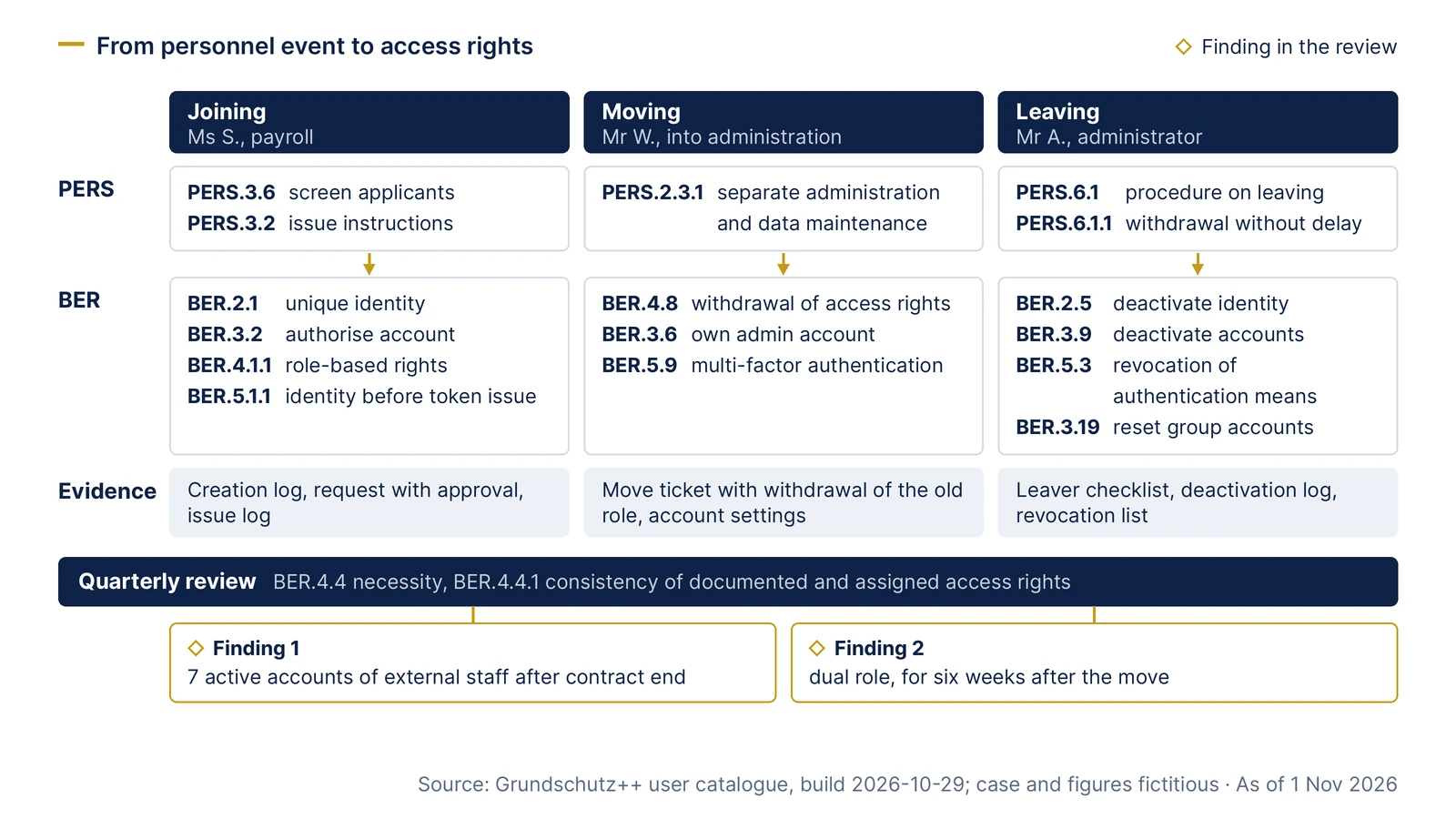
Three events run through the case: Ms S. starts as a clerk in payroll (joining). Mr W. moves from maintaining HR master data to administering the directory service (moving). Mr A., an administrator with access to the emergency access account of the directory service and to a group account on the control room console, leaves LSM (leaving). At the end of the quarter, LSM compares documented and actually assigned access rights.
First: set the parameters
Many requirements in BER and PERS leave the actual value open. Under chapter 3.5 of 300-1, the institution specifies these parameters when or after creating the requirements package. Without a set value no status can be assigned, because it remains open what is being checked against. LSM sets the following (fictitious):
| Requirement | Parameter in the catalogue | LSM setting |
|---|---|---|
| BER.3.2 authorise the creation of access accounts; BER.4.2 authorise the assignment of access rights | [certain persons or roles] | line manager; for administration rights also the head of IT |
| BER.4.4 review assigned access rights for necessity | [regularly] | quarterly; the catalogue guidance names quarterly, half-yearly or annually as possible values „je nach Kritikalität der Systeme und Sensibilität der Daten“ (our translation: "depending on the criticality of the systems and the sensitivity of the data") |
| BER.4.4.1 review documented and actually assigned access rights for consistency | [regularly] | quarterly, together with BER.4.4 |
| BER.2.3 check the master data of an identity against general master data | [regularly] | monthly against the HR system; for external users against the contract list of service provider management once it is connected (see finding 1) |
| BER.3.14 block the reuse of access accounts | [a certain period] | one year, permanently for administration accounts |
| PERS.4.2 carry out role-specific training and awareness on joining | [regularly] | on joining and annually |
| PERS.5.3 check trustworthiness | [defined security-critical roles], [regularly] | administrators of the directory service and the payroll application; every three years and when there is cause |
Joining, moving and leaving: requirements, audit questions, evidence
Fictitious example. Requirements from the Grundschutz++ user catalogue (build 2026-10-29), shortened to the infinitive, with modal verb and target object category in brackets ("none" = no target object category). Audit questions, evidence and roles are invented; the table is a selection along the three events.
| Event | Requirement | Audit question | Evidence in the case | Handover to |
|---|---|---|---|---|
| Joining | PERS.3.6 test the trustworthiness of applicants before appointment (SOLLTE, none); PERS.3.1 agree confidential treatment of trade and business secrets (SOLLTE, employees) | Have identity, proof of qualifications and CV been checked before the contract is signed? | Check note in the personnel file; confidentiality clause in the employment contract | HR system |
| Joining | BER.2.1 assign a unique identity to exactly one natural person or one IT system (SOLLTE, none); BER.3.5 assign an access account to exactly one identity (SOLLTE, none) | Is the identity created from the HR record and not by hand? | Creation log of the identity service with personnel number | Access rights administration |
| Joining | BER.3.2 authorise the creation of access accounts by [certain persons or roles]; BER.4.1.1 assign access rights based on roles; BER.4.3 document assignment with justification (all SOLLTE, none) | Has the line manager approved the role "Payroll clerk", and is the justification attached to the request? | Request in the ticket system with approval and justification | Access rights administration |
| Joining | BER.5.1 establish a procedure for the initial issue of authentication means; BER.5.1.1 authenticate the identity of the recipient before distribution (SOLLTE, none) | Was the ID card checked before the token was handed over? | Issue log with token number and check note | Ms S. |
| Joining | PERS.3.2 instruct new staff to comply with procedural instructions on joining; PERS.3.7 carry out induction (SOLLTE, employees); PERS.4.2 carry out role-specific training on joining and [regularly] (SOLLTE, users) | Has Ms S. explicitly received the instructions, even though they are on the intranet? | Signed acknowledgement, induction plan, attendance at the basic course according to the learning platform | Information security officer (ISB), as evidence for the training plan |
| Moving | PERS.2.3 establish separation of roles for incompatible tasks; PERS.2.3.1 separate administration of directory services from maintenance of the managed data (SOLLTE, none) | Does Mr W. keep rights after the move that let him maintain the data he will now administer? | Separation of roles matrix in the allocation of responsibilities; move ticket with withdrawal of the role "HR master data" | Access rights administration |
| Moving | BER.4.8 establish a procedure for withdrawing access rights (SOLLTE, none) | On a move, are rights withdrawn first and only then newly assigned? | Process description for moves; in the case, withdrawal only after six weeks (finding 2) | HR system |
| Moving | BER.3.6 establish separate administration accounts (SOLLTE, administrators); BER.5.9 activate multi-factor authentication for far-reaching access rights (SOLLTE, none) | Does Mr W. have his own administration account with MFA, and does he keep using his normal account for email? | Account settings from the identity service, export with date | ISB |
| Moving | PERS.4.2.1 carry out product-specific training on administrative tools (SOLLTE, administrators); PERS.5.3 check trustworthiness for [defined security-critical roles] [regularly] and when there is cause (SOLLTE, none) | Are training and trust check completed before the first administration task? | Training record; note on the check for cause in the personnel file | Head of IT |
| Leaving | PERS.6.1 establish a procedure for departure; PERS.6.1.1 on departure, establish the withdrawal without delay of all access rights in line with the rules of BER (SOLLTE, users) | Does the departure reach access rights administration on the last working day, for employees and for external users? | Leaver checklist with return of ID card, token and device | Access rights administration, facility management |
| Leaving | BER.2.5 deactivate identity on departure; BER.3.9 deactivate access accounts in an event-driven way; BER.5.3 establish a procedure for revoking authentication means (SOLLTE, none) | Are Mr A.'s identity, all accounts and all authentication means blocked, including certificates and active sessions? | Deactivation log with time; revocation list | ISB |
| Leaving | BER.3.19 change the credentials of group accounts on departure; BER.3.18 document the identities with access at the time of change (SOLLTE, none); BER.5.2 establish a procedure for resetting or replacing authentication means (SOLLTE, none) | Have the password of the control room console and the credentials of the emergency account (BER.3.23) been reset, and is it documented who knows them now? | Change log with date, list of authorised persons for both accounts | Control room, head of IT |
| Leaving | PERS.6.1.2 assign responsibilities that have become vacant (SOLLTE, employees) | Does every task of Mr A. have a new responsible person, without breaking a separation of roles? | Updated allocation of responsibilities | Head of IT |
| After the retention period | BER.2.6 delete identities no longer needed and BER.3.15 access accounts after the retention periods have expired; BER.3.14 block reuse for [a certain period] (SOLLTE, none) | Is the deletion date recorded, and is it impossible to reassign the account name until then? | Deletion date in the identity service; technical block against reassignment | Access rights administration |
On deletion, the guidance on BER.2.5 is worth a look: the requirement is also fulfilled by deleting the identity, „Empfehlenswert ist die Löschung jedoch erst nach Ablauf längerer Löschfristen, um die Nachvollziehbarkeit von Aktionen im Audit Log zu erhalten.“ (our translation: "However, deletion is only advisable after longer retention periods have expired, in order to preserve the traceability of actions in the audit log."). Deactivating on the last working day and deleting after the retention period are therefore two separate steps with two pieces of evidence.
The review at the end of the quarter: where the process breaks
BER.4.4.1 requires documented and actually assigned access rights to be reviewed regularly for consistency, and BER.1.4 an inventory of access rights with persons, identities, access accounts, access rights and their allocation. Only the review shows whether the events above take effect. LSM review log, fictitious figures:
| Check point | Result | Assessment | Consequence |
|---|---|---|---|
| Active accounts in the identity service against the inventory | 1,212 active accounts, 1,203 in the inventory with allocation | 9 accounts without a responsible identity in the inventory | Clarification per account, result in rows 2 and 3 |
| Accounts of users who have left | 7 active accounts of external users whose contract has ended; 0 of employees | BER.2.5 and PERS.6.1.1 not fulfilled for external users | Finding 1 |
| Technical accounts | 2 accounts are used by services and were never registered | BER.1.4 incomplete; BER.2.1 not implemented for IT systems | Added to the inventory as service accounts with a responsible person |
| Separation of roles | Mr W. held both roles for six weeks after the move | PERS.2.3.1 and BER.4.8 breached in this instance; role since withdrawn | Finding 2 |
| Necessity | Managers confirmed 96% of the access rights in their areas and withdrew 41 | BER.4.4 fulfilled | Result goes into the management report |
Finding 1: external users slip through. The HR system only knows employees. The departure of external users comes from the end of the contract with the service provider, and there is no trigger for it. LSM sets BER.2.5 and PERS.6.1.1 to "not fulfilled" and classifies the non-fulfilment as temporary: by the next quarter, the contract list of service provider management will be connected to the identity service as a second source. This is consistent with DLS.4.1.2, under which the access rights needed for a contract are to be deactivated without delay at the end of the contract; the procurement side is covered in Procurement and service providers. The seven accounts are blocked immediately; whether they were used for access after the end of the contract is established by an analysis of the login logs (see Detection and incident handling).
For temporary non-fulfilment, 300-1 contains two passages that do not readily match: under chapter 4.1.2 it does not trigger a risk assessment, whereas under chapter 2.11 a residual risk assessment is to be carried out for SOLLTE requirements included in the implementation planning and the risk is to be approved by top management; chapter 4.1.1 requires the risk to be identified and reported to management. This is an open question of interpretation. LSM describes the residual risk, reports it and has it approved for a limited period.
Finding 2: move without withdrawal. Mr W.'s move ran as two tickets, new assignment and withdrawal, and the second was left pending. The procedure under BER.4.8 exists but does not work reliably for moves. LSM sets BER.4.8 and PERS.2.3.1 to "not fulfilled" and classifies the non-fulfilment as temporary. LSM changes the procedure so that a move is a single process that withdraws the old role before the new one is approved. Whether master data was changed through the dual role is shown by the log of master data changes under BER.2.4. The deadline for the change is in the implementation plan.
A MUSS finding would have to be handled differently: if, for example, the procedures and rules for identity and access rights management were missing (BER.1.1, MUSS), LSM would have to define them; under chapter 4.1.2 a risk assessment does not replace a MUSS requirement, and risk acceptance is not possible.
Handovers that must be defined in the process
- HR system → identity service: joining, moving and leaving as an event with a date. Without this handover there is no event for BER.3.9 (event-driven deactivation).
- Service provider management → identity service: start and end of contract for external users. In the case, exactly this handover was missing.
- Line manager → access rights administration: approval and justification of every role (BER.3.2, BER.4.2, BER.4.3) and confirmation in the quarterly review (BER.4.4).
- Access rights administration → ISB: the export of the access rights actually assigned. In the case, the ISB carries out the review under BER.4.4.1; access rights administration assigns the rights and so does not check itself. The log is the evidence for BER.4.4 and BER.4.4.1. The separation can be derived from PERS.2.3.3, which requires separation of roles between implementing security requirements and reviewing them; chapter 4.5 of 300-1 contains the same idea for tracking progress on the implementation plan.
- Leaving → detection: blocked accounts remain under monitoring. A login to a deactivated account is an event that must be assessed.
How to organise the evidence with date and reviewer under chapter 4.3 is shown in the evidence plan. An export of the account settings from the identity service is automated evidence; what needs to be recorded for it is described in Automated evidence.
Audit questions on access rights management
- Are all parameters in BER and PERS set, in particular the authorising roles (BER.3.2, BER.4.2) and the intervals (BER.2.3, BER.4.4, BER.4.4.1)?
- Is every identity created from a source that also knows about departures, for employees and for external users?
- Is exactly one identity allocated to each access account, and are technical accounts in the inventory with a responsible person (BER.3.5, BER.1.4)?
- Are access rights assigned via roles, with approval and justification (BER.4.1.1, BER.4.2, BER.4.3)?
- Does a move withdraw the old role before the new one applies, and has the separation of roles been checked (BER.4.8, PERS.2.3)?
- Do administrators have separate administration accounts with MFA (BER.3.6, BER.5.9)?
- On departure, are group accounts, emergency access and authentication means dealt with as well (BER.3.19, BER.3.18, BER.5.3)?
- Are deactivation and deletion separate steps with their own dates (BER.2.5, BER.2.6, BER.3.15)?
- Does the regular review show that all of this works, and who carries it out (BER.4.4.1, PERS.2.3.3)?
Blackfort Technology supports you with package C of implementation under Grundschutz++: status determination per requirement, including BER and PERS, setting the parameters with you, and an evidence plan that links personnel events, identity service and review.
Context
- You assign status and deviations as described under Assessing requirements, documenting deviations. Under chapter 4.1.1, "not applicable" is only permitted if the component does not exist in the information domain or the requirement cannot be fulfilled functionally. If there are no group accounts, the guidance on BER.3.18 calls the requirement dispensable; in the status this can be assigned to the first reason, with justification.
- If a SOLLTE requirement remains permanently unfulfilled, for example because a legacy system does not support separate administration accounts, a risk assessment follows; see Risk analysis.
- How access rights on systems are technically restricted belongs to the practice KONF; the comparison of target and actual state is shown in Configuration and assets.
- How to plan the instructions under PERS.4.2 and check their effect is shown in Awareness.
- Employment law questions, for example on the scope of a trustworthiness check under PERS.3.6 or PERS.5.3, should be clarified with your legal department and the staff representatives.