

What KONF and ASST cover in the catalogue
Our own count in the Grundschutz++ user catalogue, build 2026-10-29, recursively across all nesting levels:
| Practice | Sub-practices | Requirements | MUSS / SOLLTE / KANN (MUST / SHOULD / MAY) | without target object category | Target object categories with the most requirements |
|---|---|---|---|---|---|
| KONF Configuration | 15 | 157 | 5 / 110 / 42 | 8 | IT systems 55, applications 26, web browsers 13, e-mail 12, mobile devices 8 |
| ASST Information and assets | 7 (fundamentals, inventory, rules for use, rules for transfer, maintenance, return of assets, erasure and destruction) | 58 | 5 / 37 / 16 | 17 | data 20, IT systems 10, information 3 |
Four KONF requirements are assigned to two categories and are counted under both here.
The two practices behave in opposite ways. KONF depends almost entirely on target object categories (Zielobjektkategorien): only 8 of the 157 requirements apply without an assignment, the rest enter the package only through modelling (chapters 3.4.1 and 3.4.2 of BSI Standard 300-1). Which configuration requirements you have to fulfil is therefore decided by which assets you have modelled as IT systems, applications, web browsers or e-mail. And 146 of the 157 KONF requirements have the value „Konfigurationshistorie“ (our translation: "configuration history") in the field documentation. The evidence for KONF is thus almost always the same: the versioned baseline configuration and the results of the checks against it.
The case: a technical state authority (fictitious)
The Technische Prüfstelle Nordtal (TPN) is invented, as are all figures and results; identifiers and requirements come from the catalogue. The TPN operates 380 notebooks, 64 servers (52 of them virtual), three measurement data gateways as appliances and 41 specialist applications. In the modelling, the notebooks are assigned as a group to the target object categories mobile devices and IT systems, the servers to host systems and IT systems; chapter 3.2 of 300-1 allows assets with similar properties and the same purpose to be grouped.
Configuration is done through a central configuration management tool for notebooks and Windows servers and through version control with scripts for the Linux servers. The inventory of IT systems is held in a CMDB, the inventory of applications in a software list. Both had been maintained so far, but never checked against each other or against the network.
Step 1: define and version the target configuration
KONF.2.1 (SOLLTE, IT systems) and KONF.10.1 (SOLLTE, applications) each require a documented baseline configuration. According to the catalogue guidance on KONF.2.1, this is a documented initial state that „als verbindlicher Referenzpunkt für den Betrieb und die Härtung dient“ (our translation: "serves as a binding reference point for operation and hardening"). KONF.2.1.1 and KONF.10.1.1 (SOLLTE) require previous configurations to be versioned. The TPN defines (fictitious):
| System group | Baseline configuration | Contents (selection, with requirement) | Storage and version |
|---|---|---|---|
| Notebooks | GK-NB, version 3.2 | Storage encryption (KONF.3.2), local firewall (KONF.7.15), execution of authorised applications only (KONF.7.10), no functions that are not needed (KONF.2.4) | Policy export from configuration management, versioned |
| Windows servers | GK-WS, version 2.0 | Default credentials changed (KONF.2.3), legacy protocols and services not needed deactivated (KONF.2.4) | Policy export, versioned |
| Linux servers | GK-LS, version 1.4 | as GK-WS, plus configuration secrets encrypted only (KONF.1.5) | Version control repository, every change as a commit |
| Measurement data gateways | GK-MG, version 1.0 | Manufacturer recommendation for secure operation (supplied at procurement under BES.7.4.3), reconciled with KONF.2.3 and KONF.2.4 | Configuration export as a file with checksum |
| Specialist applications | one GK-A per application, 41 in total | User rights, logging, activated interfaces (KONF.10.1, KONF.10.4) | Application documentation, versioned |
Three requirements without a target object category belong here as well: KONF.1.3 requires the configuration tools to be documented with purpose and origin, KONF.1.4 requires access to documented configurations to be restricted and KONF.1.5 requires configuration secrets to be encrypted. In concrete terms for the TPN: both tools are listed with purpose and source in the IT operations concept, the repository can only be read by the administrators of the Linux servers, and passwords in scripts are replaced by references to a vault.
Step 2: maintain the inventory
Without an inventory, the comparison has gaps: a system that is not in the inventory is not checked against its baseline configuration by anyone. ASST provides the requirements for this (all SOLLTE):
- ASST.2.2 (without target object category): inventory of IT systems including identifier and last known location. For this, the TPN keeps inventory number, DNS name, site or virtualisation host and the responsible person for each system in the CMDB.
- ASST.2.3 (without target object category): inventory of applications including product name, version, origin and licensing. ASST.2.3.1 (IT systems): authorise the use of applications on IT systems by [a responsible person or role]. The TPN sets the parameter to the head of IT operations.
- ASST.2.3.2 (applications): document the software bill of materials (SBOM). For the 41 specialist applications, 12 SBOMs exist so far, all from procurements in the last two years.
- ASST.2.2.1 (networks): establish the detection of unauthorised IT systems. The guidance names active network scans and passive analysis of network traffic as means, and as treatment that systems found are „aus dem Netz entfernt, in eine Quarantäne verschoben oder nach Überprüfung autorisiert werden“ (our translation: "removed from the network, moved to quarantine or authorised after review").
This inventory is not the same as the inventory of the structure analysis. The structure analysis records assets and dependencies so that a requirements package can be built. ASST.2.2 requires an inventory as an ongoing operational record. In practice it makes sense to feed both from the same source. How inventory data gets into the structure survey is shown on the page structure analysis.
Step 3: comparing target, inventory and actual state
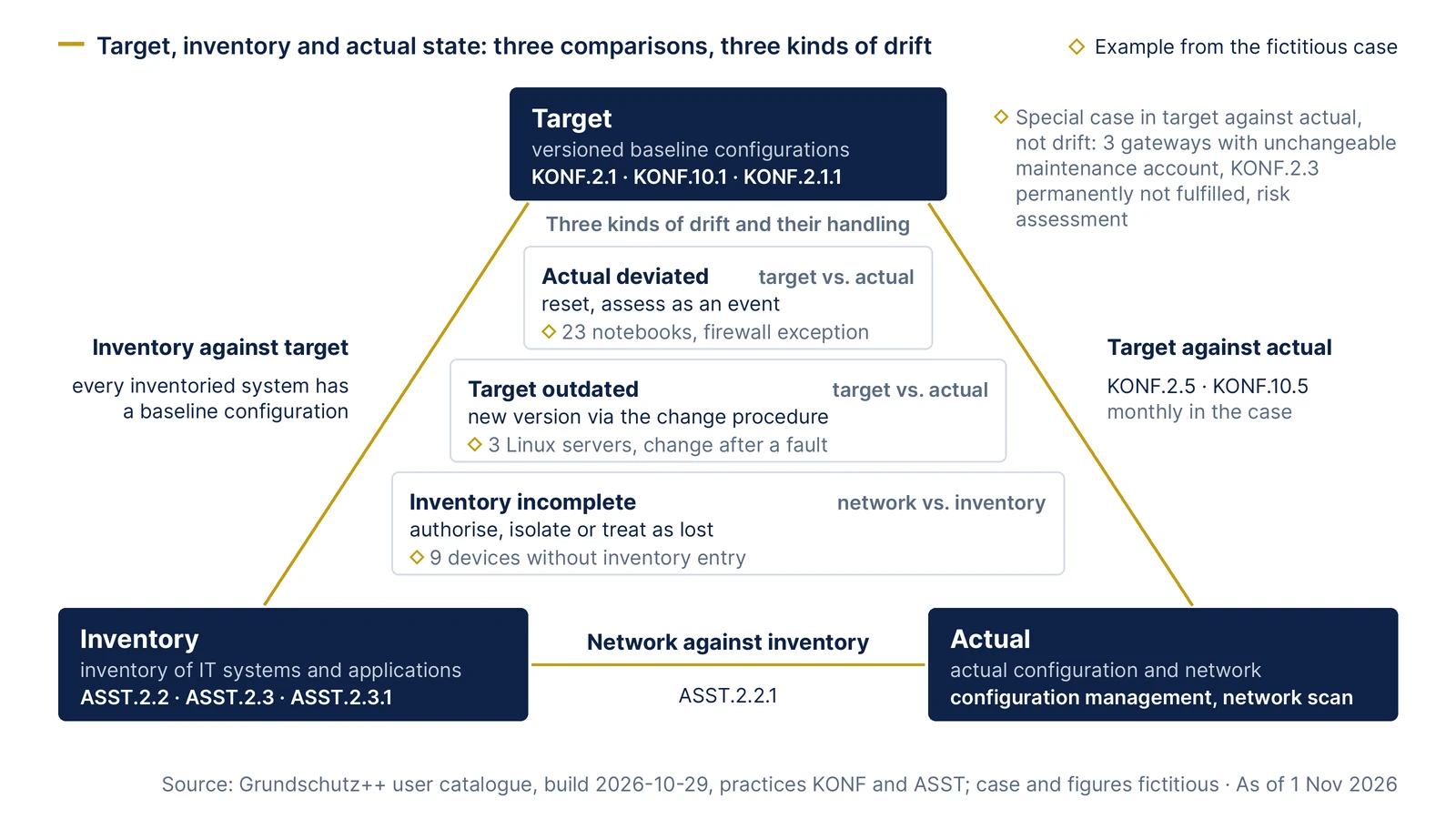
KONF.2.5 (SOLLTE, IT systems) and KONF.10.5 (SOLLTE, applications) require a check [regularly] that the actual configuration matches the reference state; the TPN has set the parameter to monthly. The guidance names the purpose as avoiding configuration drift, that is „dass Systeme schleichend von der definierten Soll-Konfiguration abweichen“ (our translation: "that systems gradually deviate from the defined target configuration"). Automatic checking by [an automated mechanism] is a KANN requirement with security level elevated (erhöht) under KONF.2.5.1. The TPN uses its configuration management tool for this anyway, because it is already in place.
The TPN's reconciliation log for one month, fictitious figures:
| Check | Target source | Actual source | Result | Classification | Consequence |
|---|---|---|---|---|---|
| Network against inventory | CMDB | Network scan and DHCP log | 9 devices on the network without a CMDB entry: 4 leased printers, 3 test VMs, 2 unknown | Inventory incomplete; 2 devices unauthorised | Printers and test VMs authorised after review and entered; the 2 unknown devices quarantined and reported as an event to detection |
| Inventory against network | CMDB | Configuration management, last check-in | 14 notebooks without a check-in for more than 60 days | Last known location (ASST.2.2) unclear | Query to the responsible persons; 11 in storage, 3 not found and handled under the procedure for lost assets (ASST.6.1) |
| Notebooks against GK-NB 3.2 | GK-NB 3.2 | Configuration management | 343 compliant, 23 with their own firewall exception, 14 without a recent check-in (see row inventory against network) | Actual has deviated without authorisation | Exceptions reset; cause: local administration rights in a project group, handed over to access rights management |
| Servers against GK-WS 2.0 and GK-LS 1.4 | GK-WS, GK-LS | Configuration management, script run | 59 compliant; 2 Windows servers with a legacy protocol enabled; 3 Linux servers with a change made directly on the system after a fault | Legacy protocol: actual has deviated. Linux: change was authorised, the target is out of date | Legacy protocol deactivated, deadline 30 days because of a dependent specialist application; Linux: change adopted into GK-LS 1.5 via the change procedure (ASST.5.4) |
| Measurement data gateways against GK-MG 1.0 | GK-MG | Configuration export | all 3 with a manufacturer maintenance account whose credentials cannot be changed | KONF.2.3 permanently impossible to fulfil for this group | Risk assessment, see below |
| Specialist applications against GK-A | 41 GK-A | Configuration exports of the applications | 38 compliant, 3 with an additional interface enabled | Actual has deviated without authorisation | Interfaces deactivated, cause clarified with the specialist procedure owner |
| Applications against software list | Software list with authorisation | Software inventory from configuration management | 3 unauthorised applications on 17 notebooks | Execution of unauthorised applications not fully restricted (KONF.7.10) | Uninstalled; execution rule tightened in GK-NB 3.3 |
The log shows three kinds of drift, which are handled differently. Actual has deviated: reset and clarify the cause, and where authorisation was missing, also assess it as a security-relevant event. Target is out of date: the change was authorised, but the baseline configuration was not updated. In that case a new version of the baseline configuration is created via the change procedure of the practice TEST (changes and tests). Inventory is incomplete: a system is missing from the inventory or can no longer be found. In that case it is authorised and entered after review, isolated or treated as lost.
Step 4: from the comparison to the status of the requirements
The comparison itself is a safeguard for KONF.2.5 and KONF.10.5. In our reading, these two requirements are fulfilled if the comparison takes place at the defined interval and is logged, even if it finds deviations. The deviations show up in the status of the requirements whose content deviates. Under chapter 4.1.1 of 300-1 the status is assigned per requirement; in its justification the TPN states which systems are affected. Status decisions in the case (fictitious):
| Requirement | Status | Justification and consequence |
|---|---|---|
| KONF.2.5 and KONF.10.5 check [regularly] that the configuration matches the reference state (SOLLTE) | fulfilled | Monthly comparison with a log for IT systems and specialist applications; evidence under chapter 4.3 with tool, time of check and result |
| KONF.2.4 deactivate system functions that are not needed (SOLLTE, IT systems) | not fulfilled, temporary | 2 Windows servers with a legacy protocol, deadline 30 days in the implementation plan |
| KONF.2.3 change default credentials (SOLLTE, IT systems) | not fulfilled, permanent | 3 measurement data gateways, maintenance account cannot be changed on the manufacturer side; risk assessment |
| ASST.2.2 inventory of IT systems with identifier and last location (SOLLTE) | not fulfilled, temporary | 7 devices added after review, 2 unknown devices isolated, 3 notebooks not found; repeat comparison in the following month |
| ASST.2.2.1 establish detection of unauthorised IT systems (SOLLTE, networks) | fulfilled | Network scan and evaluation of the DHCP log in the monthly comparison, treatment described |
| ASST.2.3.2 document SBOM (SOLLTE, applications) | not fulfilled, temporary | 12 of 41 SBOMs available; requirement included in future procurements via BES.7.4.4.1 (KANN) and as a subsequent request to the manufacturers |
The gateways. Under chapter 4.1.1, a requirement can count as „nicht anwendbar“ (our translation: "not applicable") „wenn die Anforderung funktional nicht erfüllt werden kann oder die zugrunde liegende Komponente nicht im Informationsverbund existiert“ (our translation: "if the requirement cannot be fulfilled functionally or the underlying component does not exist in the information domain"). One could argue that KONF.2.3 cannot be fulfilled functionally for the three gateways. But the status is assigned per requirement, and for all other IT systems KONF.2.3 can be fulfilled and is fulfilled. 300-1 does not expressly address the case of a requirement that cannot be fulfilled functionally for only part of the assigned assets. The TPN chooses the cautious assessment: permanent non-fulfilment of a SOLLTE requirement, which under chapters 2.11 and 4.1.2 triggers a risk assessment. Treatment: the gateways sit in a network segment of their own, the maintenance account can only be reached via a jump server, and logins to the maintenance account are logged and trigger an alert. The residual risk goes to top management for approval (chapter 4.2.3). At the next procurement, the ability to change all credentials becomes a procurement criterion; what that looks like is shown on the page procurement and service providers.
Temporary non-fulfilment. For KONF.2.4, ASST.2.2 and ASST.2.3.2 the same open question of interpretation applies as everywhere in Grundschutz++: chapter 4.1.2 says that temporary non-fulfilment does not trigger a risk assessment. Chapter 2.11 requires a residual risk assessment and approval by top management for SOLLTE requirements in implementation planning, and chapter 4.1.1 requires the risk to be identified and communicated to management. The TPN briefly describes the residual risk per requirement, communicates it and has it approved until the deadline.
Step 5: decommissioning closes the loop
The inventory only stays accurate if disposal is regulated as well. ASST.6.4 (SOLLTE, IT systems) requires a returned system to be reset to a defined initial state, ASST.7.1 (SOLLTE, applications) the uninstallation of application instances no longer needed, ASST.7.3 (SOLLTE, data) erasure when the retention and erasure period is reached by [cryptographic erasure, overwriting or destruction of the storage medium], ASST.7.6 (SOLLTE) the authorisation of disposals by [a responsible person or role] and ASST.7.7 (SOLLTE) the removal of all labels that can be attributed to the institution.
At the TPN, each of these steps ends with an entry in the CMDB: status "decommissioned", date, erasure procedure, authorising person. Only then does the system drop out of the monthly comparison. If the entry is missing, it shows up in the next comparison as "inventory without check-in", and the search starts all over again. The TPN documents maintenance under ASST.5.7 with asset, reason, time, people involved, measures taken and result. Changes during maintenance go through the change procedure under ASST.5.4 and thus also into the baseline configuration.
Review questions on configuration and inventory
- Does every system group and every application in the inventory have a documented and versioned baseline configuration (KONF.2.1, KONF.2.1.1, KONF.10.1, KONF.10.1.1)?
- Does the baseline configuration state which requirement a setting belongs to, so that the comparison affects the status of the right requirement?
- Are configuration tools documented with purpose and origin, access to configurations restricted and configuration secrets encrypted (KONF.1.3 to KONF.1.5)?
- Does the inventory hold identifier and last known location, and the application inventory product name, version, origin and licence (ASST.2.2, ASST.2.3)?
- Is the parameter "regularly" in KONF.2.5 and KONF.10.5 defined, and is there a log for every interval?
- Is the check also run in the other direction, that is network against inventory (ASST.2.2.1)?
- Has it been decided for every deviation whether the actual state has deviated, the target is out of date or the inventory is incomplete?
- Do unauthorised deviations go to detection as an event, and authorised changes via the change procedure into a new version of the baseline configuration?
- Does decommissioning end with an inventory entry, so that systems taken out of service do not count as missing (ASST.6.4, ASST.7.6)?
Blackfort Technology supports you here with package C of implementation under Grundschutz++: status determination per requirement, including KONF and ASST, and an evidence plan that maps baseline configurations, inventory and the reports of your existing tools to the requirements.
Handovers and context
- To detection: unknown devices and unauthorised deviations. How such an event becomes an assessed incident is shown on the page detection and incident handling.
- To access rights management: local administration rights that make deviations possible in the first place; see access rights and personnel.
- To procurement: manufacturer configuration (BES.7.4.3), component description (BES.7.4.4) and SBOM (BES.7.4.4.1) as acceptance documents, so that baseline configuration and application inventory are correct from the start.
- To the evidence plan: a comparison from configuration management is automated evidence. Under chapter 4.3 it includes tool, time of check and result; what such evidence does not cover, for example systems without an agent, is described under automated evidence. The mapping to safeguard and requirement is shown in the evidence plan.
- To the change procedure: authorised changes that need a new version of the baseline configuration; the course of a change is shown on the page architecture, changes and development.
- Which KONF requirements enter the package at all is decided by the assignment of the assets; see modelling and target object categories.