

Three practices, one procedure: how ARCH, TEST and DEV fit together
In the user catalogue of 29 October 2026, the practice ARCH contains 63 requirements, TEST 36 and DEV 34, each counted recursively across all levels. For the requirements package, it matters more which target object categories (Zielobjektkategorien) they are assigned to. Under 300-1 chapter 3.4.1, requirements without a target object category belong in the requirements package without being assigned to assets. For TEST this applies to 35 of the 36 requirements; only TEST.2.2 (impact assessment) is addressed to the category Administrierende (administrators). Of the 35, 26 are at the security level "normal-SdT" (SdT = Stand der Technik, state of the art), with 5 MUSS (MUST) and 21 SOLLTE (SHOULD) requirements. 9 are KANN (MAY) requirements at "elevated (erhöht)" and optional under chapter 3.4.2. The change procedure therefore belongs in every requirements package, regardless of which assets an information domain has.
For DEV, 9 requirements have no target object category, among them the procedure, Security by Design, restricting write access to source code, approval and deployment. 25 requirements are addressed to the category Anwendungen (applications) and are added as soon as assets of this category are assigned. For ARCH, 7 requirements have no target object category, and the others relate mainly to networks and external network connections. 300-1 does not expressly say whether DEV can be dropped if an institution develops nothing itself. The guidance on DEV.1.1 in the catalogue says: „Entwickelt die Institution im Informationsverbund keine IT-Produkte, so sind diese und alle anderen Anforderungen der Praktik entbehrlich.“ (our translation: "If the institution does not develop any IT products in the information domain, this and all other requirements of the practice are dispensable.") In the requirements package, this is recorded for each requirement with the status "not applicable" and a justification (300-1 chapter 4.1.1). The reason is then that the underlying component does not exist in the information domain.
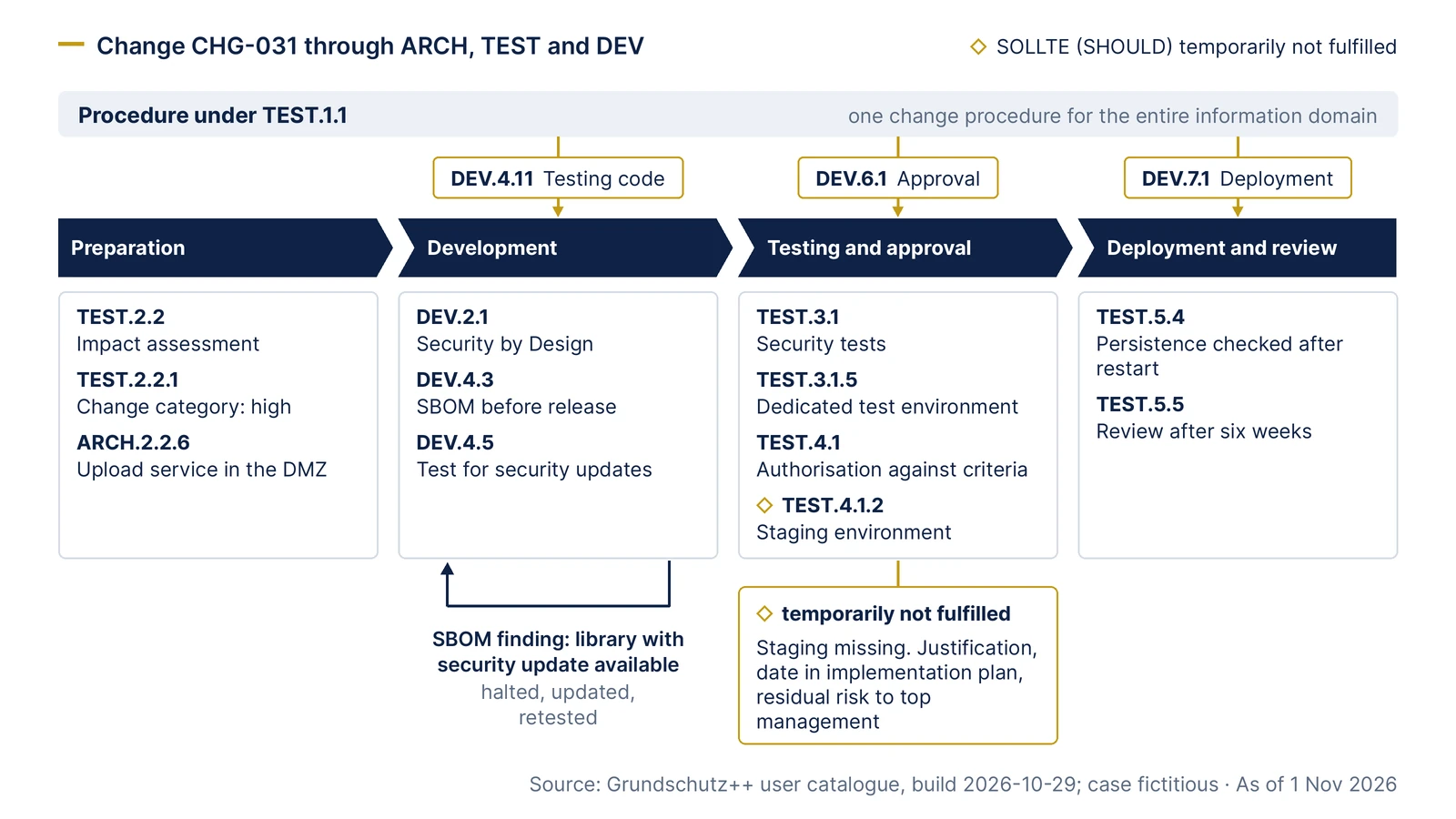
The link is set out in the catalogue itself. DEV.4.11 requires changes to source code to be tested „im Einklang mit den Verfahren und Regelungen für Änderungen und Tests“ (our translation: "in accordance with the procedures and rules for changes and tests"), and DEV.6.1 and DEV.7.1 likewise tie approval and deployment to these procedures. ARCH.2.2.8 (segmentation of test and operations) and ARCH.7.3 (development and test environments) refer to TEST.3.1.5, the dedicated test environment. Setting up the change process properly thus lays the groundwork for the DEV requirements that refer to this procedure, and for some architecture questions.
The case: an upload function in the member portal (fictitious)
Versorgungswerk Musterland (VWM), a professional pension scheme, is invented. It runs a self-developed member portal on its own virtualisation hosts in its own server room. A small development team maintains the code, and the administration team runs hosts, network and database. The business process Beitragsfestsetzung (contribution assessment) has the protection requirements category high for confidentiality, because members' proof of income is processed.
Change CHG-031 is meant to let members upload proof of income as a PDF instead of sending it by post. This requires a new upload service, a store for the files and an interface to the specialist application (Fachverfahren). Because the business process has high protection requirements, 300-1 chapter 2.11 requires an explicit risk assessment in any case. How it works is shown on the risk analysis page. This page is about the path of the change itself.
Step 1: Preparation with category, impact assessment and architecture decision
Before the first change, the VWM made the design decisions that TEST leaves open. TEST.1.1 requires procedures and rules for managing the introduction, change or removal of components and leaves open by parameter whether they apply to the information domain, per business process or per IT system. The VWM chose one procedure for the entire information domain. It set the parameter „regelmäßig“ (regularly) in TEST.1.2 to annually. Under 300-1 chapter 3.5, parameters are specified during or after the creation of the requirements package.
TEST.2.2 requires administrators to be instructed to carry out a structured impact assessment before significant changes. For CHG-031 they prepare this assessment and assign the change to a category (TEST.2.2.1). The guidance on TEST.2.2 and TEST.2.2.1 suggests classes such as low, medium and high impact and recommends aligning the depth of testing with this classification. The VWM classifies CHG-031 as high: a new service reachable from the internet, data from a business process with high protection requirements, a new interface. The planned changes and the affected dependencies are documented (TEST.2.2.2, TEST.2.2.3), among them database, specialist application, certificate of the portal domain and data backup.
The architecture decision is made in the same step. The upload service runs on its own virtual host (ARCH.7.1 requires server services on dedicated virtual or physical host systems) in the demilitarised zone (ARCH.2.2.6). The store sits in the internal segment and can only be reached via the new interface. Network inventory and network plan are updated before implementation (ARCH.2.4, ARCH.2.5) so that testing and approval can check against the planned state.
Step 2: Development with Security by Design, dependencies and SBOM
DEV.2.1 requires the architecture to be anchored in the principle of "Security by Design", and DEV.2.2 requires the architecture of the application to be documented. For CHG-031 this means: the team describes which component sees which data, that the upload service runs without write access to the specialist application (DEV.2.3, execution with the least possible privileges) and where inputs are checked (DEV.2.6.1, input validation). Error messages from the upload service do not output paths or file names of other members (DEV.3.3).
The upload uses two external libraries for PDF processing. DEV.4.2 prohibits including external software artefacts from unreliable or unknown sources, DEV.4.3 requires a software bill of materials (SBOM) before release, DEV.4.4 an integrity test of external artefacts and DEV.4.5 a test for security updates before release. When the SBOM is checked, it turns out that one of the libraries is included in a version for which a security update is available. The release is halted, the library is updated, and SBOM and tests are generated again. This negative finding belongs in the change record: it shows that the check actually took place.
Every code change is logged with time, content, the person making it and the reason (DEV.4.10) and tested under the change procedure (DEV.4.11). At the VWM, version control takes care of this: every merge references CHG-031.
Step 3: Testing and approval, including a gap
TEST.3.1 requires compliance with the security requirements to be tested before significant changes. The guidance counts technical requirements among them as well as procedural ones, for example on monitoring events or on staff awareness. Testing takes place in a dedicated test environment (TEST.3.1.5) that runs on separate hosts outside the production virtualisation (ARCH.7.3) and is restricted from operations (ARCH.2.2.8). Generated PDF files without real income data serve as test data (TEST.3.1.4). Test steps, results and corrections are documented (TEST.3.1.1). TEST.3.1.11 provides for a penetration test for critical changes as a KANN requirement. The VWM commissions one for CHG-031 because the service can be reached from the internet.
Under TEST.4.1, critical changes are to be authorised against criteria that include the security requirements. The VWM has an approval checklist for this: all test cases passed, no open finding of high severity from the penetration test, SBOM up to date, fallback described. In addition, the head of IT operations authorises the change as a person who was not involved in the implementation (TEST.4.1.1, KANN). The approval is documented with time, project, criteria and approving persons (TEST.4.1.3). The fallback (TEST.4.3) consists of switching off the upload service via configuration and restoring the previous release.
One gap remains: TEST.4.1.2 requires changes due for approval to be tested in a staging environment whose components match the production environment as closely as possible. The VWM's test environment has a different database version. The staging environment is provided for in the implementation plan but has not yet been built. This is a temporary non-fulfilment of a SOLLTE requirement, documented with a justification (300-1 chapter 4.1.2). 300-1 leaves open what follows from it. Chapter 4.1.2 says a temporary non-fulfilment does not trigger a risk assessment, chapter 2.11 requires a residual risk assessment with approval by top management for SOLLTE requirements that are included in implementation planning but not yet fulfilled, and chapter 4.1.1 requires the risk not yet mitigated to be identified and communicated to top management. This is an open question of interpretation. The VWM presents the residual risk to top management and notes in the change record that it proceeds this way and why.
Step 4: Deployment, persistence and review
Before deployment, the VWM informs the groups concerned (TEST.5.1): member services, the contribution assessment caseworkers and the information security officer (ISB). The deployment itself is encrypted (TEST.5.2) and follows the change procedure (DEV.7.1). After going live, the administration team checks persistence (TEST.5.4): according to the guidance in the catalogue, this means that a significant change remains effective even after a restart, an update or the restoration of configuration backups. At the VWM, the upload host is restarted once and the firewall rule for the new interface is checked again after the restart.
The VWM has specified the parameter „regelmäßig“ (regularly) in TEST.5.5 as follows: a review six weeks after every deployment of category high, and for all other changes collectively once a quarter. For CHG-031 the review therefore follows after six weeks: were the deployment objectives achieved, and were there unintended effects on security, stability or availability? Result in the case: objectives achieved, and one open finding of medium severity from the penetration test has a date in the implementation plan. The VWM checks compliance with the network architecture regularly anyway (ARCH.2.6), and the next run covers the new zone.
Had an actively exploited vulnerability in one of the PDF libraries become known after go-live, the procedure for emergency changes would have applied (TEST.4.4). It sets out the approach, responsibilities, required resources and minimum test steps. The guidance gives as examples an escalation procedure, accelerated security checks under the four-eyes principle and a follow-up review. An emergency change shortens the path. Documentation and follow-up remain.
Working result: the change record CHG-031 (fictitious)
The table shows the change record as it looks in the case. Column two gives the identifier and modal verb of the requirement, column four the evidence an auditor will want to see. 300-1 chapter 4.3 requires evidence to be clearly assigned to the respective safeguard. The record does this by having each row refer to a document or an entry. All details are fictitious.
| Step | Requirement (modal verb) | Decision or result in the case | Evidence | Status |
|---|---|---|---|---|
| Procedure | TEST.1.1 (MUSS), parameter scope | one change procedure for the entire information domain | Change management procedure description, version and approval date | fulfilled |
| Procedure | TEST.1.2 (MUSS), parameter „regelmäßig“ (regularly) | annual and event-driven review | Audit note on the last review | fulfilled |
| Preparation | TEST.2.2, TEST.2.2.1 (SOLLTE) | impact assessment, category high | Change ticket CHG-031, category field with justification | fulfilled |
| Preparation | TEST.2.2.3 (SOLLTE) | dependencies: database, specialist application, certificate, data backup | Dependency list in the ticket | fulfilled |
| Architecture | ARCH.2.2.6, ARCH.7.1 (SOLLTE) | own host for the upload service in the DMZ | Network plan under ARCH.2.5, new version | fulfilled |
| Development | DEV.2.1, DEV.2.2 (SOLLTE) | architecture description with data flows and permissions | Development documentation, upload section | fulfilled |
| Development | DEV.4.3, DEV.4.5 (SOLLTE) | SBOM generated; library with available security update found, updated, retested | SBOM before and after the correction, test run | fulfilled after correction |
| Development | DEV.4.10, DEV.4.11 (SOLLTE) | every merge references CHG-031, tests in the pipeline | Code history, pipeline log | fulfilled |
| Testing | TEST.3.1, TEST.3.1.1, TEST.3.1.4, TEST.3.1.5 (SOLLTE) | security tests in the test environment with generated test files | Test log with test steps, results, corrections | fulfilled |
| Testing | TEST.3.1.11 (KANN) | penetration test commissioned; one medium finding open | Test report, entry in the implementation plan | fulfilled, finding being addressed |
| Approval | TEST.4.1 (SOLLTE), TEST.4.1.1 (KANN) | approval checklist met, authorisation by a person not involved | Approval note under TEST.4.1.3 | fulfilled |
| Approval | TEST.4.1.2 (SOLLTE) | staging environment missing, test environment differs | Justification of the temporary non-fulfilment, date in the implementation plan, residual risk submitted to top management | not fulfilled, temporary |
| Approval | TEST.4.3 (SOLLTE) | fallback: switch off the service via configuration, restore the previous release | Fallback description in the ticket | fulfilled |
| Deployment | TEST.5.1, TEST.5.2 (SOLLTE), DEV.7.1 (SOLLTE) | groups concerned informed, encrypted deployment | Notification, deployment log | fulfilled |
| Deployment | TEST.5.4 (SOLLTE) | host restarted, firewall rule checked afterwards | Audit note with time | fulfilled |
| Review | TEST.5.5 (SOLLTE) | objectives achieved, one open finding with a date | Review note | fulfilled |
Fictitious example. Identifiers and modal verbs from the Grundschutz++ user catalogue, build 2026-10-29. The status values "fulfilled" and "not fulfilled" follow 300-1 chapter 4.1.1, the addition "temporary" chapter 4.1.2.
Audit questions for your own change process
The questions are derived from the case. They do not replace the assessment of each individual requirement in your requirements package, but they show where change processes dating from before Grundschutz++ need tightening.
- Is it decided whether the change procedure applies to the information domain, per business process or per IT system (parameter in TEST.1.1), and is the parameter „regelmäßig“ (regularly) in TEST.1.2 specified?
- Are there categories of change with graded depth of testing, and is the justification for the classification recorded in the ticket (TEST.2.2.1)?
- Is it defined what a significant change and what a critical change is? TEST.3.1 links security tests to significant changes, TEST.4.1 links authorisation to critical changes.
- Do development and test environments run separately from production hosts and networks (ARCH.7.3, ARCH.2.2.8), and is there non-critical test data (TEST.3.1.4)?
- Is an SBOM generated before every release and checked against available security updates (DEV.4.3, DEV.4.5), and is a negative finding visible in the record?
- Does the approval note contain time, project, approval criteria and approving persons (TEST.4.1.3)?
- Is a fallback described for every critical change (TEST.4.3), and is there a procedure for emergency changes with minimum test steps (TEST.4.4)?
- Is persistence checked after deployment (TEST.5.4), and is the parameter „regelmäßig“ (regularly) specified for the review of the deployment objectives (TEST.5.5)?
- For SOLLTE requirements that are temporarily not fulfilled, is it settled how you deal with the open question of interpretation between 300-1 chapter 2.11 and chapter 4.1.2?
Related topics: status and deviations per requirement on the page Assessing requirements, assigning applications and networks to target object categories on the page Modelling, evidence from pipelines and scans on the page Automated evidence, the risk assessment for high protection requirements on the page Risk analysis. Target configuration and inventory are covered on the practice page Configuration and assets, incident handling on the practice page Detection and incidents.
Blackfort Technology supports you with package C of Implementation under Grundschutz++: status determination per requirement, including TEST and DEV, specifying the parameters together with you, and an evidence plan that maps impact assessment, approval and post-deployment review to the requirements.
Rights notice: Details from BSI Standard 300-1 © Bundesamt für Sicherheit in der Informationstechnik 2026, source: BSI, Grundschutz++. They are not licensed under CC BY-SA 4.0. The licence notice at the end of the page applies to the excerpts from the catalogue data.