

Three levels, three different kinds of evidence
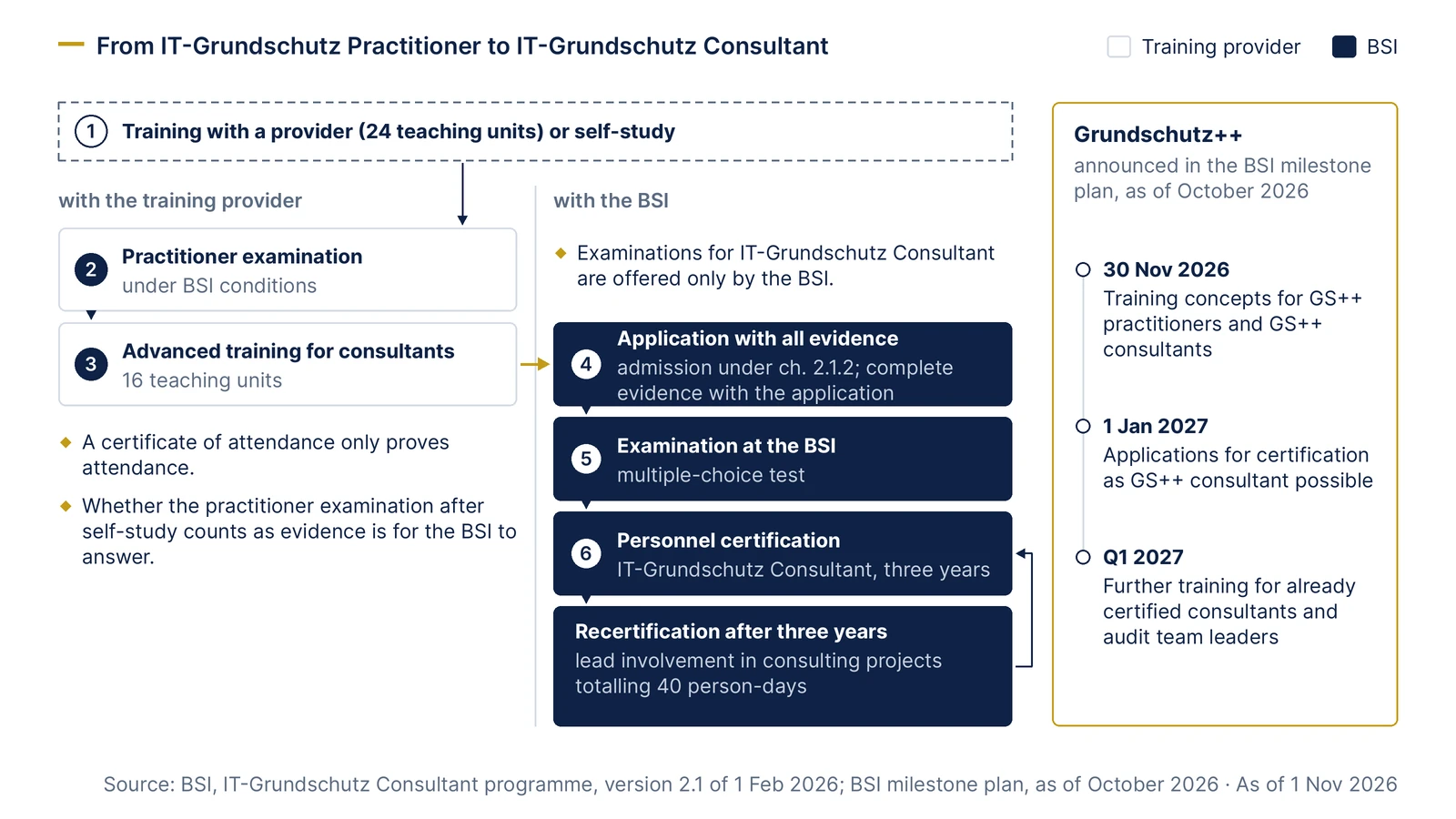
According to the BSI, a curriculum for training providers enables „eine zweistufige Weiterbildung“ (our translation: "a two-stage further training"): first an IT-Grundschutz basic training course with a subsequent examination as IT-Grundschutz Practitioner, then certification as IT-Grundschutz Consultant. The training courses are run by training providers. The contents of the curriculum are „verbindlich umzusetzen“ (our translation: "to be implemented as binding"), but the BSI does not approve a provider's individual training concept.
For your selection this means: anyone who attends a training course receives a certificate of attendance. Anyone who also passes the practitioner examination has an examination result from the training provider. A person is only certified by the BSI once they become an IT-Grundschutz Consultant.
| Level | Who carries it out | What it proves | Reference |
|---|---|---|---|
| Certificate of attendance for a training course | Training provider | Attendance at a basic training course (24 teaching units) or an advanced training course (16 teaching units), one teaching unit being 60 minutes | BSI page on the training courses; programme, ch. 2.1.2.5 (certificates of attendance as evidence) |
| IT-Grundschutz Practitioner | Examination by the training provider, under uniform BSI examination conditions; participation also possible without prior training | passed examination after the basic training course or after self-study | BSI page on the training courses; programme, ch. 2.1.2.4 |
| IT-Grundschutz Consultant | BSI: application, review of evidence, examination at the BSI, personnel certification | Certification by the BSI for a three-year certification period | BSI page on the IT-Grundschutz Consultant; programme, ch. 2 and 3.3 |
The BSI page on the training courses states this explicitly: „Prüfungen zum IT-Grundschutz-Berater werden nur durch das BSI angeboten.“ (our translation: "Examinations for IT-Grundschutz Consultant are offered only by the BSI.") Anyone who books a training course as a "consultant course" is therefore attending the advanced training course and is not yet certified afterwards.
The path to IT-Grundschutz Consultant in six steps
- Basic training course or self-study. The programme allows both (chapter 2.1.2.4).
- Examination as IT-Grundschutz Practitioner with a training provider.
- Advanced training course for IT-Grundschutz Consultant with a training provider.
- Application to the BSI with all evidence of the admission requirements. The BSI page requires the evidence to be „vollständig mit Antragstellung einzureichen“ (our translation: "submitted in full with the application"), together with a declaration of cost assumption (Kostenübernahmeerklärung).
- Examination at the BSI. Professional competence is assessed with a multiple-choice test. Anyone who fails can repeat the examination once as an individual examination within six months. A second repetition is not possible (programme, chapter 2.2).
- Personnel certification, once all evidence has been provided and the examination has been passed.
After that, obligations apply during the current certification period: confidentiality, orientation towards the state of the art and providing information about the course and content of the consulting (programme, chapters 3.1 and 4). The BSI can monitor the activity on a random-sample basis (chapter 3.2). Anyone who is also certified as an audit team leader may not audit an institution they have previously advised (chapter 3.1).
Admission requirements under the IT-Grundschutz Consultant programme 2.1
The programme in version 2.1 of 1 February 2026 checks four requirements on the basis of external evidence, including a CV with education and employment history and a current employer's certificate stating the type and extent of employment (chapter 2.1.2). The table summarises the details. The programme itself is binding.
| Requirement | What the programme requires | Evidence | Chapter |
|---|---|---|---|
| Educational qualification | completed vocational training providing basic knowledge for the activity, for example in IT, or a university degree; otherwise comparable in-service further training; alternatively at least eight years of relevant professional experience in IT, of which at least five in information security | CV, final certificate, where applicable certificates of further training or confirmation of the professional experience by a third party | 2.1.2.1 |
| Professional experience | within the last eight years at least five years of practical professional experience in IT, calculated on a full-time basis, of which at least two years in information security; in addition at least five years of experience in implementing IT-Grundschutz requirements | reference or confirmation by an independent third party with a short description of the activity | 2.1.2.2 |
| Practical experience | in the three years before the application, leading involvement as a consultant or expert in external consulting projects for the complete introduction of an ISMS under BSI Standard 200-2 or for producing security concepts, emergency concepts or risk documentation under IT-Grundschutz, totalling at least 40 person-days; IT-Grundschutz must have been an essential part | short reports confirmed by the client or employer, stating objectives, basis, role, period and scope; may be anonymised | 2.1.2.3 |
| Qualification | basic training course or self-study, passed examination as IT-Grundschutz Practitioner, attendance at the advanced training course | evidence of successful participation in a basic training course of at least three days and attendance at an advanced training course of at least two days with a qualified training provider | 2.1.2.4 |
One point should be clarified before the application: for the requirement the programme names „Basisschulung oder Selbststudium“ (our translation: "basic training or self-study"), but for the evidence it names participation in a basic training course of at least three days. Whether the passed practitioner examination after self-study is sufficient as evidence is for the BSI personnel certification body to answer. The contact address is on the BSI page on the IT-Grundschutz Consultant.
The requirements for professional competence are set out in chapter 2.1.3: knowledge of BSI Standards 200-1 to 200-4 is presupposed, among other things. In the examination at the BSI, candidates must demonstrate knowledge of, among other things, the ISO 27000 series of standards, the IT-Grundschutz Compendium, the IT-Grundschutz Check and the risk analysis under BSI Standard 200-3. BSI Standard 300-1 and Grundschutz++ do not appear in version 2.1.
Validity, recertification and public list
The programme speaks of the „aktuellen 3-jährigen Zertifizierungszeitraum“ (our translation: "current three-year certification period") (chapter 3.3). For recertification, an application and activity records signed by the client must be submitted in good time. What is required is lead involvement in consulting projects totalling 40 person-days from the current period, with the same objectives as for the initial certification. The person should have attended the BSI's experience-exchange events, where such events are offered.
The BSI keeps a public list of certified IT-Grundschutz Consultants with certificate number, name, address and the date until which the certificate is valid. Under chapter 3.4 of the programme, publication takes place „sofern“ (our translation: "provided that") the certified person wishes it. An entry in the list therefore proves the certification, while a missing entry does not on its own prove the opposite. If in doubt, ask for the certificate number and the validity date and check both against the list, or contact the personnel certification body.
The application includes a declaration of cost assumption. For the billing of costs, the BSI refers to the BMIBGebV, the special fee ordinance of the German Federal Ministry of the Interior. We do not state amounts here. The details provided by the BSI apply.
What comes with Grundschutz++
The BSI milestone plan (as of October 2026) announces three steps for personnel qualification:
| Date according to the BSI | Announced | Status on 1 Nov 2026 |
|---|---|---|
| 30 Nov 2026 | Publication of training concepts for qualification as GS++ practitioner (GS++-Praktiker) and GS++ consultant (GS++-Berater) | announced |
| 1 Jan 2027 | Applications for ISO 27001 certification on the basis of Grundschutz++ possible, „ebenso für die Zertifizierung zum GS++-Berater und GS++-Auditteamleiter“ (our translation: "likewise for certification as GS++ consultant and GS++ audit team leader") | announced |
| Q1 2027 | separate further training for IT-Grundschutz Consultants and audit team leaders who are already certified, leading to certification as GS++ consultant and GS++ audit team leader (GS++-Auditteamleiter) | announced |
The BSI has not yet published admission requirements for the GS++ consultant in the sources evaluated here. Until the training concepts are available, a training course labelled "Grundschutz++" says nothing about whether it prepares for a future examination. Ask the provider which curriculum the course is based on. What changes in terms of method is set out on the page BSI Standard 300-1, and all dates with sources are in the Grundschutz++ timeline.
Work result: selection checklist
Part A: choosing a training course
| Question to check | How you recognise it | Source for cross-checking |
|---|---|---|
| Is the provider listed in the BSI overview? | The BSI publishes a link to the offer after the provider has submitted a self-declaration. Check whether the link is set for the level you want (practitioner, consultant). Inclusion does not mean that the BSI has approved the training concept. | BSI page on the training courses, list of training providers |
| Which level are you booking? | Basic training course for practitioner with 24 teaching units or advanced training course for consultant with 16 teaching units | BSI page on the training courses |
| Is the practitioner examination included? | The provider can offer the examination. Whether it does is shown by the column „Link zur Prüfung“ (our translation: "link to the examination") in the BSI overview | BSI page on the training courses |
| What does the certificate state? | Attendance, a passed examination or both; for the later application you need evidence of successful participation in the basic training course and of attendance at the advanced training course | Programme, ch. 2.1.2.4 |
| How long is the training course? | For the application, at least three days of basic training and at least two days of advanced training | Programme, ch. 2.1.2.4 |
| Which version is the content based on? | BSI curriculum (as of 16 Sep 2024); for Grundschutz++ courses, ask whether the announced training concept is already the basis | BSI page on the training courses (curriculum), milestone plan |
| Is your own practical experience sufficient for the later application? | five years of implementing IT-Grundschutz requirements and leading project involvement of the required scope from the last three years, documented by confirmed short reports | Programme, ch. 2.1.2.2 and 2.1.2.3 |
Part B: assessing a person's qualification
| Question to check | What counts as reliable evidence | What is not sufficient on its own |
|---|---|---|
| Which qualification does your project require? | the specific requirement from the tender documents or the contract, for example a certificate as IT-Grundschutz Consultant, a passed practitioner examination or project experience on a particular basis | the demand for a "BSI certification" without stating which one is meant |
| If a certificate as IT-Grundschutz Consultant is required: is it available? | certificate number and validity date, checked against the BSI list or confirmed by the personnel certification body | the title "Grundschutz consultant" in a profile; a certificate of attendance for the advanced training course |
| Is the certificate still valid? | Date in the column „gültig bis“ (our translation: "valid until") of the BSI list | a certificate without a validity date |
| Has the person passed the practitioner examination? | Proof of examination from the training provider | Attendance at the basic training course without proof of examination |
| Does the experience fit your project? | Project reports with objective, basis (for example 200-2), role and period; the programme requirements show which details can be documented | general statements about "Grundschutz experience" without role and subject matter |
| Is there a conflict of roles? | clear separation: whoever advised on your ISMS does not audit it as audit team leader | a commitment without naming the persons for consulting and audit |
| Does the qualification relate to Grundschutz++? | from 2027, a certification as GS++ consultant, as soon as the BSI grants it | before that point, any claim to be certified for Grundschutz++ |
The checklist does not replace a suitability assessment. Whether a certificate is required for a tender or a contract is stated in your tender documents. Whether it is legally required is for your legal department to check.
Personnel certification and certification of the institution
Personnel certification concerns persons. Your ISMS is certified in a separate procedure. How an institution is certified to ISO 27001 on the basis of IT-Grundschutz, and from 2027 also on the basis of Grundschutz++, is described on the page Certification. If you want to learn the methodology yourself without booking a training course, start with the page Understanding IT-Grundschutz and BSI Standard 300-1.
Blackfort Technology does not offer training or examinations for the qualifications described here. This page puts the public information provided by the BSI into context. The programme and the BSI pages in their current version are binding.
Rights notice: Short quotations from the BSI pages on certification as IT-Grundschutz Consultant, on the training courses and on Grundschutz++, and from the Programm IT-Grundschutz-Berater (IT-Grundschutz Consultant programme), version 2.1 of 1 February 2026, © Bundesamt für Sicherheit in der Informationstechnik, source: BSI page on the IT-Grundschutz Consultant.