
Profile summary
| Original title | „KRITIS-IT-Grundschutz-Profil ÖSPV“, subtitle „Öffentlicher Straßenpersonenverkehr“ (our translation: "public road passenger transport") |
|---|---|
| Publisher | Bundesamt für Sicherheit in der Informationstechnik. Author according to ch. 1 „(ohne Namensnennung)“ (our translation: "(not named)"), the change history names division W 13. According to Annex 10.1.2.3, experts from local public transport were consulted for the additional threats, and according to Annex 10.1.3.1, several suppliers were surveyed. |
| Version and date | Version 1.0 of 14 Feb 2025 according to the change history („Initiale Veröffentlichung“, our translation: "initial publication"); the BSI page on the profile gives the same date |
| Revision cycle | „2-jährig“ (our translation: "every two years") according to ch. 1; we did not find a newer version on the BSI page on 2 Nov 2026 |
| Compendium edition | IT-Grundschutz Compendium of February 2022 (ch. 2, bibliography no. 4), although the 2023 edition was available at the time of publication |
| Methodology | Standard Protection under BSI Standard 200-2, requirements in case of elevated protection needs following protection requirements determination and risk analysis (ch. 3.4); risk analysis under BSI Standard 200-3; structured according to the template for creating KRITIS IT-Grundschutz Profiles |
| Scope | 67 pages (PDF, about 1 MB according to the BSI page), 10 chapters, 16 tables, one network plan |
| Accessibility | freely available via the BSI page on the profile, without registration; confidentiality according to ch. 1 „öffentlich“ (our translation: "public") |
| Licence and rights | © Bundesamt für Sicherheit in der Informationstechnik 2025, no open licence. We therefore quote only briefly and with references; we do not reproduce the profile's tables or network plan. |
| Type | KRITIS IT-Grundschutz Profile of the BSI (not a profile of an association, not a thesis) |
| Reference | BSI page „KRITIS-IT-Grundschutz-Profil ÖSPV“ (German), retrieved on 2 Nov 2026 |
How the four KRITIS IT-Grundschutz Profiles and their template relate to B3S, audit and statutory evidence is described in the section KRITIS IT-Grundschutz Profiles on the page NIS2 and Grundschutz. The other three KRITIS profiles and all other profiles are listed on the page Finding and reusing IT-Grundschutz Profiles.
Scope and reference architecture
The profile is aimed at operators of metro, tram and bus services. Trolleybuses and suspension railways do belong to the ÖSPV, but are „aufgrund ihrer geringeren Bedeutung nicht betrachtet“ (our translation: "not considered because of their lesser importance") (chapter 2, fn. 1). The profile refers to local public transport (ÖPNV) only to draw boundaries: it comprises the ÖSPV and local rail passenger transport, and local services of railways under the General Railway Act (Allgemeines Eisenbahngesetz), such as S-Bahn suburban trains, are outside the scope (chapters 3.2, 4). By metro (U-Bahn), the profile means a grade-separated railway independent of other modes of transport, not necessarily an underground one (fn. 2). It defines the critical service more narrowly than the ordinance, namely as „die sichere und planmäßige Beförderung von Fahrgästen“ (our translation: "the safe and scheduled carriage of passengers") (chapter 3.2).
Based on the BSI Critical Infrastructure Ordinance (BSI-Kritisverordnung) in the version the profile relies on, chapter 3.2 names two categories of installation: the rail-bound network with interlockings, train control equipment and traction power supply, and the control centre for monitoring and controlling traffic. According to this, the control centre also includes fleet telematics and vehicle provisioning at the depot, as well as systems for passenger safety, passenger information and staff and vehicle scheduling, the latter only insofar as their disruption can significantly impair the carriage of passengers or they are needed for evacuation, especially underground.
The profile divides the business processes into service planning (G1), operations planning (G2), resource deployment with vehicle and staff scheduling and workshop (G3) and traffic control (G4) with the sub-processes operations control (G4.1: control room, central control systems, communication with drivers, influencing traffic lights, routes) and infrastructure (G4.2: track, traction power and charging power, incident management). It does not consider controlling, sales, legal, corporate communications, human resources, fare management and passenger information, insofar as they do not contribute directly to the critical service (chapter 4). Also expressly outside are the applications dynamic passenger information, passenger counting, forecasting system and traffic light priority; whether they are part of the critical infrastructure in your case is for you to check (chapter 5.1.2).
The reference architecture describes a larger operator with buses, trams and metro and abstracts to one building each of the types control centre, station, depot and interlocking (chapter 5.2). At its centre is the transport control system, today usually called ITCS (Intermodal Transport Control System), formerly RBL (rechnergestütztes Betriebsleitsystem, computer-aided operations control system): it compares vehicle positions with the timetable and connects drivers and the control room (chapter 5.1.3). In addition, there are 14 applications, of which train protection and train protection incident management apply only to rail operations, eleven IT systems from the servers for ITCS, office, depot management and stations to the mobile phone, eight objects of industrial IT following the Purdue model (server of the electronic interlocking, control unit of the central control system, programmable logic controllers, on-board unit, on-board computer, actuators, sensors), six network components, seven networks, three room types and two vehicle types (chapters 5.1.2 to 5.1.7).
You should know five assumptions before adopting it (chapter 5.2): redundancies of buildings and systems are not shown, no external service provider is assumed for any function, servers run Windows Server 2012 and clients Windows 10, ITCS and the control unit of the central control system are located in the same room for simplicity, and each building type occurs only once. The reference architecture provides separate network segments for the control centre, interlockings, central control systems, depots and office, and calls their separation a key factor for security. The interlocking and control system networks span several sites and are to be secured there by VPN or equivalent means. The connection from the control centre workstations to the interlockings „erfolgt nur lesend“ (our translation: "is read-only"), and the profile gives network diodes as an example; an internet connection may exist only from the office network via a DMZ (chapter 5.2).
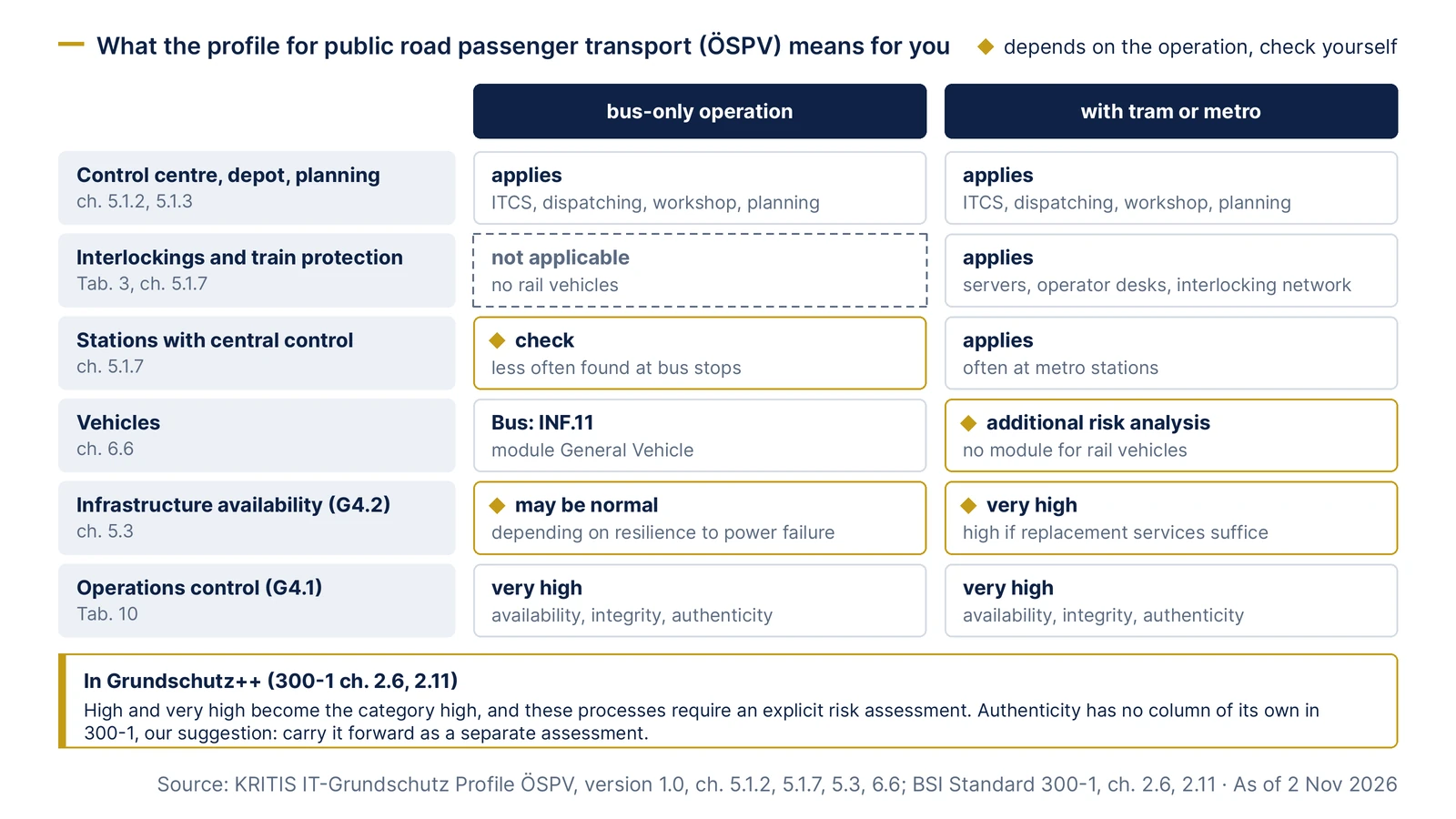
The graphic shows which of these parts apply to a bus-only operation and which apply additionally with tram or metro. The profile itself requires architecture, applications, systems and residual risks to be checked against your own operation; „sicherheitsrelevante Abweichungen sollten dokumentiert und in ihrer Auswirkung betrachtet werden“ (our translation: "security-relevant deviations should be documented and their impact considered") (chapter 8).
Does the profile fit your transport operation?
The profile fits if …
- you run a transport company with its own control centre and ITCS, plus depots and, for rail operations, interlockings and stations with central control systems;
- you operate bus and rail together: the reference architecture is built for exactly that, and the justifications for the protection requirements expressly distinguish by vehicle type;
- your security concept under BSI Standard 200-2 has so far covered the OT layer only roughly: the profile assigns interlocking technology, control systems, controllers and on-board systems to the industrial IT modules and provides a fully worked risk example;
- you are drawing up a business continuity and redundancy concept: the questions on DER.4 and the redundancy notes in chapter 6 are a useful starting point.
The profile does not fit, or fits only partly, if …
- you operate railway services under the General Railway Act, such as S-Bahn suburban trains: they are excluded (chapters 3.2, 4);
- you operate only buses: interlockings, train protection and rail vehicles do not apply, and according to the profile, stations with central control systems are less often found at bus stops (chapter 5.1.7); the control centre, depot, planning and the process-oriented modules remain usable (see graphic);
- your ITCS, office IT or telecommunications are run by service providers: the reference architecture makes no assumptions about this, and cloud use is „Nicht Gegenstand“ (our translation: "not covered") (chapter 5.2, Annex 10.2.4);
- you work as a public transport authority (Aufgabenträger) or transport association (Verkehrsverbund) without your own operations: the profile is aimed at operators and lists contracting authorities and associations only as interested parties and interfaces (chapters 3.3, 3.5);
- passenger information, sales or fare management are your focus: the profile does not look at these processes and applications in detail (chapters 4, 5.1.2);
- you start directly with Grundschutz++: in that case, adopt the process structure G1 to G4, the emergency operation questions on DER.4 and the justifications for the protection requirements of ITCS, interlockings and central control systems; you set categories and requirements afresh under BSI Standard 300-1 (see below).
What sets the profile apart
Protection requirements measured against operations: the categories are based on the effect on the critical service. Normal means the carriage of passengers remains unaffected, high that it can be impaired, very high that it can fail (Tab. 9). In addition to confidentiality, integrity and availability, the profile assesses authenticity for each of the four business processes. Service planning and operations planning are normal throughout, resource deployment is high except for confidentiality, operations control is very high for availability, integrity and authenticity, and infrastructure is very high for availability and otherwise high (Tab. 10). The justifications show knowledge of the sector: vehicles could run autonomously for days without ITCS, but in practice an outage is manageable only for hours or so, because disruptions are hard to handle without ITCS; bus operations are the most likely to be independent; incorrect data in the ITCS has the same effect as an outage (chapter 5.3).
Confidentiality high only where plans are held: it is high for the infrastructure and the geographic information application, because cable plans and location data make attacks easier (Tab. 10, 11). Chapter 7 supports this with coordinated attacks on several sites of transport operators, which were evidently only possible with detailed knowledge of the infrastructure and also hit redundant systems. By contrast, the profile rates the on-board application, on-board unit, on-board computer and thus the vehicles themselves as normal throughout, because their failure affects only one vehicle (Tab. 11, 13, 16).
Safety takes precedence over availability: according to chapter 3.5, the Passenger Transport Act (Personenbeförderungsgesetz), BOStrab (the ordinance on the construction and operation of tramways) and BOKraft (the ordinance on the operation of motor vehicle undertakings in passenger transport) rate the protection of life and limb higher than availability. The standstill of all vehicles counts as a „sicherer Betriebszustand“ (our translation: "safe operating state"), which runs counter to the critical service and which targeted attackers could exploit (chapter 7). Conflicts between the two are to be resolved consistently through compliance management (note on ORP.5).
What comes from the template and what was written specifically for the ÖSPV: a large part of the additional requirements in chapter 6 is almost identical to the template for creating KRITIS IT-Grundschutz Profiles, for example on inventories, group IDs, legacy systems in authentication and patching, parameterisation as development, logging, detection and the audit programme. Written specifically for the ÖSPV are above all: the emergency operation questions on DER.4 (rail replacement bus services if rail services fail, strategies for power failure, operation without ITCS with verbal instructions from the traffic controllers, setting points by hand if an interlocking fails, range of fuel reserves), redundancy for ITCS and operator workstations with cooperation between neighbouring transport operators, geo-redundancy for train protection and depots, countermeasures against denial of service for traffic control and train protection, access protection and alarms at unmanned decentralised interlockings and stations, the note that a control room staffed around the clock by at least two people does offer protection but that staff should be made aware of social engineering, public mobile networks or satellite telephony as a fallback for operational radio, and offline backups in an additional fire compartment because of ransomware, worded more strictly than in the template (chapters 6.1 to 6.6).
Vehicles as target objects: the profile models buses and rail vehicles with the module INF.11 General Vehicle. „Es gibt keinen für Schienenfahrzeuge vorgesehenen IT-Grundschutzbaustein“ (our translation: "There is no IT-Grundschutz module intended for rail vehicles"), which is why it recommends supplementing INF.11 with a risk analysis for rail vehicles (chapter 6.6). It mentions the manipulation of automatic door opening, which could cause greater damage on metro trains, a wired control network along the tracks and additional functions on the on-board systems. In the profile's assessment, most ÖSPV operators consider a derailment considerably easier to bring about mechanically than through a cyber attack on the sealed-off interlockings.
A worked risk example: Annex 10.1 demonstrates the risk analysis for the control unit of the central control system, with three additional threats (increasing networking of internal systems, increasing connection to the internet, violation of real-time requirements). For the networking of IT and OT, it sets the frequency of occurrence at least at „selten“ (our translation: "rare") and the damage at „beträchtlich“ (our translation: "considerable"), and so arrives at a high risk. As safeguards it names an isolated client with encrypted access to a jump host and a gateway PC for all software brought in; some operators separate the OT entirely from the IT network and, in an emergency, deploy staff on site at the relay interlockings.
Passages in the ÖSPV profile that do not match each other:
- Chapter 6 and the assignment tables in Annex 10.2 differ. CON.7 is in chapter 6, in the annex as „Nicht Gegenstand“ (our translation: "not covered"). APP.7, SYS.3.2.2 (Mobile Device Management), SYS.4.3, NET.2.2 and INF.9 appear only in the annex, INF.5 only in chapter 6. Chapter 6 assigns APP.1.4 to the on-board application, the annex to train protection; chapter 6 assigns NET.2.1 to the WLAN access point, the annex to three networks; the annex assigns INF.11 only to the bus.
- On OPS.1.2.5 Remote Maintenance, the profile refers to „die Ergänzung zu ORP.4.A21“ (our translation: "the supplement to ORP.4.A21") on multi-factor authentication. No such supplement appears in the profile; the requirement itself is covered, however, because the profile recommends taking all requirements in case of elevated protection needs for ORP.4 into account (chapter 6.1.2). At this point, the template adds that multi-factor authentication for remote access is to be regarded as state of the art.
- Train protection is assigned to the infrastructure sub-process (G4.2) in Tab. 3, but its protection requirements in Tab. 11 are derived from operations control (G4.1). In Tab. 14, the VPN has „Normal“ for availability, with the justification that the maximum principle applies because of „Sehr hoch“ (our translation: "very high").
- Influencing traffic lights is part of operations control (chapter 5.1.1), but the corresponding application lies outside the scope (chapter 5.1.2). The reporting points belong to the road traffic authority, the on-board systems to the operator (chapter 4).
- Annex 10.1.3.1 names „G 0.34 (schädliche Seiteneffekte von IT-Angriffen)“ (our translation: "G 0.34 (harmful side effects of IT attacks)"). In the list of elementary threats, G 0.34 is Assault; the harmful side effects of IT-supported attacks are G 0.47.
- The module OPS.2.1 „Outsourcing für Kunden“ (our translation: "Outsourcing for customers") was dropped in the 2023 edition and replaced by OPS.2.3 „Nutzung von Outsourcing“ (our translation: "Use of outsourcing"). There, CON.3.A12 is called „Sichere Aufbewahrung der Speichermedien für die Datensicherungen“ (our translation: "Secure storage of the storage media for backups").
Working tool: checklist for the assumptions of the reference architecture
The checklist goes through the assumptions that the profile itself describes as model assumptions (chapters 5.2, 8) and adds the points where it expressly leaves checks to you. Answer each question for your operation. Document every deviation with its impact, as chapter 8 requires. The right-hand column shows where the result belongs in Grundschutz++: sites, service providers and mobile devices as assets (300-1 Annex 1), remote maintenance access points and reporting points as interfaces (chapter 3.1), passenger information as a separate business process where needed (chapters 2.5, 2.6), legacy systems and a control network along the tracks as a trigger for a risk assessment (chapter 2.11) and the redundancy and read-access provisions as supplementary requirements (chapter 3.4.3).
| No. | Assumption of the profile | Check question for your operation | How to carry the result into Grundschutz++ |
|---|---|---|---|
| 1 | buses, trams and metro (ch. 5.2) | Which vehicle types do you operate? Can replacement services keep the carriage of passengers at an acceptable level if traction power fails? | leave out parts not operated; justify the protection requirements of the infrastructure afresh for your type of operation (2.6), see graphic |
| 2 | one building per type, no redundancies shown (ch. 5.2) | How many control rooms, depots, interlockings and stations are there, and which of them are actually redundant? | record each site as an asset in the categories sites, buildings, rooms (Standorte, Gebäude, Räume); carry the profile's redundancy provisions as supplementary requirements (3.4.3) |
| 3 | no external service providers (ch. 5.2) | Do service providers run office IT, telecommunications, ITCS or the maintenance of interlockings and control systems? | record services as assets in the categories services (Dienstleistungen) or outsourcing; answer the outsourcing boundary under 3.1 |
| 4 | remote maintenance via manufacturers' remote maintenance access points (ch. 6.1.4, 6.1.6) | Which access points exist for ITCS, interlockings, control systems and on-board systems, and with which authentication? | document each access point as an external interface (3.1); adopt multi-factor authentication for remote access from ORP.4.A21, which the profile includes through its note on ORP.4 (ch. 6.1.2) |
| 5 | Windows Server 2012 and Windows 10 (ch. 5.2, fn. 3) | Which operating systems, virtualisation and Linux systems do you actually use? | assign systems by function, for example host systems (Hostsysteme) (Annex 1); Grundschutz++ has no operating-system-specific modules |
| 6 | mobile phones, no smartphones or tablets (Annex 10.2.7, fn. 9) | Do drivers, workshop or control room use smartphones, tablets or apps? | record devices as mobile devices (Mobile Endgeräte) |
| 7 | passenger information, passenger counting and forecasting outside the scope (ch. 5.1.2) | Are these systems needed in your case for carrying passengers or for an evacuation, for example in underground facilities (ch. 3.2, 7)? | if yes: include as a business process with its own protection requirements determination (2.5, 2.6) |
| 8 | traffic light priority outside the scope, reporting points with the road traffic authority (ch. 4, 5.1.2) | Do your on-board systems send telegrams to reporting points? Who operates what? | document the data flow as an interface to an external system, with responsibilities (3.1) |
| 9 | legacy systems that cannot be patched, do not offer state-of-the-art authentication or lose their approval through updates (ch. 6.1.2, 6.1.4, 7) | Which systems does this affect, for example relay interlockings, older control systems or on-board routers with outdated protocols? | keep a list; every SOLLTE (SHOULD) requirement that will not be fulfilled for the foreseeable future triggers an explicit risk assessment (2.11) |
| 10 | connection from the control centre to the interlockings „nur lesend“ (our translation: "read-only") (ch. 5.2) | Does this apply in your case, and with which technology is it implemented? | formulate as a supplementary requirement (3.4.3); we did not find a suitable requirement in the user catalogue (see below) |
| 11 | no wired control network along the tracks (ch. 6.6) | Do you have such a network? | record as a separate network asset and include in the risk assessment (2.11) |
| 12 | technical supervisory authority and contracting authority are to be named in the profile (ch. 3.5) | Which supervisory authority is responsible, who is the contracting authority, which timetable service and which deviations does the transport service contract allow? | obligations into compliance management (2.2), contracting authorities and associations into the analysis of interested parties (2.4); the contract values as justification of the protection requirements |
The assignment to target object categories (Zielobjektkategorien) is our suggestion; the definitions in Annex 1 of 300-1 are authoritative. How to define boundaries and interfaces in general is described on the page Defining the information domain, the procedure for the risk assessment on the page Carrying out a risk analysis.
Route to Grundschutz++: what becomes of the ÖSPV profile
For a transport operator, four things change when moving to Grundschutz++: the categories for resource deployment, operations control and infrastructure, authenticity as a protection goal of its own, the classification of interlockings, control systems and vehicles, and the module basis, of which only around a third of the valid requirements are linked in the draft mapping. We did not find a Grundschutz++ version of the ÖSPV profile on 2 November 2026; it is still based on BSI Standard 200-2 and the 2022 Compendium.
First, the categories. For business processes, Grundschutz++ knows the categories normal and high; categories of your own are permitted and are „auf die Schutzbedarfskategorien des GS++ zu mappen“ (our translation: "to be mapped to the protection requirements categories of GS++") (300-1 chapter 2.6). The profile's high and very high therefore fall into the category high. Resource deployment, operations control and infrastructure then need an explicit risk assessment, while service planning and operations planning with normal protection requirements need none of their own (chapters 2.6, 2.11). Note the different yardsticks: in the profile, normal means damage has „keinen Einfluss auf die Erbringung der kritischen Dienstleistung“ (our translation: "no influence on the provision of the critical service") (Tab. 9), in 300-1 the effects are „begrenzt und überschaubar“ (our translation: "limited and manageable") (chapter 2.6). If a bus-only operator rates the infrastructure as normal following the profile, the trigger "high protection requirements" no longer applies to this process; the other triggers from chapter 2.11 remain, and operations control stays high.
Second, authenticity. 300-1 determines the protection requirements for the basic values confidentiality, integrity and availability (chapter 2.6). The profile additionally assesses authenticity and rates it as very high for operations control. Our suggestion: carry the column forward as a separate assessment and take it into account in the risk assessment, instead of silently folding it into integrity. Whether you have to show it separately for legal reasons is not decided on this page.
Third, OT and vehicles. In the list of target object categories in Annex 1 of 300-1, we did not find a separate category for interlocking technology, programmable logic controllers, sensors and actuators or vehicles. For assets that the existing categories do not adequately cover, 300-1 requires an explicit risk assessment (chapter 2.11) and recommends supplementary requirements (chapter 3.4.3). This goes to the core of the ÖSPV profile: interlockings, central control systems, on-board units and rail vehicles.
Fourth, the modules. We counted the modules to which the profile assigns target objects in chapter 6 or in Annex 10.2 against the draft mapping IT-Grundschutz 2023 to Grundschutz++. Not counted are CON.7 and CON.10, which the profile lists in one place as „Nicht Gegenstand“ (our translation: "not covered"); we replaced OPS.2.1 with its successor OPS.2.3. All other identifiers still exist in the 2023 edition. The basis is the mapping file with status "draft" of 21 July 2026; we resolved the targets against the user catalogue (Anwenderkatalog) build 2026-10-29. The result is a draft and is not an official assignment.
You can use the profile's justifications on ITCS, interlockings and traction power for your own rating, following the approach on the page Rating protection requirements with justification.
| Metric (62 modules of the profile) | Value |
|---|---|
| Requirement identifiers in the 2023 Compendium | 1,178, of which 158 marked as dropped, leaving 1,020 valid |
| Requirements with at least one entry in the draft mapping | 336 (around 33 % of the valid ones); none of them dropped |
| distinct Grundschutz++ requirements as targets | 259 from 18 practices (Praktiken); most in DET (71), ARCH (59) and TEST (34) |
| Modules without a single entry | 11: ORP.4 Identity and Access Management, CON.2 Data Protection, CON.3 Backup Concept, CON.6 Deletion and Destruction, OPS.1.2.4 Teleworking, SYS.1.2.2 Windows Server 2012, IND.2.2 Programmable Logic Controller, IND.2.3 Sensors and Actuators, INF.5 Room or Cabinet for Technical Infrastructure, INF.7 Office Workplace, INF.9 Mobile Workplace |
| of which OT part (IND.1, IND.2.1, IND.2.2, IND.2.3, IND.3.2) | 64 identifiers, 9 dropped, 22 with an entry (40 % of the valid ones) |
| Target references that cannot be resolved in the catalogue | 13, all to the same identifier VRB.1.2, which is missing from the catalogue build 2026-10-29 (including it, 260 distinct targets) |
An entry in the mapping does not mean that the requirement is fully covered; the relationships range from equivalent to partial overlap. The very modules to which the profile adds its own supplements are poorly represented: ORP.4 and CON.3 are missing entirely, as are the controllers, sensors and actuators. For backup, IT/OT separation and remote maintenance, we traced the route individually:
| Profile passage | Requirement 2023 Compendium | Grundschutz++ target (user catalogue, build 2026-10-29) | Gap |
|---|---|---|---|
| Ch. 6.1.3 on CON.3: because of ransomware, offline backup and storage in an additional fire compartment „hoch zu priorisieren“ (our translation: "to be given high priority") | CON.3.A2 „Festlegung der Verfahrensweisen für die Datensicherung“ (our translation: "Defining the procedures for data backup") (basic; sentence on storage media requiring special protection as SOLLTE) and CON.3.A12 „Sichere Aufbewahrung der Speichermedien für die Datensicherungen“ (our translation: "Secure storage of the storage media for backups") (basic; different fire compartment as SOLLTE) | Mapping: CON.3 does not appear in the draft with any requirement. Our suggestion from our own search: NOT.4.14 „Offline-Kopie“ (our translation: "Offline copy") (normal-SdT, SOLLTE, parameter „regelmäßig“, our translation: "regularly") and NOT.4.10 „Getrennte Aufbewahrung“ (our translation: "Separate storage") (normal-SdT, SOLLTE); also NOT.4.11 „Datenträgerarchiv“ (our translation: "Data media archive") (normal-SdT, SOLLTE), whose explanation presupposes a fire compartment different from that of the original data | The fire compartment does not appear in any requirement text, only in the explanation of NOT.4.11. You implement the profile's prioritisation through the parameter „regelmäßig“ and your implementation planning; if you do not run a data media archive, carry the fire compartment as a supplementary requirement |
| Ch. 5.2: separate network segments, office network separated from the operational systems, control centre to interlocking „nur lesend“ (our translation: "read-only"); Annex 10.1.3.1 names a zone concept and network segmentation of the industrial IT | IND.2.1.A6 „Netzsegmentierung“ (our translation: "Network segmentation") (basic: ICS components MUST be separated from office IT), IND.1.A5 „Entwicklung eines geeigneten Zonenkonzepts“ (our translation: "Development of a suitable zone concept") (standard), NET.1.1.A4 „Netztrennung in Zonen“ (our translation: "Network separation into zones") (basic) | Mapping: IND.2.1.A6 and IND.1.A5 without an entry. NET.1.1.A4 to, among others, ARCH.2.1 „Netzsegmente“ (our translation: "Network segments") (superset-of), ARCH.2.2 „Einschränkung von Verbindungen zwischen Segmenten“ (our translation: "Restricting connections between segments") (intersects-with) and ARCH.2.2.6 „Demilitarisierte Zone“ (our translation: "Demilitarised zone") (equal-to), all normal-SdT, SOLLTE. Our own search: ARCH.2.2.5 „OT-Systeme“ (our translation: "OT systems") (normal-SdT, SOLLTE, restrict connections between OT systems and other IT systems) | The MUSS (MUST) on separation from office IT becomes a SOLLTE (SHOULD) on restricting connections. We did not find a requirement in the catalogue on "read-only" or network diodes; carry this as a supplementary requirement or as a criterion in the parameter of ARCH.2.2 |
| Ch. 6.1.4 on OPS.1.2.5: for OT components take IND.2.1.A1 and IND.2.1.A2 into account, weigh up jump servers as the link to the process network | IND.2.1.A1 „Einschränkung des Zugriffs auf Konfigurations- und Wartungsschnittstellen“ (our translation: "Restricting access to configuration and maintenance interfaces") (basic: change default passwords, only authorised persons at the interfaces, configuration changes only after approval or authentication); OPS.1.2.5.A25 „Entkopplung der Kommunikation bei der Fernwartung“ (our translation: "Decoupling communication during remote maintenance") (standard) | Mapping: of IND.2.1.A1, only sub-requirement 1 to KONF.2.3 „Default-Zugangsdaten in IT-Systemen“ (our translation: "Default credentials in IT systems") (intersects-with, normal-SdT, SOLLTE). OPS.1.2.5.A25 to ARCH.2.2.12 „Sprungserver“ (our translation: "Jump server") (equivalent-to, elevated (erhöht), KANN (MAY)) and ARCH.5.1.6 „Blockieren direkter Management-Verbindungen“ (our translation: "Blocking direct management connections") (subset-of, normal-SdT, SOLLTE). Our own search: KONF.4.3 „Authentifizierung von Fernwartungsfunktionen“ (our translation: "Authentication of remote maintenance functions"), KONF.4.4 „Einschränkung von Fernwartungsfunktionen“ (our translation: "Restriction of remote maintenance functions") and BER.5.8 „Mehr-Faktor-Authentisierung am Perimeter“ (our translation: "Multi-factor authentication at the perimeter"), all normal-SdT, SOLLTE | For the core of IND.2.1.A1, access only for authorised persons, the draft contains no assignment. The jump server becomes optional. The assignments to KONF.4.3, KONF.4.4 and BER.5.8 are ours and do not come from the draft |
The profile's additional requirements and notes are provisions specific to the profile. The draft mapping does not know them, because it links only Compendium requirements. This concerns, among other things, the emergency operation questions on DER.4, the redundancy and geo-redundancy provisions, the countermeasures against denial of service, the protection of unmanned sites, the fallback for operational radio and the provisions on rail vehicles. Also included are the provision in chapter 6.1.7 on handling information, a provision not assigned to any module, and the user-defined module „APP.bd.1 ArcGIS Enterprise“ for the geographic information application, for which the profile supplies no content. Whatever of this is to apply to your transport operation, you add to the requirements package as a supplementary requirement. Before adopting an assignment from the draft for your interlocking or control system package, check it individually, as described on the page Checking the IT-Grundschutz 2023 mapping.
Rights notice: Requirement titles from the IT-Grundschutz-Kompendium, Edition 2023, © 2023 Reguvis Fachmedien GmbH and © 2023 Bundesamt für Sicherheit in der Informationstechnik, source: BSI page on the IT-Grundschutz Compendium (German). Quotations from the KRITIS-IT-Grundschutz-Profil ÖSPV © 2025 Bundesamt für Sicherheit in der Informationstechnik. Neither is licensed under CC BY-SA 4.0; the licence notice at the end of the page applies to the extracts from catalogue and mapping data.
What this page does not decide
The profile bases itself on Section 8a(1) and (1a) BSIG, refers to the contact point under Section 8b BSIG for security incidents, derives the categories of installation from the BSI Critical Infrastructure Ordinance and names the minimum standard under Section 8 BSIG in chapter 9. These references relate to the BSI Act (BSIG) and the BSI Critical Infrastructure Ordinance as worded before 6 December 2025, that is, to the legal situation at the time of the profile. The BSI Critical Infrastructure Ordinance itself continues to apply in amended form. Whether and with which obligations the current BSI Act or the KRITIS umbrella act (KRITIS-Dachgesetz) covers your transport operation, whether your installations reach thresholds and which evidence you have to provide is not interpreted on this page.
According to its own statement, the profile specifies the state of the art for the ÖSPV and must be adapted to the individual operation (chapters 2, 8). It mentions the guidance on sector-specific security standards (B3S) only in the bibliography; we have not checked whether a B3S exists for the ÖSPV and how it relates to the profile. The profile contains no statement that applying it counts as evidence. How profile, B3S, audit and statutory evidence relate to each other in general is set out in the section linked below.
The profile names the Passenger Transport Act, BOStrab, BOKraft, the Road Traffic Regulations (Straßenverkehrsordnung), EN 50128 and the VDV publications of the Association of German Transport Companies (VDV) as further regulations (chapter 3.5). We mention them but do not interpret them; according to chapter 9, you obtain a complete list of the statutory requirements from your technical supervisory authority. Implementing the profile is also not a certification.
For former operators of critical infrastructure, Section 39(3) of the current BSI Act contains a transitional provision that still refers to the old Section 8a(3); the wording is given on the page NIS2 and Grundschutz. Who falls under it and which deadlines follow from it is not interpreted on this page.
The general classification of the KRITIS IT-Grundschutz Profiles, the template and their legal references as worded before 6 December 2025 is given in the section KRITIS IT-Grundschutz Profiles: what they are and what they are not.
Support with the transfer
If you want to move a security concept based on the ÖSPV profile to Grundschutz++ or adapt the profile to your transport operation, the team at Blackfort Technology supports you with the gap analysis, protection requirements, risk assessment for interlocking and control systems and the requirements package. How such support works is described on the page Consulting on IT-Grundschutz and Grundschutz++. For securing operational technology beyond Grundschutz, for example under IEC 62443, which the profile also refers to in chapter 9, see the company website https://www.blackfort-tec.de/en. Back to the overview of IT-Grundschutz Profiles with the general transfer route.