

What Section 391 SGB V and the BSI Act require, in brief
Section 391(1) SGB V obliges hospitals „nach dem Stand der Technik angemessene organisatorische und technische Vorkehrungen zur Vermeidung von Störungen der Verfügbarkeit, Integrität und Vertraulichkeit ihrer informationstechnischen Systeme, Komponenten oder Prozesse zu treffen, die für die Funktionsfähigkeit des jeweiligen Krankenhauses und den Schutzbedarf der verarbeiteten Patienteninformationen maßgeblich sind.“ (our translation: "to take appropriate organisational and technical precautions in line with the state of the art to avoid disruptions to the availability, integrity and confidentiality of their information technology systems, components or processes that are essential for the functioning of the hospital concerned and for the protection requirements of the patient information processed.") Under subsection 2, this includes mandatory measures to raise staff security awareness. Under subsection 3, the precautions are appropriate if the effort is not disproportionate to the consequences of a failure or impairment of the hospital or to the protection requirements of the patient information.
Section 391 does not prescribe a particular framework. Subsection 4 expressly names one route: hospitals can fulfil their obligations „insbesondere“ (our translation: "in particular") by applying an industry-specific security standard (branchenspezifischer Sicherheitsstandard, B3S) whose suitability the BSI has established under Section 30(8) BSIG. The provision does not mention IT-Grundschutz or Grundschutz++. Under subsection 5, the obligation applies to all hospitals unless they already have to take precautions as operators of critical facilities under Sections 30, 31 and 39 BSIG.
The BSI lists the „B3S Krankenhaus“ (industry-specific security standard for hospitals) of the Deutsche Krankenhausgesellschaft (German Hospital Federation) in version 1.3.1, with the suitability determination expiring in November 2028. On the BSI overview page, it appears in the section for standards whose suitability was established by 5 December 2025 under Section 8a(2) BSIG in its former version. Section 391(4) SGB V refers to a determination under Section 30(8) BSIG in its new version. Whether the determination under the former law is sufficient for subsection 4 is a legal question that this page does not answer. On drawing up a B3S, the BSI states: „Eine gesetzliche Pflicht zur Erarbeitung eines B3S besteht nicht.“ (our translation: "There is no legal obligation to draw up a B3S.")
Whether your hospital is an operator of a critical facility or counts as a particularly important or important entity under Section 28 BSIG is for your legal department to clarify. For the definition of a critical facility, Section 2 no. 22 BSIG refers to the KRITIS-Dachgesetz (German Critical Infrastructure Umbrella Act). Under Section 66 BSIG, however, this version only applies once a statutory ordinance under Section 4(3) and Section 5(1) of the KRITIS-Dachgesetz has entered into force; until then, Section 2 no. 22 continues to apply in the version in force up to and including 16 March 2026. For operators of critical facilities, Section 39 BSIG requires proof through security audits, inspections or certifications, and Section 31(2) requires systems for attack detection. Section 61 BSIG governs supervisory measures with regard to particularly important entities. Under subsection 3 sentence 5, the BSI may order proof from hospitals licensed under Section 108 SGB V no earlier than five years after the Act enters into force, unless a statutory ordinance under Section 56(6) BSIG sets an earlier date. We place in context the requirements you name or that appear in your documents. Whether they legally apply is for your legal department to check.
What this means for the methodology: under BSI Standard 300-1, the requirements your legal department has established belong in compliance management (chapter 2.2) and supplement the requirements package (chapter 3.4.3). How Grundschutz++ fits the risk management measures under Section 30 BSIG is described on the page NIS2 and IT-Grundschutz. Blackfort Technology provides information on NIS2 implementation itself on its company website: https://www.blackfort-tec.de/en.
Determining the protection requirements of treatment processes
Grundschutz++ starts with the business process. Business processes „können Abläufe, Verwaltungsverfahren und Fachverfahren verstanden werden“ (our translation: "can be understood as workflows, administrative procedures and specialist procedures") (300-1 chapter 2.5). In a hospital, besides administration and billing, these are above all the treatment processes, such as admission, diagnostics, medication, surgery and discharge. Protection requirements are set for each process for confidentiality, integrity and availability, in the categories "normal" and "high". According to chapter 2.6, high means that the impact can be considerable. As an aid, the standard names damage scenarios, including „Beeinträchtigung der persönlichen Unversehrtheit“ (our translation: "impairment of personal physical integrity"). The scenarios are an aid. The institution makes the classification and top management approves it (chapter 2.10).
For treatment processes, it seems reasonable to assume that a falsified medication entry or an unavailable result can impair the physical integrity of patients. If a process is classified as "high" for this reason, two obligations follow. First, an explicit risk assessment is required if a business process has high protection requirements for at least one protection goal (chapter 2.11). Second, the membership and dependency of the assets in relation to this process must be documented (chapter 3.2). The standard recommends starting the initial set-up with the most important business process from the highest protection requirements category (chapter 2.6). Step by step, all processes within the scope are to be examined.
Top management defines the scope. It can cover the entire hospital or part of it (300-1 chapter 2.3). If the hospital belongs to a group with several sites, a central IT company or a medical care centre (Medizinisches Versorgungszentrum), these boundaries and their interfaces must be clarified when delimiting the scope.
How the classification works in detail is described on the page Protection requirements determination; how to delimit the information domain, on the page Delimiting the information domain.
Documenting dependencies: the resource path of a treatment process
When documenting assets, BSI Standard 300-1 differentiates according to protection requirements. For normal protection requirements, the dependencies between applications and IT systems and between IT systems and rooms are sufficient. For high protection requirements, the membership and dependency of the assets in relation to the business process must be documented. According to chapter 3.2, the documentation is „unter anderem für die spätere Risikobetrachtung erforderlich, da diese auf Ebene des Geschäftsprozesses und entlang des Ressourcenpfades durchgeführt wird.“ (our translation: "required, among other things, for the subsequent risk assessment, as this is carried out at the level of the business process and along the resource path.") The form is up to you: table, CMDB, service map, network plan or dependency overview.
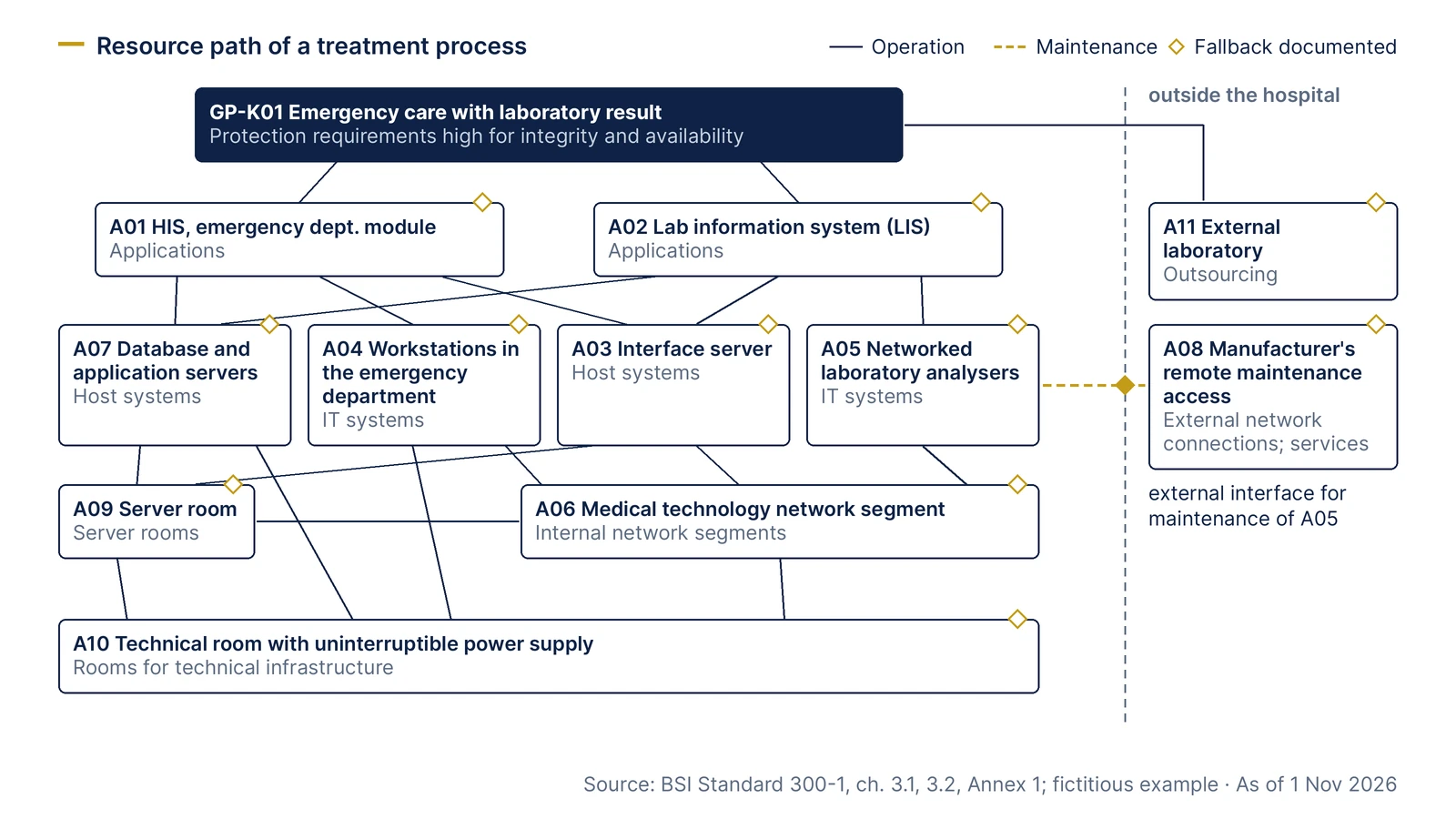
For a hospital, this means that the path does not end at the hospital information system (HIS). A treatment process also includes interfaces between systems, networked devices, the network segments they are connected to, manufacturers' remote maintenance access, server rooms, the power supply and external service providers. Chapter 3.1 also requires the interfaces of the information domain to external processes and systems to be clearly documented, at organisational, technical and infrastructure level. The dependency map below shows the path using a fictitious example, with the target object category (Zielobjektkategorie) from Annex 1 of 300-1 and the catalogue reference for each asset.
Dependency map: emergency department with laboratory result (fictitious extract)
The example is fictitious: a general hospital (Regelversorgung) with its own emergency department, central laboratory and hospital information system. The business process "GP-K01 Emergency care with laboratory result" is classified as "high" for integrity and availability, because a falsified or delayed result can impair treatment. Names, dependencies and fallbacks are assumptions for the example. The map is a simplified extract: telephone system, printers, authentication service, specimen transport and further resources are missing. The "depends on" column distinguishes dependencies in operation from dependencies for maintenance. The map mainly considers failures. For integrity, a second case belongs here too: the systems are running, but results or their assignment to patients could be falsified. Record who then restricts use of the affected information, has its reliability checked and releases it again.
According to the guidance on the methodology requirement STM.2.1.2, every asset is given a responsible role or an asset owner. For treatment processes, the clinical side is part of this: the consequences of failure, the fallbacks and the return to normal operation are confirmed by the medical and nursing management of the department and by the laboratory management, rather than by IT or medical technology alone. This division is our suggestion.
| No. | Asset (fictitious) | Target object category (300-1 Annex 1) | depends on | Consequence of failure for GP-K01 (assumption) | Fallback you document | Catalogue reference |
|---|---|---|---|---|---|---|
| A01 | Hospital information system (HIS), emergency department module | Applications | Operation: A03, A04, A07 | Laboratory requests and viewing of results not possible electronically | Paper requests, results passed on by telephone with call-back; check the telephone system and forms themselves as assets | NOT.3.1 (SOLLTE, i.e. SHOULD) recovery plan; NOT.3.2 (KANN, i.e. MAY) business continuity plan |
| A02 | Laboratory information system (LIS) | Applications | Operation: A03, A05, A07 | The assumption is a disruption of transmission: results are produced but do not reach the HIS. If the results function itself fails, a different fallback is needed. | Printout in the laboratory, messenger or fax according to a defined list; printer and fax route with their own dependencies | NOT.3.1; NOT.4.15 (SOLLTE) recovery procedure |
| A03 | Interface server between HIS, LIS and devices | Host systems | Operation: A06, A09 | Requests and results back up; assignment to patients uncertain | After recovery, reconcile patient, specimen and request, handle buffered messages, avoid duplicate requests, enter results transmitted on paper or by telephone retrospectively; document technical recovery and the clinical release of normal operation separately | ASST.2.2 (SOLLTE) inventory of systems; NOT.4.17 (KANN) application test after recovery |
| A04 | Workstations in the emergency department | IT systems | Operation: A06, A10 | No data entry at the treatment area | Spare devices, paper documentation | ASST.2.2 |
| A05 | Networked laboratory analysers (medical devices) | IT systems; justify the assignment | Operation: A06; maintenance: A08 | The assumption is a disruption of the connection: analyses run, results are not sent to the LIS automatically. If the device fails, a replacement device or the external laboratory takes over. | Manual transfer with dual control (four-eyes check) | ARCH.2.2.5 (SOLLTE) OT systems, if you classify the devices this way; BES.2.1.6 (SOLLTE) support and maintenance contracts |
| A06 | Medical technology network segment | Internal network segments | Operation: A09, A10 | Devices and interface server cut off | Recovery plan for the segment | ARCH.2.1 (SOLLTE) network segments; ARCH.2.2.7 (SOLLTE) management network |
| A07 | Database and application servers of HIS and LIS | Host systems | Operation: A09, A10 | HIS, LIS and interfaces fail together | Recovery in a defined order according to the emergency manual | NOT.4.2 (SOLLTE) system backup; NOT.4.16 (SOLLTE) backup test |
| A08 | Device manufacturer's remote maintenance access | External network connections; services | Operation: A06 | No direct failure of the process; troubleshooting on A05 is delayed; risk of unauthorised access to A05 | Access only after activation, disconnection in an incident | KONF.4.3, KONF.4.4 (SOLLTE) authenticate and restrict remote maintenance, assigned via A05 (IT systems); ASST.5.6 (KANN) supervision of external maintenance |
| A09 | Server room | Server rooms | Operation: A10 | Failure of all servers in the room | Alternative operation according to the emergency manual | Requirements of the target object category Server rooms and of the higher-level categories |
| A10 | Technical room with uninterruptible power supply | Rooms for technical infrastructure | Operation: building services, emergency generator | Failure of all dependent assets after the bridging time | Shutdown sequence, contact person in building services | see page Buildings and emergency preparedness |
| A11 | External laboratory for specialist analyses | Outsourcing | Operation: specimen transport, transmission of results | Specialist results delayed | Agreed alternative route for transmitting results | DLS.3.1.1 (SOLLTE) audit or certificate |
| A12 | Emergency department and laboratory staff | Users; employees | - | Fallback is not applied if it is unknown | Instruction in and practice of the fallback | NOT.3.3 (SOLLTE) awareness of the procedure in an emergency; SENS.1.1 (MUSS, i.e. MUST) procedures and rules |
The assignment of categories and catalogue references is our suggestion. A fallback only helps if it works during the failure under consideration, so also record the dependencies of telephone, fax, printers and spare devices. Through inheritance under 300-1 chapter 3.4.2, each asset also receives the requirements of the higher-level categories; the column only gives examples. Requirements assigned to several assets of the same category appear only once in the requirements package (chapter 3.4). How to record assets and assign categories is described on the pages Structure analysis and Modelling with target object categories.
Medical technology, remote maintenance and manufacturers in the requirements package
Annex 1 of 300-1 has no target object category of its own for medical devices. Networked devices can be assigned to the IT systems category, which the standard defines as „Informationstechnische Systeme zur elektronischen Datenverarbeitung“ (our translation: "information technology systems for electronic data processing"). Check for each device type whether the requirements of this category cover a device adequately. If they do not, chapter 2.11 requires an explicit risk assessment „wenn ein für den Informationsverbund relevantes Asset durch die bestehenden Zielobjektkategorien und die ihnen zugeordneten Anforderungen nicht hinreichend abgedeckt wird“ (our translation: "if an asset relevant to the information domain is not adequately covered by the existing target object categories and the requirements assigned to them"). For this, chapter 3.4.3 provides for supplementary requirements in the catalogue format. Obligations under medical device law are not covered by this page.
If a requirement cannot be implemented on a device, for example because the manufacturer does not permit any change to the configuration, "not applicable" under 300-1 chapter 4.1.1 is only permissible for one of the two reasons given there: the underlying component does not exist in the information domain, or the requirement cannot be fulfilled functionally. The justification must be documented. If an applicable SOLLTE requirement remains unfulfilled for the foreseeable future, chapter 2.11 likewise requires an explicit risk assessment.
How to assess such cases is described on the page Assessing requirements and handling deviations.
In the user catalogue (build 2026-10-29), these requirements in particular apply to medical technology and manufacturer access:
| Identifier | Title | Modal verb | Relevance to medical technology (our classification) |
|---|---|---|---|
| ASST.2.2 | Inventory of systems | SOLLTE | Besides end devices, the guidance also names IoT devices, provided they process data from the information domain. Networked devices therefore belong in the inventory. |
| ARCH.2.1 | Network segments | SOLLTE | Division of the internal network according to requirements and protection requirements; the guidance names operational technology and building management systems as examples. |
| ARCH.2.2.5 | OT systems | SOLLTE | Restrict connections between OT systems and other IT systems. Whether you treat medical devices as OT systems is for you to decide and justify. |
| ARCH.2.2.7 | Management network | SOLLTE | Administration and maintenance via a separate network. |
| KONF.4.3 | Authentication of remote maintenance functions | SOLLTE | Remote maintenance by manufacturers only after authentication according to the rules of the practice (Praktik) BER. |
| KONF.4.4 | Restriction of remote maintenance functions | SOLLTE | Limit remote maintenance functions to what is necessary. |
| BES.2.1.6 | Support and maintenance contracts | SOLLTE | Document the need for support and maintenance contracts according to the protection requirements for availability. |
| ASST.5.6 | Maintenance by external parties | KANN | Supervision by internal staff during maintenance by external parties without a security clearance, security level "elevated (erhöht)". |
KANN requirements have the security level "elevated (erhöht)" and are optional. They can be drawn on in the risk assessment (300-1 chapter 3.4.2). How procurement and service provider management interact is shown on the page Practice: procurement and service providers; target configuration and inventory on the page Practice: configuration and assets.
Emergency operation, recovery and awareness
The "fallback" column of the dependency map leads to emergency planning. The user catalogue requires a recovery plan for time-critical systems and applications (NOT.3.1, SOLLTE). According to the guidance, it specifies how a failed resource is brought to a planned emergency operation level within a recovery time. Without a BCMS, the time-critical resources can be identified via the protection requirements determination with high protection requirements for availability. In the catalogue, a business continuity plan for time-critical business processes is a KANN requirement (NOT.3.2). As an example of emergency operation, the guidance expressly names a digitally supported process being carried out in analogue form again, and it assigns business continuity plans to the responsibility of a BCMS.
Classifying a process as "high" does not replace time planning. How long a process may be interrupted, what minimum emergency operation level is needed and how long manual operation can be sustained are things you define with those clinically responsible. The recovery plan under NOT.3.1 presupposes such recovery times. If a BCMS exists, they are produced in the business impact analysis under BSI Standard 200-4 chapter 7. For a hospital, this also means that the paper forms, telephone lists and messenger runs from the dependency map only become a fallback once they are documented, distributed and practised. The catalogue requires users to be made aware of the procedure in emergencies and crises (NOT.3.3, SOLLTE) and, as a MUSS requirement, a procedure for role-specific training and awareness (SENS.1.1). This provides a point of connection for the awareness measures under Section 391(2) SGB V. Whether your measures fulfil the statutory obligation is a legal question.
Emergency management under BSI Standard 200-4 does not replace Grundschutz++; 200-4 has not been superseded by 300-1. How to combine the two is described on the page BSI Standard 200-4; the failure of a site as a case worked through from start to finish on the page Practice: buildings and emergency preparedness. How to plan instruction sessions and check their effect is set out on the page Practice: awareness.
B3S Krankenhaus and Grundschutz++ side by side
A hospital that applies or intends to apply the B3S may still want to work according to Grundschutz++, for example because the hospital operator runs several facilities using a uniform methodology or is aiming for ISO 27001 certification on the basis of IT-Grundschutz. In the sources evaluated (as of 1 November 2026), the BSI has not published a mapping between the B3S Krankenhaus and the Grundschutz++ user catalogue. Anyone using both creates the mapping themselves and labels it as their own.
This page does not describe the content of the B3S. According to the BSI, it is available for download on the website of the Deutsche Krankenhausgesellschaft. Methodologically, requirements from the B3S can be handled like any other contractual or sector-specific obligation: they belong in compliance management (300-1 chapter 2.2), and anything the user catalogue does not cover is added to the requirements package (chapter 3.4.3). Which framework leads for your hospital and whether it fulfils the obligations under Section 391 SGB V or the BSI Act is decided by top management and the legal department.
The trade-off between the ISO route and the IT-Grundschutz route is described on the page ISO 27001 or IT-Grundschutz.
Approach for a hospital
The steps follow the process steps from 300-1. The order and the link to the dependency map are our suggestion.
- Have the requirements established: The legal department records which obligations under Section 391 SGB V and the BSI Act apply and whether a B3S is applied. The result goes into compliance management (300-1 chapter 2.2).
- Scope and processes: Top management defines the scope and approves the protection requirements of the processes (chapters 2.3, 2.10). Choose a treatment process with high protection requirements as the first one (chapter 2.6).
- Clarify roles: Name the information security officer (ISB), head of IT, medical technology, building services, data protection and the clinical leads for the processes under consideration (medical and nursing management, laboratory management), with responsibilities and interfaces. Avoid conflicts of interest between the head of IT and the ISB and between the data protection officer (DSB) and the ISB (chapter 2.8). The page Roles and responsibilities can help.
- Create the dependency map: For the chosen process, document the resource path down to devices, network segments, remote maintenance, rooms and service providers (chapters 3.1, 3.2). Use existing sources such as the medical device inventory, CMDB and network plans.
- Build the requirements package: Assign assets to target object categories, flag devices that are not adequately covered and formulate supplementary requirements (chapters 3.4.2, 3.4.3).
- Risk assessment and fallbacks: Carry out an explicit risk assessment for the process and for assets that are not covered (chapter 2.11); include fallbacks in the recovery plan and practise them (NOT.3.1, NOT.3.3). Procedure and minimum criteria (Mindestkriterien) are described on the page Risk analysis.
Blackfort Technology supports hospitals with scoping, the dependency map, the requirements package and the risk assessment under Grundschutz++. The packages are listed on the page Consulting. For general information on setting up an ISMS and on ISO 27001, see the company website at https://www.blackfort-tec.de/en and https://www.blackfort-tec.de/en, and on the external information security officer at https://www.blackfort-tec.de/en. If the hospital belongs to a university, the page IT-Grundschutz at universities describes the delimitation on the university side.
Rights notice: Quotations from BSI Standard 300-1 © Bundesamt für Sicherheit in der Informationstechnik 2026, source: BSI topic page Grundschutz++. Quotation and information on B3S © Bundesamt für Sicherheit in der Informationstechnik, source: BSI page on industry-specific security standards and BSI page B3S Krankenhaus, retrieved on 1 November 2026. They are not licensed under CC BY-SA 4.0. The licence notice at the bottom of the page applies only to the extracts from the catalogue data.