

Several operators, one management
At a university, several units may run IT: the computing centre or central IT with the network, identity management and campus management, the administration with finance and HR systems, faculties and institutes with their own servers, computer pools and websites, and research groups with project servers, lab computers and large-scale equipment. The IT-Grundschutz Profile for universities is expressly aimed at those responsible „die sich aufgrund der oft dezentralen IT-Strukturen an Hochschulen mit Informationssicherheit beschäftigen“ (our translation: "who deal with information security because of the often decentralised IT structures at universities") (profile chapter 7.1).
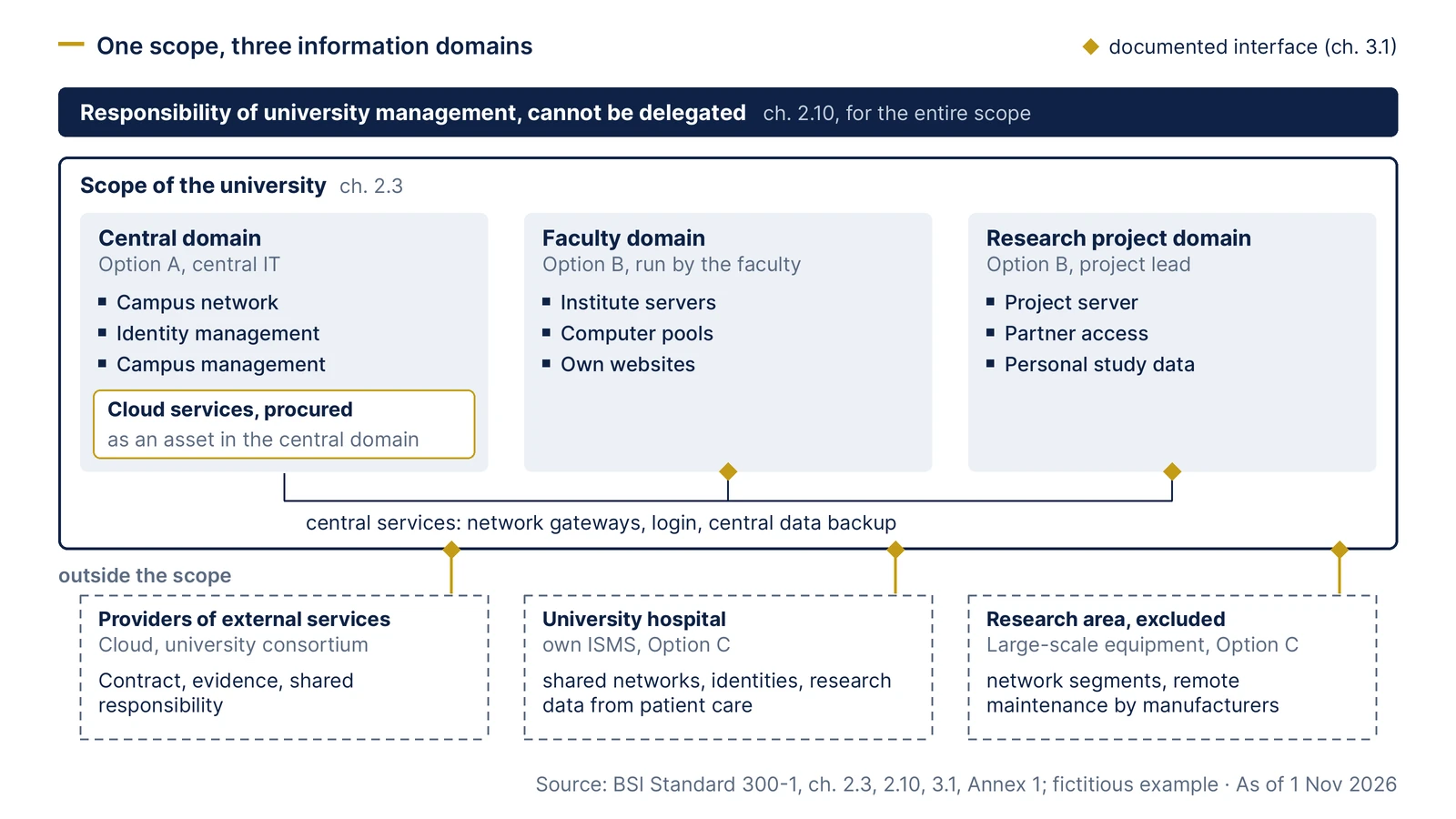
Grundschutz++ offers three tools for this situation. First, top management defines the scope. It „kann somit die gesamte Institution oder einen Teilbereich umfassen“ (our translation: "can therefore cover the entire institution or a part of it"), and excluded areas can be named (300-1 chapter 2.3). Second, a scope can „einen oder mehrere Informationsverbünde enthalten“ (our translation: "contain one or more information domains") (chapter 3.1), divided along organisational structures or shared business processes. Third, the interfaces between information domains and to external systems must be documented unambiguously, at organisational, technical and infrastructure level (chapter 3.1).
Under chapter 2.10, responsibility for implementing an ISMS lies with top management „und kann nicht delegiert werden“ (our translation: "and cannot be delegated"). It applies to the entire scope, including the parts a faculty runs itself. Who forms top management at your university follows from the law that applies to it. This page does not examine that.
Delimitation matrix: central IT, faculties, research
The matrix sorts seven areas of a fictitious university. For each area it names who operates it and who is responsible for it in substance, the option within the scope that we suggest as a starting point, and the interface you document. The separation of operation and responsibility in substance is based on the methodology requirement STM.2.1.2 in the user catalogue. According to its explanation, each asset is assigned a responsible role or an asset owner. The options are: A in the central information domain, B a separate information domain within the same scope, C excluded, with a documented interface. University management decides which option fits, based on protection requirements and responsibilities.
| Area | Examples (fictitious) | Who operates | Responsible in substance (example) | Suggested option | Interface you document | Reference |
|---|---|---|---|---|---|---|
| Central IT, computing centre | Campus network, Wi-Fi, identity management, email, campus management, learning platform | central IT | Head of central IT; for campus management, student administration | A | Services used by faculties and projects: network gateways, login, central data backup | 300-1 ch. 2.3, 3.1 |
| University administration | Budget, HR, procurement | central IT, specialist departments | Head of the specialist department concerned | A, B if run separately | Connections to external procedures and networks, for example those of the federal state | 300-1 ch. 3.1; profile ch. 9.4 |
| Faculty or institute with its own IT | Institute servers, computer pools, own websites, own administrators | faculty | Dean's office or institute management | B, smaller units A | Gateway to the campus network, use of central identity management, roles of decentralised administrators | 300-1 ch. 2.8, 3.1 |
| Research project with contractual obligations | Project server, data exchange with partners, personal study data | research group, central IT where applicable | Project lead | B | Obligations from project contracts, partner access, end of the project with archiving and deletion | 300-1 ch. 2.2, 2.6 |
| Research infrastructure and lab control systems | Large-scale equipment, measurement computers, building automation of the labs | research group, building services, manufacturer | Head of the working group or of the central facility | B or C | Network segments, remote maintenance by manufacturers, gateway to storage and computing services | 300-1 ch. 2.11, 3.4.3; catalogue ARCH.2.2.5 |
| Procured external services | Cloud services, services of a university consortium, computing centre of a partner university | Providers outside the university | Unit that procures the service | The procured service appears in A or B as an asset of the category Outsourcing or Cloud services. The provider itself lies outside | Contract, evidence, shared responsibility | 300-1 ch. 3.1, Annex 1 |
| University hospital | Hospital information system, medical technology | hospital | Hospital management | C from the university's point of view, if the hospital runs its own ISMS | shared networks, identities of people with roles at both the university and the hospital, research data from patient care | 300-1 ch. 2.3, 3.1 |
The allocation of options is our assessment. In your case it is determined by responsibilities, contracts and the legal form of the parties involved, which we do not interpret. Excluding an area from the scope does not change its organisational and legal affiliation. It merely lies outside the ISMS. You document its interfaces to the scope in the same way as interfaces to external processes and systems (300-1 chapter 3.1). For the hospital, the page IT-Grundschutz in hospitals describes the delimitation from the hospital's point of view. How to delimit an information domain in general is described on the page Delimiting the information domain.
The IT-Grundschutz Profile for universities: what it covers and where it stops
Among its IT-Grundschutz Profiles, the BSI publishes a profile for universities, written by the information security working group of the association „Zentren für Kommunikation und Informationsverarbeitung in Lehre und Forschung“ (ZKI), an association of computing and information centres in teaching and research, version 2022.0.0, published according to the profile on 4 August 2022. The BSI page on the profile gives the date 15 December 2022. According to the BSI page, it was created as part of the ZKI's membership in the Allianz für Cybersicherheit (Alliance for Cyber Security), based on several workshops led by the BSI. The BSI describes IT-Grundschutz Profiles as „Muster für Sicherheitskonzepte, die anhand eines Anwendungsbeispiels die IT-Grundschutz Vorgehensweise darstellen“ (our translation: "templates for security concepts that illustrate the IT-Grundschutz approach using an application example").
The profile looks at five business processes: cross-cutting applications, application and admission, enrolment and student management, examinations, and IT infrastructure for students (profile chapters 7.3, 9.1). It therefore concentrates on teaching. For research and administration it notes itself that requirements still need to be assessed, „Anforderungen der Zentralverwaltung und der Forschung zu evaluieren“ (our translation: "to evaluate requirements of the central administration and of research"), and that special requirements of research environments vary „mit den dort abgewickelten Projekten“ (our translation: "with the projects carried out there") (chapter 9.4). For protection requirements, the authors mostly assume "normal" and raise them to "high" at selected points, for example for confidentiality in enrolment and student management and for confidentiality and integrity in examinations (chapter 8.2).
Methodologically, the profile is based on classic IT-Grundschutz: it uses Basic and Standard Protection under BSI Standard 200-2 (chapter 8.3) and comments on modules of the IT-Grundschutz Compendium in the 2022 edition. We have not found a version for Grundschutz++ in the sources we evaluated (as of 1 November 2026). The mapping of the Compendium to Grundschutz++ in the State-of-the-Art Library (Stand-der-Technik-Bibliothek) refers to the 2023 edition and has the status "draft".
For work with Grundschutz++ this means:
- Adopt the process selection: The five processes of the profile are a useful starting point for the list of business processes under 300-1 chapter 2.5. You add research, administration and continuing education yourself.
- Justify protection requirements afresh: The profile's classifications are proposals for three categories under 200-2. Grundschutz++ has two categories, "normal" and "high" (300-1 chapter 2.6). University management approves every classification (chapter 2.10).
- Read module comments as implementation notes: The comments refer to modules of the 2022 edition. For the requirements package under Grundschutz++, you assign assets to the target object categories (Zielobjektkategorien) (chapter 3.4.2) and check every item you adopt individually. How to check assignments from the mapping is described on the page Checking the IT-Grundschutz 2023 mapping.
- Do not mix approaches: Basic and Standard Protection do not exist in 300-1. The differences are described on the page Basic, Core and Standard Protection, and the decision on whether and when to switch on the page Deciding on the switch.
Among the published profiles, the BSI also lists an IT-Grundschutz Profile for departmental research institutions (Ressort-Forschungseinrichtungen) (working group Ressort Forschungseinrichtungen, version 1.0). Departmental research means the federal government's research institutions, which the profile describes as federal authorities, often connected to the federal networks (Netze des Bundes). It does not mention universities. Its scope and limits are set out in the section IT-Grundschutz Profile for departmental research institutions on the page on the federal administration. Check against its own scope whether it fits a university. All profiles with publisher and status are listed in the overview IT-Grundschutz Profiles.
Delimiting research: projects, contracts and equipment
In Grundschutz++, research can be represented through business processes like any other area. A research project with its own data, partners and duration is a candidate for a separate business process with its own protection requirements. If specifications come from a project or funding agreement, they are contractual obligations. 300-1 chapter 2.2 provides for them to be compiled, and they supplement the requirements package (chapter 3.4.3). If a project has high protection requirements for at least one protection goal, an explicit risk assessment is required (chapter 2.11), and the dependencies of the assets on the process must be documented (chapter 3.2).
Large-scale equipment, measurement computers and lab control systems raise a second question. Annex 1 of 300-1 has no target object category of its own for research equipment. Networked devices can be assigned to the category IT systems. The catalogue requires connections between OT systems and other IT systems to be restricted (ARCH.2.2.5, SOLLTE, i.e. SHOULD). Its explanation names industrial control systems and building automation as examples. If the catalogue does not cover a device adequately, an explicit risk assessment follows under chapter 2.11, and you formulate supplementary requirements. If a requirement cannot be fulfilled on a device for functional reasons, "not applicable" is permitted, with a documented justification (chapter 4.1.1).
For a project with a fixed duration, its end belongs in the planning: partner access, project accounts and data. The catalogue requires a procedure for users leaving (PERS.6.1, SOLLTE) and deactivation of the identity on leaving (BER.2.5, SOLLTE). The explanation of BER.2.5 understands leaving as the end of activities that is more than short-term, for example through termination of employment, parental leave or a sabbatical. If only a role ends, such as work on a project, while the person remains employed or enrolled, you withdraw the project-related access rights and keep the identity. For this the catalogue requires a procedure for withdrawing access rights (BER.4.8, SOLLTE). The end of a project also includes handing over repositories, software and data access that are still needed to a permanently responsible unit. That is our suggestion. Export control, research data management and data protection for study data are separate areas of law. This page does not cover them.
Students, guests and changing staff
Under "users" (Nutzende), Grundschutz++ includes all natural persons who can regularly use assets in the information domain for the institution, „unabhängig davon ob sie aus Sicht der Institution intern oder extern sind“ (our translation: "regardless of whether they are internal or external from the institution's point of view") (300-1 Annex 1). For a university, this brings students, associate lecturers, visiting researchers and project partners with access into view, alongside employees. In the user catalogue (build 2026-10-29), by our count 81 requirements are directly assigned to the target object category users and 11 to the category employees.
In its reference architecture, the university profile also lists remote access via Wi-Fi and eduroam and via VPN among the cross-cutting applications (profile chapter 10.1.1). The table lists requirements of the user catalogue that address open networks, guests and changing people.
| Identifier | Title | Modal verb | Relevance at the university (our classification) |
|---|---|---|---|
| ARCH.2.1 | Network segments | SOLLTE | Divide the campus network by requirements and protection requirements, for example administration, teaching, research, devices |
| ARCH.2.2.2 | Guest network | SOLLTE | Restrict connections between the guest network and the internal network. The explanation names meeting, event and training rooms |
| ARCH.2.2.5 | OT systems | SOLLTE | Restrict connections between lab control systems, building automation and the rest of the network |
| ASST.2.2 | Inventory of systems | SOLLTE | Inventory with identifier and last known location, including devices of the institutes |
| SENS.2.4 | Use of unauthorised assets | SOLLTE | Prohibit the use of non-approved systems, storage media and cloud services. According to the explanation, aimed at shadow IT |
| PERS.6.1 | Procedure for leaving | SOLLTE | Handle the end of contracts, projects and guest stays in an orderly way |
| BER.2.5 | Deactivation on leaving | SOLLTE | Deactivate identities on leaving, including after fixed-term contracts and guest stays. If only a role ends, withdraw access rights under BER.4.8 |
For students' and employees' own devices, the yardstick is the methodology requirement STM.2.1.2 (MUSS, i.e. MUST): all relevant assets for the business processes under consideration are to be defined. Private use is left out. If a process uses own devices, for example an electronic examination on students' devices or access to research data from private computers, you assess data access, requirements and control options for that process. The network the devices log into and the services they use are included in any case. How to link joining, moving and leaving with access rights is shown on the page Practice: access rights and personnel, and training for very different groups on the page Practice: awareness.
Roles between university management, central IT and faculties
Chapter 2.8 of 300-1 requires an information security organisation with defined roles and responsibilities, the avoidance of conflicts of interest, expressly between head of IT and information security officer (ISB) and between data protection officer (DSB) and ISB, and the definition of interfaces within the scope. The ISB or another role from the security organisation must be involved in and informed about security-relevant projects. When this happens is defined.
For a university with decentralised IT, it makes sense to appoint a contact person for information security for each faculty or information domain who works with the ISB and knows the interfaces of their area. Whether the head of IT role lies with the computing centre, with a CIO or with a committee is for the university to decide. 300-1 only requires roles, responsibilities and qualifications to be defined and conflicts to be avoided. For research projects, we recommend defining in the project proposal who in the project is responsible for information security. These suggestions are ours. The standard does not contain them in this form.
An allocation of decisions and evidence to roles is described on the page Roles and responsibilities. The policy with which university management sets objectives and organisation is covered on the page Information security policy.
Legal framework: what this page does not decide
This page does not answer whether a university falls under the BSI Act (BSIG). Classification depends, among other things, on Section 28 BSIG and Annexes 1 and 2. In the research sector, Annex 2 lists the type of entity "Forschungseinrichtungen" (research organisations). Section 2 no. 12 BSIG defines the term and excludes educational institutions from it. This definition alone does not answer whether a university is covered: depending on its activities, further types of entity in Annexes 1 and 2 may apply, and Section 28 also links classification to size and to offering goods or services for a fee. We have not evaluated federal state law requirements for universities for this page.
We classify the requirements that you name or that appear in your documents. Whether they apply legally is checked by your legal department. A result of this check belongs in compliance management under 300-1 chapter 2.2 as a legal obligation.
How Grundschutz++ fits the risk management measures under Section 30 BSIG is described on the page NIS2 and IT-Grundschutz. Blackfort Technology provides information on NIS2 implementation on its company website: https://www.blackfort-tec.de/en.
Approach for a university
The steps follow the process steps from 300-1. The order and the link to the delimitation matrix are our suggestion.
- Survey the inventory: Who runs which IT at the university? Enter central IT, administration, faculties, research groups and external services in the delimitation matrix.
- Define the scope: University management decides whether the scope covers the whole university or initially a part of it, and names excluded areas (300-1 chapters 2.3, 2.10).
- Choose the first business process: 300-1 recommends the most important process from the highest protection requirements category (chapter 2.6). The process list of the university profile helps you get started.
- Cut the information domains: Record the option from the matrix for each area and document interfaces between the domains and to the outside (chapter 3.1).
- Appoint roles: ISB, head of IT, contact persons per faculty or domain, responsibilities in research projects (chapter 2.8).
- Build the requirements package: Assign assets to the target object categories, flag research equipment with inadequate coverage and supplement it, include contractual obligations (chapters 2.2, 3.4.2, 3.4.3).
The individual steps are described on the pages Structure analysis, Protection requirements determination and Modelling with target object categories. Blackfort Technology supports universities in delimiting the scope and information domains, clarifying roles and building the requirements package. The packages are set out on the page Consulting. Information on building an ISMS in general is available on the company website at https://www.blackfort-tec.de/en, and on the external information security officer at https://www.blackfort-tec.de/en.
Rights notice: Quotations from BSI Standard 300-1 © Bundesamt für Sicherheit in der Informationstechnik 2026, source: BSI topic page Grundschutz++. Quotation from the BSI page IT-Grundschutz-Profile © Bundesamt für Sicherheit in der Informationstechnik, source: BSI page IT-Grundschutz-Profile, retrieved on 1 November 2026. These quotations are not licensed under CC BY-SA 4.0. Quotations and information from the IT-Grundschutz-Profil für Hochschulen, version 2022.0.0: copyright according to the profile held by the participants in the workshop series „IT-Grundschutz-Profil für Hochschulen“, publisher Arbeitskreis Informationssicherheit im ZKI e. V., licensed under CC BY-SA 4.0, source: BSI page Profil für Hochschulen. The quotations are unaltered, the summaries are our own. The licence notice at the end of the page refers to the extracts from the catalogue data.