

What Sections 43 and 44 BSIG regulate
Both provisions are in Part 3 of the BSI Act and are addressed to „Einrichtungen der Bundesverwaltung“ (our translation: "federal administration bodies"). Section 29(1) BSIG defines who belongs to this group: federal authorities, IT service providers of the federal administration organised under public law and other federal corporations, institutions and foundations under public law, the latter only where the BSI orders this in agreement with the responsible federal ministry. The same subsection excludes the social security institutions and the Deutsche Bundesbank. In addition, Section 29(3) exempts the portfolios of the Federal Foreign Office and the Federal Ministry of Defence, as well as the Federal Intelligence Service and the Federal Office for the Protection of the Constitution, from individual provisions, including Sections 30, 33 and 35, and Section 44(1) sentence 7 declares the exceptions under Section 7(6) and (7) to apply accordingly to the minimum requirements; these concern information and communication technology abroad under the Foreign Service Act and the technology used by the armed forces and the Military Counter-Intelligence Service. Clarify with your legal department whether your organisation is covered; this page assumes that this question has been answered.
The table summarises what the two provisions say and what follows for planning a project. The right-hand column is our assessment for project planning, not a legal interpretation.
| Provision | Content (abridged, wording in the Act) | Consequence for planning |
|---|---|---|
| Section 44(1) sentences 1 and 2 | The bodies „müssen Mindestanforderungen zum Schutz der in der Bundesverwaltung verarbeiteten Informationen erfüllen“ (our translation: "must meet minimum requirements for the protection of the information processed in the federal administration"). These derive „aus den BSI-Standards und dem Grundschutzkompendium (IT-Grundschutz) sowie aus den Mindeststandards für die Sicherheit in der Informationstechnik des Bundes (Mindeststandards) in den jeweils geltenden Fassungen“ (our translation: "from the BSI standards and the Grundschutzkompendium (IT-Grundschutz) and from the minimum standards for the security of federal information technology (minimum standards) in the versions in force at the time"). | Three sources belong in the legal register: BSI standards, Grundschutzkompendium, minimum standards. The version applied for each source is recorded with its date. |
| Section 44(1) sentence 3 | The versions in force at the time are published on the BSI website. | Checking the version is a recurring task in operation. |
| Section 44(1) sentence 6 | The BSI will „bis zum 1. Januar 2026 modernisieren und fortentwickeln“ (our translation: "modernise and further develop by 1 January 2026") IT-Grundschutz. | Background to Grundschutz++; which version is published as in force is covered in the next section. |
| Section 44(2) | Implementing the minimum requirements ensures compliance with the requirements under Section 30 BSIG, unless a more far-reaching implementing act of the European Commission under Article 21(5) second subparagraph of the NIS2 Directive exists; special rule for operators of critical facilities. | A project under Section 44 also covers the measures under Section 30, subject to the reservation mentioned. The legal department checks the reservation. |
| Section 44(3) | On request, the BSI advises the bodies on implementation, provides aids and supports solutions of the federal IT service providers. | Open questions on the interpretation of the requirements can be addressed to the BSI. |
| Section 44(4) | The BSI provides technical guidelines and reference architectures, which are taken into account in requirements for contractors and IT products in procurement procedures. | For procurements within the project, checking suitable guidelines belongs in the tender documents. |
| Section 43(1) | Top management is responsible for „unter Berücksichtigung der Belange des IT-Betriebs die Voraussetzungen zur Gewährleistung der Informationssicherheit zu schaffen“ (our translation: "creating the conditions for ensuring information security, taking into account the needs of IT operations"). Fulfilment must be evidenced to the BSI „spätestens fünf Jahre nach Inkrafttreten dieses Gesetzes und anschließend regelmäßig nach seinen Vorgaben“ (our translation: "no later than five years after this Act enters into force and regularly thereafter in accordance with its specifications"). | The evidence to the BSI is a deliverable in its own right with its own deadline. Form and content follow the specifications of the BSI. |
| Section 43(2) | Top management must regularly attend training on risks and risk management practices. | Training dates for top management belong in the plan, with evidence of attendance. |
| Section 43(3) | Where bodies are commissioned with services for federal information technology, it must be ensured by contract that they undertake to comply with the conditions; this also applies to interfaces with federal communication technology. The obligations of top management remain unaffected. | Contracts with service providers are part of the project. What this means for contractors is described on the page IT-Grundschutz for federal IT service providers. |
| Section 43(4) and (5) | Registration under Section 33 is the responsibility of top management; subsection 5 governs duties to inform the BSI. | Registration and reporting channels are tasks alongside the Grundschutz project; list them in the plan only as an interface. |
The start of the period under Section 43(1) sentence 2 is determined by the Act's entry into force. The BSI Act was adopted as Article 1 of the Act of 2 December 2025 (Federal Law Gazette, BGBl. 2025 I No. 301) and, under its Article 30, entered into force on 6 December 2025 (footnote of the consolidated version on gesetze-im-internet.de). Have your legal department confirm the reference date for your project.
Which version applies: IT-Grundschutz 2023 or Grundschutz++?
Section 44(1) BSIG refers to the „Grundschutzkompendium“ and to the „jeweils geltenden Fassungen“ (our translation: "versions in force at the time") that the BSI publishes on its website. BSI Standard 300-1 version 1.0 is dated 20 October 2026; according to its press release, the BSI published it on 26 October 2026 and presented it at it-sa on 27 October 2026. On its Grundschutz++ topic page, the BSI writes that the State-of-the-Art Library (Stand-der-Technik-Bibliothek) with the user catalogue (Anwenderkatalog) „löst das IT-Grundschutz-Kompendium ab“ (our translation: "replaces the IT-Grundschutz Compendium"). The milestone plan (as of October 2026) provides that applications for certification based on Grundschutz++ can be submitted from 1 January 2027 and that certifiability of classic IT-Grundschutz ends on 30 November 2031.
In the sources we evaluated (as of 1 November 2026), we found no publication that expressly states for Section 44(1) whether the IT-Grundschutz Compendium Edition 2023, Grundschutz++ or both currently apply as the version in force. In its metadata, the Grundschutz++ user catalogue names „§ 44 Abs. 1 BSIG“ (Section 44(1) BSIG) as the provision implemented; it gives no date from which it applies as the version in force (build 2026-10-29). The end of certifiability in the milestone plan is a decision by the BSI on the certification procedure, not a statutory deadline. For planning, this means: record in the legal register which version you apply and which BSI publication you rely on. If this is open, the question belongs in the decision paper for top management and, where necessary, in a request to the BSI under Section 44(3).
For the compliance plan, what counts is the version in force under Section 44; for the certification plan, it is the procedure chosen by top management. The two questions can be answered separately, which is why the planning sheet further down keeps them in two columns.
Minimum standards: a binding minimum level alongside Grundschutz
Under Section 44(1) sentence 4, the BSI sets minimum standards in consultation with the federal ministries and other supreme federal authorities. On its overview page, the BSI describes them as a statutory requirement that defines „ein verbindliches Mindestniveau für die Informationssicherheit“ (our translation: "a binding minimum level for information security"). The same page states: „Daher können sich in der Praxis regelmäßig höhere Anforderungen an die Informationssicherheit ergeben, als in den Mindeststandards beschrieben werden.“ (our translation: "In practice, therefore, higher information security requirements than those described in the minimum standards may regularly arise.") According to the BSI, the BSI standards under IT-Grundschutz describe how these are determined. According to the BSI FAQ, certification based on the minimum standards is currently not possible.
Two points from the BSI FAQ matter for planning. First, each minimum standard becomes „unmittelbar mit seiner Veröffentlichung gültig“ (our translation: "valid immediately upon its publication"), previous versions lose their validity, and no general transition periods apply. Second, the BSI usually publishes a reference table for each minimum standard with references to IT-Grundschutz requirements. These reference tables refer to the Compendium; for the minimum standard on the use of external cloud services (version 2.1), to the 2022 edition. In the sources we evaluated, we found no mapping of the minimum standards to requirements of the Grundschutz++ user catalogue.
On 1 November 2026, the BSI overview page listed, among others, these minimum standards under its latest updates: regulatory document for the ISMS in the federal IT consolidation (version 1.0a, 07/2025), use of the cross-departmental federal communication networks (version 3.0, 01/2025), logging and detection of cyber attacks (version 2.1, 11/2024), web browsers (version 3.0, 02/2024), HV-Benchmark kompakt (version 2.0, 11/2023), Transport Layer Security (version 2.4, 05/2023), use of external cloud services (version 2.1, 12/2022), mobile device management (version 2.0, 09/2022) and video conferencing services (version 1.0, 10/2021). The minimum standard for interface controls is marked there as repealed (04/2024). Check the current status on the page itself before any planning.
In a Grundschutz++ project, minimum standards enter the requirements package through compliance management. In chapter 2.2, BSI Standard 300-1 lists analysing the legal register and requirement catalogues among the aspects of compliance management; statutory obligations should be documented. Chapter 3.4.3 provides that obligations from this step supplement the requirements package, in the format that Grundschutz++ provides for requirements. Chapter 3.3 also mentions that there may be „für bestimmte Institutionen verpflichtende Blaupausen geben“ (our translation: "mandatory blueprints for certain organisations"). Whether, and which, blueprints (Blaupausen) are mandatory for the federal administration has not been published in the sources we evaluated.
Our suggestion for implementation: each requirement of an applicable minimum standard gets its own line in the requirements package, with identifier, version of the minimum standard and a reference to the user catalogue requirement that covers the same matter, if there is one. How to assess requirements and document deviations is described on the page Assessing requirements and documenting deviations.
Planning sheet: keeping the compliance plan and the certification plan apart
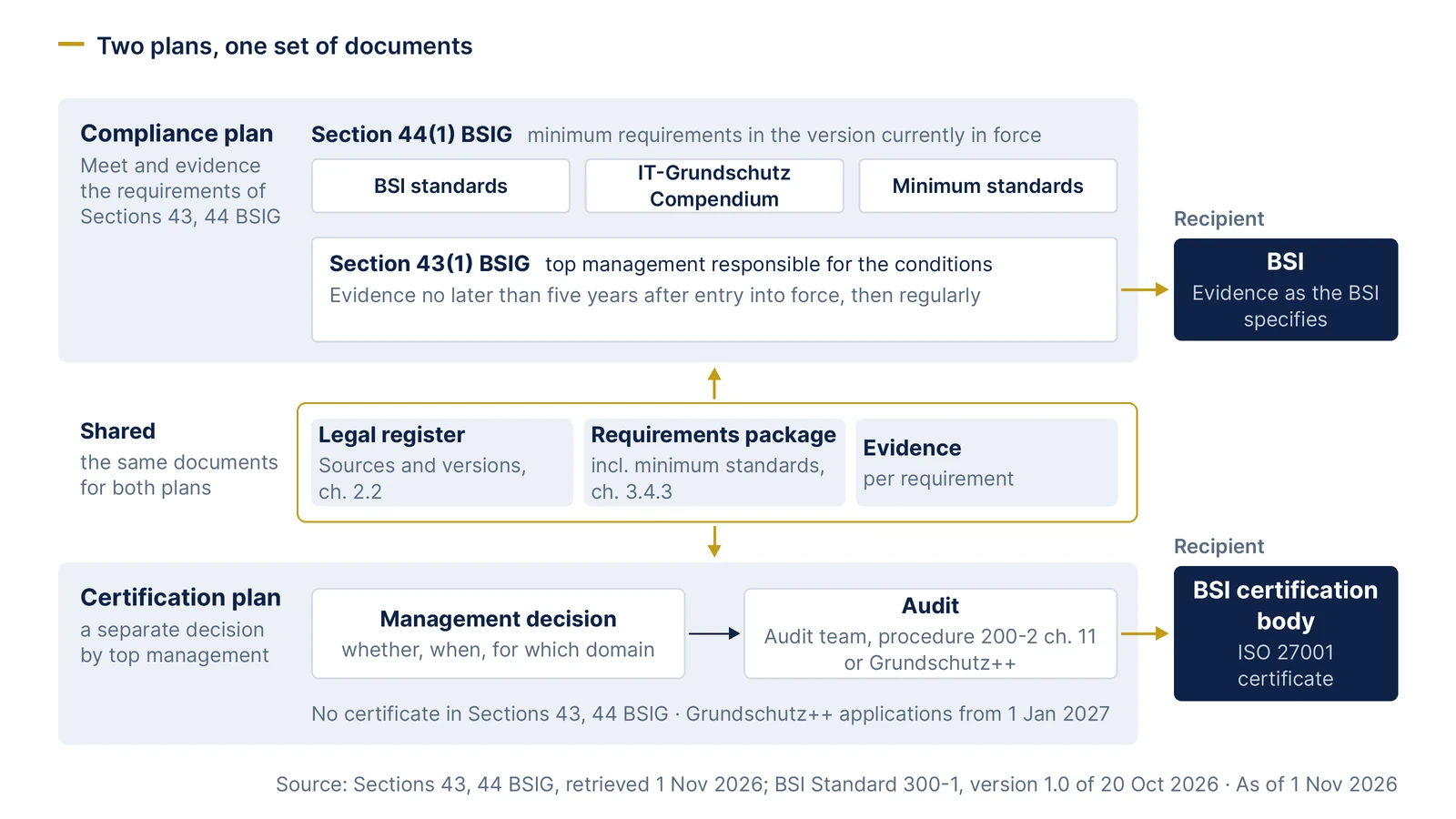
The compliance plan answers how the organisation meets the requirements of Sections 43 and 44 BSIG and evidences this to the BSI. The certification plan answers whether and when top management seeks a certificate under ISO 27001 on the basis of IT-Grundschutz or Grundschutz++. Both use the same documents but have different reference points, recipients and deadlines. If they are mixed, it can easily seem as if the certificate were the deliverable required by law, or as if the evidence to the BSI only became due with the audit.
| Field | Compliance plan under Sections 43, 44 BSIG | Certification plan |
|---|---|---|
| Basis | Section 44(1) (minimum requirements), Section 43(1) (responsibility, evidence) | Decision by top management; procedure under BSI Standard 200-2 ch. 11 or on the basis of Grundschutz++ |
| Reference point | BSI standards, Grundschutzkompendium and minimum standards in the version in force | ISO 27001 and the criteria of the chosen procedure |
| Scope | The organisation within the scope of its obligations; justify the boundary in the legal register | The information domain to be named in the certificate |
| Recipient of the evidence | BSI, in accordance with its specifications (Section 43(1) sentence 2) | Audit team and certification body |
| Deadlines | Evidence no later than five years after entry into force, then regularly; minimum standards from publication | Application, audit, surveillance; GS++ applications from 1 Jan 2027 according to the milestone plan |
| Management decisions | Scope, protection requirements, order, resources, policy (300-1 ch. 2.10); training under Section 43(2) | Whether, when and for which domain a certificate is applied for |
| Service providers | Contractual obligation under Section 43(3) | Evidence from service providers for the certified domain |
| Open points (example) | Form of the evidence to the BSI; version in force under Section 44(1) sentence 3 | BSI audit scheme for Grundschutz++, where not yet published |
The "Open points" row is an example. We have not evaluated the BSI specifications on the form of the evidence under Section 43(1) sentence 2 for this page; ask the BSI for them before planning. How a certification procedure works is described on the page BSI Grundschutz certification; the deadlines with their status are in the deadline register. For choosing between classic IT-Grundschutz and Grundschutz++, there is a decision table on the page Deciding on the switch.
Preparation in a federal authority: what should be settled before process step 1
BSI Standard 300-1 names a separate entry point for public authorities: when identifying business processes, authorities and institutions under public law draw on their statutory mandates (chapter 2.5). This gives the process list a source that exists in every authority. The list below brings together what should be in place before the actual process step 1, so that the compliance plan and the method fit together.
- Applicability clarified: The legal department has recorded whether and to what extent Sections 43 and 44 BSIG apply to the organisation. The result is in the legal register (300-1 chapter 2.2).
- Versions recorded: For BSI standards, Grundschutzkompendium or user catalogue and each applicable minimum standard, the version, date and the BSI publication on which the organisation relies are noted.
- Mandate from top management: Top management has issued the mandate and knows its decisions under 300-1 chapter 2.10: scope, protection requirements of the business processes, order, resources, policy. Under 300-1, responsibility cannot be delegated; Section 43(1) BSIG also assigns it to top management.
- ISB appointed: Under Section 45(1) BSIG, top management has appointed an information security officer (ISB) and designated at least one person authorised to act as deputy. Under Section 45(3), the ISB draws up the information security concept, which meets at least the requirements under Section 44(1).
- Training for top management: Dates under Section 43(2) BSIG are scheduled.
- Business processes from statutory mandates: The process list is derived from the legal bases, with identifier, name and the unit responsible for the subject matter (300-1 chapter 2.5 and Annex 2).
- Minimum standards in the requirements package: For each requirement of an applicable minimum standard, a supplementary requirement has been created (our suggestion for implementing 300-1 chapter 3.4.3).
- Service providers recorded: All bodies providing services for the organisation's information technology are listed, with the contract status regarding the obligation under Section 43(3) BSIG.
- Form of evidence requested: The BSI specifications on the evidence under Section 43(1) sentence 2 are available or have been requested from the BSI.
- Certification question decided separately: Whether a certificate is sought has been submitted as a separate management decision or expressly deferred.
The BSI has announced a worked example for Grundschutz++ for December 2026, based on the fictitious example authority „BDIT“ (milestone plan, as of October 2026). Once it appears, it is worth comparing it with your own process list and requirements package. The pages BSI Standard 300-1, Defining the information domain and Protection requirements determination describe how to get started with the method.
IT-Grundschutz Profiles for the federal administration: four model concepts
Among its published IT-Grundschutz Profiles, the BSI lists four model concepts for the federal administration: for supreme federal authorities, for the use of the E-Akte Bund, for federal courts and for departmental research institutions. All four are based on BSI Standard 200-2 and the 2023 edition of the IT-Grundschutz Compendium; we found no version for Grundschutz++ in the sources we evaluated (as of 2 November 2026). The following four sections each place one profile; all other profiles with publisher, date and Compendium edition, including those for traffic control on the federal motorways and for UAS in authorities with security tasks, are listed in the overview IT-Grundschutz Profiles.
The counts in the following four sections come from the mapping of the 2023 Compendium to Grundschutz++ in the State-of-the-Art Library (mapping file of 21 July 2026, status "draft") and from the user catalogue build 2026-10-29. They are a draft and not an official mapping; how to check individual mappings on their merits is described in Checking the IT-Grundschutz 2023 mapping.
Three of the four profiles, for supreme federal authorities, for federal courts and for departmental research institutions, refer to Section 8(1) BSIG in the earlier version of the Act, the provision on minimum standards. Today the BSI sets the minimum standards under Section 44(1) BSIG; see Minimum standards.
IT-Grundschutz Profile for the use of the E-Akte Bund: who is responsible for what
| Profile summary | Details |
|---|---|
| Original title | IT-Grundschutz-Profil für die Nutzung der E-Akte Bund (IT-Grundschutz Profile for the use of the federal electronic file, E-Akte Bund) (on the BSI list: „Das IT-Grundschutz-Profil für die Nutzung der E-Akte Bund“) |
| Publisher | „Anwendendengruppe“ (user group) (formal aspects); according to the BSI list, the user community (Anwenderkreis) of the E-Akte Bund. The list of authors names the BSI and three federal ministries; produced with the support of the E-Akte Bund programme management (Maßnahmenleitung) (ch. 4). |
| Version and date | Version 1.0 of 11 Jul 2024 (version history); the BSI page on the profile gives the date 10 Jul 2024 |
| Basis | IT-Grundschutz Compendium Edition 2023; Standard Protection under BSI Standard 200-2 (ch. 5.3) |
| Length and rights | 37 pages; no licence information in the document |
| Location | BSI page on the profile, retrieved 2 Nov 2026 |
Scope: The profile looks at the side of the user authority. It is aimed at those responsible for information security in authorities of the Federal Government and the direct federal administration that use the E-Akte Bund (chapter 5.1) and, according to chapter 5.2, is to serve as a „Blaupause für die Erstellung und Umsetzung eines fachspezifischen Sicherheitskonzepts zur E-Akte-Nutzung“ (our translation: "blueprint for drawing up and implementing a subject-specific security concept for using the E-Akte"), which feeds into the authority's overall security concept. „Blaupause“ is the profile's own word here, not a blueprint in the sense of BSI Standard 300-1. The information domain includes everything the user authority needs for use, including the services for connection and authentication to the tenants at the Federal Information Technology Centre (ITZBund) (chapter 6.2.2). Because the E-Akte itself is not a business process, the model scenario contains an abstract core or management process, which the authority replaces with its real specialist tasks; in addition there are digitisation of incoming mail, functional and technical administration and IT operations (chapters 6.2.1, 6.3.1).
Special features: Cumulation effects must be taken into account in the protection requirements determination, so the assessment also covers compilations of files (chapter 7.1). The protection requirements categories are to come from the minimum standard for the ISMS of the federal IT consolidation; for this, the profile refers to a provisional regulatory document 4.0 (chapter 7.1, footnote 2). On 1 November 2026, the overview of minimum standards listed a regulatory document for the ISMS in the federal IT consolidation in version 1.0a (07/2025); check which version you rely on. The profile uses two user-defined modules that are not in the Compendium: OPS.bd.3.1 for service relationships in the federal IT consolidation and SYS.bd.3 for SINA end devices (chapters 7.2, 9.3). The profile names the aid for the risk analysis only by file name (chapter 10.2), and according to the profile, sample documents and working aids are in the internal area of the BSI website (chapter 10.3); we have evaluated neither.
The following table summarises the profile's rules on responsibilities. It works as a checklist for a user authority's security concept.
| Question | Provision in the profile | Reference |
|---|---|---|
| Do the central services belong to the user authority's domain? | No. The services operated at ITZBund, the user authority's tenants, the provisioning IT and the interfaces to other central services lie outside. | ch. 6.2.2 |
| What is included? | Clients, laptops and tablets with E-Akte access, internal network, WLAN, VPN, directory service and DNS, e-mail, file storage, scanning workstation, connection to the federal networks and to the ITZBund WAN. | ch. 6.3 |
| Who implements the technical modules in a fully consolidated authority? | ITZBund, for the layers OPS, APP, SYS and NET. | ch. 9.1 |
| May an authority that is not or only partly consolidated refer to its overall security concept? | Yes, if it is up to date, the modules in it have been fully worked through and no E-Akte-specific safeguards arise. | ch. 9.2 |
| What applies if the authority's own protection requirements exceed the ITZBund protection level? | Whether the E-Akte can be used as provided is decided by the user authority only on the basis of a risk analysis. | ch. 7.1 |
| How are IT consolidation services modelled? | With OPS.bd.3.1 for each service used, not with OPS.2.2, OPS.2.3 or OPS.3.2. | ch. 7.2 |
| Who is responsible for emergency preparedness? | The emergency officer, involving ITZBund in preparedness and response. | ch. 9.3 (DER.4) |
| Who is responsible for VS-NfD? | The user authority's classified information protection officers. | ch. 9.3 (CON.11.1) |
| What applies to classifying and deleting files? | Awareness raising on staff's own responsibility for classification; observe statutory deletion and retention periods. | ch. 9.3 (ORP.3, CON.6) |
| What applies to scanning? | At the scanner, additionally the requirements of BSI TR-03138 „Ersetzendes Scannen“ (replacement scanning); an outsourced digitisation service is not part of the profile. | ch. 6.2.2, 9.3 (SYS.4.1) |
- Suitable if your authority uses or is introducing the E-Akte Bund and you are drawing up a subject-specific security concept for its use that feeds into your overall concept.
- Not suitable if you want to secure provisioning at the service provider, use a different e-file solution or clarify questions on operating and running the application; the profile contains nothing on these.
Route to Grundschutz++: Record the ITZBund services as assets in the outsourcing category and document the interfaces (300-1 chapter 3.1, Annex 1); the table above provides the boundary for this. The user-defined modules OPS.bd.3.1 and SYS.bd.3 are not in any mapping. Transfer their requirements yourself and record them as supplementary requirements (chapter 3.4.3). How responsibility is generally divided between customer and operator is shown on the page Grundschutz in data centre and cloud operations.
IT-Grundschutz Profile for federal courts: from incoming mail to judgment
| Profile summary | Details |
|---|---|
| Original title | IT-Grundschutz-Profil für Bundesgerichte (IT-Grundschutz Profile for federal courts) |
| Authorship | According to the BSI list, participants in the workshop of the same name; the list of authors names those responsible for information security at five federal courts and the BSI (ch. 4). The document names no publisher. |
| Version and date | Version 1.0 of 7 Mar 2023 (version history); the BSI page on the profile gives the date 4 May 2023 |
| Basis | IT-Grundschutz Compendium Edition 2023; at least Standard Protection under BSI Standard 200-2 (ch. 6.3) |
| Length and rights | 25 pages; no licence information in the document |
| Location | BSI page on the profile, retrieved 2 Nov 2026 |
Scope: The profile is aimed at those responsible for information security at the federal courts and comparable courts, expressly including at state level (chapters 1, 6.1). Unlike the other federal profiles, it maps the specialist task: the course of proceedings from receipt to publication of the decision, in eight business processes from incoming mail via scanning unit, registration, court office, votum (draft opinion) and deliberation, hearing and judgment to publication, plus basic IT as the ninth process (chapters 7.1, 8.1). Documentation units, libraries and general administration, as well as processes such as those of the human resources department, are not considered, even though information with elevated protection requirements arises there (chapter 7.2). By its own account, it defines an „empfohlenes Mindest-Schutzniveau für die Informationssicherheit eines Gerichtsverfahrens“ (our translation: "recommended minimum protection level for the information security of court proceedings") (chapter 5.2).
Special features: The profile determines protection requirements per process. It rates votum and deliberation as high for confidentiality and availability, citing the secrecy of the vote (Abstimmungsgeheimnis) as the reason; basic IT inherits this maximum value and passes it on to clients, networks and rooms (chapters 9.2 to 9.6). As criteria for higher protection requirements, it names, among others, urgent proceedings, non-public hearings in criminal cases, unpublished judgments and traceability of who submitted what and when (Table 8). For twelve target objects, the profile records that it must be checked whether the existing modules represent them adequately, including EGVP (the electronic court and administration mailbox), the electronic file, the scanning service, the specialist application for metadata and records, outsourced legal research and the courtroom (chapter 10.1).
- Suitable if you are building the security concept of a court with electronic files and electronic incoming mail and are looking for a process chain with justified protection requirements as a starting point.
- Not suitable, or only to a limited extent, if you want to secure court administration, the library or human resources, or for criminal jurisdiction; there the profile itself sees a possible need for action (chapter 5.2).
Route to Grundschutz++: The process chain is a suitable starting point for the list of business processes (300-1 chapter 2.5). Because votum and deliberation, and with them basic IT, are rated high for at least one protection goal, an explicit risk assessment is required for these processes (chapter 2.11). The same chapter requires one for assets that the target object categories (Zielobjektkategorien) and their requirements do not adequately cover; the checklist of twelve target objects from chapter 10.1 of the profile is a useful starting point for this. Besides SYS.1.2.3, the profile also models SYS.1.2.2 Windows Server 2012. For its 14 requirements, the draft mapping contains no mapping; whether the catalogue adequately covers such servers is for you to decide in the risk assessment.
IT-Grundschutz Profile for departmental research institutions: research and administration under one roof
| Profile summary | Details |
|---|---|
| Original title | IT-Grundschutz-Profil für Ressort-Forschungseinrichtungen (IT-Grundschutz Profile for departmental research institutions) (on the BSI list: „IT-Grundschutz-Profil Ressort-Forschungseinrichtungen“) |
| Authorship | According to the BSI list, the Arbeitskreis Ressort Forschungseinrichtungen (departmental research institutions working group); the list of authors names nine federal departmental research institutions and the BSI (ch. 4). The document names no publisher. |
| Version and date | Version 1.0 of 9 Sep 2024 (version history); the BSI page on the profile gives the date 23 Sep 2024 |
| Basis | IT-Grundschutz Compendium Edition 2023; Standard Protection under BSI Standard 200-2 (ch. 5) |
| Length and rights | 17 pages; no licence information in the document |
| Location | BSI page on the profile, retrieved 2 Nov 2026 |
Scope: The target group is the federal departmental research institutions, which advise on political decisions through research and development and also perform administrative tasks (chapter 1); the profile describes them as federal authorities that often have network segments on the federal networks (chapter 5). As with the supreme federal authorities, it is limited to basic IT, supplemented by a second business process for processing VS-NfD (chapters 6, 7.1). The network plan separates public services in a DMZ, internal network, server network, management network, WLAN and separate VS-NfD networks for data, voice and video; the research networks are drawn in but „nicht ausmodelliert“ (our translation: "not modelled in detail") (Figure 1). Specialist procedures are excluded (chapter 6). As its framework, the profile names the BSI Act, the GDPR, the Umsetzungsplan Bund 2017 (federal implementation plan) and the minimum standard on user obligations for the federal networks (chapter 5).
Special features: The profile names the conflict between open research and a high level of security: the requirements from IT-Grundschutz and the minimum standards are said to be „nicht immer 1:1 im Forschungsbereich umzusetzen“ (our translation: "not always implementable one-to-one in research") (chapter 1). As characteristics of elevated protection requirements, it names research data affecting life and limb, health data, published data because of reputational damage and the operation of critical infrastructure; laboratories with hazardous substances are an example of high or very high protection requirements (chapter 5, Table 9). In the modelling, printers, removable media, mobile device management, virtualisation and storage systems are set to "not in use", as are all modules of industrial IT (Table 10). Check these assumptions first; if one does not apply, add the module under chapter 7.6.
Distinction from universities: The profile does not mention universities; for them there is the profile of the ZKI (the German association of university IT centres), placed on the page IT-Grundschutz at universities, with notes on separating research projects in Grundschutz++.
- Suitable if you are a federal departmental research institution connected to the federal networks and processing VS-NfD and are building the security concept for administration and basic IT.
- Not suitable, or only to a limited extent, if research networks, laboratory and measurement systems or specialist procedures form the core of your domain, or if you are not a federal body; in that case check the references to the Umsetzungsplan Bund, the federal networks and VS-NfD one by one.
Route to Grundschutz++: Like the profiles for supreme federal authorities and for the E-Akte Bund, the profile models the module DER.3.2 Revisionen auf Basis des Leitfadens IS-Revision (audits based on the IS audit guideline). Of its 23 requirements, the draft mapping assigns seven to a requirement in Grundschutz++, spread across the practices UMS, VRB, GC and PERF. An example:
| Profile reference | Requirement 2023 | Mapping in the draft | Gap |
|---|---|---|---|
| Table 10: DER.3.2 "yes" | DER.3.2.A5 „Auswahl eines geeigneten IS-Revisionsteams“ (selection of a suitable IS audit team) (basic): team of at least two people, unrestricted right of inspection, no involvement in planning or implementing the ISMS | PERF.3.1.3 „Auswahl des Auditteams“ (selection of the audit team) (MUSS: professionally qualified and independent auditors), relationship "equivalent-to" for part of A5 | PERF.3.1.3 does not mention the minimum team size or the right of inspection. If you want to keep the IS audit rules, record them as a supplementary requirement (300-1 ch. 3.4.3). |
The profile provides no template for the research side. In Grundschutz++, record research networks and devices as separate assets and check whether the target object categories cover them adequately; if not, an explicit risk assessment follows (300-1 chapter 2.11).
What this page does not decide
This page makes no statement as to whether a particular body is a federal administration body within the meaning of Section 29 BSIG, which exceptions apply to it or which version of IT-Grundschutz it must apply under Section 44(1). We place the requirements that you name or that are in your documents; whether they apply legally is checked by your legal department.
This page does not cover obligations under Section 30 BSIG for bodies outside the federal administration, registration or reporting obligations. Blackfort Technology provides information on NIS2 implementation on its company website.
On NIS2 implementation: NIS2 implementation on the Blackfort Technology company website. Blackfort Technology supports federal authorities in preparing a Grundschutz project, in building the legal register from the requirements your legal department has identified, with the requirements package and with the decision paper for top management; the services are described on the page Consulting.
Rights notice: Quotations from BSI Standard 300-1 © Bundesamt für Sicherheit in der Informationstechnik 2026, source: BSI-Standard 300-1 „Methodik Grundschutz++“, version 1.0 of 20 October 2026, BSI topic page Grundschutz++. Quotation from the BSI topic page Grundschutz++ © Bundesamt für Sicherheit in der Informationstechnik, retrieved 1 November 2026. Quotations from the BSI pages on the minimum standards © Bundesamt für Sicherheit in der Informationstechnik, source: BSI page Mindeststandards and FAQ Mindeststandards, retrieved 1 November 2026. Statutory text from https://www.gesetze-im-internet.de/bsig_2025/. Short quotations from the IT-Grundschutz Profiles for supreme federal authorities, for the use of the E-Akte Bund, for federal courts and for departmental research institutions with chapter reference; authorship as stated in the respective profile summary, source in each case the BSI page on the profile, retrieved 2 November 2026; the profiles contain no licence information. Requirement titles from the IT-Grundschutz-Kompendium, Edition 2023 © 2023 Reguvis Fachmedien GmbH, © 2023 Bundesamt für Sicherheit in der Informationstechnik, Bonn (as stated in the imprint of the edition), source: BSI page IT-Grundschutz-Kompendium. They are not licensed under CC BY-SA 4.0; the licence notice at the end of the page applies only to the extracts from the catalogue data.