

How a state authority is affected differently from a federal authority
If you come from the page on the federal administration, you will find a plan of obligations under Sections 43 and 44 BSI Act (BSIG) there. That plan cannot be transferred to a state authority. The table shows what can be evidenced for the state level from federal law and from the publications of the IT-Planungsrat (IT Planning Council of the federal and state governments). What your state itself prescribes, for example in a state act, an administrative regulation or a guideline of the state government, is not in the table. Your legal department checks that.
| Topic | Federal authority | State authority (evidenced points only) |
|---|---|---|
| Statutory requirement on IT-Grundschutz | Section 44(1) BSIG obliges the bodies of the federal administration to meet minimum requirements from BSI standards, the IT-Grundschutz Compendium and minimum standards. Section 43 governs management responsibility and evidence to the BSI. Details on the page Grundschutz in the federal administration. | Section 29(1) BSIG determines who is a body of the federal administration: federal authorities, IT service providers of the federal administration organised under public law, and other bodies „auf Bundesebene“ (our translation: "at federal level"). The provision does not mention state authorities. Whether and in what form your state prescribes IT-Grundschutz is not assessed on this page. |
| Support from the BSI | Advice on request when implementing the minimum requirements (Section 44(3) BSIG) | Section 3(2) BSIG: „Das Bundesamt kann die Länder auf Ersuchen bei der Sicherung ihrer Informationstechnik unterstützen.“ (our translation: "The Federal Office may support the federal states, on request, in securing their information technology.") Under Section 3(1) no. 20, the BSI also advises, informs and warns the federal states. |
| NIS 2 implementation | For bodies of the federal administration, the rules for particularly important entities apply, with exceptions (Section 29(2) BSIG). | Section 2 no. 2 letter (b) BSIG counts among the „berechtigten Zugangsnachfragern“ (our translation: "legitimate access seekers", access to domain registration data) those state authorities which the federal states have designated as competent authorities for the supervision of public administration entities at regional level under Art. 2(2)(f)(ii) of the NIS 2 Directive. The provision does not set out obligations for state authorities. Whether your authority is affected and who is competent is not decided on this page. |
| Agreement between federal and state governments | According to the IT-Planungsrat, it adopted the guideline „Informationssicherheit für die öffentliche Verwaltung“ (information security for public administration) in March 2013 and thereby agreed a binding minimum security level for IT-supported cooperation across administrative levels. The updated version was adopted in March 2019. The implementation plan of March 2020 provides for safeguards and measurable targets in stages up to 2025, with annual reporting on 26 indicators. The revenue administration profile expressly refers to the 2019 decision of the IT-Planungsrat and to an implementation plan from 2022 (ch. 1.3). The profile for the supreme state authorities cites a „Leitlinie für die Informationssicherheit in der öffentlichen Verwaltung vom 06.12.2018 (ISLL-Bund)“ (our translation: "guideline for information security in public administration of 6 December 2018 (ISLL-Bund)") for the federal and state governments (ch. 2). The profile gives no reference for this guideline. Whether it means the IT-Planungsrat version which, according to the project page, was adopted in March 2019 cannot be established from the profile. The project page does not say what applies after 2025. | |
| Certification | The same for both levels: ISO 27001 on the basis of IT-Grundschutz or, according to the BSI milestone plan from 1 Jan 2027, on the basis of Grundschutz++. The procedure is described on the page BSI Grundschutz certification. | |
In terms of method, a state authority starts like any authority: BSI Standard 300-1 provides that „Behörden und Anstalten des öffentlichen Rechts“ (our translation: "authorities and institutions under public law") draw on their statutory mandates when identifying business processes (chapter 2.5). Both profiles already do this. The profile for the supreme state authorities derives its business process from the tasks of the ministries, and the revenue administration profile derives its service processes from Section 17 of the Finanzverwaltungsgesetz (Fiscal Administration Act).
Profile 2: IT-Grundschutz Profile for the revenue administration of the Ministry of Finance of Saxony-Anhalt (2023)
| Fact sheet | |
|---|---|
| Original title | IT-Grundschutz-Profil der Einnahmeverwaltung des Ministeriums der Finanzen Sachsen-Anhalt, short form „IT-Grundschutz-Profil Finanzamt“ (IT-Grundschutz Profile tax office) |
| Publisher | Information security officer (ISB) of the Ministry of Finance of Saxony-Anhalt. The document owner is the ministry |
| Version, date | 1.0 of 7 Sep 2023, status „gültig“ (valid), approved by the head of the ministry's administration (Amtschef). Previous versions 0.8 of 22 Nov 2022 („Initiale Erstellung, Arbeitsversion für BSI“, our translation: "initial preparation, working version for BSI") and 0.9 of 20 Mar 2023 („Qualitätssicherung, Anpassungen des BSI“, our translation: "quality assurance, adjustments by the BSI"). On the BSI page dated 2 Oct 2023 |
| Review cycle | two years or as required (ch. 1.7). No newer version was linked on the BSI page on 2 Nov 2026. |
| Compendium edition | 2022, as of February 2022 (ch. 2.6) |
| Scope | 33 pages. The evidence documents A.1 to A.6, including the modelling (A.3), and the responsibility matrix (Annex 2) are not part of the published document. |
| Accessibility | freely available via the BSI page on the profile |
| Licence, rights | Confidentiality level TLP: White. The document names no licence for reuse. We use only marked quotations and our own presentation. |
| Type | profile of a state authority for its portfolio, published on the BSI profile list |
| Reference | BSI page on the profile, retrieved on 2 Nov 2026 |
Scope and reference architecture
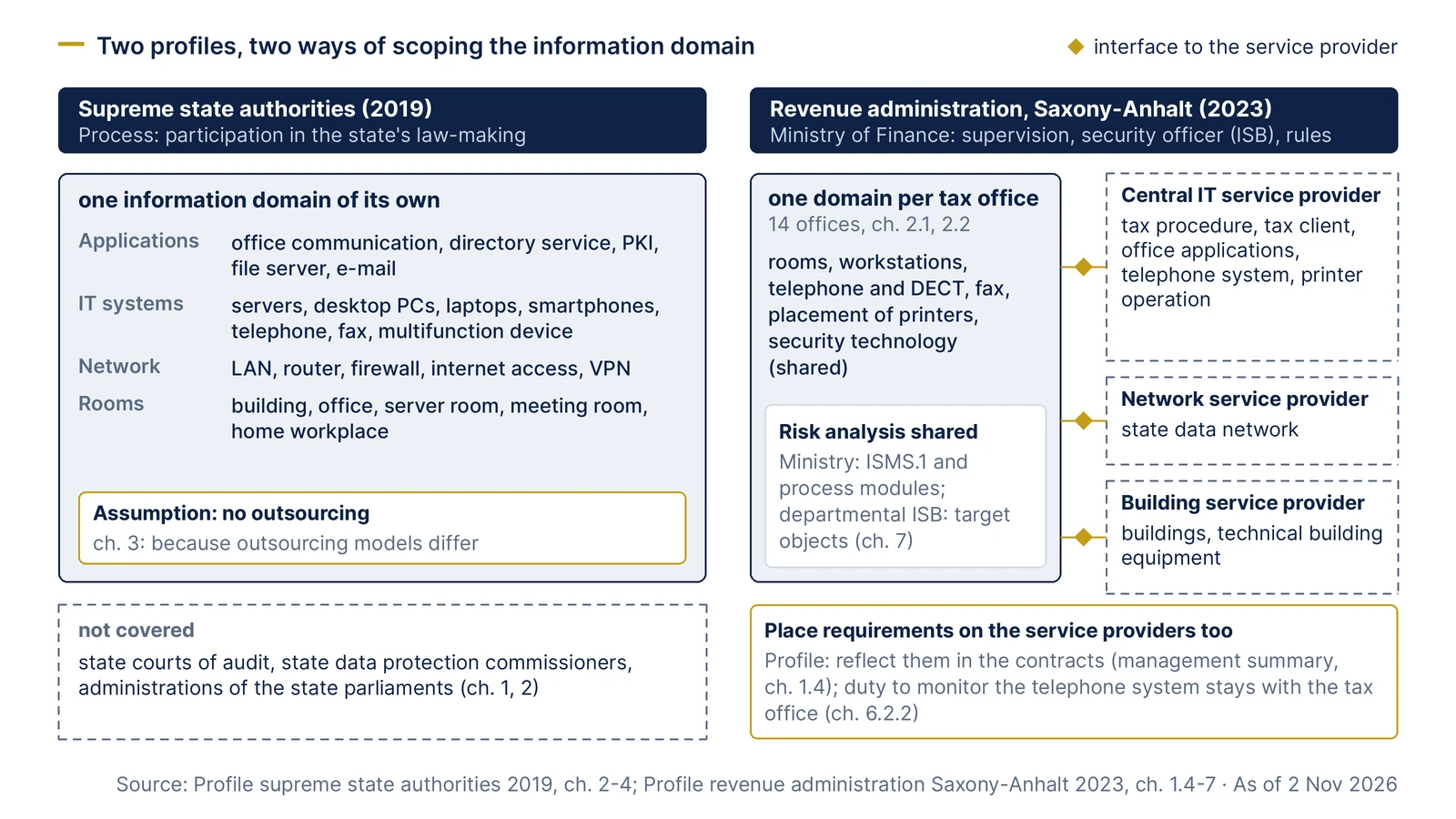
The profile applies to the 14 tax offices in Saxony-Anhalt, which it lists with location and tax office number (chapter 2.2). „Jedes FA ist als ein eigenständiger Informationsverbund definiert.“ (our translation: "Each tax office is defined as a separate information domain.") A tax office may not maintain more than one information domain (chapter 2.1). The domain includes the business processes, the applications and IT systems for which the tax office itself is responsible, buildings and rooms, the telecommunications equipment and the security technology. Excluded are the tax procedure and all applications and systems run by service providers, among them the tax client and the standard workstation, as well as separated networks such as the state data network and non-networked media technology.
The profile considers the service processes „Innendienst steuerliche Verfahren“ (office-based tax procedures) and „Außendienst steuerliche Verfahren“ (field-based tax procedures) and the support processes personnel, organisation, information and communication technology and finance. The steering processes, that is, subject-matter supervision (Fachaufsicht) by the ministry, appear on the process map but do not belong to the domain (chapter 3.3). Table 5 assigns each central target object to one of four responsible parties: network service provider for the state data network, building service provider, central IT service provider, tax office. For the building infrastructure, the profile names the state enterprise Landesbetrieb Bau- und Liegenschaftsmanagement Sachsen-Anhalt (building and property management) or, for rented premises, companies operating on the market (management summary).
What sets the profile apart
- High protection requirements: Confidentiality, integrity and availability are „hoch“ (high), inherited under the maximum principle from the tax procedure and the tax client, whose protection requirements determinations are cited as internal documents from 2019 and 2020 (chapter 4).
- Exclusions with reasons: Chapter 6.2 refers 16 requirements from SYS.3.1 (laptops), NET.4.1 (telephone systems) and SYS.4.1 (printers and multifunction devices) to other bodies. For the telephone system, operating responsibility lies with the service provider, „Die Kontrollpflicht obliegt dem Finanzamt.“ (our translation: "The duty to monitor lies with the tax office.") (chapter 6.2.2)
- Shared risk analysis: The ministry is responsible for overarching requirements from ISMS.1 and the process modules, and the departmental ISB in the tax office for the requirements of the target objects (chapter 7).
- Phased introduction: In the first year Basic Protection is permitted, after that Standard Protection must be applied. From then on, the prescribed IT-Grundschutz tool is mandatory. Certifiability is also a goal (chapter 8.2).
- Own rule on binding force: Standard requirements „können“ (may) be fulfilled. If one is not fulfilled, a risk analysis follows (chapter 6).
- Certified service providers: In figure 4, the access network, procedure services and central data centre infrastructures are marked „Zertifiziert nach ISO 27001 auf Basis von IT-Grundschutz“ (our translation: "certified to ISO 27001 on the basis of IT-Grundschutz") (as shown in the 2023 figure).
No template for all federal states
By its own account, the profile describes „ein idealtypisches Finanzamt im Bundesland Sachsen-Anhalt“ (our translation: "an ideal-typical tax office in the federal state of Saxony-Anhalt") (chapter 8.1). Its scoping rests on the service provider structure of this state, on state networks that it names specifically and on ministry rules (policy, risk management rule, organisational rule) that are not published. Its binding force applies to the revenue administration in Saxony-Anhalt. A tax administration in another federal state can adopt the structure and the way exclusions are justified. It has to determine scoping, service providers and protection requirements itself.
Suitability
A good fit if you are looking for a uniform pattern for a portfolio with many similar offices, a central state IT service provider runs the specialist procedures and workstations, and you want to draw the boundary between your own domain and the service providers' domains in a traceable way.
Not a fit, or only a limited one, if your authority runs its specialist procedure itself, you expect a complete list of modules (the modelling is not published) or your protection requirements are not inherited from a specialist procedure with high protection requirements.
Transfer sheet: classifying the target objects of your state authority
The two profiles answer the same question in opposite ways: does a target object belong in your own domain or in a service provider's domain? The sheet sets out both answers for each target object group side by side and states what you have to decide for your authority and where the result ends up in Grundschutz++. The last column is our proposal. It is based on BSI Standard 300-1 chapter 3.1 (scoping, outsourcing, interfaces) and chapter 3.4 (requirements package).
| Target object group | Supreme state authorities (2019) | Revenue administration Saxony-Anhalt (2023) | To clarify in your authority | Consequence in Grundschutz++ |
|---|---|---|---|---|
| Specialist procedures | not included. The core is office communication (ch. 4) | tax procedure at the central IT service provider, outside the domain (ch. 2.1, table 5) | Who runs the procedure, who sets its protection requirements, is the justification available? | run in-house: asset in the domain. Run externally: asset of the Outsourcing category with a documented interface |
| Desktop computers and laptops | in the domain (SYS.2.1, SYS.2.2.3, SYS.3.1) | stationary tax client with the service provider, mobile tax client shared. Personal firewall and remote access are governed by the security concept of the tax client (ch. 6.2.1) | Which security concept applies to the client, and who provides the evidence? | require the client requirements from the service provider, own requirements (storage, use) in your own package |
| Directory service, e-mail, file storage | in the domain. Directory service high in all basic values, file server in availability (ch. 6.3) | directory service and mail server hosted centrally (figure 6). The file server is in the tax office's server room on the network plan, table 5 names no responsible party for it | Who operates, who administers, where is the data? | record responsibility per asset. Unresolved assets block the requirements package |
| Networks | own LAN with router, firewall, internet access and VPN (ch. 4.4) | state data network (ITN-XT in table 5) at the network service provider, separated and outside the domain (ch. 2.1) | Does your domain end at the in-house cabling or at the handover point of the state network? | document the transition as an interface (300-1 ch. 3.1) |
| Telephony and fax | in the domain (NET.4.1, NET.4.2, NET.4.3) | telephone system at the service provider with the tax office's duty to monitor. The tax office procures and installs telephones and DECT itself (ch. 6.2.2 to 6.2.4) | How do you exercise monitoring when operation is not in your hands? | plan monitoring as a safeguard of your own, for example request and check evidence |
| Printers and multifunction devices | in the domain (SYS.4.1). Printer and copier room without a matching module | operation by the service provider, procurement and placement by the tax office. Four standard requirements with the service provider (ch. 6.2.5) | Which configuration rules does the operating contract contain? | see example 3 below |
| Buildings and rooms | building, office, server room, meeting room, home workplace in the domain | building and technical building equipment with the building service provider, rooms with the tax office, security technology shared (table 5) | Who is the contact for access, fire protection and intrusion alarms? | keep the requirements on the building side as requirements on the building service provider |
| Business continuity management | in the domain (DER.4) | steered across the board in the ministry and the revenue administration (ch. 3.2, 3.3) | Are there rules from the supreme authority that you have to adopt? | adopted rules as a binding obligation in the requirements package |
| Risk analysis and ISMS processes | by the authority itself (ch. 7) | overarching by the ministry, per target object by the departmental ISB (ch. 7) | Which requirements does the supreme authority answer for all offices? | scope with several information domains. 300-1 permits this (ch. 3.1) |
Use the two columns "To clarify" and "Consequence" as a discussion guide with your state IT service provider. How to scope an information domain and document interfaces is described on the page Scoping the information domain. How responsibility is split between client and service provider is shown in the role matrix on the page IT-Grundschutz in municipalities.
Path to Grundschutz++: what the draft mapping covers for both profiles
The count is based on the mapping of the IT-Grundschutz Compendium 2023 to Grundschutz++ in the State-of-the-Art Library (Stand-der-Technik-Bibliothek). This mapping has the status „draft“ (mapping file of 21 July 2026). Targets are resolved against the user catalogue (Anwenderkatalog) build 2026-10-29. All figures are therefore draft figures. A mapping does not prove that a requirement is fully covered in Grundschutz++.
Before counting, we checked every module identifier against the 2023 edition. The profile for the supreme state authorities models 61 modules from the 2019 edition, 54 of which exist under the same identifier in 2023. Seven identifiers no longer exist. For CON.4, APP.5.1, INF.3 and INF.4, the 2021 Compendium names the successors APP.6, APP.5.3 and INF.12. For OPS.2.4 Fernwartung (remote maintenance), OPS.1.2.3 Informations- und Datenträgeraustausch (exchange of information and data media) and SYS.3.4 Mobile Datenträger (mobile data media), we found no expressly named successor in the chapters „Neues im IT-Grundschutz-Kompendium“ (what is new in the IT-Grundschutz Compendium) of the 2020, 2021 and 2023 editions. Based on title and subject matter, we assign OPS.1.2.5 Fernwartung (remote maintenance), CON.9 Informationsaustausch (exchange of information) and SYS.4.5 Wechseldatenträger (removable media) and count them separately. SYS.1.2.3 „Windows Server 2016“ was marked in 2019 as a module in preparation. Under the same identifier, 2023 has the new module „Windows Server“, which is a different text. The revenue administration profile names only four modules in the published text (ISMS.1, SYS.3.1, NET.4.1, SYS.4.1). All of them exist unchanged in 2023.
| Profile and module group | Modules | Requirement identifiers in the 2023 Compendium | of which mapped in the draft | distinct target requirements in the build | Target identifiers not in the build |
|---|---|---|---|---|---|
| Supreme state authorities, same identifier in 2023 | 54 | 1,068 | 279 | 260 | 1 (VRB.1.2, 11 references) |
| Supreme state authorities, successors according to the 2021 Compendium (APP.6, APP.5.3, INF.12) | 3 | 44 | 15 | 21 | 0 |
| Supreme state authorities, successors by our own assignment (OPS.1.2.5, CON.9, SYS.4.5) | 3 | 51 | 8 | 12 | 0 |
| Revenue administration, modules named in the text (ISMS.1, SYS.3.1, NET.4.1, SYS.4.1) | 4 | 76 | 18 | 31 | 1 (VRB.1.2, 3 references) |
How to check individual mappings on the merits is described on the page Checking the IT-Grundschutz 2023 mapping.
The requirement identifiers include those marked as withdrawn in the 2023 Compendium. For the 54 modules of the supreme state authorities, roughly a quarter of the requirements therefore have a mapping. The 260 targets lie mainly in the practices (Praktiken) detection (DET, 65) and architecture (ARCH, 57), followed by configuration (KONF, 31), changes and tests (TEST, 25) and awareness (SENS, 14). A target can be mapped to several modules. It counts once here. Six modules have no mapping at all: ORP.4 Identitäts- und Berechtigungsmanagement (identity and access management), CON.3 Datensicherungskonzept (data backup concept), CON.6 Löschen und Vernichten (deletion and destruction), OPS.1.2.4 Telearbeit (teleworking), NET.4.3 Faxgeräte und Faxserver (fax machines and fax servers) and INF.7 Büroarbeitsplatz (office workplace). Eleven references point to VRB.1.2, which appears in the build of 29 October 2026 neither under its identifier nor via its UUID. For the revenue administration, the count is only an excerpt, because the complete modelling is not published.
Example 1: management reports, declared a MUSS requirement in the profile
Profile passage: Supreme state authorities, chapter 5.2.1, note on ISMS.1.A12 „Management-Berichte zur Informationssicherheit“ (management reports on information security): „Die Anforderung MUSS umgesetzt werden.“ (our translation: "The requirement MUST be implemented.") Reason given in the profile: the reports ensure the successful implementation of the ISMS in the authority. Requirement 2023: ISMS.1.A12, standard requirement with SOLLTE (SHOULD) throughout: regular information of top management, reports with prioritised proposals for safeguards and an effort estimate, audit-proof archiving of reports and decisions. Grundschutz++: The draft maps three sub-requirements to five targets. It names PERF.5.2 and PERF.5.1.9. Resolved via the UUID, in the build these are PERF.4.2 „Bericht an die Institutionsleitung“ (report to top management) and PERF.4.1.9 „Maßnahmenvorschläge“ (proposals for safeguards), both MUSS. In addition there are ARCH.1.1.1 „Dokumentation“ (documentation) and UMS.5.2 „Dokumentation von Ausnahmen“ (documentation of exceptions), both MUSS, and VRB.1.2, which is missing from the build. Gap: The profile's stricter rule is already provided for in the catalogue for the report and the proposals for safeguards. The draft maps the documentation of management decisions to ARCH.1.1.1, UMS.5.2 and VRB.1.2, which is missing from the build. For the audit-proof archiving of reports and decisions, the draft contains no mapping. For that, you look for a target yourself or keep archiving as a requirement of your own.
Example 2: password storage, a note without a target
Profile passage: Supreme state authorities, chapter 5.2.2, note on ORP.4.A8: passwords must not be stored electronically in plain text, and a checksum method in line with the state of the art should be used. Requirement 2023: ORP.4.A8 „Regelung des Passwortgebrauchs“ (rules for password use) contains this point neither in the 2019 edition nor in 2023. In 2023, storage is governed by ORP.4.A23 „Regelung für passwortverarbeitende Anwendungen und IT-Systeme“ (rules for password-processing applications and IT systems) with „Passwörter MÜSSEN so sicher wie möglich gespeichert werden“ (our translation: "passwords MUST be stored as securely as possible"). Grundschutz++: For the whole module ORP.4, the draft contains no mapping. After our own search of the catalogue, DEV.3.4 „Passwort-Hashing“ (password hashing) (SOLLTE) comes into consideration. It is aimed at application development. Gap: For purchased and operated products such as the directory service, we found no target that prescribes the storage form of passwords. The profile's note therefore belongs in the requirements package as a requirement of your own, with a reference to the profile passage.
Example 3: printer configuration, handed over to the service provider
Profile passage: Revenue administration, chapter 6.2.5: SYS.4.1.A7, A15, A17 and A18 are handled by the service provider that operates the printers. Requirement 2023: all four unchanged in identifier and title, among them SYS.4.1.A18 „Konfiguration von Druckern, Kopierern und Multifunktionsgeräten“ (configuration of printers, copiers and multifunction devices) (only IT operations configures, unneeded functions and interfaces switched off, administration only via encrypted protocols). Grundschutz++: Only one sub-requirement of A18 has a mapping, as a subset of ARCH.2.2.10 „Drucker-Netz“ (printer network) (SOLLTE, restrict connections between printers and other systems). A7, A15 and A17 have none. Of all 16 requirements that chapter 6.2 refers to other bodies, only two have a mapping in the draft. The second is NET.4.1.A5 as a superset of DET.3.1.12 „Datenverarbeitungen“ (data processing operations), a KANN requirement (MAY) for elevated (erhöht) protection requirements. Gap: The exclusion in the profile does not carry over by itself. In Grundschutz++ you need your own targets or requirements for printer configuration and an agreement under which the service provider proves that they are fulfilled.
Keep profile-specific requirements and rules separate
What a profile lays down itself is not in any mapping. For the profile for the supreme state authorities, these are the tightening of ISMS.1.A10 and ISMS.1.A12 to MUSS, the note on password storage and the exclusion of CON.2. The risk treatment for the file server (chapter 7.3.3) names 14 additional requirements. Of these, four are marked as withdrawn in 2023 (ORP.5.A10, CON.6.A9, CON.1.A14, OPS.1.1.2.A14), CON.5.A13 no longer exists under this identifier (CON.5 has been APP.7 since 2021), and of the remaining nine, three have a mapping (ORP.2.A13, OPS.1.1.2.A17, ORP.3.A9). For the revenue administration profile, these are organisational rules: Basic Protection in the first year, a risk analysis for every unfulfilled standard requirement, mandatory tool use and review every two years. BSI Standard 300-1 does not provide for Basic and Standard Protection (see Basic, Core and Standard Protection). In our proposal, phasing over time could be mapped via implementation planning and deadlines. Include profile-specific provisions in the requirements package as additional requirements. 300-1 provides that the package can be supplemented with requirements from risk assessment and compliance management (chapter 3.4).
What this page does not decide
This page does not interpret state law. We have not assessed whether your state prescribes IT-Grundschutz, BSI minimum standards or a particular profile, whether there is a state act on information security and what it requires. Your legal department checks that. Nor does the page say whether your authority falls under the NIS 2 implementation, which supervisory authority is competent or which evidence you owe to whom.
The references in both profiles to guidelines for the federal and state governments reflect the status of the profiles (2019 and 2023). The count and the examples refer to the draft mapping of 21 July 2026 and the build of 29 October 2026. Figures and identifiers may change with every new version. A profile is a pattern. It replaces neither the structure analysis nor the protection requirements determination nor the risk analysis of your own authority, and its publication by the BSI is no recognition for your information domain.
Municipal administrations will find their profile and the route via WiBA on the page IT-Grundschutz in municipalities.
All published profiles with their path to Grundschutz++ are listed in the overview of IT-Grundschutz Profiles. Blackfort Technology supports state authorities as a team in scoping the information domain against state IT service providers, in transferring a profile into a Grundschutz++ requirements package and in checking mappings from the draft mapping. The services are listed on the page Consulting.
Rights notice: Quotations from the „IT-Grundschutz-Profil für die obersten Landesbehörden Deutschlands“ © Raphael Grieger, version 1.0 of 31 May 2019, source: BSI page on the profile. Quotations from the „IT-Grundschutz-Profil der Einnahmeverwaltung des Ministeriums der Finanzen Sachsen-Anhalt“ © Ministerium der Finanzen Sachsen-Anhalt, version 1.0 of 7 September 2023, source: BSI page on the profile. Quotations from the IT-Grundschutz Compendium 2023 © Bundesamt für Sicherheit in der Informationstechnik and Reguvis Fachmedien GmbH 2023, quotations from BSI Standard 300-1 © Bundesamt für Sicherheit in der Informationstechnik 2026, source: Compendium page and BSI topic page Grundschutz++, retrieved on 2 November 2026. Statutory text according to https://www.gesetze-im-internet.de/bsig_2025/. Information on the guideline according to the project page of the IT-Planungsrat, retrieved on 2 November 2026. Identifiers and titles from the user catalogue and the draft mapping are licensed under CC BY-SA 4.0 (licence notice at the foot of the page).