

Distributed service: who is responsible for what?
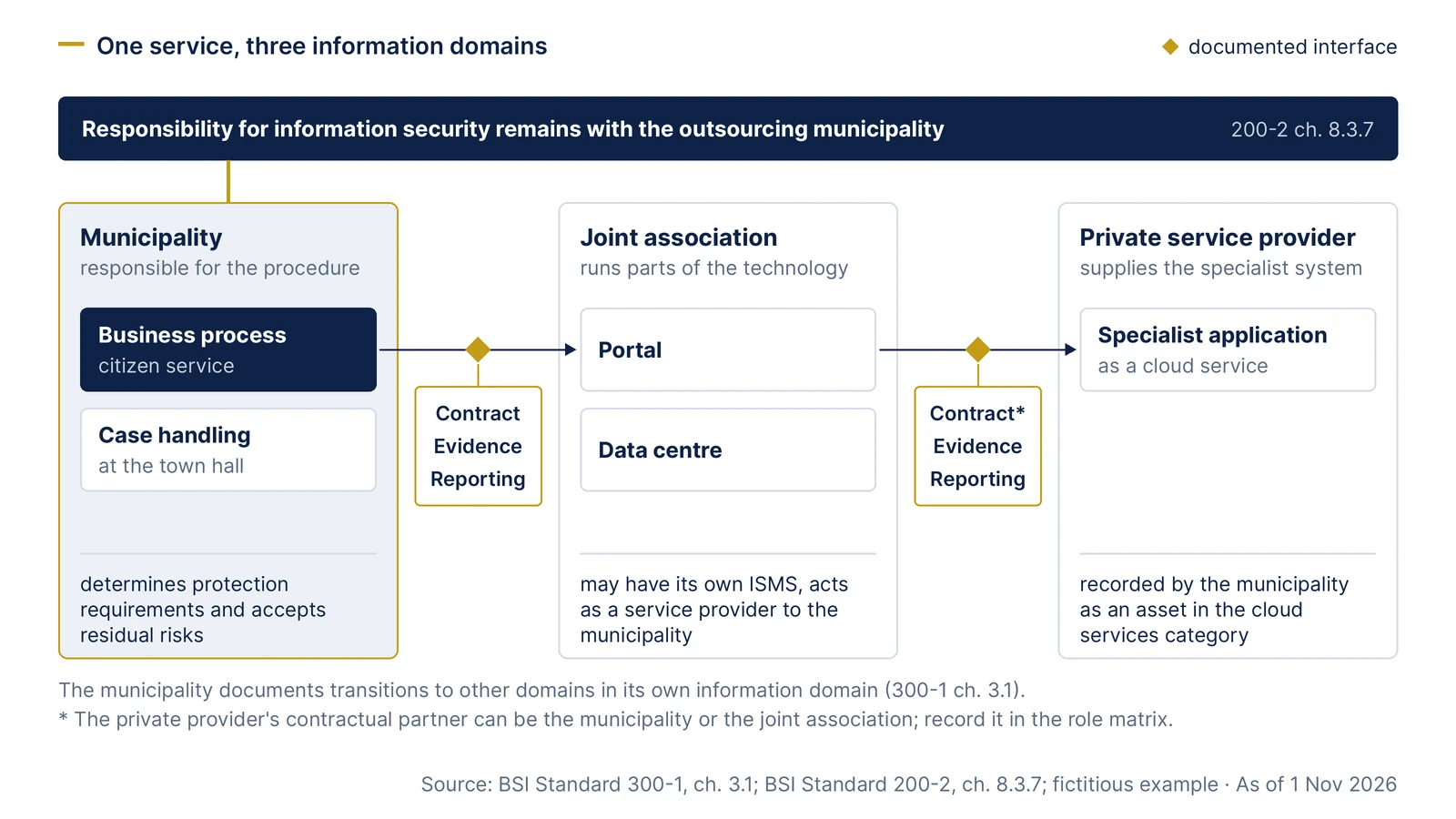
If a citizen service runs through a portal of a joint association, the specialist application is hosted by a private provider and case handling sits in the town hall, there are three organisations with their own management, contracts and systems. For the municipality's ISMS, what matters is who takes on which task and where responsibility lies. BSI Standard 200-2 states in chapter 8.3.7: „Aufgaben können an externe Dienstleister ausgelagert werden, die Verantwortung für die Informationssicherheit verbleibt jedoch immer bei der auslagernden Institution.“ (our translation: "Tasks can be outsourced to external service providers, but responsibility for information security always remains with the outsourcing institution.")
BSI Standard 300-1 starts at the same point. When defining the information domain, chapter 3.1 expressly asks which parts are operated locally, which are outsourced to external parties and which cloud services are used. Transitions to external processes, systems and other information domains must be documented. Annex 1 lists Outsourcing and Cloud services as separate target object categories (Zielobjektkategorien). They give rise mainly to requirements of the practices (Praktiken) procurement management (BES) and service provider management (DLS) for the outsourcing municipality, and some also from emergency planning (NOT) and detection (DET). By our count, the user catalogue (Anwenderkatalog, build 2026-10-29) assigns 29 requirements directly to the target object category Outsourcing and 9 to the category Cloud services.
A joint association that operates technology for several municipalities can appear in the municipality's ISMS as a service provider. At the same time, it can have its own ISMS with its own information domain. If the business process stays with the municipality, the municipality determines its protection requirements and maps the association's service in its own information domain. Whether a task has been transferred to the joint association under state law and who then has which obligations is not covered by this page; your legal department checks that.
Role matrix: municipality, joint association, private service provider
The matrix is a starting proposal for coordination between the parties. R stands for responsible, P for performs, C for contributes, I for informed. The assignment is our assessment based on the references given; in your case it is governed by contracts, statutes and agreements, which we do not interpret.
| Task | Municipality | Joint association / municipal IT service provider | Private service provider | Reference |
|---|---|---|---|---|
| Define the scope of the ISMS | R (top management) | C (information on its own systems) | I | 300-1 ch. 2.3, 2.10 |
| Define business processes and their protection requirements | R | C (technical dependencies) | - | 300-1 ch. 2.5, 2.6, 2.10 |
| Overall responsibility for information security | R (mayor or district administrator, Bürgermeisterin/Bürgermeister or Landrätin/Landrat) | R only for its own ISMS; P towards the municipality | R only for its own ISMS; P towards the municipality | 300-1 ch. 2.10; BSI FAQ WiBA; 200-2 ch. 8.3.7 |
| Document the interfaces between the domains | R | C | C | 300-1 ch. 3.1 |
| Outsourcing strategy and approval | R (top management) | I | - | Catalogue BES.1.4, BES.1.4.1 |
| Agree and document shared responsibility for each cloud service | R | P, if the association brokers the service | C | Catalogue BES.1.6, BES.1.7 |
| Implement requirements in operation | P for its own systems | P for the systems it operates | P for its own service | 300-1 ch. 4 |
| Check compliance at the service provider (audit, certificate or comparable evidence) | R | P, if agreed | C (supplies evidence) | Catalogue DLS.3.1, DLS.3.1.1 |
| Report incidents that affect the client | I | P towards the municipalities | P towards the client | Catalogue BES.5.10.2 |
| Backup of data held by the service provider | R | P, if agreed | P, if agreed | Catalogue NOT.4.13 |
| Accept residual risks | R (top management) | I | I | 300-1 ch. 4.1.2 |
| Operational coordination | P (information security officer (ISB) or a designated unit from IT, organisation or HR) | C | - | 300-1 ch. 2.8; BSI FAQ WiBA |
On overall responsibility, the BSI writes in its FAQ on WiBA that in municipal administrations it lies „in der Regel bei der Landrätin / dem Landrat oder der Bürgermeisterin / dem Bürgermeister“ (our translation: "as a rule with the district administrator or the mayor"); for operational implementation, a lead unit at working level should be designated, ideally an information security officer. How this works in a fictitious municipal IT joint association is shown in the case file starting with Case study 1: survey and planning.
WiBA: what the Path to Basic Protection is and what it is not
WiBA is a BSI project to make getting started with IT-Grundschutz easier, with a focus on municipalities. According to the BSI, WiBA consists „insbesondere aus 19 themenspezifischen Checklisten und insgesamt rund 250 Prüffragen“ (our translation: "in particular of 19 topic-specific checklists and a total of around 250 audit questions"). It is based on the IT-Grundschutz Profile „Basis-Absicherung Kommunalverwaltung“ (Basic Protection for municipal administration) of the Arbeitsgruppe kommunale Basis-Absicherung (AG koBA, working group on municipal basic protection); the WiBA documents are available in version 2.0. The BSI describes IT-Grundschutz Profiles as „Muster für Sicherheitskonzepte, die anhand eines Anwendungsbeispiels die IT-Grundschutz Vorgehensweise darstellen“ (our translation: "templates for security concepts that use an application example to illustrate the IT-Grundschutz approach").
Four statements from the BSI FAQ matter for planning. WiBA is not a methodology for building an ISMS; it is meant to lay the groundwork for one. The FAQ states: „verzichtet [WiBA] bewusst auf eine umfangreiche Planung, Konzeption und Dokumentation“ (our translation: "[WiBA] deliberately dispenses with extensive planning, design and documentation"). Certification under WiBA is currently not possible and not intended; the BSI is working on a confirmation by self-declaration. And: „das BSI kann die Umsetzung von WiBA nicht vorschreiben“ (our translation: "the BSI cannot prescribe the implementation of WiBA"), although there may be state-specific rules under which implementation is mandatory. This page does not say whether that applies in your state.
As the next step after WiBA, the BSI names the IT-Grundschutz Profile „Basis-Absicherung Kommunalverwaltung“, building on that the full Basic Protection and then Standard Protection under IT-Grundschutz. These levels belong to the classic methodology under BSI Standard 200-2. BSI Standard 300-1 does not have Basic, Core and Standard Protection. In the sources evaluated (as of 1 November 2026), the BSI has not published a mapping of WiBA to Grundschutz++.
Fact sheet: the IT-Grundschutz Profile „Basis-Absicherung Kommunalverwaltung“
| Fact sheet | Details |
|---|---|
| Original title | IT-Grundschutz-Profil Basis-Absicherung Kommunalverwaltung (IT-Grundschutz Profile Basic Protection for municipal administration) |
| Author | Arbeitsgruppe kommunale Basis-Absicherung (AG koBA), supported by the Deutscher Städtetag, the Deutscher Landkreistag and the Deutscher Städte- und Gemeindebund (German associations of cities, districts and towns and municipalities) (title page, ch. 1) |
| Version and date | Version 4.0 of 13 Nov 2023, status „freigegeben“ (released); previous versions from 2018, 2019 and 2022 (document history). The BSI page on the profile gives the date 16 Jan 2024. |
| Basis | Applicable only in conjunction with the IT-Grundschutz Compendium, 2023 edition (ch. 6.6). Based on Basic Protection under BSI Standard 200-2, partly extended by standard requirements; according to chapter 6.2 the level is at least Basic Protection and below Standard Protection. |
| Length and rights | 57 pages; licence CC BY-SA 3.0 Germany (ch. 1, 3) |
| Reference | BSI page on the profile, retrieved 2 Nov 2026 |
The profile defines minimum security safeguards for getting started and is aimed at all municipal administrations regardless of type and size (ch. 5.2, 6.1). The profile itself states that protection requirements in municipal administrations are usually higher and that additional requirements are needed (ch. 6.2); according to chapter 5.4, the medium-term goal is a security concept under Standard Protection. It does not cover specialist systems, nor does it cover data-protection-specific requirements (ch. 7.2). According to chapter 6.4, full Basic Protection also requires implementing the basic requirements of further modules, including OPS.1.1.6, DER.2.3, DER.3.1, DER.4 and APP.1.4; according to chapter 6.5, Basic Protection does not achieve protection that is certifiable under ISO 27001. How the profile relates to the other IT-Grundschutz Profiles is shown in the overview IT-Grundschutz Profiles.
Reusing WiBA results in Grundschutz++: the chain and its gaps
There is no direct path from WiBA to Grundschutz++, but there is a detour. The BSI provides a mapping table that maps WiBA audit questions to the requirements of the IT-Grundschutz Profile „Basis-Absicherung Kommunalverwaltung“ (version 4.0) and thus to requirements of the Compendium; the file is called WiBA_Mapping_2023.xlsx. For the 2023 Compendium, the State-of-the-Art Library (Stand-der-Technik-Bibliothek) contains a mapping to Grundschutz++ that has the status "draft" there. Together they form a chain: WiBA audit question, Compendium requirement, Grundschutz++ requirement. Each link has to be checked, and the second is expressly a draft.
The mapping table lists the Compendium requirements sentence by sentence. By our count of the file WiBA_Mapping_2023.xlsx (retrieved on 1 November 2026), the sheet „Mapping WiBA“ contains 2,059 rows; 864 are marked „ja“ (yes) as covered by WiBA, 1,195 „nein“ (no). A completed WiBA therefore covers only some of the sentences of the assigned modules. The table uses three checklists to show how far the chain reaches today.
| WiBA checklist | Compendium requirements according to the BSI mapping table (selection) | Assignment in the mapping 2023 → GS++ (draft, 21 Jul 2026) | Finding in build 2026-10-29 | What you do with the WiBA result |
|---|---|---|---|---|
| IT administration (audit questions 10 to 15) | OPS.1.1.3.A1, A3, A15 (patch and change management) | A1: eleven assignments, including DET.5.10 „Zeitnahes Patchmanagement“ (timely patch management), TEST.4.1 „Autorisierung von Änderungen“ (authorisation of changes), TEST.4.3 „Rückfalllösung“ (fallback solution), TEST.5.1 „Information betroffener Kreise“ (informing affected parties); A15: DET.5.10, DET.5.10.3, DET.5.10.5; A3: no assignment | The DET and TEST identifiers named are present; the assignment target VRB.1.2 from A1 is missing in the build | Use the answers as input for the implementation status of the assigned GS++ requirements, but assess each requirement afresh |
| Backup | CON.3.A1, A2, A4, A12, A14, A15 (data backup concept) | The mapping contains no assignment for CON.3 | Candidates from our own search of the catalogue: NOT.4.6 „Geschützte Aufbewahrung“ (protected storage), NOT.4.10 „Getrennte Aufbewahrung“ (separate storage), NOT.4.15 „Vorgehen zur Wiederherstellung“ (restore procedure), NOT.4.16 „Test der Datensicherung“ (backup testing) | Create the assignment yourself, justify it and mark it as your own assignment |
| Outsourcing and cloud | OPS.2.2.A2, A3, A4, A9, A13 (cloud usage); OPS.2.3.A1 to A7, A11, A14 (use of outsourcing) | OPS.2.2: one assignment, namely for A6, which WiBA does not cover. OPS.2.3: for A2, two assignments at sentence level (sub-requirement 4 equivalent to DLS.3.2 „Checkup“, sub-requirement 1 overlapping with UMS.3.2), none for the other requirements touched by WiBA | DET.3.1.13 and UMS.3.2 are missing in the build. Of OPS.2.3.A2, WiBA covers only the sentence on the outsourcing register; DLS.3.2 corresponds in content to the recurring review, so to a different sentence. We found no assignment in the mapping for the sentence covered by WiBA. Candidates from our own search: BES.1.7 „Vereinbarung der geteilten Verantwortung“ (agreement on shared responsibility), BES.7.4.10 „Serviceprofil“ (service profile), DLS.3.1.1 „Audit oder Zertifikat“ (audit or certificate) | Create the assignment yourself; take into account the contractual position with the joint association and providers |
"Candidates from our own search" are our proposals, not an assignment by the BSI. The figures and identifiers refer to the versions named; the chain may change with every new catalogue build or mapping version. How to check assignments from the mapping on the merits is described on the page Checking the IT-Grundschutz 2023 mapping.
Two rules help with reuse. First, a WiBA result is a status survey. It does not replace the implementation status within the meaning of 300-1: there, each requirement has exactly one status, "fulfilled", "not fulfilled" or "not applicable", the latter only if the requirement cannot be fulfilled functionally or the component does not exist in the information domain (ch. 4.1.1). Second, WiBA questions sometimes cover only individual sentences of a Compendium requirement; the mapping table shows this in the rows marked „nein“. Use WiBA as preparatory work for the structure analysis and for the first pass through the requirements package. In Grundschutz++ you provide the evidence for a requirement separately.
Approach for a municipality with WiBA in place
If a municipality has implemented WiBA and wants to move on to Grundschutz++, an order suggests itself that uses the existing results and makes the distributed service visible early. The steps follow the process steps of 300-1; the assignment to the WiBA results is our proposal.
- Prepare the decision by top management: scope, order of business processes and resources as a decision paper (300-1 ch. 2.10). The BSI's WiBA management summary can serve as a starting point.
- Choose the first business process: 300-1 recommends the most important process from the highest protection requirements category (ch. 2.6). If a joint association or provider is involved in this process, their services belong in the scope from the outset.
- Record parties and contracts: include the joint association, specialist system providers and cloud services as assets of the categories Outsourcing and Cloud services, and document interfaces (ch. 3.1, Annex 1). Keep the role matrix above as a working document.
- Transfer WiBA answers: use the chain WiBA → Compendium → Grundschutz++ to assign the answers to the requirements, mark gaps in the chain and assess each requirement with its own status (ch. 4.1.1).
- Request evidence from the joint association: for outsourced services, specify the form of evidence, such as an audit, certificate or comparable security evidence (catalogue DLS.3.1.1). For a certificate, check whether its scope covers the service obtained (200-2 ch. 8.3.7).
- Handle deviations: put MUSS gaps (MUST) in the implementation plan, classify SOLLTE gaps (SHOULD) as temporary or permanent; permanent ones are followed by a risk assessment (ch. 4.1.2). Details on the page Assessing requirements.
If you want to take the classic route via the profile and Basic Protection first instead of Grundschutz++, you will find the differences between the approaches on the page Basic, Core and Standard Protection, and the trade-off between the two routes on the page Deciding on the switch. Blackfort Technology supports municipalities and joint associations in defining the information domain, clarifying roles and building the requirements package; the packages are on the page Consulting.
Rights notice: Quotations from the BSI pages on WiBA © Bundesamt für Sicherheit in der Informationstechnik, source: BSI page WiBA and FAQ WiBA and BSI page IT-Grundschutz Profiles, retrieved on 1 November 2026. Quotation from BSI Standard 200-2 © Bundesamt für Sicherheit in der Informationstechnik, source: BSI Standard 200-2. Identifiers and relationships from the WiBA mapping table are BSI data; the count is our own. They are not under CC BY-SA 4.0; the licence notice at the end of the page applies only to the extracts from the catalogue data.