

What this case file is and is not
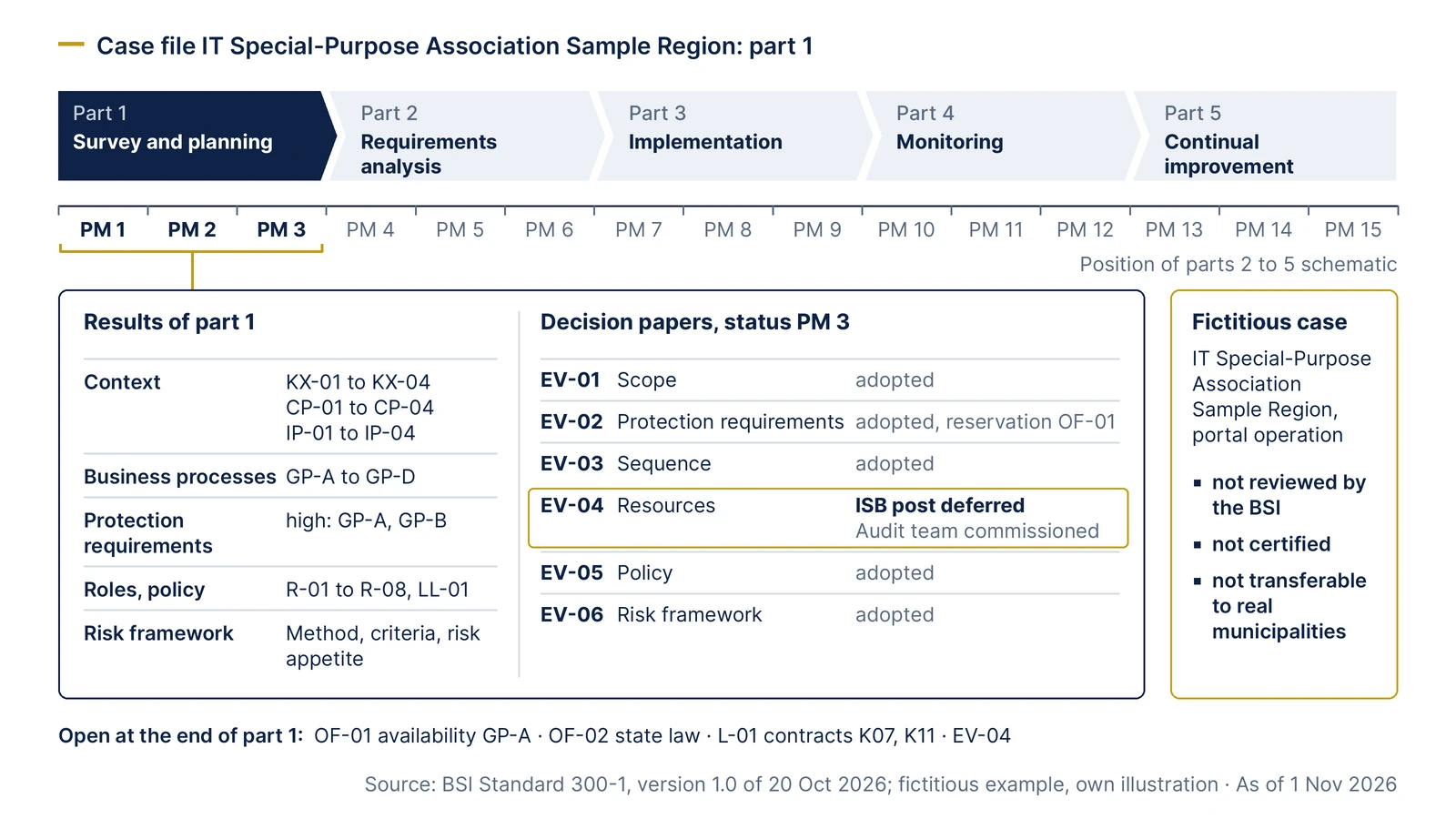
Fictitious case. The IT Special-Purpose Association Sample Region, its municipalities, systems, people, figures and decisions are invented. The case file has not been reviewed by the BSI, is not certified and cannot be transferred to real municipalities or service providers. It shows what the requirements of BSI Standard 300-1 can look like in a file and does not replace an assessment in your organisation.
Common source status for all five parts: BSI Standard 300-1 "Methodik Grundschutz++" (Grundschutz++ methodology), version 1.0 of 20 October 2026, and the Grundschutz++ user catalogue (Anwenderkatalog), build of 29 October 2026 (commit c3f37859 of 30 October 2026). Identifiers and texts of requirements come from this build, and we counted all quantities ourselves. The file covers project months PM 1 to PM 15; later months appear only as planned deadlines. Counting in project months is meant to prevent dates from looking like events that actually happened.
In the milestone plan on its Grundschutz++ page, the BSI has announced its own application example for December 2026, based on the fictitious example authority "BDIT". This case file is independent of it and may differ from it.
The case file in five parts:
- Survey and planning (this page)
- Requirements analysis: information domain, assets, requirements package
- Implementation: implementation status, risk register, implementation plan
- Monitoring: metrics, internal audit, management review
- Improvement: nonconformities, corrective action plan, effectiveness review
The methodology itself is explained on the topic pages that each section refers to. This page only records what the IZM decided and documented.
Profile: the IT Special-Purpose Association Sample Region
The following assumptions apply unchanged to all five parts. They were chosen so that as many rules of 300-1 as possible come into play: many clients, a shared portal, external editorial teams and a server room in the basement on a river.
| Characteristic | Assumption in the case (fictitious) |
|---|---|
| Organisation | IT Special-Purpose Association Sample Region (IZM), supported by twelve municipalities K01 to K12; around 180 employees |
| Top management | Executive management of the IZM (role R-01); it decides within the resolutions of the association assembly |
| Area under consideration | Portal Services division with 14 employees: operation of the shared citizen portal through which residents of the twelve municipalities submit applications online |
| Location | one site with an administration building and a technical building; server room RZ-1 in the basement of the technical building, the site lies on a river |
| Starting point | no ISMS based on IT-Grundschutz, individual security rules in IT operations, a data protection officer, a part-time information security officer (ISB) |
| Trigger | the service agreements with the municipalities require an ISMS based on BSI Grundschutz; the IZM starts directly with Grundschutz++ (on choosing the route, see Grundschutz++ now or later) |
| Source status | 300-1 version 1.0; user catalogue build 2026-10-29 |
Identifier scheme of the case file
Every object in the file receives an identifier when it first appears, and that identifier never changes afterwards. If an object is discarded, its identifier stays assigned and receives a note. This makes decisions from part 1 traceable even in the audit in part 4.
| Prefix | Object | from part |
|---|---|---|
| K01 to K12 | municipality (client) | 1 |
| K13 | joining municipality | 4 |
| KX, CP, IP | context factor, compliance requirement, interested party | 1 |
| L, DL, KR | gap, document control rule, communication rule | 1 |
| GP-A to GP-D | business processes in scope | 1 |
| R | role in the security organisation | 1 |
| Z, LL | security objective, policy | 1 |
| EV | decision paper for executive management | 1 |
| OF | open question or open decision | 1 |
| IV, S, AS | information domain, interface, asset | 2 |
| EIG | own requirement of the IZM (not a BSI requirement) | 2 |
| B, P | finding from the asset inventory, resource path | 2 |
| RR, RS, MN, NW | risk, residual risk of a planned requirement, safeguard, evidence | 3 |
| KZ, FS, MB, SV | metric, audit finding, management review, security event | 4 |
| NK, SW, VP, KV | nonconformity, systemic weakness, improvement potential, entry in the corrective and improvement plan | 5 |
Requirements keep their identifier from the user catalogue, for example GC.6.1. The IZM's own requirements carry the prefix EIG so that nobody mistakes them for catalogue texts. K1 to K7 denote the criteria of the assessment matrix on the protection requirements determination page and are not objects of the file.
Context, compliance list and interested parties
Chapters 2.1 to 2.4 of 300-1 require external and internal influencing factors, legal and contractual requirements and the expectations of interested parties to be recorded. The standard does not ask for a long report for this; essential aspects are to be recorded briefly (chapter 2.1). The IZM added a consequence for the ISMS to every row so that it is clear later where the factor reappears.
| Identifier | Factor or requirement (fictitious) | Consequence for the ISMS | reappears in part |
|---|---|---|---|
| KX-01 | site on a river, server room in the basement (external factor; 300-1 gives a location on a river as an example, ch. 2.1.1) | flooding as a topic for site requirements and risk assessment | 3 |
| KX-02 | twelve municipalities with their own specialist applications (Fachverfahren) to which the portal hands over applications | many external interfaces, coordination with twelve clients | 2 |
| KX-03 | staff shortage in IT operations, part-time ISB (internal factor lack of resources, ch. 2.1.2) | allocation of resources as a separate decision paper | 1, 3 |
| KX-04 | forms are maintained by the municipalities' own editorial teams | external users with far-reaching rights in the portal | 2, 4 |
| CP-01 | service agreements with K01 to K12, including the requirement for an ISMS based on BSI Grundschutz | trigger for the project; contractual requirements for handover and availability | 2 |
| CP-02 | data processing agreements with the municipalities | requirements for deletion periods and reporting channels | 3 |
| CP-03 | maintenance contract with the manufacturer of the portal software, with remote access | service within the information domain | 2 |
| CP-04 | possible state-law requirements on information security for municipal service providers | open question OF-02 to the IZM's legal department | 2 |
| IP-01 | municipalities as clients: expect evidence and handover without loss | evidence planning, reports to the association assembly | 4 |
| IP-02 | residents: expect confidentiality of their applications and a portal that is available | protection requirements GP-A | 1 |
| IP-03 | staff council: co-determination on logging and analysis of access | involvement before log analyses are introduced | 3 |
| IP-04 | data protection officer of the IZM | consultation on protection requirements and deletion periods | 1 |
Gap L-01: The current service agreements for municipalities K07 and K11 were not available when part 1 was completed. The compliance list is therefore incomplete. The IZM documented the gap openly instead of assuming the content from the other municipalities' contracts.
Open question OF-02: The ISB did not assess personally whether state-law requirements on information security apply to the IZM as a municipal service provider. The question lies with the legal department. In such cases we classify the requirements that an organisation names or that appear in its documents; whether they apply legally is checked by its legal department.
Under chapter 2.4, the organisation determines, in agreement with top management, which binding obligations are included in the ISMS as requirements. In the case these are CP-01 to CP-03. Where the catalogue does not already cover them, they give rise to the IZM's own requirements in part 2.
Scope and business process list
Executive management set the scope as the Portal Services division at the IZM's site (EV-01). Excluded are the IZM's internal administration, the data centre services for the municipalities' specialist applications and the telephone system. The exclusion is justified: these areas have their own owners and will follow in a later cycle, and their transitions to portal operation are described as interfaces in part 2. What 300-1 says about the difference between scope and information domain is on the page on delimiting the information domain.
There was no process map for the process list. The IZM therefore used the simplified business process analysis under Annex 2 and collected the minimum information required there: identifier, name, responsible business unit, short description and key applications.
| Identifier | Name | business owner | Short description (purpose, result, contribution to objectives) | key applications |
|---|---|---|---|---|
| GP-A | Receive and hand over online applications | Head of Portal Services (R-03) | Residents submit applications with supporting documents online; the IZM checks them formally and hands them over to the specialist application of the responsible municipality. Result: complete, unaltered application at the municipality. Contribution: the municipalities' online services under the service agreements CP-01. | citizen portal, form builder, handover service |
| GP-B | Pay fees online | Head of Portal Services (R-03) | Fees are paid within the application via an external payment service provider; the payment status goes to the municipality with the application. Result: application with confirmed payment status at the municipality; contribution: fulfilling service agreement CP-01. | citizen portal, payment interface |
| GP-C | Maintain forms and content | Portal editorial lead | The municipalities' editorial teams maintain forms and texts; the IZM provides the form builder. Result: published, reviewed form; contribution: the municipalities' online services. | form builder |
| GP-D | Answer enquiries about the portal | Head of Service Desk | The service desk answers enquiries about the portal from residents and municipalities. Result: answered enquiry; contribution: accessibility of the portal for residents and municipalities. | ticketing system, email |
GP-C was kept as a separate process even though the forms are used in GP-A. The reason: maintenance has its own participants (the municipalities' editorial teams) and its own result. This separation has consequences in part 2 and part 4, because the form builder appears in both processes.
Protection requirements per business process
Protection requirements were assessed in one session per process with the responsible business unit, the ISB and the data protection officer. The yardstick was the two categories from 300-1 chapter 2.6 and the criteria K1 to K7 from the assessment matrix on the protection requirements determination page. The classification high follows the standard's definition: the impact can be considerable. The standard's damage scenarios served as guidance, not as an exhaustive list.
| Process | Confidentiality | Integrity | Availability | Justification (fictitious) |
|---|---|---|---|---|
| GP-A | high (K2) | high (K6) | normal, with reservation OF-01 | Applications contain supporting documents, some with health information (for example for parking concessions); a leak would seriously affect those concerned and damage trust in all twelve municipalities. Altered applications lead to wrong decisions by the municipalities, which rely on the handover. An outage of up to two working days can be absorbed through deadline extensions and paper applications. |
| GP-B | normal | high (K6) | normal | Payment data is held by the payment service provider; the IZM receives only the payment status and the amount. An altered status leads to decisions without payment or to duplicate claims. |
| GP-C | normal | normal | normal | Forms and texts are public; errors are noticed and corrected by the editorial team. The effect of altered form logic on applications is covered under GP-A. |
| GP-D | normal | normal | normal | Enquiries rarely contain more than contact details; outages can be absorbed by telephone and email. |
Open decision OF-01: Three municipalities require in their service agreements that the portal accepts applications again within one working day after a disruption. Portal operations therefore considered "high" to be correct for the availability of GP-A, the Head of Portal Services "normal". Executive management approved "normal", included the recovery target of one working day as security objective Z-03 and earmarked the classification for review in the second cycle. This decision comes back in part 4 and part 5.
Sequence: GP-A and GP-B both have high protection requirements. 300-1 recommends starting with the most important process in the highest category and leaves the choice to top management when there are several processes (chapter 2.6). Executive management chose GP-A for the first cycle, GP-B follows in the second (EV-03). An explicit risk assessment is required for both processes (chapter 2.11). How the classification works methodically is shown on the page Protection requirements determination.
Policy, roles and document control
The policy LL-01 describes objectives and strategy and sets out the commitment of executive management, as chapter 2.7 provides. The standard mentions measurable objectives, for example according to SMART. The IZM formulated three objectives against which the metrics in part 4 can be measured: Z-01, for every requirement in the requirements package there is an implementation status no more than three months old; Z-02, critical vulnerabilities on portal assets are remedied within seven days; Z-03, after a disruption the portal accepts applications again within one working day, measured as no more than 24 hours from the start of recovery. Executive management approved the policy, and the intranet and a briefing made it known to all employees.
One finding on the roles remained open. The ISB is also deputy head of IT operations. Chapter 2.8 explicitly names the combination of IT management and ISB as an example of a conflict of interest to be avoided, and catalogue requirement GC.9.1.1.1 provides for responsibility for information security to be assigned to a person who reports directly to top management; the parameter proposes „einer unabhängigen Person“ (our translation: "an independent person") for this. GC.9.1.1.3 requires safeguards against conflicts of interest. The guidance on GC.9.1.1.3 names, among other solutions, setting up the ISB as a staff unit or a four-eyes principle.
| Role | Task in the ISMS | Staffing in the case (fictitious) | Finding |
|---|---|---|---|
| R-01 Executive management | overall responsibility, approvals under ch. 2.10, approval of residual risks | Managing director and deputy | - |
| R-02 ISB | steering the security process, moderating the risk assessment | part-time ISB, also deputy head of IT operations | conflict of interest, GC.9.1.1.1 and GC.9.1.1.3 not fulfilled; solution deferred in EV-04 |
| R-03 Head of Portal Services | owner of GP-A and GP-B, risk owner | Head of the Portal Services division | - |
| R-04 IT operations | operation of the systems, operational implementation | data centre team, six administrators in portal operation | - |
| R-05 Data protection officer | consultation, no ISB tasks | internal DPO | separate from the ISB, as ch. 2.8 suggests |
| R-06 Audit team | internal audit (from part 4) | internal audit department of a member municipality on behalf of the IZM | mandate included in EV-04 |
| R-07 Contract management | contracts with municipalities, manufacturer and payment service provider | Legal and Contracts staff unit | L-01 open |
| R-08 Editorial lead | business responsibility for GP-C | editorial lead in portal operation | - |
Involvement of the ISB: Chapter 2.8 requires the ISB to be involved in security-relevant projects and that it be defined when this happens. The IZM has defined: the ISB is informed of every change that concerns a new interface, a new asset or a new service provider, and is involved before every go-live.
Document control DL-01: All documents of the case file are kept in a repository with version, approving role and review date. This is the basis for the procedure under chapter 2.9 and for traceability in the audit.
Communication rule KR-01: defines who communicates on security matters internally and towards municipalities, the manufacturer and the public, and through which channel, including the reports to the association assembly and the reporting channel to the municipalities.
Framework for the risk assessment
Because GP-A and GP-B have high protection requirements, the IZM needs an explicit risk assessment. Chapter 2.11 requires the framework for it as early as the first process step, at strategic, methodological and organisational level, and has it authorised by top management. The method can be chosen freely as long as the minimum criteria (Mindestkriterien) from Annex 3 are met. The IZM chose a simple scenario-based method with three levels. The scales and the matrix are the case's own definitions, not a BSI requirement. The IZM set the parameter of RISK.1.1 („nach einem anerkannten Standard“, our translation: "according to a recognised standard") as "based on ISO/IEC 27005, in compliance with the minimum criteria from Annex 3"; 300-1 chapter 2.11 names ISO/IEC 27005 and ISO 31000 as possible bases.
| Level | IZM definition (fictitious) | Minimum criterion (Annex 3) |
|---|---|---|
| strategic | Low risk appetite for confidentiality and integrity of application data; delays of up to two working days acceptable. Acceptance criteria: "low" acceptable; "medium" acceptable for a limited period, at most twelve months; "high" to be treated, otherwise only as an exception by executive management | 7, 8, 27, 28 |
| methodological | risk scenarios based on the elementary threats G 0.1 to G 0.47; likelihood rare (less often than every five years), occasional (every one to five years), recurring (at least annually); impact limited, considerable, existential | 1 to 4, 6, 10, 18, 19 |
| organisational | the risk owner is the owner of the business process (for GP-A the Head of Portal Services R-03); the ISB moderates and keeps the risk register | 5, 16 |
| Authorisation | risk policy, roles, criteria and risk appetite signed by executive management (EV-06) | 9 |
| Likelihood | limited | considerable | existential |
|---|---|---|---|
| rare | low | medium | high |
| occasional | low | high | high |
| recurring | medium | high | high |
Whether your own method covers all 35 criteria can be checked with the checklist on the page Risk minimum criteria. How a risk assessment works is shown on the page Risk analysis. The IZM's own risks are in part 3.
Decision papers for executive management
Under chapter 2.10, responsibility for the ISMS lies with top management and cannot be delegated. In chapter 2.10, 300-1 lists the decision papers that are submitted to it in particular: scope, protection requirements of the business processes, sequence of the processes, resources and policy. The list is not exhaustive; the IZM added the risk framework as a sixth paper.
| Paper | Subject | Result in PM 3 (fictitious) |
|---|---|---|
| EV-01 | Scope Portal Services with exclusions | adopted |
| EV-02 | Protection requirements GP-A to GP-D | adopted, availability of GP-A with reservation OF-01 |
| EV-03 | Sequence: GP-A in the first cycle, then GP-B, GP-C, GP-D | adopted |
| EV-04 | Resources: ISB as a full-time staff unit, mandate for the audit team | audit team mandate adopted; ISB post deferred until the association assembly's budget resolution |
| EV-05 | Policy LL-01 with objectives Z-01 to Z-03 | adopted |
| EV-06 | Framework of the risk assessment | adopted |
The deferral of EV-04 is the most important open point of part 1. It leaves the ISB's conflict of interest in place. For a MUSS (MUST) requirement such as GC.9.1.1.1 there is no way out through risk acceptance (chapter 4.1.2); the question returns in part 3 as an unfulfilled MUSS requirement with a safeguard and deadline.
Result of part 1: methodology status after the first step
The methodology requirements of the user catalogue apply to every information domain (300-1 chapter 3.4.1). The IZM recorded their status at the end of step 1, as a provisional list that feeds into the full status survey in part 3. The requirement texts are shortened, and the identifiers come from the build of 29 October 2026.
| Requirement (modal verb) | Content, shortened | Status PM 3 (fictitious) | Evidence in the file |
|---|---|---|---|
| GC.2.1, GC.2.2 (MUSS) | analyse external and internal conditions | fulfilled | KX-01 to KX-04 |
| GC.3.1 (MUSS) | establish a procedure for recording compliance obligations | fulfilled | compliance list CP-01 to CP-04 |
| GC.3.1.1 (MUSS) | analyse legal obligations | not fulfilled until OF-02 is answered | request to the legal department |
| GC.3.1.3 (SOLLTE, SHOULD) | analyse contractual obligations | not fulfilled, temporarily (L-01) | list of missing contracts |
| GC.4.1, GC.4.2 (MUSS) | analyse external and internal interested parties | fulfilled | IP-01 to IP-04 |
| GC.5.1 to GC.5.1.4 (MUSS) | objectives, strategy, top management commitment, policy and its approval | fulfilled | LL-01, EV-05 |
| GC.6.1 (MUSS) | define a delimited scope after approval by top management | fulfilled | EV-01 |
| GC.7.1, GC.7.1.1, GC.7.1.2 (MUSS) | procedure, business processes, protection requirements | fulfilled | process list, EV-02 |
| GC.7.2 (MUSS) | carry out a risk assessment for processes with high protection requirements | not fulfilled, planned for step 3 | - |
| GC.8.1 (MUSS) | establish a procedure for resource planning | not fulfilled | EV-04 deferred |
| GC.9.1, GC.9.1.1 (MUSS) | security organisation, roles and responsibilities | fulfilled | role table R-01 to R-08 |
| GC.9.1.1.1, GC.9.1.1.3 (MUSS) | independent ISB reporting directly to top management; avoid conflicts of interest | not fulfilled | finding on R-02 |
| GC.10.1, GC.10.1.2 (MUSS) | communication management; involvement in security-relevant projects | fulfilled | communication rule KR-01; rule on ISB involvement |
| GC.11.1 (MUSS) | document control across the life cycle | fulfilled | DL-01 |
| GC.12.1, RISK.1.1, RISK.1.3, RISK.1.5 (MUSS) | uniform risk methodology, risk owner role, approval by top management | fulfilled | risk policy, EV-06 |
Open at the end of part 1:
- OF-01 availability of GP-A: normal with reservation, review in the second cycle
- OF-02 state-law requirements: with the legal department
- L-01 missing service agreements K07 and K11
- EV-04 ISB post deferred, conflict of interest persists
These points do not stand in the way of part 2. 300-1 does not require step 1 to be completely fulfilled before the requirements analysis begins. They must, however, end up in the implementation plan, otherwise they disappear.
What comes next
In part 2 the IZM defines the information domain for GP-A, records the assets with their dependencies, assigns them to target object categories (Zielobjektkategorien) and recalculates the requirements package from the catalogue build.
- Continue with part 2: Requirements analysis
- Methodology for the first process step: BSI Standard 300-1, Delimiting the information domain, Protection requirements determination
Blackfort Technology supports the survey and prepares decision papers for top management, see Consulting.
Rights notice: Short quotations and references from BSI Standard 300-1 "Methodik Grundschutz++", version 1.0 of 20 October 2026, © Bundesamt für Sicherheit in der Informationstechnik 2026, source: BSI page on Grundschutz++. They are not licensed under CC BY-SA 4.0; the licence notice at the end of the page applies only to the extracts from the catalogue data.