

Note and recap of parts 1 and 2
Fictitious case. Organisation, systems, status values, risks and decisions are invented. The case file has not been reviewed by the Bundesamt für Sicherheit in der Informationstechnik (BSI), the German Federal Office for Information Security, is not certified and cannot be transferred to real municipalities or service providers. What is real are the identifiers, modal verbs and threat mappings of the requirements from the Grundschutz++ user catalogue (Anwenderkatalog), build 2026-10-29; methodology according to BSI Standard 300-1, version 1.0.
The story so far: The IT Special-Purpose Association Sample Region (IZM) runs a citizen portal for twelve municipalities. In part 1 executive management selected process GP-A "Receive and hand over online applications", with high protection requirements for confidentiality and integrity, for the first cycle and authorised a risk framework with three levels (low, medium, high). The information security officer (ISB) post remained deferred (EV-04). In part 2 a package of 928 catalogue requirements and two own requirements (EIG-01 on the approval of form logic, EIG-02 on the signature of handed-over applications) was compiled for the information domain IV-PORTAL with 24 assets. The form builder AS-02 is considered not sufficiently covered. The data backup is located in the same server room as the systems (finding B-01).
Between part 2 and part 3 the legal department examined open question OF-02 and entered its result in the compliance list. GC.3.1.1 is therefore fulfilled.
How the IZM surveyed the status
Chapter 4.1.1 requires the status of every requirement to be checked completely, with the values fulfilled, not fulfilled or not applicable. The IZM surveyed the 930 entries between PM 5 and PM 7, using the methods named in chapter 4.1: interviews with the teams, review of documents, analysis of configuration exports and existing reports from tools. Each line of the status list NW-02 contains the date of the check, the person checking and the reference to the evidence. The list thus also provides evidence for UMS.1.1, which requires a complete review at the defined interval, here quarterly.
For requirements that apply to several assets, a simple rule applied: fulfilled only if fulfilled on every affected asset. The guidance on UMS.1.1 points in the same direction. It only treats a requirement as implemented once all requirements that depend on it are implemented as well. How the three statuses are assigned in general, and where the catalogue says something different, is explained on the page Assessing requirements and documenting deviations.
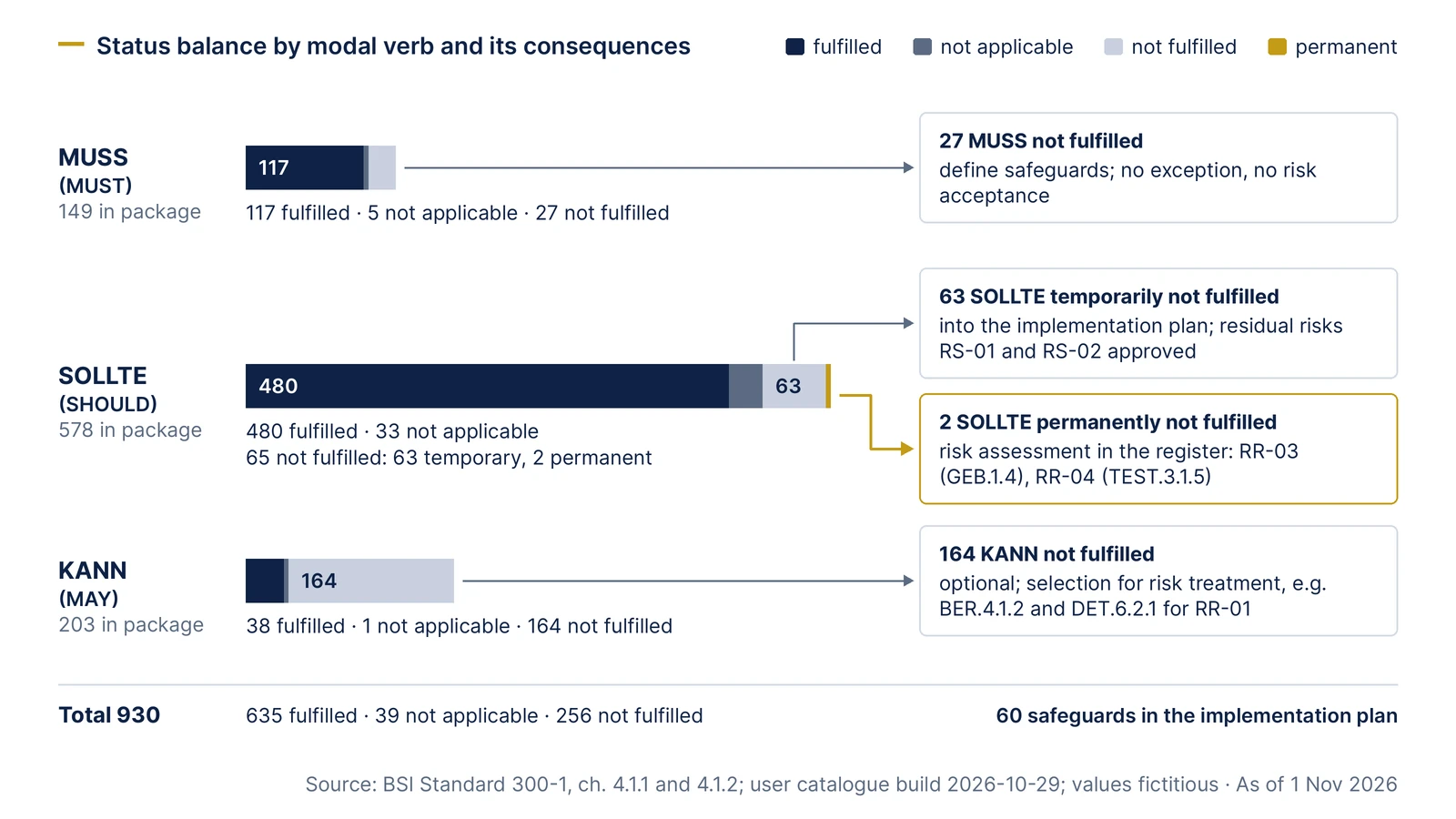
Status balance by modal verb
The figures are fictitious, but together they add up exactly to the package from part 2. The two SOLLTE (SHOULD) requirements with level "elevated (erhöht)" (DET.4.12.1, REA.2.5) and the two own requirements are included in the SOLLTE row.
| Modal verb | in package | fulfilled | not fulfilled | not applicable | Consequence under 300-1 ch. 4.1.2 |
|---|---|---|---|---|---|
| MUSS (MUST) | 149 | 117 | 27 | 5 | define safeguards for every requirement not fulfilled; no exception, no risk acceptance |
| SOLLTE (SHOULD) | 578 | 480 | 65 (63 temporary, 2 permanent) | 33 | temporary: justify and schedule; permanent: risk assessment |
| KANN (MAY) | 203 | 38 | 164 | 1 | optional; can be selected in risk treatment |
| Total | 930 | 635 | 256 | 39 |
Among the 27 MUSS requirements not fulfilled are 21 methodology requirements of the practices (Praktiken) monitoring and evaluation (Monitoring-Evaluation, PERF, 13) and improvement (Verbesserung, VRB, 8). At this stage that is consistent: audit, management review and corrective procedures belong to steps 4 and 5, which have not yet been carried out. The remaining six are GC.1.1 (establishing and maintaining the ISMS; according to the guidance only fulfilled once the approach has been run through completely at least once), GC.8.1 (resource planning), GC.9.1.1.1 and GC.9.1.1.3 (independent ISB, conflicts of interest), TEST.1.1 (change procedure, which so far does not cover the form logic) and NOT.1.1 (outdated rules on emergency preparedness).
Status examples from the list, with justification
The following selection shows every kind of entry that occurs in the case file, including several entries that turn out to be wrong in the audit in part 4 (BER.3.16 to BER.3.19, KONF.8.1, NOT.4.16.1). The requirement texts are shortened. Identifier, modal verb and target object category (Zielobjektkategorie) are taken from the build.
| Requirement (modal verb, category) | Status | Justification and evidence (fictitious) |
|---|---|---|
| GC.9.1.1.1 independent ISB, reporting directly to top management (MUSS, none) | not fulfilled | The ISB is also deputy head of IT operations. Safeguard MN-01, deadline PM 9. A proposal from executive management to accept the risk until the next budget was rejected: for MUSS requirements, exception and risk acceptance are not possible under ch. 4.1.2. |
| PERF.3.1 establish a procedure for audit programmes (MUSS, none) | not fulfilled, scheduled | audit programme is drawn up in part 4; MN-12, deadlines PM 9 (audit programme) to PM 11 (first audit) |
| GC.7.2 risk assessment for processes with high protection requirements (MUSS, none) | fulfilled for IV-PORTAL (GP-A) | risk register with RR-01 and RR-02 for GP-A, see below; the risk assessment for GP-B follows with its modelling in the second cycle (EV-03) |
| BER.3.16 prohibit group accounts in regular operation (SOLLTE, none) | fulfilled | NW-05: account export from the directory service AS-13 without group accounts |
| BER.3.17, BER.3.18, BER.3.19 rules for group accounts (SOLLTE, none) | not applicable | no group accounts exist, the underlying component does not exist (ch. 4.1.1); the guidance on BER.3.17 and BER.3.18 calls the requirement dispensable in this case |
| DEV.1.1 procedure for developing IT products (MUSS, none) and 33 further requirements of the DEV practice | not applicable | The IZM does not develop IT products within the information domain, the portal was procured. In this case the guidance on DEV.1.1 calls the whole practice dispensable. |
| KONF.3.3 SIM PIN for mobile network connection (SOLLTE, IT systems) | not applicable | no IT system in the information domain has a mobile network connection |
| NOT.4.5 archiving of data needed in the long term (SOLLTE, data) | not applicable | application data is deleted 90 days after handover; the guidance calls the requirement dispensable if no data is needed in the long term |
| KONF.11.4 block trial-and-error guessing of access links (SOLLTE, web applications) | fulfilled | Proposal "not applicable because everyone logs in" rejected: the application status can be retrieved by case number without logging in, and the guidance calls the requirement dispensable only if the web application offers no access whatsoever to information worth protecting without authentication; the application status linked to a case is such information. NW-09: configuration export of the reverse proxy |
| KONF.12.10 activate cookie attributes (SOLLTE, web applications) | not fulfilled, temporary | one attribute is missing in the session cookie, fixed with the manufacturer's update in PM 10; MN-07; residual risk RS-02 |
| KONF.8.1 monitor the availability of security updates (SOLLTE, IT systems) | fulfilled | NW-11: automated report from software distribution with tool, time and result "41 of 41 recorded systems without open critical updates" |
| NOT.4.16.1 check restoration using random samples (SOLLTE, data) | fulfilled | NW-14: test record from PM 4 with three samples |
| BER.5.9 multi-factor authentication for far-reaching permissions (SOLLTE, none) | not fulfilled, temporary | administrators have MFA; the editorial teams who can publish form logic do not yet; MN-21, deadline PM 11 |
| GEB.1.4 place assets worth protecting outside exposed areas (SOLLTE, locations) | not fulfilled, permanent | server room RZ-1 in the basement by the river (KX-01); a move is not planned for the foreseeable future; risk assessment RR-03 |
| TEST.3.1.5 install a dedicated test environment (SOLLTE, none) | not fulfilled, permanent | The citizen portal licence does not include a test instance until the end of the contract; risk assessment RR-04 |
| BER.4.1.2 JIT/JEA permissions (KANN, none) and DET.6.2.1 sandbox analysis of suspicious files (KANN, none) | not fulfilled | selected in the risk treatment of RR-01, MN-53 and MN-54 |
| EIG-01 approval of form logic by an independent role (SOLLTE, own requirement) | not fulfilled, temporary | MN-55, deadline PM 9 |
For "not applicable" the IZM only allowed the two reasons from chapter 4.1.1: the underlying component does not exist in the information domain, or the requirement cannot be fulfilled functionally. Lack of relevance does not count. In total the teams submitted 47 proposals for "not applicable". 39 were accepted with a justification, eight were rejected and entered as fulfilled or not fulfilled, among them KONF.11.4. Which of the 39 justifications hold up is checked by the internal audit in part 4.
Temporarily unfulfilled SOLLTE requirements: an open question of interpretation
For the 63 temporarily unfulfilled SOLLTE requirements the standard says different things in two places. Chapter 4.1.2: „Eine temporäre Nichterfüllung löst keine Risikobetrachtung aus.“ (our translation: "Temporary non-fulfilment does not trigger a risk assessment.") Chapter 2.11: „Für SOLLTE-Anforderungen, die in der Umsetzungsplanung enthalten, aber noch nicht erfüllt sind, muss eine Restrisikobetrachtung durchgeführt werden.“ (our translation: "For SOLLTE requirements that are included in the implementation planning but not yet fulfilled, a residual risk assessment must be carried out.") Chapter 4.1.1 additionally requires the risk not yet mitigated to be identified and communicated to top management. How the two fit together is open.
The IZM chose the more cautious route. The guidance on the catalogue requirement UMS.1.2 allows the risks of requirements not implemented to be consolidated so that top management can follow them. The ISB therefore formed a joint residual risk RS-01 for the remaining 62 entries, with the latest deadline as its end, and kept KONF.12.10 separately as RS-02, because it affects the confidentiality of GP-A. Executive management approved both. Chapter 4.1.1 is not limited to SOLLTE requirements. The IZM therefore also informed executive management of the existing risk of the 27 scheduled MUSS requirements, as part of decision paper EV-07. This is not an acceptance: for these requirements safeguards and deadlines remain mandatory (chapter 4.1.2).
Risk register for GP-A
All three triggers for an explicit risk assessment from chapter 2.11 occur in the case: high protection requirements of GP-A, the asset AS-02 that is not sufficiently covered, and two permanently unfulfilled SOLLTE requirements. The residual risk assessment for scheduled SOLLTE requirements not yet fulfilled is in the previous section (RS-01, RS-02). The assessment used the matrix from part 1. With high protection requirements the IZM first identifies risks at process level and adds critical assets (chapter 4.2.1). For the permanently unfulfilled requirements the elementary threats from the catalogue are taken into account, as criterion 17 requires. The columns cover the minimum information under criterion 15.
| Item | RR-01 | RR-02 | RR-03 | RR-04 |
|---|---|---|---|---|
| Trigger | high protection requirements GP-A | high protection requirements GP-A; AS-02 not sufficiently covered | GEB.1.4 permanently not fulfilled | TEST.3.1.5 permanently not fulfilled |
| Object of analysis | GP-A; critical AS-01, AS-19 | GP-A; critical AS-02, AS-20 | AS-17, AS-16; affects GP-A to GP-D | AS-01, AS-02 |
| Description | Unauthorised access to application data and supporting documents via vulnerabilities of the portal, uploaded malware or misused administration accounts | Manipulated or faulty form logic corrupts application data that reaches the municipalities unnoticed | Water ingress in the basement destroys systems and backups at the same time (B-01) | Updates and changes go into operation untested and cause malfunctions |
| Elementary threats | G 0.19, G 0.23, G 0.28, G 0.32, G 0.39 | G 0.21, G 0.22, G 0.31 | per catalogue for GEB.1.4: G 0.5, G 0.6, G 0.7, G 0.18; added by the IZM: G 0.3 Water | per catalogue for TEST.3.1.5: G 0.28, G 0.18 |
| Protection goals | confidentiality | integrity | availability, integrity | integrity, availability |
| Risk owner | R-03 | R-03 | R-03 lead for GP-A to GP-D (ch. 4.2.1) | R-03 |
| Assessment before | occasional, considerable: high | occasional, considerable: high | rare, existential: high | occasional, limited: low |
| Priority | 1 | 1 | 2 | 3 |
| Treatment option | reduction | reduction | reduction | acceptance |
| Safeguards | MN-53 (BER.4.1.2), MN-54 (DET.6.2.1), MN-58 (TEST.3.1.11) | MN-55 (EIG-01), MN-56 (TEST.4.1.1), MN-21 brought forward (BER.5.9) | MN-59 copy of the backup at K05 (own safeguard), MN-60 flood protection (own safeguard) | - |
| Assessment after | rare, considerable: medium | rare, considerable: medium | rare, considerable: medium | low |
| Decision | accepted for a limited period, twelve months | accepted for a limited period, twelve months | accepted for a limited period, twelve months; move open (OF-05) | accepted |
The safeguards come first from the KANN requirements with level "elevated (erhöht)" that 300-1 provides for this (chapter 3.4.2): BER.4.1.2 (rights only at the time of access, here for administration access to AS-07 and AS-13), DET.6.2.1 (test suspicious uploaded files in an isolated environment), TEST.3.1.11 (test known vulnerabilities for critical changes), TEST.4.1.1 (have critical changes also authorised by an independent person). The IZM examined NOT.4.12 (keep a copy of the data backup geo-redundantly) but did not select it: the guidance generally understands geo-redundant as 200 km or more in a straight line, and no data centre that far away was available. Where the catalogue contained nothing suitable or it could not be implemented, the own requirement EIG-01 and two own safeguards were added.
Approvals: Executive management authorised the residual risks of RR-01 to RR-04 (criterion 30), those accepted for a limited period with an expiry date (criterion 28). The risk owner R-03 approved the implementation planning of the safeguards (chapter 4.2.3, criterion 31). Because the first three risks were initially "high", that is outside the acceptance criteria, assessment and treatment were carried out again after the safeguards (criterion 26). The review takes place at least annually and after significant changes (criterion 35).
Open decision OF-05: Moving the server room to an upper floor would make GEB.1.4 achievable. Executive management commissioned a feasibility study but has decided nothing. Until then GEB.1.4 remains permanently not fulfilled. How a risk assessment works in detail is shown on the page Risk analysis.
Implementation plan: extract with responsibility, deadline and evidence
The implementation plan contains 60 safeguards: MN-01 to MN-52 for the scheduled MUSS and SOLLTE requirements and MN-53 to MN-60 from risk treatment; together they cover all 90 scheduled requirements (27 MUSS, 63 SOLLTE temporary). Some safeguards from risk treatment also address scheduled requirements, for example MN-55 for EIG-01 and TEST.1.1. Chapter 4.3 requires each safeguard to be linked to the requirements it addresses and at least the requirement, the date of implementation or review and the person documenting or checking to be recorded. The IZM prioritised by level of risk, by dependencies and, as chapter 4.3 recommends, with precedence for requirements of the parent nodes. The plan is kept in the ticket system of IT operations (chapter 4.4).
| Safeguard (fictitious) | addresses | responsible (business / operational) | Deadline | Evidence | checked by |
|---|---|---|---|---|---|
| MN-01 set up the ISB as a staff unit of executive management | GC.9.1.1.1, GC.9.1.1.3 | R-01 / HR department | PM 9 | organisation chart, appointment | audit team R-06 |
| MN-07 deliver the session cookie with all attributes | KONF.12.10 | R-03 / IT operations R-04 | PM 10 | scan report with tool, time, result | ISB |
| MN-12 draw up the audit programme and carry out the first internal audit | PERF.3.1, PERF.3.1.1 to PERF.3.1.4, PERF.3.2 | R-01 / audit team R-06 | PM 9 to PM 11 | audit programme, audit report | executive management |
| MN-21 MFA for editorial accounts | BER.5.9; brought forward for RR-02 | R-08 / IT operations | PM 9 instead of PM 11 | configuration export of the portal | ISB |
| MN-53 administration rights for AS-07 and AS-13 only on request and time-limited | BER.4.1.2; RR-01 | R-04 / identity team | PM 10 | log of rights assignments | ISB |
| MN-54 sandbox check of suspicious uploads | DET.6.2.1; RR-01 | R-04 / IT operations | PM 11 | configuration, test report with prepared file | ISB |
| MN-55 approval of form logic by the IZM's editorial lead before publication | EIG-01; TEST.1.1; RR-02 | R-08 / editorial lead | PM 9 | approval record in the form builder | ISB |
| MN-59 daily copy of the data backup to the data centre of municipality K05 outside the flood zone | RR-03 (own safeguard; NOT.4.12 remains not fulfilled because the distance is below the 200 km named in the guidance) | R-03 / IT operations | PM 11 | backup log, agreement with the municipality | ISB |
| MN-60 mobile flood barriers and water detectors in the basement | RR-03 (own safeguard) | R-03 / building services | PM 10 | acceptance record, alarm test | ISB |
MN-59 creates a new interface to the municipality whose data centre receives the copy. Under the rules from part 1 this is a case for involving the ISB and a change in the information domain that is taken into account in the validation in part 4. How evidence is planned per safeguard is described on the page Evidence plan.
Approval and progress: Executive management approved the plan with EV-07, because it provides the resources (chapter 4.4), and decided on the ISB staff unit for PM 9. Until then progress is tracked by the controlling staff unit and not by the ISB, because as deputy head of IT operations he implements many safeguards himself. This avoids the conflict of interest between implementation and progress tracking that chapter 4.5 aims to rule out. The status report goes to executive management monthly.
Result of part 3 and open items
At the end of PM 8 three documents are available: the status list NW-02 with 930 entries and justifications, the risk register with RR-01 to RR-04 and the residual risks RS-01 and RS-02, and the approved implementation plan with 60 safeguards. For GP-A there is now, for the first time, evidence of which requirements are fulfilled and who will fulfil the others by when.
Open at the end of part 3:
- OF-01 availability of GP-A, review in the second cycle
- OF-03 login service as an interface instead of an asset
- OF-04 coverage of the form builder, still disputed by portal operations
- OF-05 moving the server room
- L-01 service agreements K07 and K11 still outstanding (GC.3.1.3 temporarily not fulfilled)
- Question of interpretation chapters 2.11 and 4.1.2 on temporary non-fulfilment, resolved cautiously via RS-01
Whether the status list is correct only becomes clear during the review. In part 4 the internal audit checks samples, including entries listed here as fulfilled or not applicable.
What comes next
In part 4 the IZM measures its objectives with its own metrics, has the first internal audit carried out, evaluates the monitoring procedures and presents the management review to executive management.
- Continue with part 4: Monitoring
- Back to part 2: Requirements analysis
- Methodology for the third process step: Assessing requirements and documenting deviations, Risk analysis, Risk minimum criteria, Evidence plan
Blackfort Technology supports status surveys, risk assessment and implementation planning, see Consulting.
Rights notice: Short quotations and references from BSI Standard 300-1 „Methodik Grundschutz++“ (Grundschutz++ methodology), version 1.0 of 20 October 2026, © Bundesamt für Sicherheit in der Informationstechnik 2026, source: BSI page on Grundschutz++. They are not licensed under CC BY-SA 4.0. The licence notice at the end of the page applies only to the extracts from the catalogue data.