
Note and recap of part 1
Fictitious case. The organisation, systems, asset figures and all decisions are invented. The case file has not been reviewed by the Bundesamt für Sicherheit in der Informationstechnik (BSI), the German Federal Office for Information Security, is not certified and cannot be transferred to real municipalities or service providers. Only the identifiers and texts of the requirements and the figures counted from them from the Grundschutz++ user catalogue, build 2026-10-29, are real; the methodology follows BSI Standard 300-1, version 1.0.
What happened so far (part 1): The IT Special-Purpose Association Sample Region (IZM) runs a citizen portal for twelve municipalities. Executive management has set the Portal Services division as the scope (EV-01). Process GP-A "Receive and hand over online applications" has high protection requirements for confidentiality and integrity, availability is normal with a reservation (OF-01). GP-A is handled in the first cycle (EV-03). Still open are, among other things, the information security officer (ISB) post (EV-04) and two missing service agreements (L-01).
Information domain IV-PORTAL and its interfaces
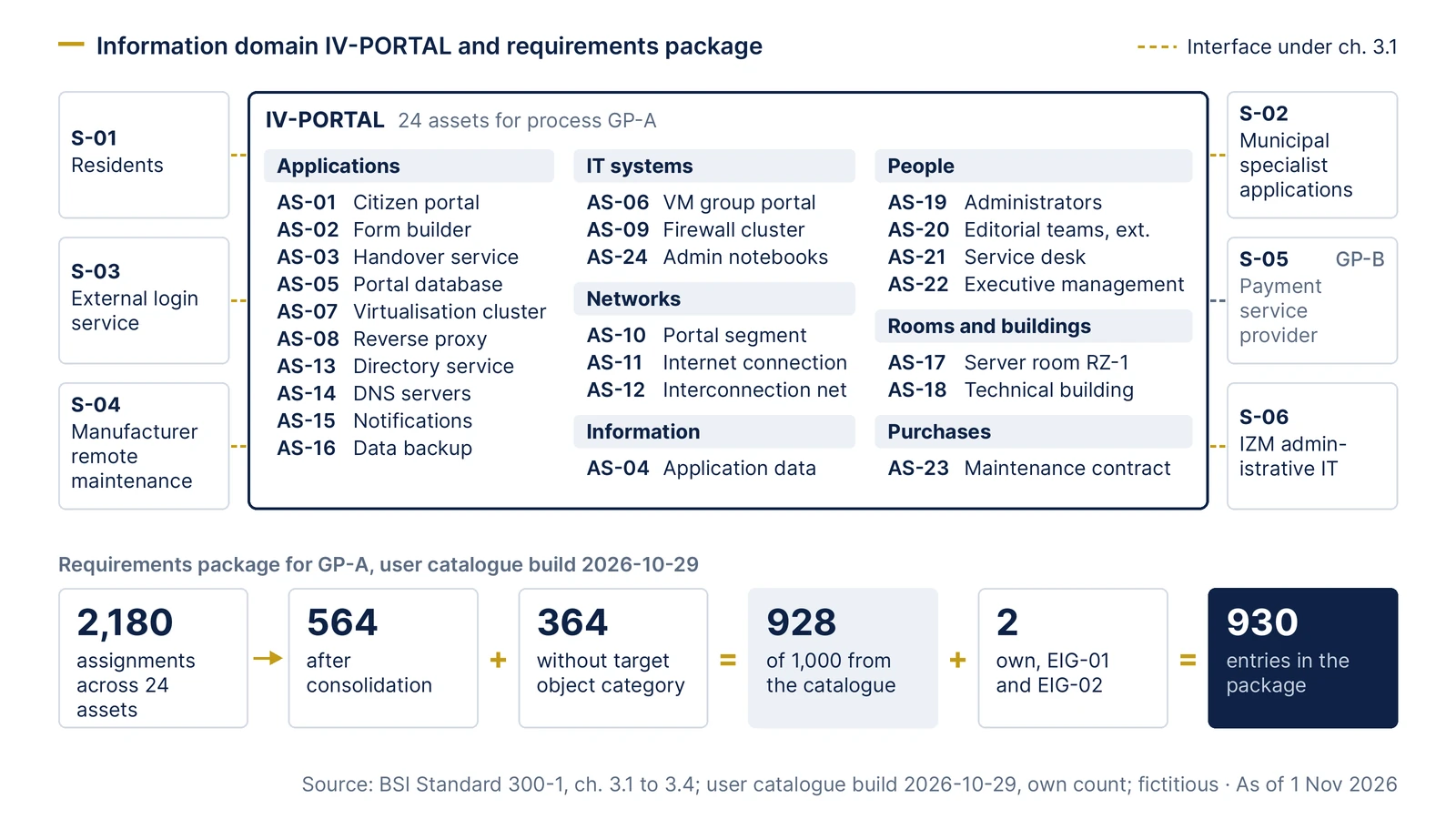
Within the scope, the IZM has formed an information domain, IV-PORTAL. It comprises the portal platform, the teams that operate and maintain it, server room RZ-1 and the technical building. In the first cycle it contains the assets that GP-A needs. This matches the guidance on catalogue requirement STM.2.1.2: in the first pass it is sufficient to record the assets of the most important business process; further processes are added in later cycles.
Chapter 3.1 requires the interfaces to external processes, systems and other domains to be documented at organisational, technical and infrastructure level; in the catalogue this is STM.1.2. The table shows the six interfaces in the case file. The page Delimiting the information domain explains delimitation in general.
| Interface | organisational | technical | infrastructure |
|---|---|---|---|
| S-01 Residents | Terms of use and privacy notices of the portal | HTTPS via the internet connection AS-11 | Applicants' end devices outside the domain |
| S-02 Specialist applications of municipalities K01 to K12 | Service agreements CP-01, contact persons per municipality | Handover service AS-03 via the municipal interconnection network AS-12 | Data centres of the municipalities, outside |
| S-03 External login service for user accounts | Operator's terms of use, no contract of the IZM's own | Redirect and return of a login confirmation to AS-01 | at the operator |
| S-04 Remote maintenance by the portal manufacturer | Maintenance contract CP-03 (asset AS-23) | VPN access on approval by IT operations | Manufacturer's workstations, outside |
| S-05 Payment service provider | belongs to GP-B, in the second cycle | Payment interface of the portal | at the service provider |
| S-06 IZM administrative IT | separate area of responsibility, outside the scope | Mail relay for sending notifications AS-15, transfer of log data | Administration building |
Open question OF-03: The login service S-03 is used but not procured; the IZM has no contract with the operator. The IZM has therefore recorded it as an external interface and not as an asset in the Services category. Whether that will hold up in an audit is open. As a result, the IZM does not have the requirements for the other side of the login in its package, only those for its own connection.
Asset list with target object categories
The 24 assets come from the IT operations CMDB, the contract register and interviews with portal operations. People are recorded as groups, similar servers as a VM group; 300-1 permits grouping where properties and purpose are similar (chapter 3.2). Every asset has a responsible role in the inventory list, which is omitted here for lack of space.
The column "per asset" counts all requirements that apply to the asset via the assigned and the inherited categories. The column "new" counts how many of them enter the package for the first time in the order of the table. The calculation uses the build of 29 October 2026 and the same counting method as the page on modelling: a requirement with two categories counts for an asset as soon as one of them is assigned.
| Identifier | Asset (fictitious) | assigned | inherited | per asset | new |
|---|---|---|---|---|---|
| AS-01 | Citizen portal (procured software, application interface) | Web applications; IT products | Web servers, Applications; Purchases | 144 | 144 |
| AS-02 | Form builder with scripting function | Web applications | Web servers, Applications | 91 | 0 |
| AS-03 | Handover service to the specialist applications | Applications | - | 81 | 0 |
| AS-04 | Application data and supporting documents | Data | Information | 36 | 36 |
| AS-05 | Portal database | Applications | - | 81 | 0 |
| AS-06 | VM group portal (web, application and database servers) | Host systems | IT systems | 102 | 99 |
| AS-07 | Virtualisation cluster | Virtualisation solutions; Host systems | Applications; IT systems | 184 | 4 |
| AS-08 | Reverse proxy with web filter | Web servers | Applications | 87 | 0 |
| AS-09 | Firewall cluster | Host systems | IT systems | 102 | 0 |
| AS-10 | Portal network segment | Internal network segments | Networks | 37 | 37 |
| AS-11 | Internet connection (two providers) | External network connections | Networks | 50 | 15 |
| AS-12 | Connection to the municipal interconnection network | External network connections | Networks | 50 | 0 |
| AS-13 | Directory service for administration | Directory services | Applications | 84 | 3 |
| AS-14 | DNS servers of the portal domain | DNS servers | Applications | 86 | 5 |
| AS-15 | Notifications to applicants | Interpersonal communication, Applications | 105 | 24 | |
| AS-16 | Data backup (software and backup storage) | Applications; Host systems | IT systems | 180 | 0 |
| AS-17 | Server room RZ-1 | Server rooms | Rooms for technical infrastructure, Rooms, Locations | 72 | 72 |
| AS-18 | Technical building | Buildings | Locations | 61 | 2 |
| AS-19 | Portal operations administrators (group, 6 people) | Administrators | Employees, Users | 101 | 82 |
| AS-20 | Form editorial teams of the municipalities (group, 24 people, external) | Users | - | 81 | 0 |
| AS-21 | Service desk (group) | Employees | Users | 92 | 0 |
| AS-22 | Executive management | Top management | Managers, Employees, Users | 95 | 3 |
| AS-23 | Maintenance contract with the portal manufacturer including remote access | Services | Purchases | 70 | 31 |
| AS-24 | Admin notebooks | Mobile devices | IT systems | 108 | 7 |
Total of assignments: 2,180. After the consolidation required by chapter 3.4 (in the catalogue STM.2.1.4.2), 564 distinct requirements with a target object category remain. The form editorial teams AS-20 are external; Annex 1 counts as users all persons who can regularly use assets of the domain, whether internal or external. A proposal from portal operations to leave the editorial teams out because they are not IZM staff was therefore rejected.
That AS-02 and AS-03 add nothing new follows from inheritance: the Applications category has already brought the citizen portal AS-01 into the package. For the status check in part 3, the "per asset" column is still the more important one, because each of these requirements has to be checked on every asset it applies to. The page Modelling with target object categories explains how assignment and inheritance work in general.
Dependencies along the resource paths
Because GP-A has high protection requirements, the IZM documents the assets' membership of the process and their dependencies (chapter 3.2). The form is free; the IZM has formed seven resource paths because, under chapter 3.2, risk assessment follows the resource path. Two findings from this work feed directly into part 3.
| Path | Step of GP-A | Dependencies |
|---|---|---|
| P1 | Submit application | S-01 → AS-11 → AS-08 → AS-01 → AS-06 → AS-07 → AS-17 → AS-18 |
| P2 | Store application and supporting documents | AS-01 → AS-05 (contains AS-04) → AS-06 → AS-07 → AS-17 |
| P3 | Hand over application | AS-05 → AS-03 → AS-10 → AS-09 → AS-12 → S-02 |
| P4 | Notify applicants | AS-01 → AS-15 → S-06 |
| P5 | Provide forms | AS-20 → AS-02 → AS-01 |
| P6 | Administer platform | AS-19 → AS-24 → AS-13 → AS-09 → AS-07, AS-08; remote maintenance S-04 via AS-23 |
| P7 | Back up and restore data | AS-16 → AS-05, AS-06 → AS-17 |
Finding B-01: The data backup AS-16 is in the same server room as the systems it backs up. Together with context factor KX-01 (basement next to the river), water ingress would affect originals and backup at the same time.
Finding B-02: Through P5, the external editorial teams change the behaviour of the citizen portal without IT operations seeing every change. This is the starting point for the section on assets that are not sufficiently covered.
Ten categories without an asset and their justification
After assignment, ten of the 39 target object categories were occupied neither directly nor through inheritance. The IZM recorded a justification for each. An empty category is permitted if it genuinely does not occur in the domain for GP-A. The justification must then withstand review, because the requirements that stay out of the package depend on it: in the build of 29 October 2026 there are 72 of them.
| Category without asset | IZM justification (fictitious) | not in package |
|---|---|---|
| Outsourcing, Cloud services | GP-A uses no contractually procured outsourced service; the payment service provider belongs to GP-B and comes in the second cycle. Whether the login service S-03 in use is to be modelled as a cloud service is open (OF-03); if the decision goes that way, the 38 requirements enter the package. | 38 |
| Web browsers, Office applications | According to IT operations, administration is done only via consoles and the command line; no office software is said to be in use for portal operations on the admin notebooks (checked in part 4) | 14 |
| Telecommunications applications, Video conferencing applications, Fax applications | GP-A does not process applications by telephone, video or fax | 11 |
| WLANs | no WLAN in the technical building | 4 |
| File servers | Supporting documents are held in the portal database, no file server in the path | 3 |
| Data media archive (in the catalogue "Archiv", archive) | Applications are kept for 90 days after handover and then deleted; retention lies with the municipalities | 2 |
The figures in the right-hand column add up to 72. They show what a wrong justification costs: if the statement on web browsers and office applications were incorrect, 14 requirements would be missing from the package without the total giving it away.
An asset the categories do not sufficiently cover, and a contractual obligation
The form builder AS-02 allows the editorial teams to store validation and calculation logic in a scripting language that the portal executes for every application. In the requirements of the categories Web applications, Web servers and Applications, the ISB found nothing that governs the approval of such logic before it is published. The IZM has therefore classified AS-02 as not sufficiently covered. Two obligations follow: an explicit risk assessment (300-1 chapter 2.11; Annex 3, criterion 33) and a supplementary requirement of its own (chapter 3.4.3; in the catalogue STM.2.1.6). The guidance on STM.2.1.6 describes the steps: name the asset, justify why the catalogue requirements are not sufficient, formulate the requirement, extend the package.
A second requirement of the IZM's own comes from the compliance list. The service agreements CP-01 require applications handed over to arrive encrypted and signed. Before writing a requirement of one's own, the guidance on STM.2.1.7 recommends looking in the State-of-the-Art Library (Stand-der-Technik-Bibliothek). For encryption, the IZM found KONF.14.1 („Konfiguration für Anwendungen SOLLTE Kommunikation beim Transport über Netze nach [einem anerkannten Standard] verschlüsseln“ (our translation: "Configuration for applications SHOULD encrypt communication during transport over networks in accordance with [a recognised standard]")), which is already in the package via the Applications category. It found no requirement on signing transferred data in the build. EIG-02 was created for that alone.
| Identifier | Own requirement in catalogue format (not from the BSI) | Origin | Asset |
|---|---|---|---|
| EIG-01 | Changes and tests for web applications SOLLTE (SHOULD) authorise changes to form logic before publication by {{a role independent of their creation}}. | asset not sufficiently covered (ch. 3.4.3, STM.2.1.6) | AS-02 |
| EIG-02 | Configuration for applications SOLLTE (SHOULD) sign application data transferred to the municipalities' specialist applications in accordance with {{a recognised standard}}. | compliance requirement CP-01 (ch. 2.2, 3.4.3, STM.2.1.7) | AS-03 |
Open question OF-04: Portal operations considers AS-02 sufficiently covered, because the form builder is a web application and the requirements on changes and tests without a target object category are in the package anyway. The ISB sees the gap in the fact that the logic comes from external parties and is created outside the IT operations change process. Executive management followed the ISB's assessment. The question returns in a different form in the internal audit in part 4.
Blueprints and parameters
Blueprints (Blaupausen) are prepared catalogues of requirements for particular application scenarios in which the parameters are also preset (chapter 3.3). The IZM did not use a blueprint for IV-PORTAL and recorded this with date and justification: no suitable blueprint was available to it for the profile of the portal operation. Because chapter 3.3 requires the choice to be reviewed when the domain or the available blueprints change, the question is on the list for every validation in part 4.
Without a blueprint, the IZM sets the parameters itself where the catalogue does not specify values (chapter 3.5; in the catalogue STM.5.1, MUSS (MUST)). Of the 928 requirements in the package, 200 contain at least one parameter. For 199 of them the IZM sets at least one value itself; only for GC.1.1 does the catalogue specify the value completely, and for NOT.1.1.4 one of two parameters (own count). The table shows six settings that play a role in the following parts.
| Requirement (modal verb) | Parameter in the catalogue | IZM setting (fictitious) | takes effect in part |
|---|---|---|---|
| UMS.1.1 Determining the implementation status (MUSS) | regularly | quarterly, in line with objective Z-01 | 3, 4 |
| BER.4.4 Review of authorisations (SOLLTE) | regularly | every six months for administrators, annually for editorial teams; the guidance names quarterly, every six months or annually as possible values | 4 |
| NOT.4.16.1 Restore testing (SOLLTE) | regularly | every six months, three samples per test | 3, 4 |
| KONF.11.4 Guessing of access links (SOLLTE) | an automated mechanism | rate limiting at the reverse proxy and non-sequential case numbers; the guidance names both as possible safeguards | 3 |
| BER.4.1.2 JIT/JEA authorisations (KANN (MAY)) | particularly critical resources or access paths | administrative access to the virtualisation cluster AS-07 and to the directory service AS-13 | 3 |
| GC.9.1.1.1 Information security officer (MUSS) | an independent person | ISB as a staff unit of executive management, subject to EV-04 | 3, 5 |
Result of part 2: the requirements package for GP-A
The 564 requirements from modelling are joined by the 364 requirements without a target object category which, under chapter 3.4.1, always belong in the package: 95 methodology requirements, 265 technical and organisational requirements and 4 requirements of the risk management practice (Praktik). The package covers 928 of the build's 1,000 requirements, plus the two requirements of the IZM's own.
| Part of the package | Number | Consequence under 300-1 |
|---|---|---|
| normal-SdT, MUSS | 149 | mandatory, no risk acceptance (ch. 4.1.2); all 149 MUSS requirements of the build are in the package, 139 of them without a target object category |
| normal-SdT, SOLLTE | 574 | to be fulfilled; permanent non-fulfilment only with a risk assessment (ch. 4.1.2) |
| elevated (erhöht), SOLLTE | 2 | DET.4.12.1 and REA.2.5; set to SOLLTE in the build, although ch. 3.4.2 provides KANN for "erhöht". The IZM treats them as SOLLTE requirements |
| elevated, KANN | 203 | optional; pool for risk treatment where protection requirements are high (ch. 3.4.2) |
| Total from the catalogue | 928 | |
| own requirements, SOLLTE | 2 | EIG-01, EIG-02 |
| Entries in the package | 930 |
Status of structure modelling (methodology requirements, as of PM 5, fictitious):
| Requirement | Status | Evidence in the case file |
|---|---|---|
| STM.1.1, STM.1.2 Delimit the domain, define interfaces | fulfilled; OF-03 open | IV-PORTAL, S-01 to S-06 |
| STM.2.1, STM.2.1.1 Requirements package, model methodology requirements | fulfilled | Package list with 930 entries |
| STM.2.1.2, STM.2.1.3 Define assets, assign categories | fulfilled for GP-A | AS-01 to AS-24 |
| STM.2.1.4, STM.2.1.4.1, STM.2.1.4.2 Modelling, inheritance, consolidation | fulfilled | Calculation log 2,180 → 564 |
| STM.2.1.5 Requirements without target object category | fulfilled | 364 entries |
| STM.2.1.6, STM.2.1.7 Additional requirements for assets and obligations | fulfilled; OF-04 open | EIG-01, EIG-02 |
| STM.5.1 Set parameters | fulfilled; values set for 199 requirements, GC.1.1 preset by the catalogue | Parameter list |
| STM.4.1 Risk assessment where the need has been established | not fulfilled, scheduled for part 3 | Triggers: high protection requirements of GP-A, AS-02 |
The requirements at the "erhöht" level are in the package because GP-A has high protection requirements and 300-1 chapter 3.4.2 has the security level selected according to the protection requirements of the process. 160 of them come via the assigned categories, 45 have no target object category and belong in the package anyway under chapter 3.4.1, among them BER.4.1.2, DET.6.2.1, TEST.3.1.11, TEST.4.1.1 and NOT.4.12, which part 3 draws on (own count). For the status survey in part 3 this means: KANN requirements also receive a status, but not fulfilling them has no consequence as long as risk treatment does not select them.
What comes next
In part 3, the IZM determines the implementation status for all 930 entries, classifies requirements not fulfilled by modal verb, carries out the risk assessment for GP-A and AS-02 and draws up the implementation plan.
- Continue with part 3: Implementation
- Back to part 1: Survey and planning
- Methodology for the second process step: Delimiting the information domain, Structure analysis and asset recording, Modelling with target object categories, Grundschutz++ user catalogue
Blackfort Technology supports modelling and recalculates requirements packages from the catalogue data, see Consulting.
Rights notice: Short quotations and references from BSI Standard 300-1 „Methodik Grundschutz++“ (Grundschutz++ methodology), version 1.0 of 20 October 2026, © Bundesamt für Sicherheit in der Informationstechnik 2026, source: BSI page on Grundschutz++. They are not licensed under CC BY-SA 4.0; the licence notice at the end of the page applies only to the extracts from the catalogue data.