

Note and recap of parts 1 to 3
Fictitious case. Organisation, metrics, audit findings and decisions are invented. The case file has not been reviewed by the Bundesamt für Sicherheit in der Informationstechnik (BSI), the German Federal Office for Information Security, is not certified and cannot be transferred to real municipalities or service providers. What is real are the identifiers and texts of the requirements from the Grundschutz++ user catalogue (Anwenderkatalog), build 2026-10-29; methodology according to BSI Standard 300-1, version 1.0.
The story so far: The IT Special-Purpose Association Sample Region (IZM) operates a citizen portal for twelve municipalities. Part 1: process GP-A with high protection requirements for confidentiality and integrity, three security objectives Z-01 to Z-03, information security officer (ISB) with a conflict of interest. Part 2: information domain IV-PORTAL with 24 assets, package with 930 entries, ten categories deliberately without an asset. Part 3: status balance 635 fulfilled, 256 not fulfilled, 39 not applicable; risk register RR-01 to RR-04; implementation plan with 60 safeguards; ISB staff unit decided for PM 9.
Performance evaluation with own metrics
Chapter 5.1 considers a performance evaluation necessary that should be presented to top management in a comprehensible form, and states that uniform requirements for it are still pending in Grundschutz++. Until then, organisations are free in how they design it. According to the milestone plan on the BSI's Grundschutz++ page, the concept for performance measurement is to be integrated into the methodology on 26 February 2027, and by 31 March 2027 every requirement from the methodology practices is to receive performance metrics.
The following metrics are therefore the IZM's own definitions. They measure the objectives from the policy and are not BSI metrics. As soon as the BSI publishes metrics, the IZM intends to place them next to its own and check which of them they replace. Measurements were taken at the end of PM 11.
| Metric (own) | Measurement method | Target | Actual PM 11 (fictitious) | Assessment |
|---|---|---|---|---|
| KZ-01 Status currency (for Z-01) | entries in status list NW-02 with a check date no more than three months old | 100% | 864 of 930, 92.9% | missed |
| KZ-02 Deadline compliance of the implementation plan | safeguards due by PM 11, completed on time | at least 90% | 26 of 36, 72% | missed |
| KZ-03 Remediation time for critical vulnerabilities (for Z-02) | cases on portal assets, remedied within seven days | all | 7 of 9; longest duration 23 days | missed |
| KZ-04 Recovery (for Z-03) | time until applications are accepted again after recovery from the backup, measured in the audit | one working day | 31 hours | missed |
| KZ-05 automatically documented evidence | share of evidence generated by a tool with time and result | no target, observed value | 31% | - |
| KZ-06 Approval of residual risks | residual risks with a valid, unexpired approval by executive management | 100% | 6 of 6 | met |
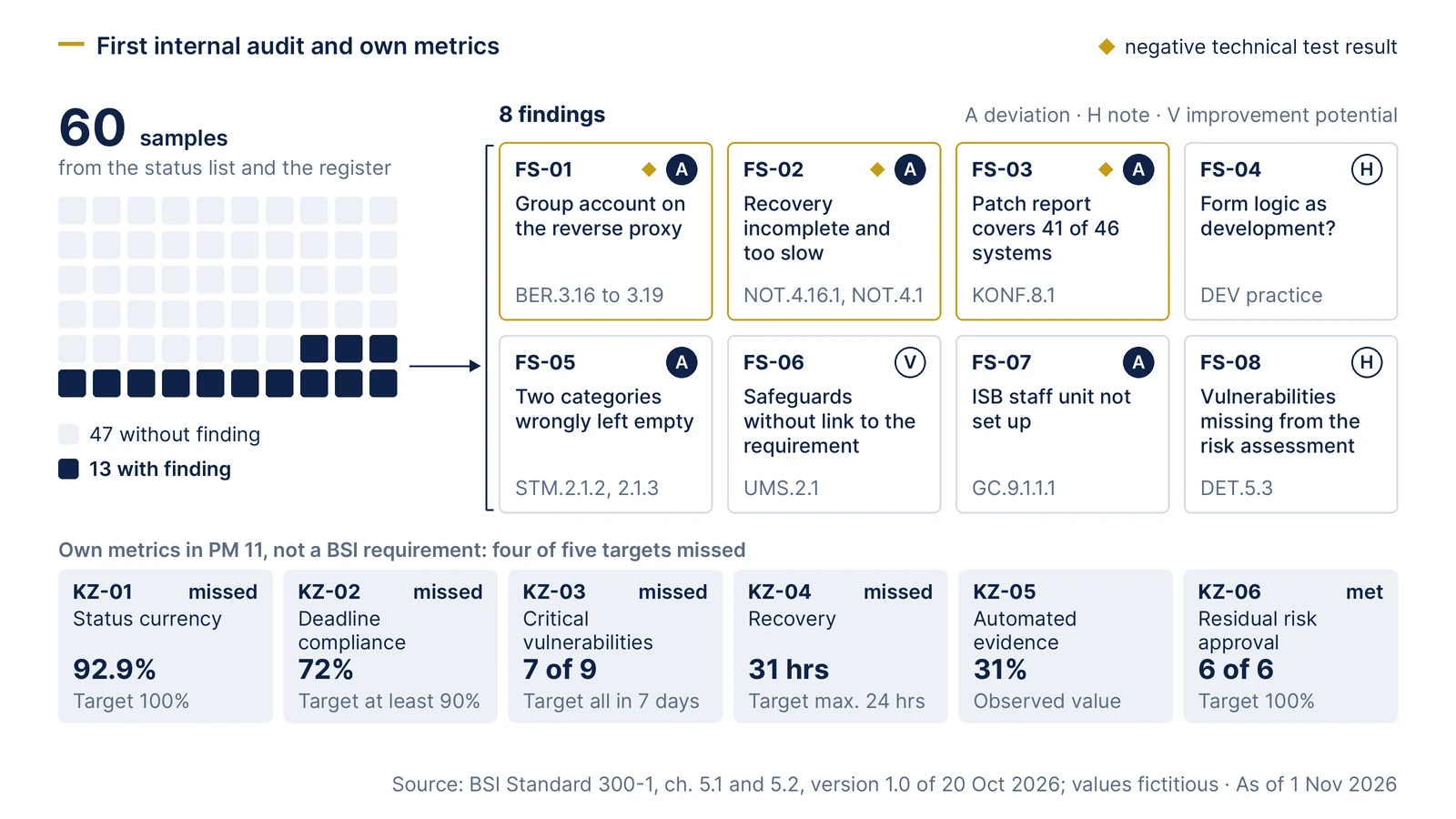
Four of the five metrics with a target were missed. That is no reason to lower the targets. The values show management where the ISMS stands after the first cycle, and that is exactly what the performance evaluation under chapter 5.1 is for: as a basis for decisions on further implementation.
Internal audit programme and audit plan
The audit programme (MN-12) starts with objectives, as chapter 5.2.1 requires. The IZM adopted the aspects that the standard explicitly names and gave each of them a concrete audit objective. Chapter 5.2 sees the internal audit above all as a means of self-monitoring that is meant to reveal potential for improvement. The IZM aligned the audit plan accordingly: it examines specifically where an incorrect entry would have the greatest consequences.
| Aspect under ch. 5.2.1 | Audit objective in the first audit (fictitious) |
|---|---|
| Information security requirements | Are the statuses "fulfilled" and "not applicable" in the status list supported by evidence? |
| Detection and incident handling | Do detection and the reporting channel work, was event SV-01 handled appropriately? |
| identified risks | Are the safeguards for RR-01 to RR-03 effective, are the residual risks properly approved? |
| Characteristics of the processes | Does the modelling represent GP-A completely? |
| Maturity of the ISMS | Are safeguards implemented on time and traceably? |
| Results of previous audits | not applicable in the first audit |
Audit team: The internal audit department of member municipality K03 audits on behalf of the IZM, with an audit team leader and an auditor, neither of whom has a role in portal operations. This corresponds to PERF.3.1.3, which requires professionally qualified and independent auditors; its guidance names not being involved in the audited processes as the yardstick. The ISB is not part of the team. As a risk of the audit programme, the IZM assessed access by external parties to application data (ch. 5.2.1): the team audits only with read access and on pseudonymised examples, and has signed a confidentiality agreement.
Audit plan (PERF.3.1.1, risk-based under PERF.3.1.2): 60 samples from the status list, of which 12 entries marked "not applicable", 20 entries marked "fulfilled" on assets from risks RR-01 to RR-03, 10 MUSS (MUST) requirements, the two residual risks and all four risks of the register, plus 12 random samples. Methods: interviews, document review, comparison of configuration exports with the CMDB and a recovery test repeated on site; the interviews with the municipalities' editorial teams were held remotely (ch. 5.2.2). Rating scheme under PERF.3.2.1: A deviation, H note requiring clarification, V improvement potential, no finding.
Audit report: eight findings
47 of the 60 samples produced no finding, among them the risk register, whose entries fully contain the minimum information under Annex 3, criterion 15, the time-limited approvals of the residual risks and the limitation of status queries under KONF.11.4, which the team confirmed with a query test. The justifications for KONF.3.3 and NOT.4.5 as not applicable also held up. The remaining 13 samples led to eight findings.
| Finding | Rating | Requirements affected | Facts (fictitious) |
|---|---|---|---|
| FS-01 Group account on the reverse proxy | A | BER.3.16, BER.3.17, BER.3.18, BER.3.19 | On AS-08 there is a local administration account shared by three administrators. It is not in the directory service and was therefore missing from account export NW-05. Found when comparing the local account lists of all systems. The guidance on BER.3.16 permits only narrowly limited, justified exceptional cases; this is regular operation. |
| FS-02 Recovery incomplete and too slow | A | NOT.4.16.1, NOT.4.1 | In the repeated test the portal database was running again after 31 hours. Around 2% of the evidence documents from the reference date were missing: since a change in PM 6 the backup job had excluded a directory that was also missing from the list of data to be backed up. The test from PM 4 predated this change, and the test due every six months in PM 10 under the definition in part 2 had not included the directory as a sample. NOT.4.16.1 requires representative samples; this test was not one. |
| FS-03 Patch report does not cover all systems | A | KONF.8.1 | Report NW-11 stated "41 of 41 recorded systems without open critical updates". The CMDB lists 46 systems in the information domain. Five virtual machines, including the backup proxy, had no agent. Evidence from a tool only proves what the tool sees. |
| FS-04 Form logic as development? | H, to executive management | DEV.1.1 and the DEV practice (Praktik) | The editorial teams write validation logic in a scripting language that is executed in the portal. The team considers the justification "no development of IT products in the information domain" doubtful. Neither the standard nor the guidance on DEV.1.1 explicitly states whether form logic falls under it. Related to OF-04. |
| FS-05 two categories wrongly left empty | A | STM.2.1.2, STM.2.1.3 | The administration interfaces of the virtualisation cluster and the reverse proxy are operated in the browser; on the admin notebooks, the operating documentation is written with office software. The justification from part 2 for the empty categories Web browsers and Office applications does not hold. 14 requirements are missing from the package (own count in build 2026-10-29). |
| FS-06 Safeguards without a link to requirements | V, because the assignment is complete in status list NW-02 and is missing only in the ticketing system | UMS.2.1 | For 9 of the 60 safeguards, the ticketing system lacks the link to the identifier of the requirement. Chapter 4.3 requires that for every requirement it is clear which safeguards are assigned to it. |
| FS-07 ISB staff unit not set up | A | GC.9.1.1.1 | The post has been advertised but not filled; the PM 9 deadline of MN-01 has been exceeded. The conflict of interest persists. |
| FS-08 Vulnerabilities do not feed into the risk assessment | H, because the procedure under DET.5.3 exists and only the transfer into the register is missing; reported to MB-01 as a deviation from ch. 5.4 | DET.5.3; 300-1 ch. 5.4 | Scans run and findings are remedied. Chapter 5.4, however, also requires vulnerabilities to be taken into account in the risk assessment. Two findings on the citizen portal concerned RR-01 and are not recorded in the register. |
Three findings are negative technical test results (FS-01 to FS-03): they refute entries that were listed as fulfilled or not applicable in part 3. Two more (FS-04, FS-05) concern justifications that in part 2 and part 3 were based only on statements from the teams. The audit team leader reviewed and approved the audit report; it went to executive management, the ISB and the Head of Portal Services (ch. 5.2.2).
What the findings change in the status list
The ISB corrected the status list before the management review. Chapter 4.3 requires the documentation to be updated when the implementation status or the result of a review changes, and recommends a history so that earlier findings remain traceable. No entry was therefore overwritten; every old status remains in the history with its date.
| Requirement | previously (part 3) | new (PM 12) | Reason |
|---|---|---|---|
| BER.3.16 | fulfilled | not fulfilled, temporary | FS-01 |
| BER.3.17, BER.3.18, BER.3.19 | not applicable | not fulfilled, temporary | FS-01: the component does exist after all |
| NOT.4.16.1, NOT.4.1 | fulfilled | not fulfilled, temporary | FS-02 |
| KONF.8.1 | fulfilled | not fulfilled, temporary | FS-03 |
| STM.2.1.2, STM.2.1.3 (MUSS) | fulfilled for GP-A | not fulfilled | FS-05; safeguard KV-04, risk acceptance not possible |
| 14 requirements of the categories Web browsers and Office applications | not in the package | in the package, status still to be surveyed | FS-05 |
| DEV.1.1 and the other 33 requirements of the DEV practice | not applicable | depending on EV-09 | FS-04 |
Nine entries change from "fulfilled" or "not applicable" to "not fulfilled". Seven of them are SOLLTE (SHOULD) requirements; they are scheduled temporarily, and the consolidated residual risk RS-01 is extended to include them and approved again. The two MUSS requirements STM.2.1.2 and STM.2.1.3 receive a safeguard with a deadline (KV-04 in part 5); for them there is neither an exception nor risk acceptance (chapter 4.1.2).
Monitoring procedures and a security event
Chapter 5.4 requires three established procedures: for detecting security incidents, for handling vulnerabilities and for recording new threats, the last two each with consideration in the risk assessment. In the catalogue, PERF.5.1 requires effective monitoring methods and tools for regular monitoring to be established.
| Procedure under ch. 5.4 | Status in the case (fictitious) | Finding |
|---|---|---|
| Detection of security incidents | central log analysis by IT operations with alerting, reporting channel for employees and municipalities | effective, see SV-01 |
| Handling of vulnerabilities | monthly scans, findings remedied in the ticketing system | transfer into the risk assessment missing (FS-08) |
| new threats | no fixed procedure; DET.5.8 temporarily not fulfilled since part 3, safeguard MN-31 with deadline PM 12 | open |
Event SV-01 in PM 10: On three days, log analysis reported an accumulation of failed logins to editorial accounts of the form builder. The login attempt limit that BER.3.11 requires for applications locked three accounts; there was no successful login. At that point 18 of the 24 editorial accounts already had multi-factor authentication (MN-21). The incident was documented and evaluated with the municipalities concerned. It concerns RR-02, because form logic can be changed through these accounts. The evaluation feeds into improvement in part 5.
Validation of the requirements package
With the validation, the IZM checks whether the selected requirements are still appropriate and up to date for the information domain (ch. 5.5; in the catalogue PERF.1.3, whose guidance names an annual review as the rule). The table follows the aspects that chapter 5.5 lists.
| Aspect under ch. 5.5 | Result in the case (fictitious) |
|---|---|
| Changes in the information domain | new interface S-07 to the data centre of municipality K05, which since MN-59 has taken a copy of the backup daily (recorded as asset AS-26 in the Services category, EV-13); decision that a 13th municipality (K13) joins the portal from PM 14, connection via AS-12; asset addition from FS-05 |
| Coordination with responsible organisational units and roles | workshop with IT operations, editorial lead and contract management; L-01 still open, the agreement with K07 is now available, the one with K11 is not |
| Changes in the State-of-the-Art Library (Stand-der-Technik-Bibliothek) | At every validation the IZM records which build it is working with. This case file deliberately stays with the build of 29 Oct 2026 so that the figures of all parts remain comparable. In a real project you check at every validation whether a newer build is available and recalculate the package (see Grundschutz++ user catalogue). |
| Changes to blueprints (Blaupausen) used | review under ch. 3.3 repeated; the IZM still uses none |
| Changes in the methodology | basis remains 300-1 version 1.0 |
| Adjustment of the requirements package | add 14 requirements from FS-05; implement the decision on the DEV practice after EV-09; include interfaces S-07 and K13 in the boundary of the information domain; AS-26 after EV-13 without new entries in the package, because services and purchases are already modelled |
Management review MB-01 and decisions
The basis of the management review is the management report (ch. 5.3; in the catalogue PERF.4.1). It contains the items that chapter 5.3 names: audit results, performance evaluation, security incidents, status of risk treatment, changes in the organisation and the threat situation, and the status of earlier decisions. PERF.4.1.9 additionally requires prioritised proposals for safeguards with a realistic estimate of the effort; the report contains them for every finding. Executive management decided as follows in PM 12:
| Paper | Subject | Decision (fictitious) |
|---|---|---|
| EV-08 | Corrective and improvement plan for FS-01 to FS-08 and SV-01 | commissioned, to be submitted by PM 13 |
| EV-09 | Does form logic count as development (FS-04, OF-04)? | Yes, as a decision of the IZM: the DEV practice is applied to the form logic in AS-02 and its status surveyed again. Whether an audit team in a certification procedure would assess it the same way is open. Also open is how the DEV requirements are to be treated for the procured portal software (OF-06). |
| EV-10 | ISB conflict of interest (FS-07) | With immediate effect, the ISB gives up the deputy role in IT operations and reports directly to executive management; the increase to a full-time post follows with the appointment in PM 13 |
| EV-11 | Moving the server room (OF-05) after submission of the feasibility study | deferred to budget planning; RR-03 remains accepted for a limited period, review at the end of the period |
| EV-12 | Availability of GP-A (OF-01) in light of KZ-04 and FS-02 | classification remains normal; objective Z-03 remains; the miss is treated as a nonconformity and reassessed together with the classification in the second cycle |
| EV-13 | How is the storage of the backup copy at K05 (MN-59) modelled? | as asset AS-26 in the Services category (agreement with K05) and interface S-07, not as outsourcing, because K05 does not take over any part of operations; the requirements of the categories Services and Purchases are already in the package via AS-23, and their status is also surveyed for AS-26 |
With MB-01, executive management visibly takes responsibility for the ISMS, as chapter 5.3 describes. The deferred items are recorded in the file with a date so that the next management review takes them up again, as chapter 5.3 provides for with the status of earlier management decisions.
Result of part 4 and open points
At the end of PM 12 the following are available: the metrics report with KZ-01 to KZ-06, the audit programme with audit plan, the approved audit report with FS-01 to FS-08, the corrected status list with history, the validation record and management report MB-01 with decisions EV-08 to EV-13. This also documents for the first time methodology requirements of the monitoring and evaluation practice (Monitoring-Evaluation) that were not yet fulfilled in part 3, such as PERF.3.1, PERF.3.2 and PERF.4.1.
Open at the end of part 4:
- OF-03 login service as an interface instead of an asset: not objected to in the audit, but not examined either
- OF-05 moving the server room: deferred (EV-11)
- OF-06 DEV practice for procured software
- OF-01 availability of GP-A: reassess in the second cycle (EV-12)
- L-01 agreement with K11 still missing
- Status of the 14 new requirements and of the DEV practice: not yet surveyed
- BSI performance metrics: announced for 31 March 2027, then comparison with KZ-01 to KZ-06
What comes next
In part 5 the IZM analyses the root causes of the nonconformities, collects improvement potential, draws up the corrective and improvement plan and checks whether the corrections are effective.
- Continue with part 5: Improvement
- Back to part 3: Implementation
- Methodology and documents: Evidence plan, Certification, BSI Standard 300-1, Grundschutz++ timeline
Blackfort Technology supports the preparation of internal audits and the management review, see Consulting.
Rights notice: References from BSI Standard 300-1 "Methodik Grundschutz++", version 1.0 of 20 October 2026, and information from the milestone plan, © Bundesamt für Sicherheit in der Informationstechnik 2026, source: BSI page on Grundschutz++. They are not licensed under CC BY-SA 4.0; the licence notice at the end of the page applies only to the extracts from the catalogue data.